
Lessons learned from the K computer project from

- Slides: 50
Lessons learned from the K computer project ──from K Computer to Exascale── - Historical overview of Japan and US HPC’s - What is the difference between Japan and US trends? - How can we go beyond Petaflops? Yoshio Oyanagi Kobe University 2021/10/31 ACAT 2013 1
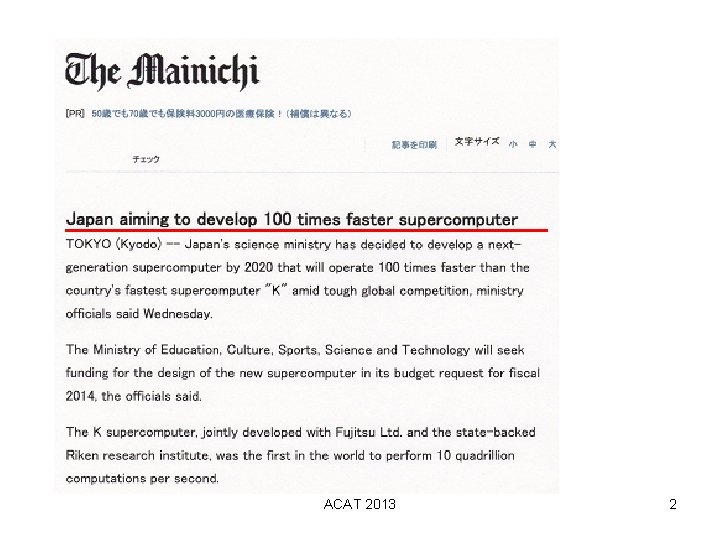
ACAT 2013 2
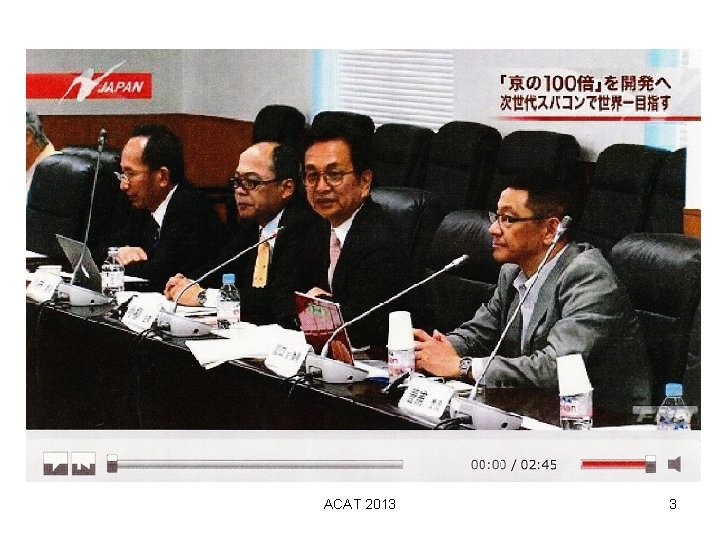
ACAT 2013 3
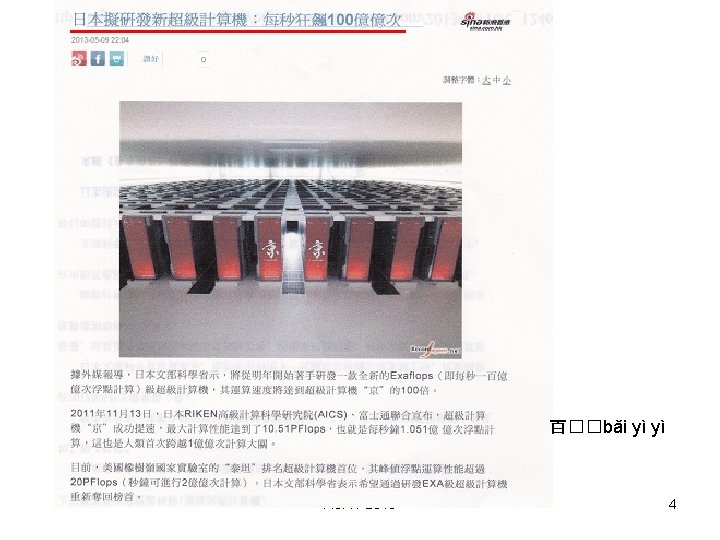
百��bǎi yì yì ACAT 2013 4
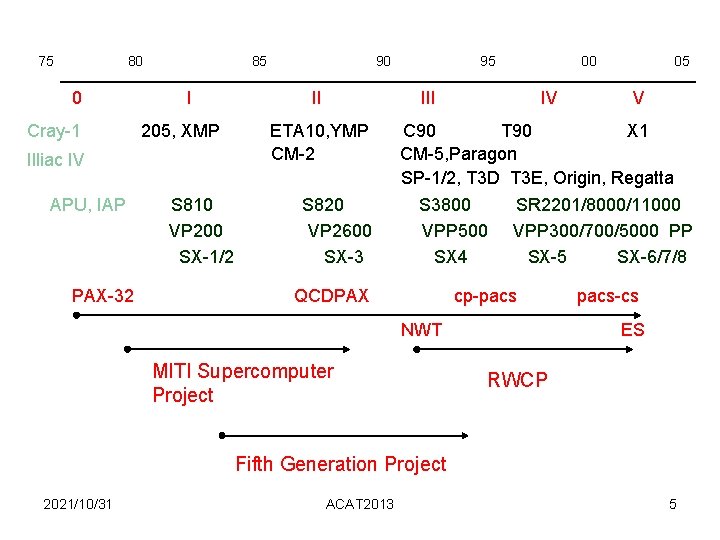
75 80 0 Cray-1 85 I 205, XMP Illiac IV APU, IAP PAX-32 S 810 VP 200 SX-1/2 90 II 95 00 III ETA 10, YMP CM-2 S 820 VP 2600 SX-3 IV 05 V C 90 T 90 X 1 CM-5, Paragon SP-1/2, T 3 D T 3 E, Origin, Regatta S 3800 VPP 500 SX 4 QCDPAX SR 2201/8000/11000 VPP 300/700/5000 PP SX-5 SX-6/7/8 cp-pacs NWT MITI Supercomputer Project pacs-cs ES RWCP Fifth Generation Project 2021/10/31 ACAT 2013 5
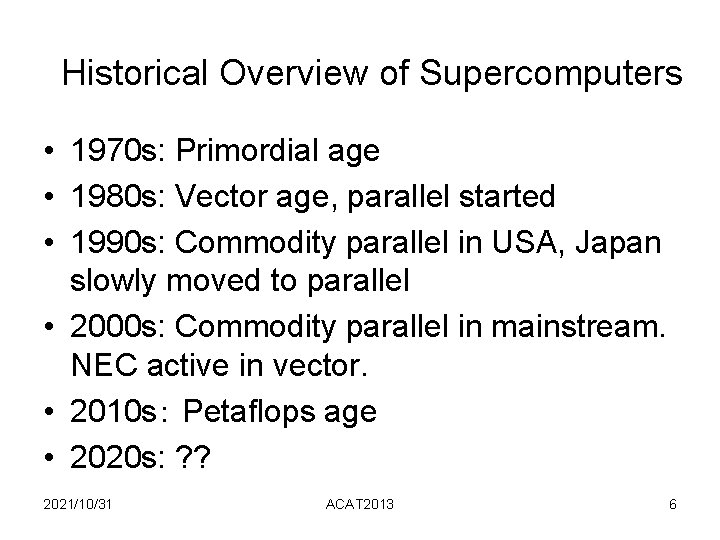
Historical Overview of Supercomputers • 1970 s: Primordial age • 1980 s: Vector age, parallel started • 1990 s: Commodity parallel in USA, Japan slowly moved to parallel • 2000 s: Commodity parallel in mainstream. NEC active in vector. • 2010 s: Petaflops age • 2020 s: ? ? 2021/10/31 ACAT 2013 6
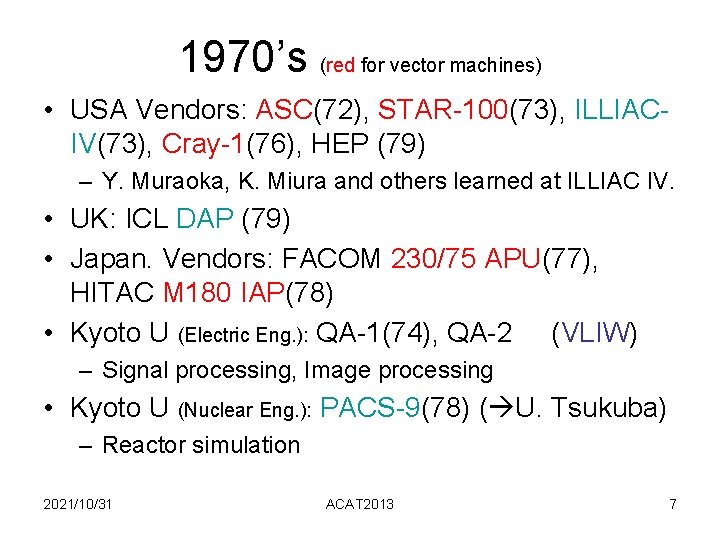
1970’s (red for vector machines) • USA Vendors: ASC(72), STAR-100(73), ILLIACIV(73), Cray-1(76), HEP (79) – Y. Muraoka, K. Miura and others learned at ILLIAC IV. • UK: ICL DAP (79) • Japan. Vendors: FACOM 230/75 APU(77), HITAC M 180 IAP(78) • Kyoto U (Electric Eng. ): QA-1(74), QA-2 (VLIW) – Signal processing, Image processing • Kyoto U (Nuclear Eng. ): PACS-9(78) ( U. Tsukuba) – Reactor simulation 2021/10/31 ACAT 2013 7
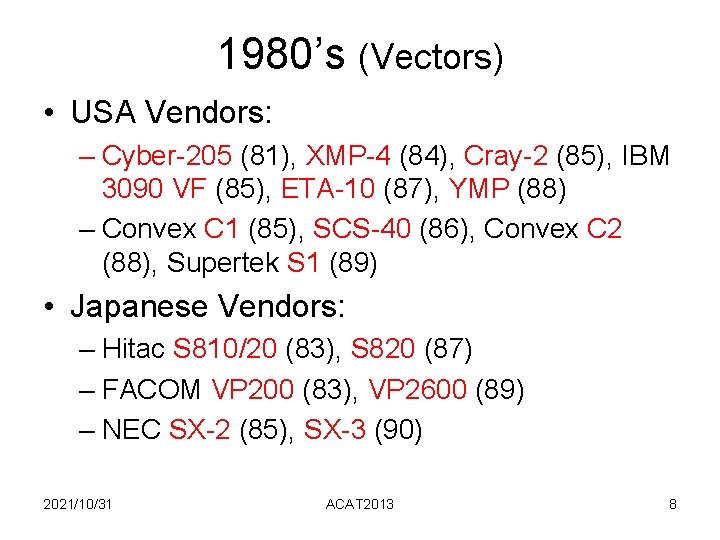
1980’s (Vectors) • USA Vendors: – Cyber-205 (81), XMP-4 (84), Cray-2 (85), IBM 3090 VF (85), ETA-10 (87), YMP (88) – Convex C 1 (85), SCS-40 (86), Convex C 2 (88), Supertek S 1 (89) • Japanese Vendors: – Hitac S 810/20 (83), S 820 (87) – FACOM VP 200 (83), VP 2600 (89) – NEC SX-2 (85), SX-3 (90) 2021/10/31 ACAT 2013 8
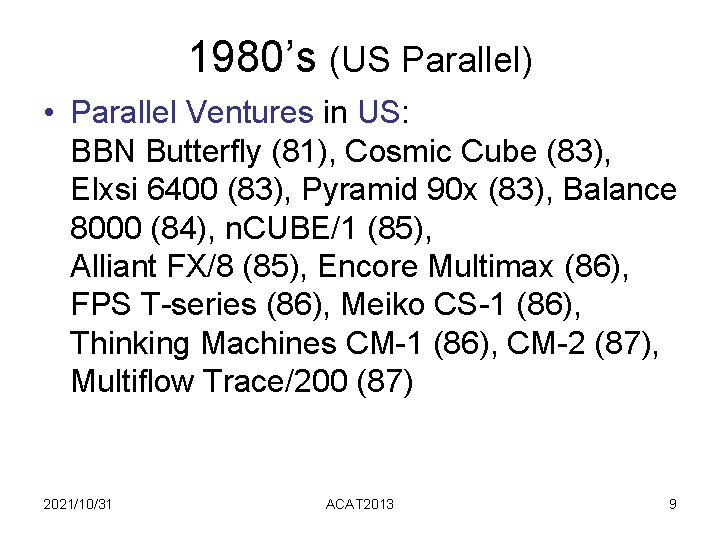
1980’s (US Parallel) • Parallel Ventures in US: BBN Butterfly (81), Cosmic Cube (83), Elxsi 6400 (83), Pyramid 90 x (83), Balance 8000 (84), n. CUBE/1 (85), Alliant FX/8 (85), Encore Multimax (86), FPS T-series (86), Meiko CS-1 (86), Thinking Machines CM-1 (86), CM-2 (87), Multiflow Trace/200 (87) 2021/10/31 ACAT 2013 9
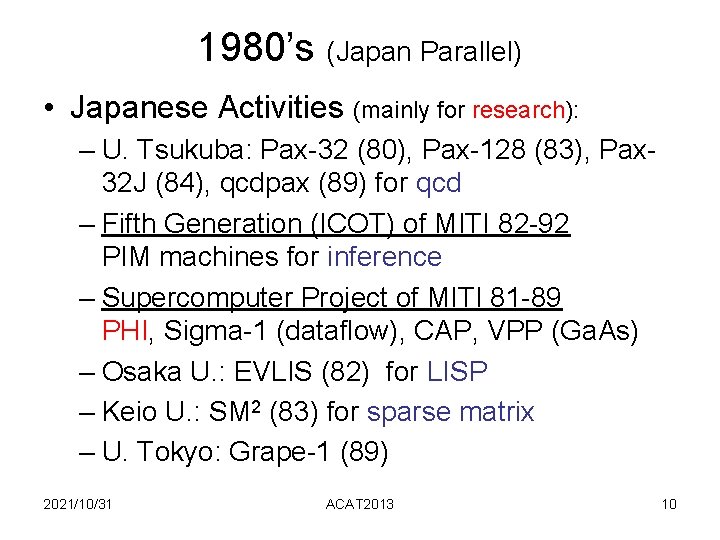
1980’s (Japan Parallel) • Japanese Activities (mainly for research): – U. Tsukuba: Pax-32 (80), Pax-128 (83), Pax 32 J (84), qcdpax (89) for qcd – Fifth Generation (ICOT) of MITI 82 -92 PIM machines for inference – Supercomputer Project of MITI 81 -89 PHI, Sigma-1 (dataflow), CAP, VPP (Ga. As) – Osaka U. : EVLIS (82) for LISP – Keio U. : SM 2 (83) for sparse matrix – U. Tokyo: Grape-1 (89) 2021/10/31 ACAT 2013 10
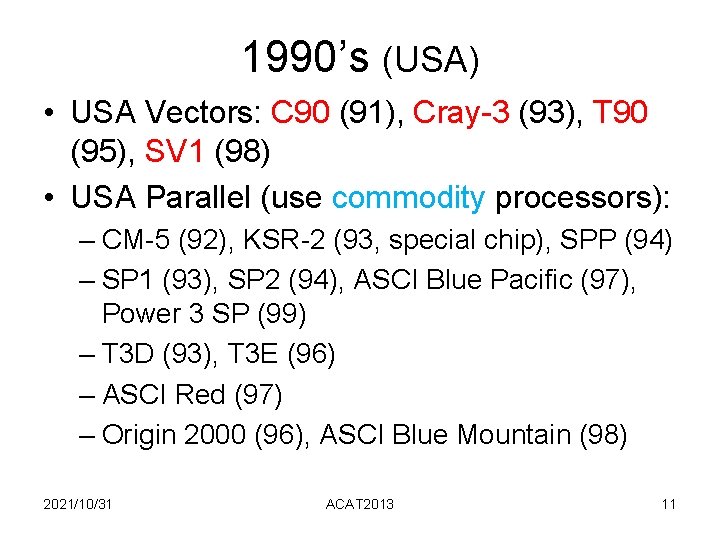
1990’s (USA) • USA Vectors: C 90 (91), Cray-3 (93), T 90 (95), SV 1 (98) • USA Parallel (use commodity processors): – CM-5 (92), KSR-2 (93, special chip), SPP (94) – SP 1 (93), SP 2 (94), ASCI Blue Pacific (97), Power 3 SP (99) – T 3 D (93), T 3 E (96) – ASCI Red (97) – Origin 2000 (96), ASCI Blue Mountain (98) 2021/10/31 ACAT 2013 11
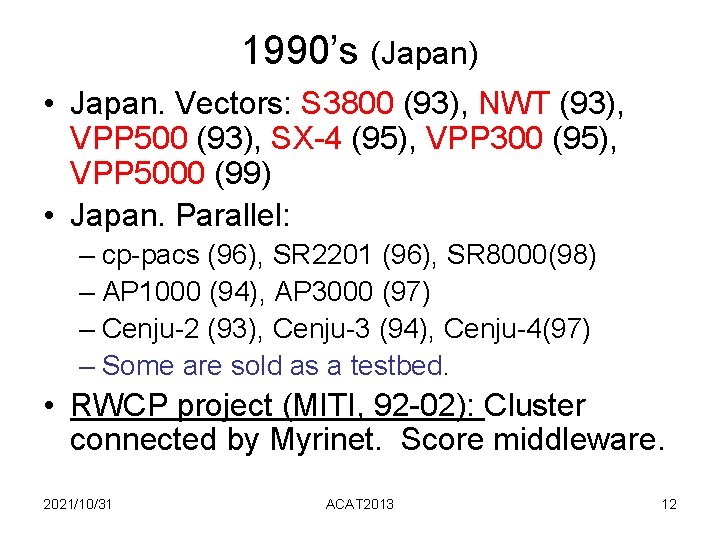
1990’s (Japan) • Japan. Vectors: S 3800 (93), NWT (93), VPP 500 (93), SX-4 (95), VPP 300 (95), VPP 5000 (99) • Japan. Parallel: – cp-pacs (96), SR 2201 (96), SR 8000(98) – AP 1000 (94), AP 3000 (97) – Cenju-2 (93), Cenju-3 (94), Cenju-4(97) – Some are sold as a testbed. • RWCP project (MITI, 92 -02): Cluster connected by Myrinet. Score middleware. 2021/10/31 ACAT 2013 12
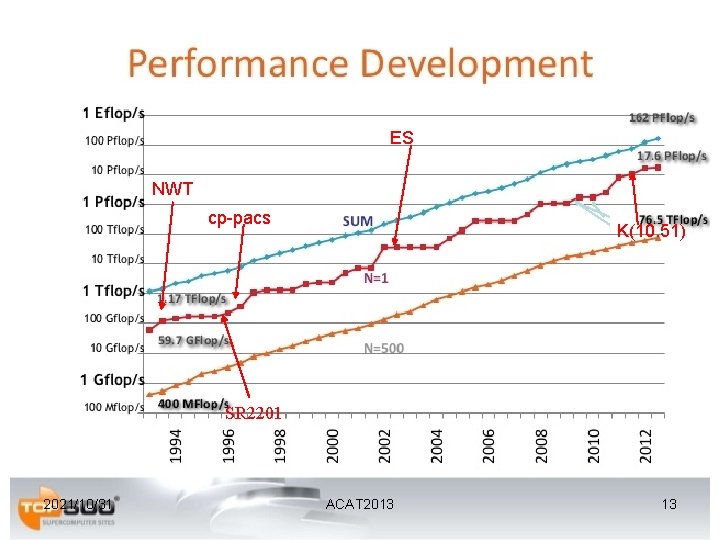
ES NWT cp-pacs K(10. 51) SR 2201 2021/10/31 ACAT 2013 13
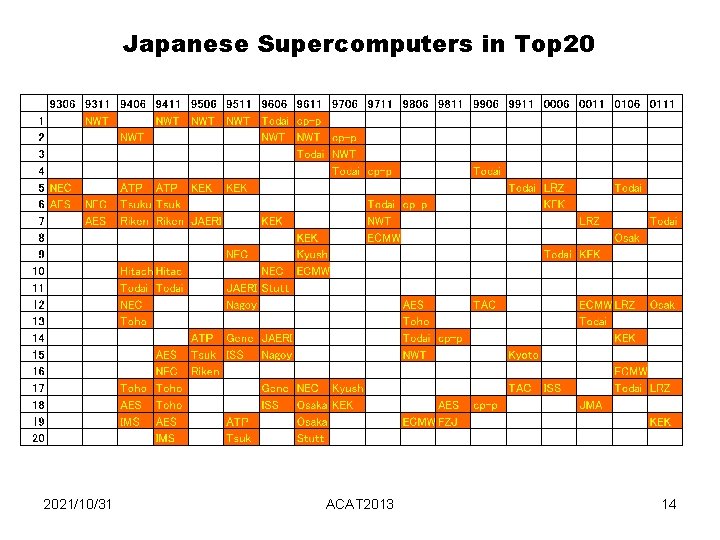
Japanese Supercomputers in Top 20 2021/10/31 ACAT 2013 14
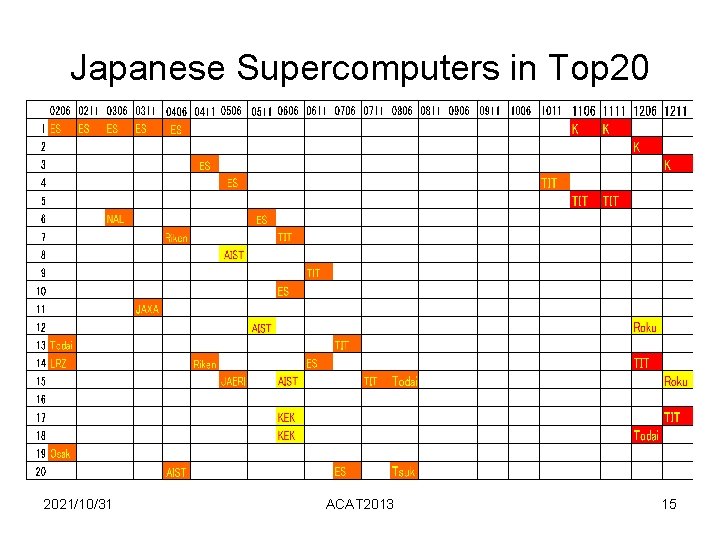
Japanese Supercomputers in Top 20 2021/10/31 ACAT 2013 15
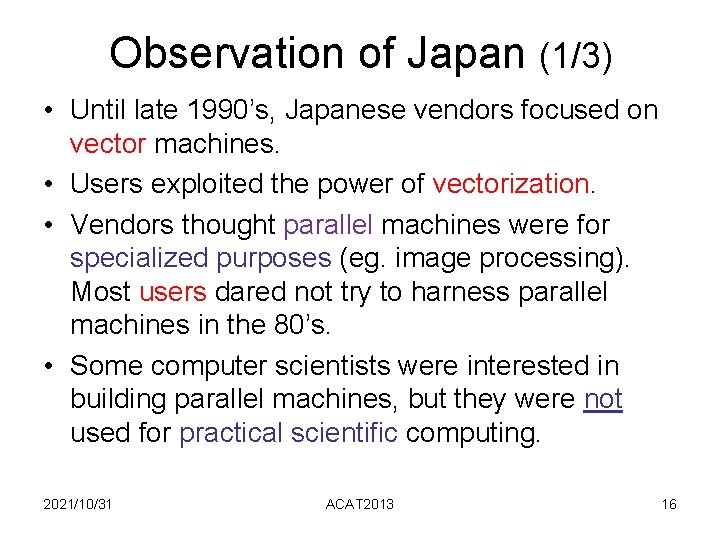
Observation of Japan (1/3) • Until late 1990’s, Japanese vendors focused on vector machines. • Users exploited the power of vectorization. • Vendors thought parallel machines were for specialized purposes (eg. image processing). Most users dared not try to harness parallel machines in the 80’s. • Some computer scientists were interested in building parallel machines, but they were not used for practical scientific computing. 2021/10/31 ACAT 2013 16
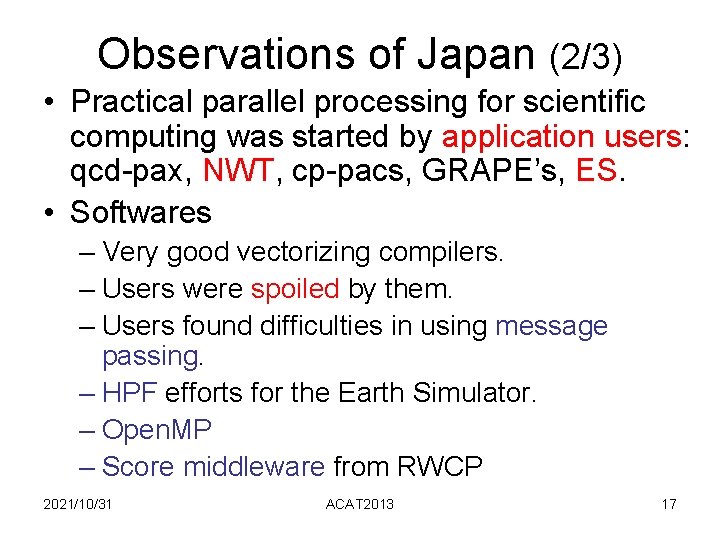
Observations of Japan (2/3) • Practical parallel processing for scientific computing was started by application users: qcd-pax, NWT, cp-pacs, GRAPE’s, ES. • Softwares – Very good vectorizing compilers. – Users were spoiled by them. – Users found difficulties in using message passing. – HPF efforts for the Earth Simulator. – Open. MP – Score middleware from RWCP 2021/10/31 ACAT 2013 17
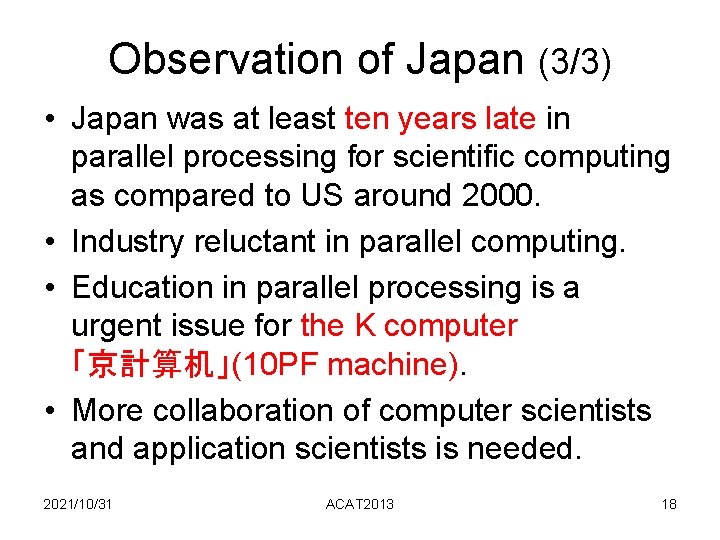
Observation of Japan (3/3) • Japan was at least ten years late in parallel processing for scientific computing as compared to US around 2000. • Industry reluctant in parallel computing. • Education in parallel processing is a urgent issue for the K computer 「京計算机」(10 PF machine). • More collaboration of computer scientists and application scientists is needed. 2021/10/31 ACAT 2013 18
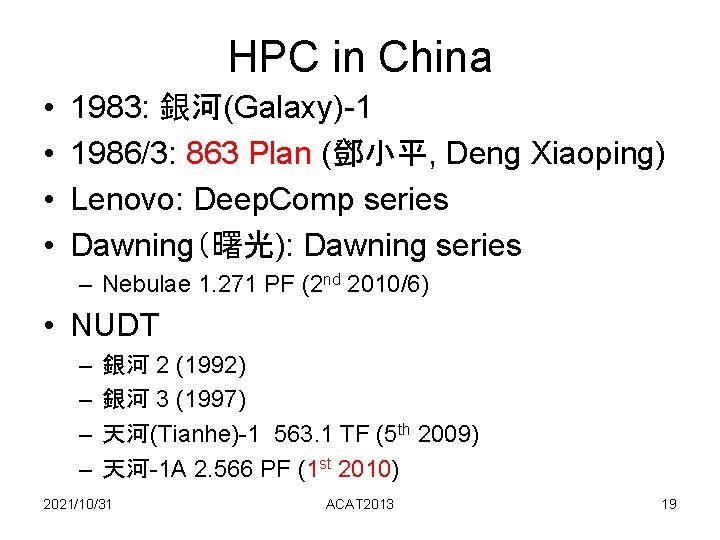
HPC in China • • 1983: 銀河(Galaxy)-1 1986/3: 863 Plan (鄧小平, Deng Xiaoping) Lenovo: Deep. Comp series Dawning(曙光): Dawning series – Nebulae 1. 271 PF (2 nd 2010/6) • NUDT – – 銀河 2 (1992) 銀河 3 (1997) 天河(Tianhe)-1 563. 1 TF (5 th 2009) 天河-1 A 2. 566 PF (1 st 2010) 2021/10/31 ACAT 2013 19
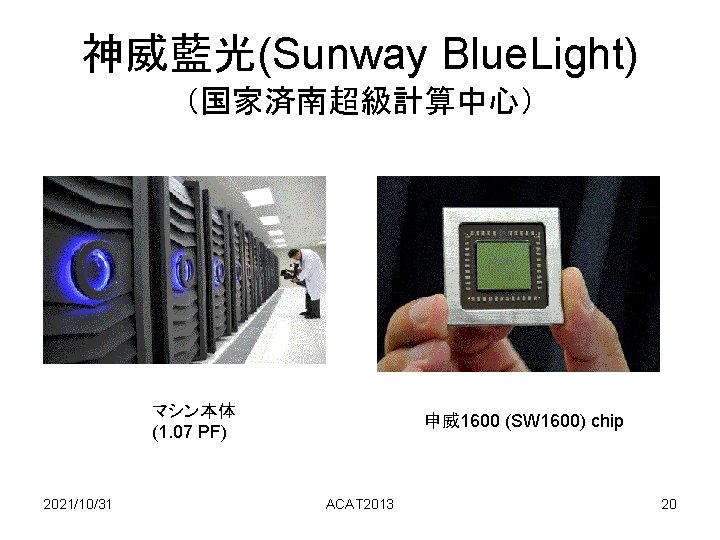
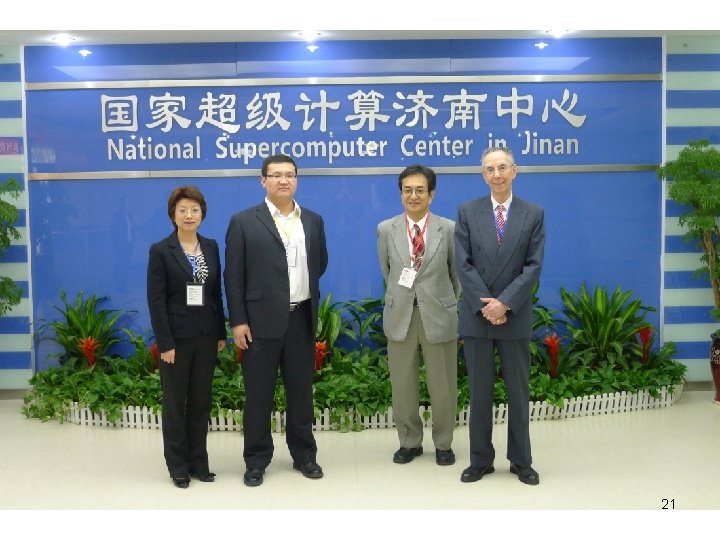
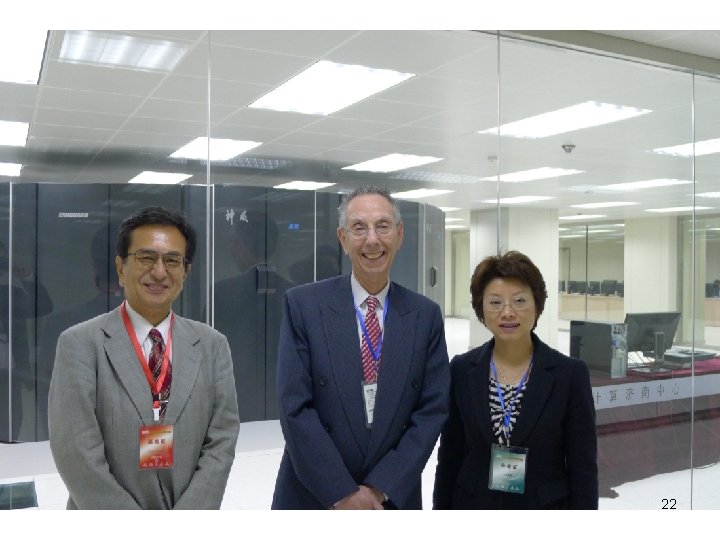
神威藍光(Sunway Blue. Light) (国家済南超級計算中心) マシン本体 (1. 07 PF) 2021/10/31 申威1600 (SW 1600) chip ACAT 2013 20
2021/10/31 ACAT 2013 21
2021/10/31 ACAT 2013 22
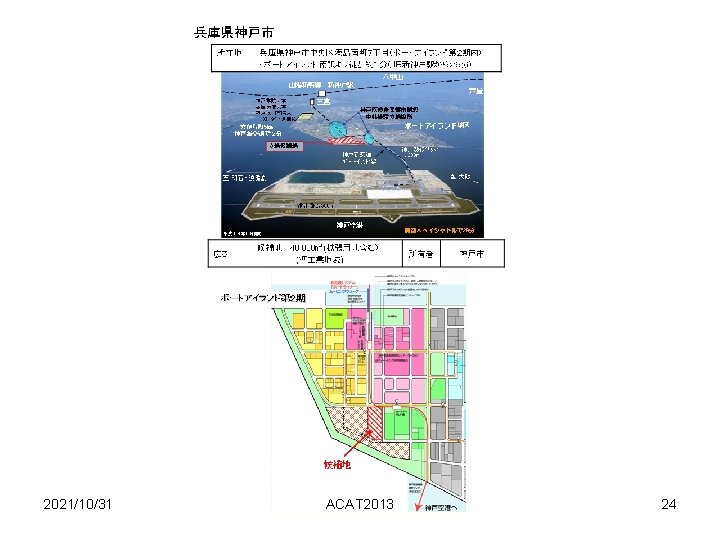
京(K) Supercomputer of Japan • Started in April 2006, open to users in September 2012 • Over 10 PF with LINPACK • Site: Kobe (Port Island) • Run by Riken (AICS) • Architecture – Octacore scalar processor (Sparc 64 viiifx) – Tofu interconnect (6 -dim torus) 2021/10/31 ACAT 2013 23
2021/10/31 ACAT 2013 24
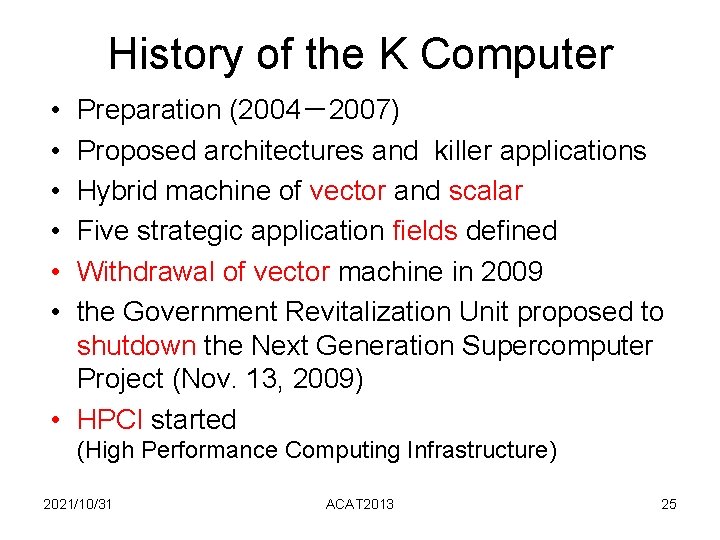
History of the K Computer • • • Preparation (2004-2007) Proposed architectures and killer applications Hybrid machine of vector and scalar Five strategic application fields defined Withdrawal of vector machine in 2009 the Government Revitalization Unit proposed to shutdown the Next Generation Supercomputer Project (Nov. 13, 2009) • HPCI started (High Performance Computing Infrastructure) 2021/10/31 ACAT 2013 25
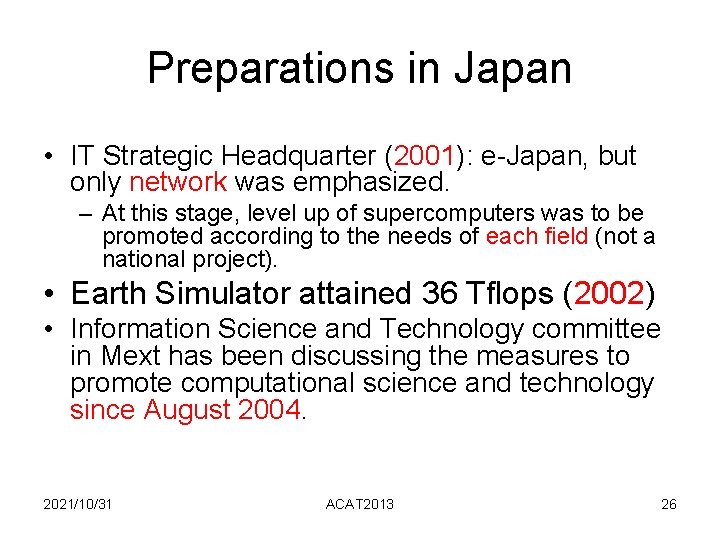
Preparations in Japan • IT Strategic Headquarter (2001): e-Japan, but only network was emphasized. – At this stage, level up of supercomputers was to be promoted according to the needs of each field (not a national project). • Earth Simulator attained 36 Tflops (2002) • Information Science and Technology committee in Mext has been discussing the measures to promote computational science and technology since August 2004. 2021/10/31 ACAT 2013 26
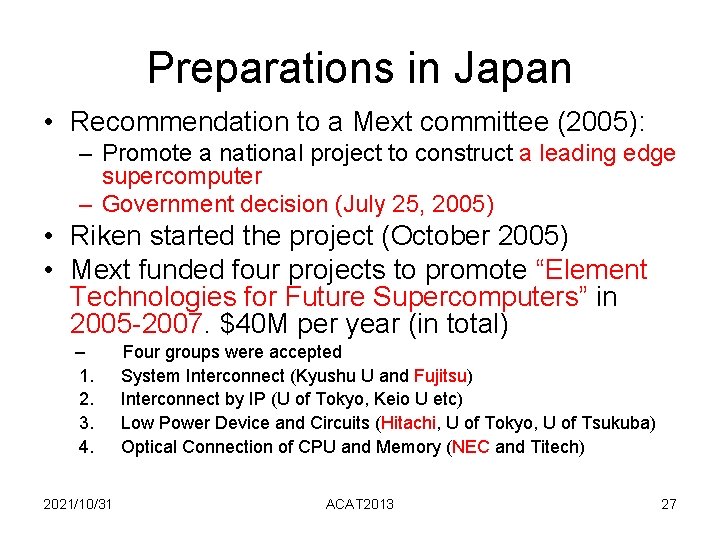
Preparations in Japan • Recommendation to a Mext committee (2005): – Promote a national project to construct a leading edge supercomputer – Government decision (July 25, 2005) • Riken started the project (October 2005) • Mext funded four projects to promote “Element Technologies for Future Supercomputers” in 2005 -2007. $40 M per year (in total) – 1. 2. 3. 4. 2021/10/31 Four groups were accepted System Interconnect (Kyushu U and Fujitsu) Interconnect by IP (U of Tokyo, Keio U etc) Low Power Device and Circuits (Hitachi, U of Tokyo, U of Tsukuba) Optical Connection of CPU and Memory (NEC and Titech) ACAT 2013 27
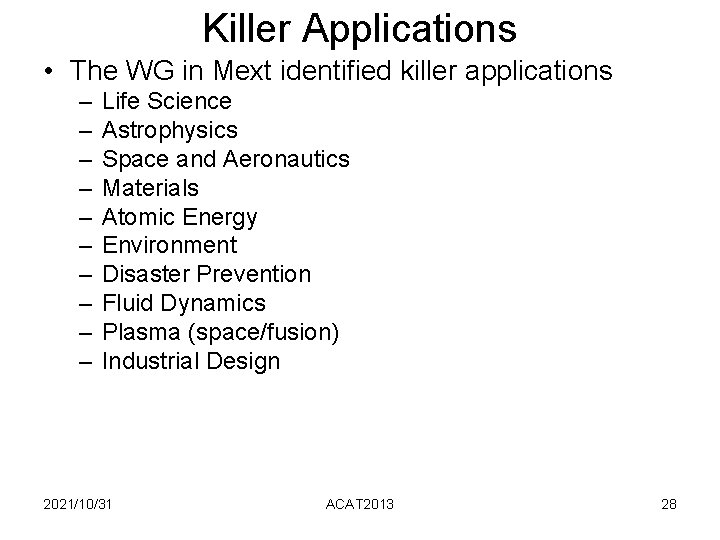
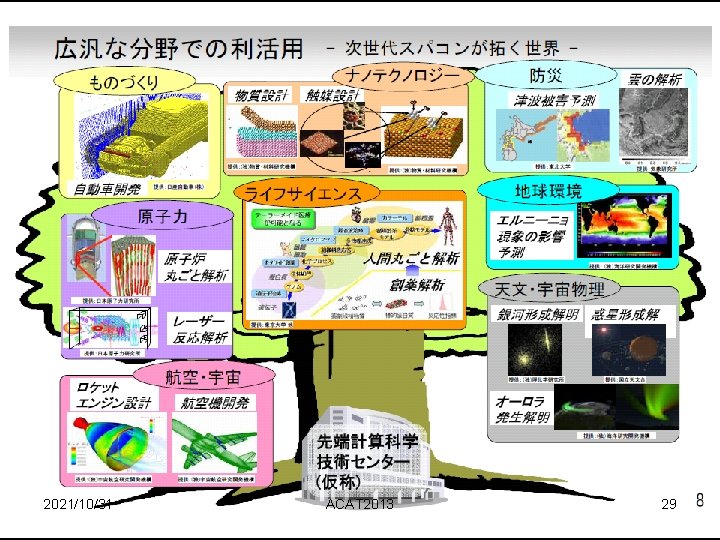
Killer Applications • The WG in Mext identified killer applications – – – – – Life Science Astrophysics Space and Aeronautics Materials Atomic Energy Environment Disaster Prevention Fluid Dynamics Plasma (space/fusion) Industrial Design 2021/10/31 ACAT 2013 28
2021/10/31 ACAT 2013 29
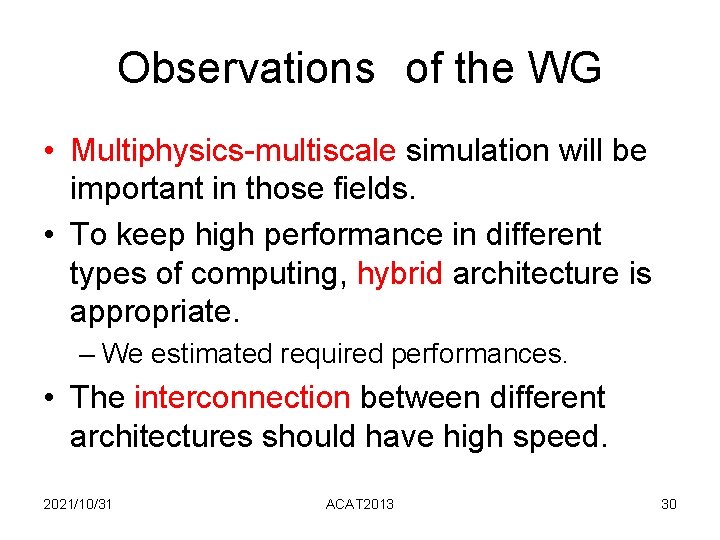
Observations of the WG • Multiphysics-multiscale simulation will be important in those fields. • To keep high performance in different types of computing, hybrid architecture is appropriate. – We estimated required performances. • The interconnection between different architectures should have high speed. 2021/10/31 ACAT 2013 30
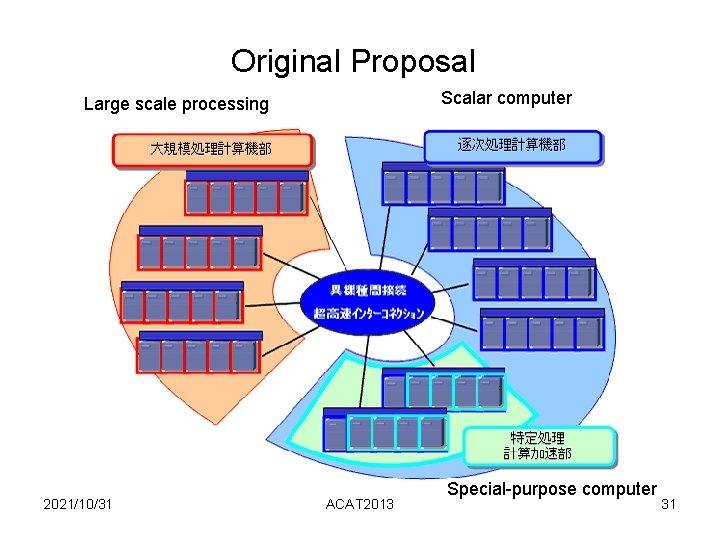
Original Proposal Scalar computer Large scale processing 2021/10/31 ACAT 2013 Special-purpose computer 31
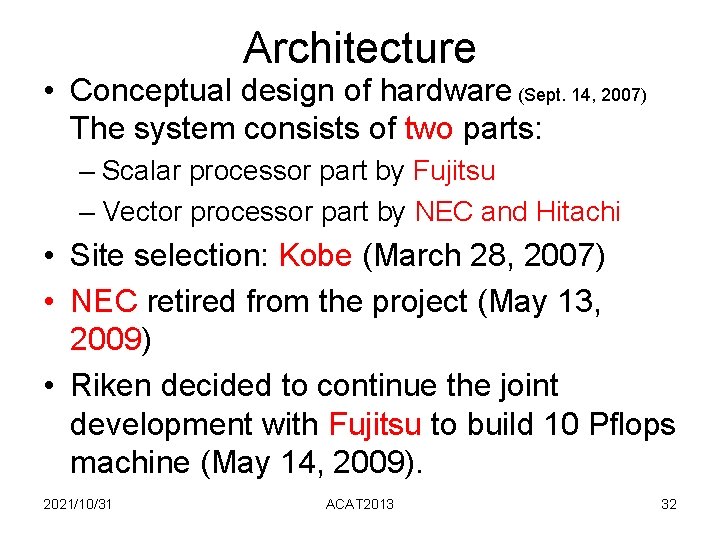
Architecture • Conceptual design of hardware (Sept. 14, 2007) The system consists of two parts: – Scalar processor part by Fujitsu – Vector processor part by NEC and Hitachi • Site selection: Kobe (March 28, 2007) • NEC retired from the project (May 13, 2009) • Riken decided to continue the joint development with Fujitsu to build 10 Pflops machine (May 14, 2009). 2021/10/31 ACAT 2013 32
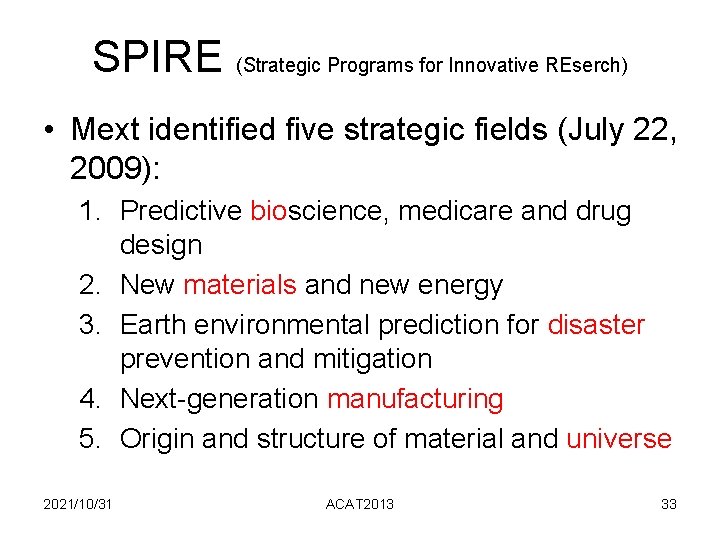
SPIRE (Strategic Programs for Innovative REserch) • Mext identified five strategic fields (July 22, 2009): 1. Predictive bioscience, medicare and drug design 2. New materials and new energy 3. Earth environmental prediction for disaster prevention and mitigation 4. Next-generation manufacturing 5. Origin and structure of material and universe 2021/10/31 ACAT 2013 33
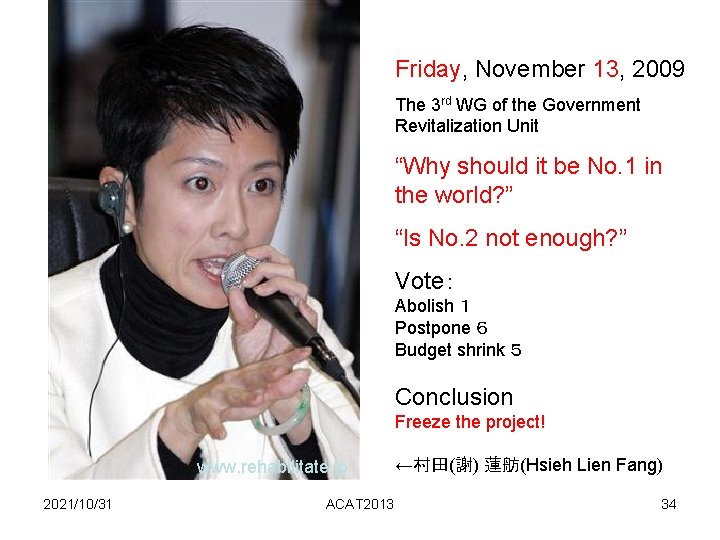
Friday, November 13, 2009 The 3 rd WG of the Government Revitalization Unit “Why should it be No. 1 in the world? ” “Is No. 2 not enough? ” Vote: Abolish 1 Postpone 6 Budget shrink 5 Conclusion Freeze the project! www. rehabilitate. jp 2021/10/31 ACAT 2013 ←村田(謝) 蓮舫(Hsieh Lien Fang) 34
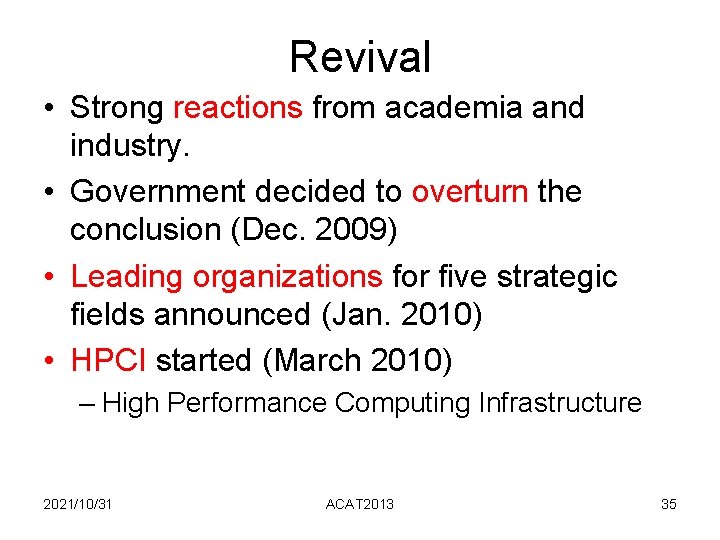
Revival • Strong reactions from academia and industry. • Government decided to overturn the conclusion (Dec. 2009) • Leading organizations for five strategic fields announced (Jan. 2010) • HPCI started (March 2010) – High Performance Computing Infrastructure 2021/10/31 ACAT 2013 35
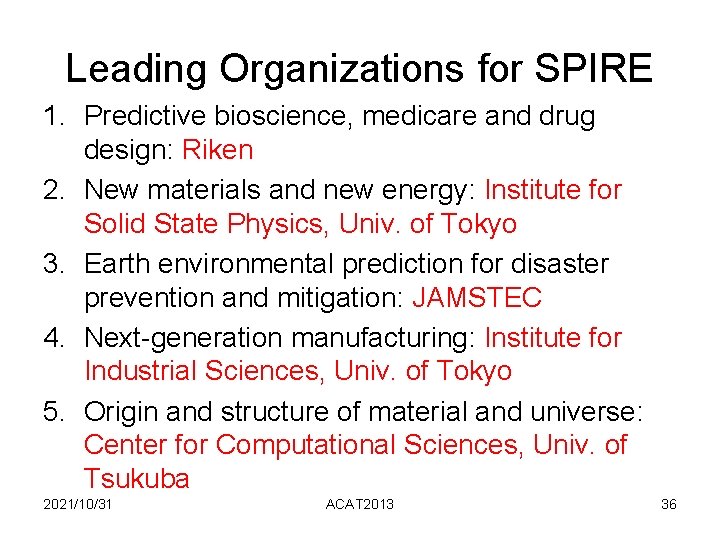
Leading Organizations for SPIRE 1. Predictive bioscience, medicare and drug design: Riken 2. New materials and new energy: Institute for Solid State Physics, Univ. of Tokyo 3. Earth environmental prediction for disaster prevention and mitigation: JAMSTEC 4. Next-generation manufacturing: Institute for Industrial Sciences, Univ. of Tokyo 5. Origin and structure of material and universe: Center for Computational Sciences, Univ. of Tsukuba 2021/10/31 ACAT 2013 36
Nickname 京 • Proposals were solicitated from public. • Final decision (July 5, 2010): • • 「京(Kei)」(The K Computer) 「京」= 1016=「億億(��)」(in Chinese) Capital or big city (北京、南京、東京、京都) Originally means “big gate” • Fujitsu disclosed SPARC 64 viiifx chip (July 9, 2010) • The first eight racks were shipped to Riken, Kobe (Sept. 28, 2010) 2021/10/31 ACAT 2013 37
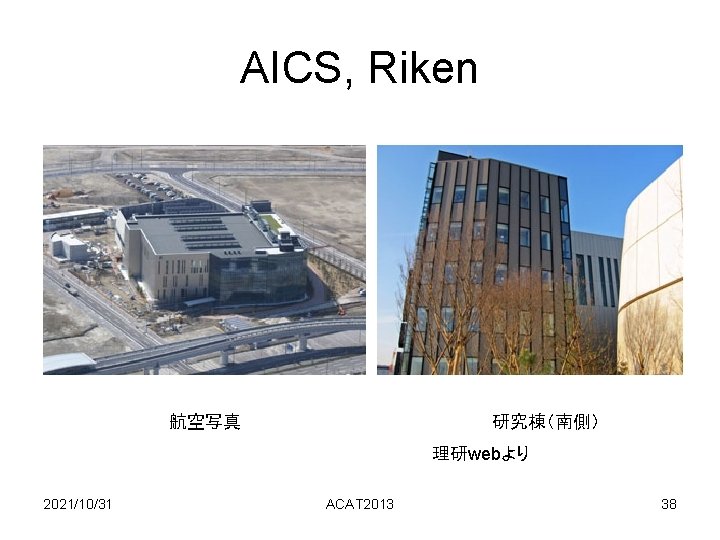
AICS, Riken 航空写真 研究棟(南側) 理研webより 2021/10/31 ACAT 2013 38
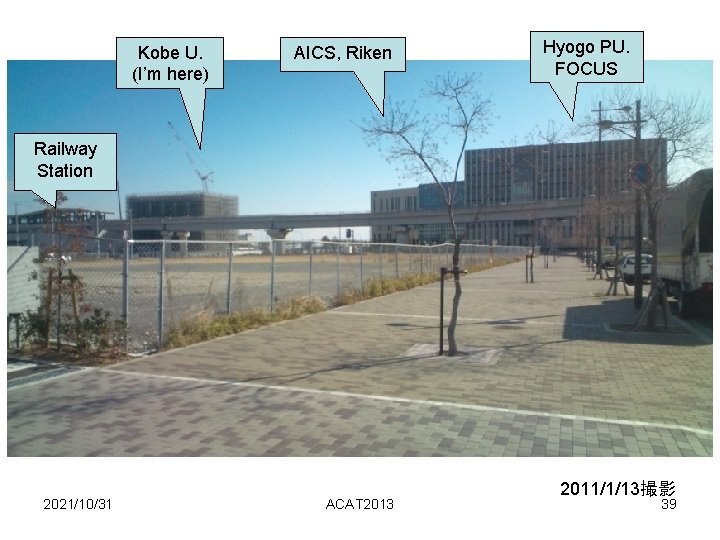
Kobe U. (I’m here) AICS, Riken Hyogo PU. FOCUS Railway Station 2021/10/31 ACAT 2013 2011/1/13撮影 39
No. 1 in the world • 8. 162 Pflops attained using 80% of the systemーNo. 1 in the Top 500 (ISC 2011) June 20, 2011 • 10. 51 Pflops in SC 2011 (Seattle) • Now tuning the system using strategic test programs in various fields. • Open to users: September 2012 • RIST is to manage K Computer users (Research Organization for Information Science & Technology) 2021/10/31 ACAT 2013 40
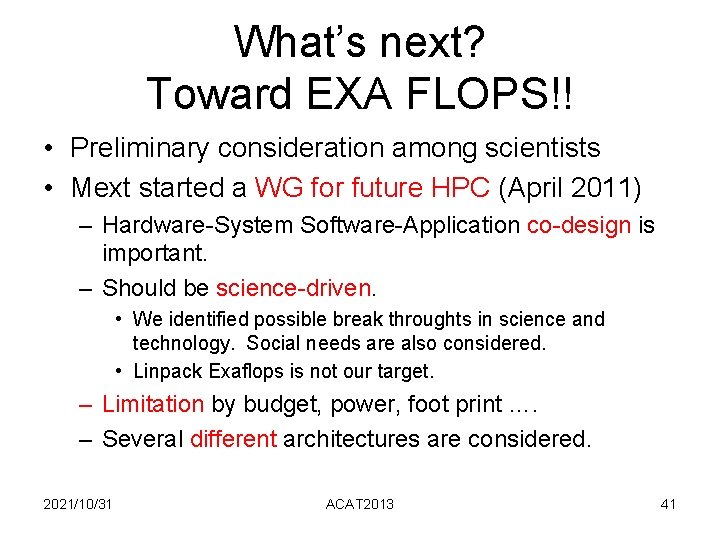
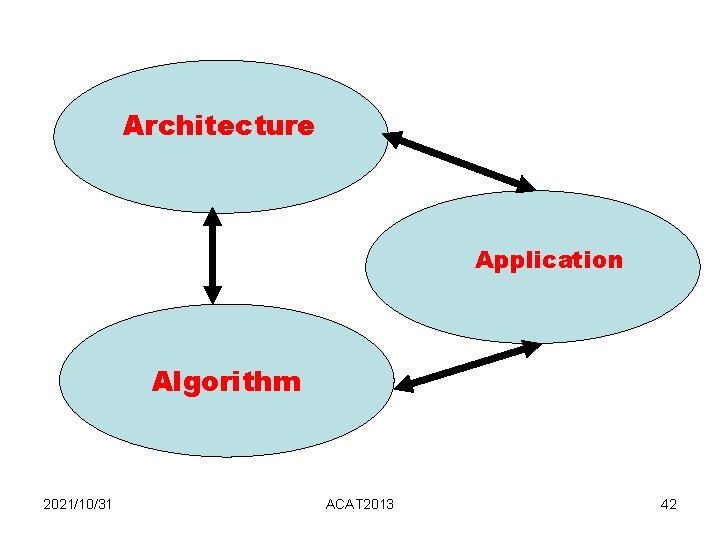
What’s next? Toward EXA FLOPS!! • Preliminary consideration among scientists • Mext started a WG for future HPC (April 2011) – Hardware-System Software-Application co-design is important. – Should be science-driven. • We identified possible break throughts in science and technology. Social needs are also considered. • Linpack Exaflops is not our target. – Limitation by budget, power, foot print …. – Several different architectures are considered. 2021/10/31 ACAT 2013 41
Architecture Application Algorithm 2021/10/31 ACAT 2013 42
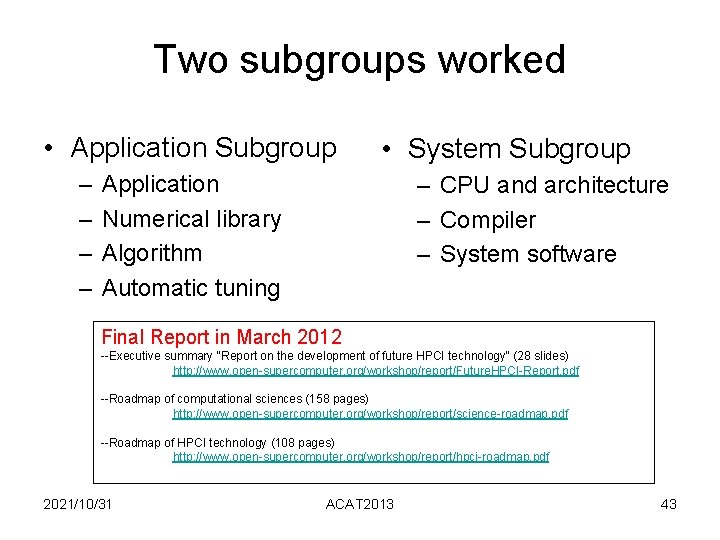
Two subgroups worked • Application Subgroup – – • System Subgroup Application Numerical library Algorithm Automatic tuning – CPU and architecture – Compiler – System software Final Report in March 2012 --Executive summary "Report on the development of future HPCI technology“ (28 slides) http: //www. open-supercomputer. org/workshop/report/Future. HPCI-Report. pdf --Roadmap of computational sciences (158 pages) http: //www. open-supercomputer. org/workshop/report/science-roadmap. pdf --Roadmap of HPCI technology (108 pages) http: //www. open-supercomputer. org/workshop/report/hpci-roadmap. pdf 2021/10/31 ACAT 2013 43
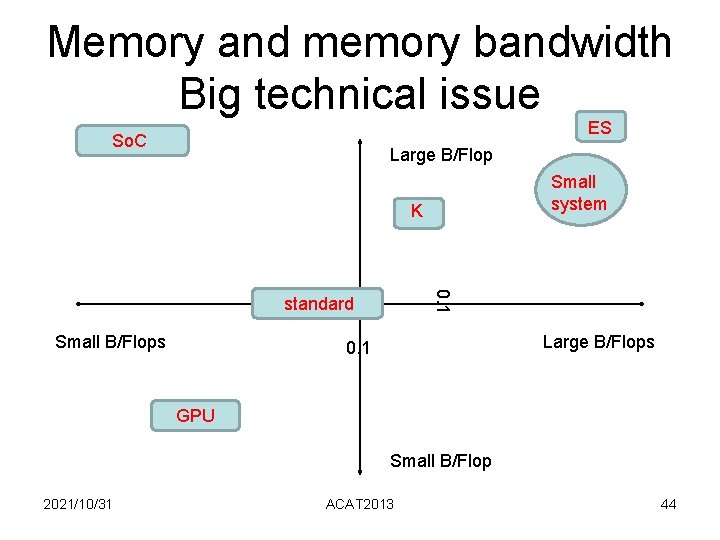
Memory and memory bandwidth Big technical issue ES So. C Large B/Flop Small system K 0. 1 standard Small B/Flops Large B/Flops 0. 1 GPU Small B/Flop 2021/10/31 ACAT 2013 44
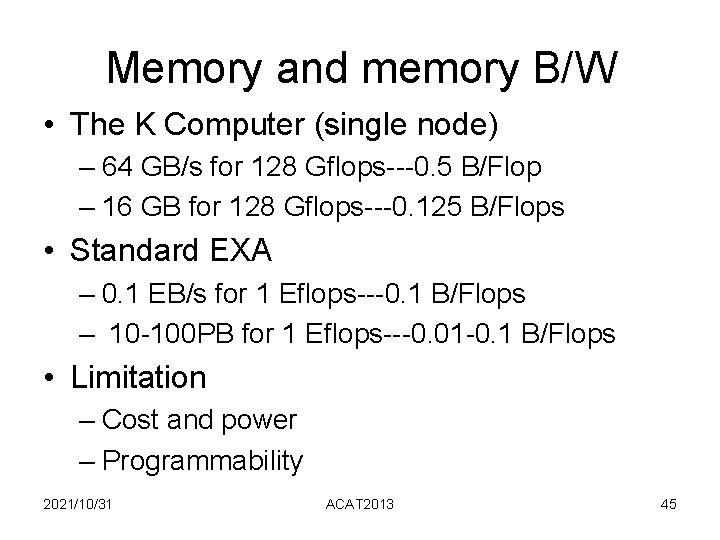
Memory and memory B/W • The K Computer (single node) – 64 GB/s for 128 Gflops---0. 5 B/Flop – 16 GB for 128 Gflops---0. 125 B/Flops • Standard EXA – 0. 1 EB/s for 1 Eflops---0. 1 B/Flops – 10 -100 PB for 1 Eflops---0. 01 -0. 1 B/Flops • Limitation – Cost and power – Programmability 2021/10/31 ACAT 2013 45
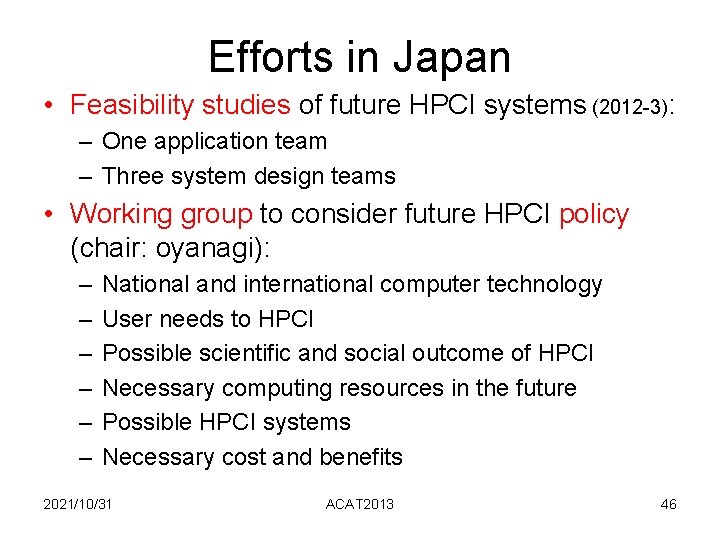
Efforts in Japan • Feasibility studies of future HPCI systems (2012 -3): – One application team – Three system design teams • Working group to consider future HPCI policy (chair: oyanagi): – – – National and international computer technology User needs to HPCI Possible scientific and social outcome of HPCI Necessary computing resources in the future Possible HPCI systems Necessary cost and benefits 2021/10/31 ACAT 2013 46
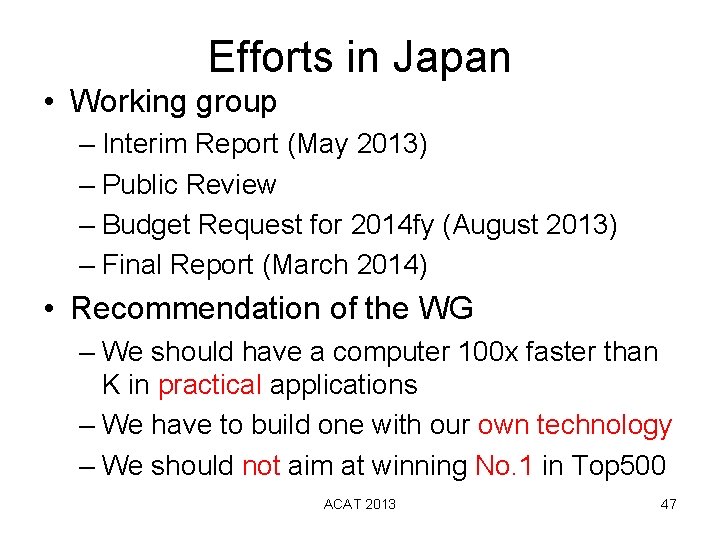
Efforts in Japan • Working group – Interim Report (May 2013) – Public Review – Budget Request for 2014 fy (August 2013) – Final Report (March 2014) • Recommendation of the WG – We should have a computer 100 x faster than K in practical applications – We have to build one with our own technology – We should not aim at winning No. 1 in Top 500 ACAT 2013 47
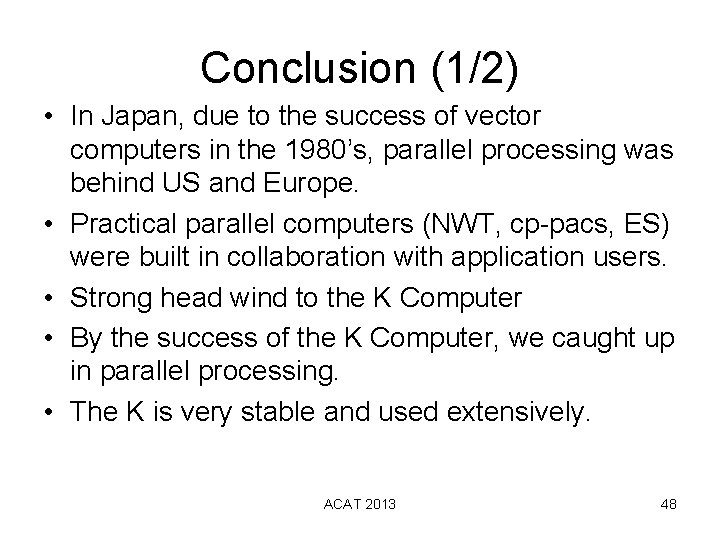
Conclusion (1/2) • In Japan, due to the success of vector computers in the 1980’s, parallel processing was behind US and Europe. • Practical parallel computers (NWT, cp-pacs, ES) were built in collaboration with application users. • Strong head wind to the K Computer • By the success of the K Computer, we caught up in parallel processing. • The K is very stable and used extensively. ACAT 2013 48
Conclusion (2/2) • We hope to build exascale supercomputers around 2020 • Different applications require different architecture in terms of B/Flop and B/Flops • They should be science-driven, not Linpackdriven • Support of taxpayers is important • Very hard to program on Exascale due to memory hierarchy • Applications strongly demand such machines ACAT 2013 49
2021/10/31 ACAT 2013 50