
Lessons Learned from Commissioning of Advanced Detectors May

- Slides: 16
Lessons Learned from Commissioning of Advanced Detectors May 18, 2015 Daniel Sigg LIGO Hanford Observatory G 1500643 Lessons learned from commissioning of Advanced Detectors
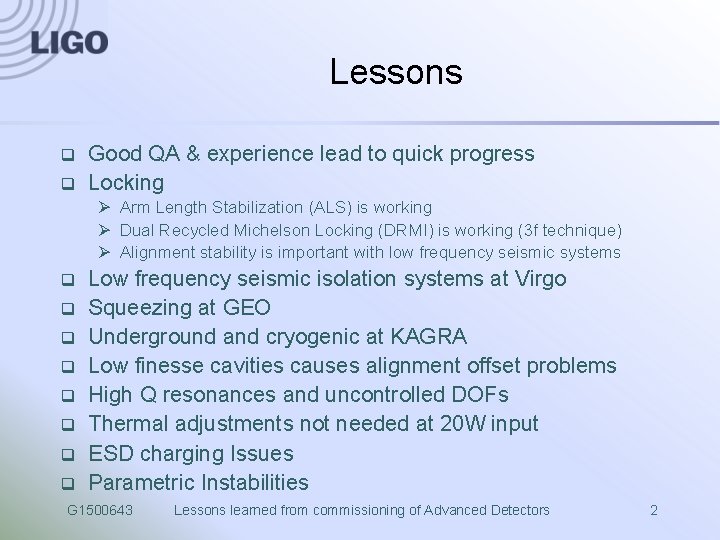
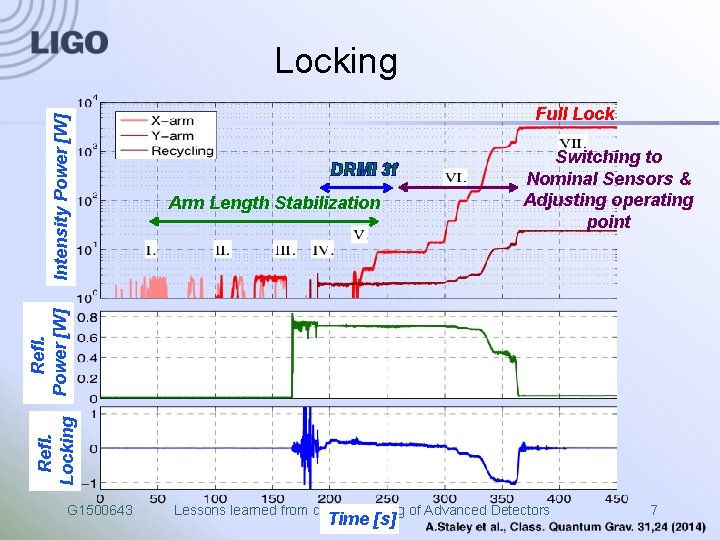
Lessons q q Good QA & experience lead to quick progress Locking Ø Arm Length Stabilization (ALS) is working Ø Dual Recycled Michelson Locking (DRMI) is working (3 f technique) Ø Alignment stability is important with low frequency seismic systems q q q q Low frequency seismic isolation systems at Virgo Squeezing at GEO Underground and cryogenic at KAGRA Low finesse cavities causes alignment offset problems High Q resonances and uncontrolled DOFs Thermal adjustments not needed at 20 W input ESD charging Issues Parametric Instabilities G 1500643 Lessons learned from commissioning of Advanced Detectors 2
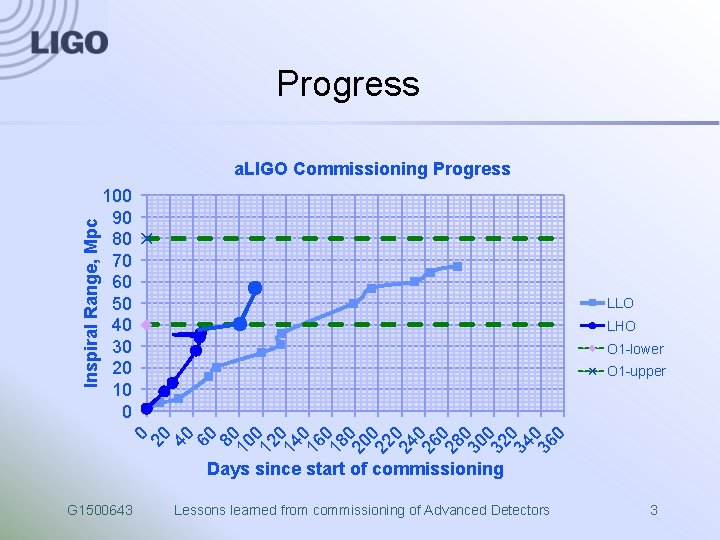
Progress 100 90 80 70 60 50 40 30 20 10 0 LLO LHO O 1 -lower O 1 -upper 0 20 40 60 80 10 0 12 0 14 0 16 0 18 0 20 0 22 0 24 0 26 0 28 0 30 0 32 0 34 0 36 0 Inspiral Range, Mpc a. LIGO Commissioning Progress Days since start of commissioning G 1500643 Lessons learned from commissioning of Advanced Detectors 3
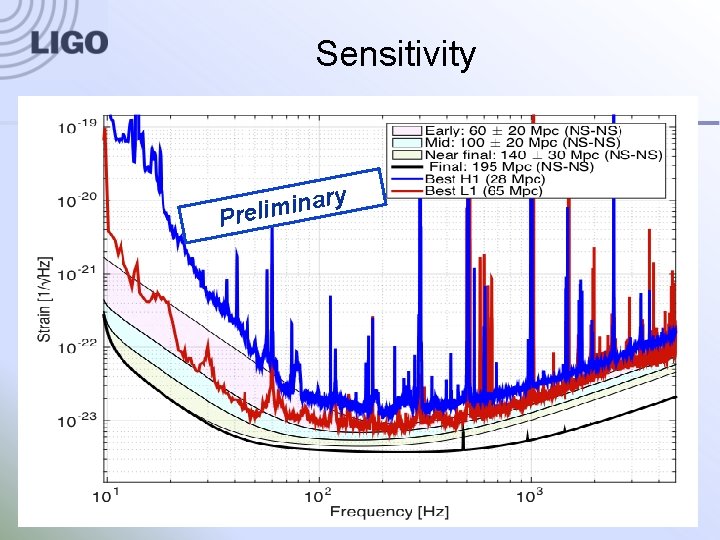
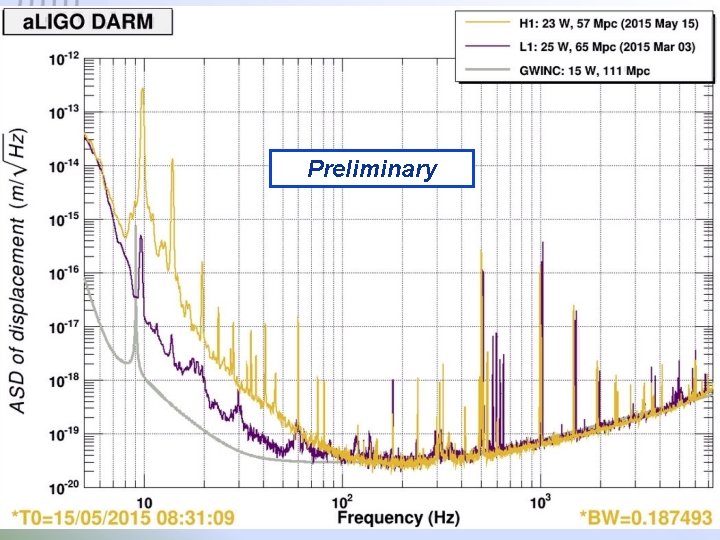
Sensitivity y ar n i m i l Pre G 1500643 Lessons learned from commissioning of Advanced Detectors 4
Preliminary G 1500643 Lessons learned from commissioning of Advanced Detectors 5
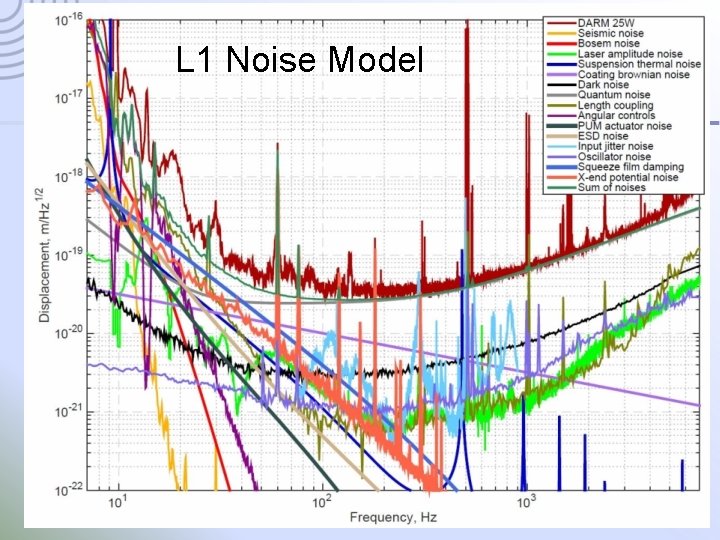
L 1 Noise Model G 1500643 Lessons learned from commissioning of Advanced Detectors 6
Full Lock DRMI 3 f Arm Length Stabilization Switching to Nominal Sensors & Adjusting operating point Refl. Locking Refl. Power [W] Intensity Power [W] Locking G 1500643 Lessons learned from commissioning of Advanced Detectors Time [s] 7
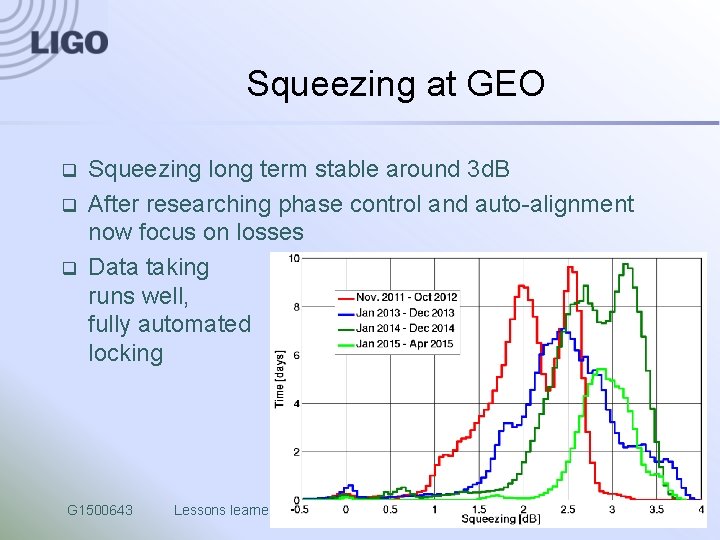
Squeezing at GEO q q q Squeezing long term stable around 3 d. B After researching phase control and auto-alignment now focus on losses Data taking runs well, fully automated locking G 1500643 Lessons learned from commissioning of Advanced Detectors 8
Underground & Cryogenic at KAGRA G 1500643 Lessons learned from commissioning of Advanced Detectors 9
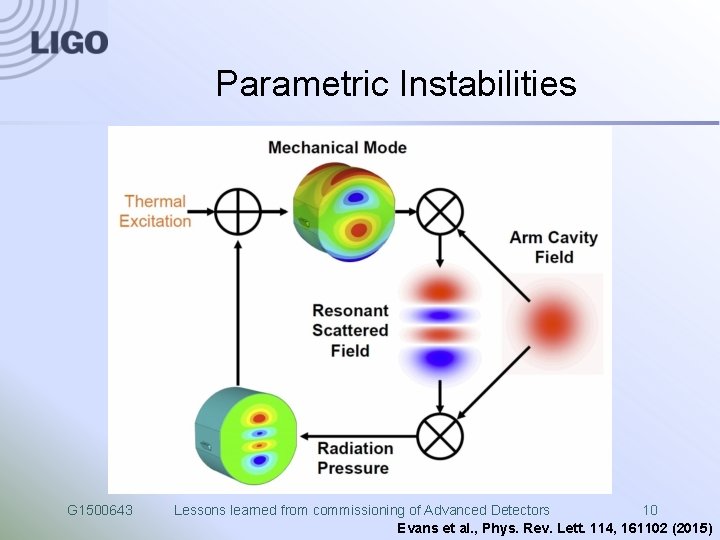
Parametric Instabilities G 1500643 Lessons learned from commissioning of Advanced Detectors 10 Evans et al. , Phys. Rev. Lett. 114, 161102 (2015)
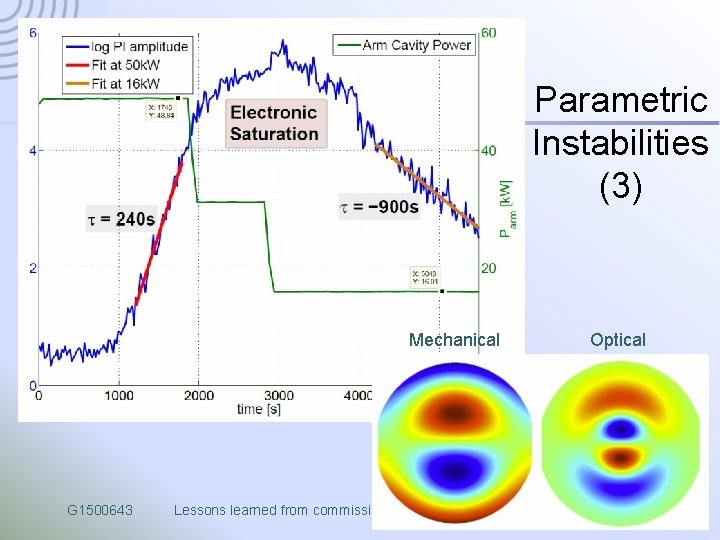
Parametric Instabilities (3) Mechanical G 1500643 Lessons learned from commissioning of Advanced Detectors Optical 11
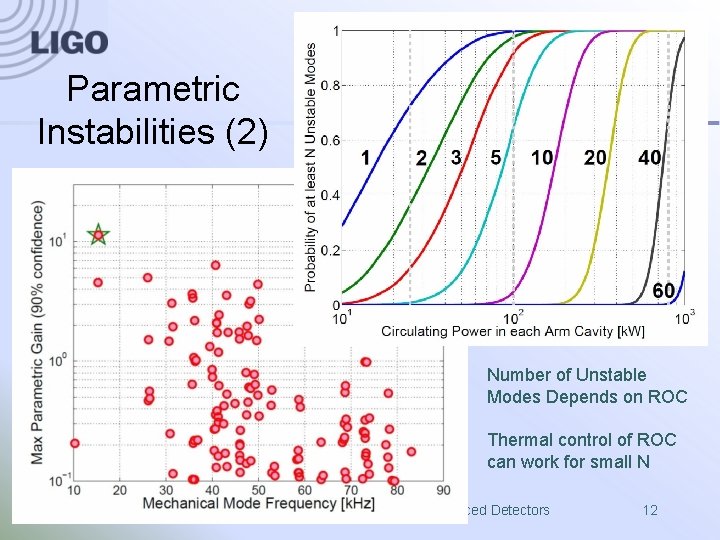
Parametric Instabilities (2) Number of Unstable Modes Depends on ROC Thermal control of ROC can work for small N G 1500643 Lessons learned from commissioning of Advanced Detectors 12
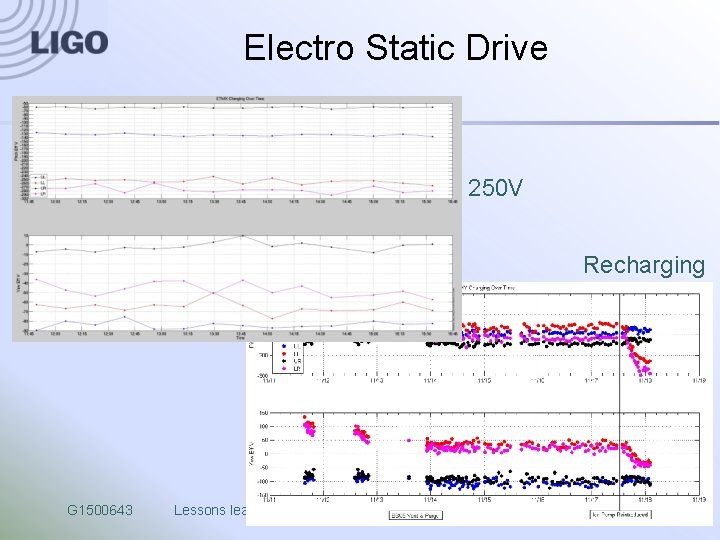
Electro Static Drive 250 V Recharging G 1500643 Lessons learned from commissioning of Advanced Detectors 13
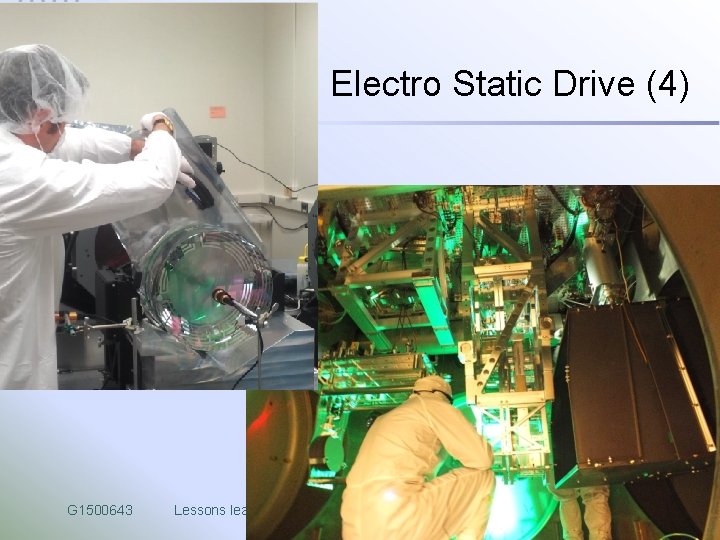
Electro Static Drive (2) q Charge is a problem, can be 10 s (even >100) of Volts Ø Ø q First contact leaves a charge behind Field lines must terminate somewhere (e. g. ring heater) Drive strength depends on charge, adds a linear term Charge is not uniform Injecting ions into the vacuum did not fix the problem Ø Hard to reach the back surface q Recharging does occur Ø Ion pump main culprit, needs to be shielded or removed q Test masses need to be discharged before pumping Ø Seems to stay discharged without an ion pump G 1500643 Lessons learned from commissioning of Advanced Detectors 14
Electro Static Drive (4) G 1500643 Lessons learned from commissioning of Advanced Detectors 15
Summary q q q Sensitivity of initial detectors surpassed quickly Robust locking achieved Squeezing is now ready and robust (GEO) Parametric instabilities are real; need to be dealt with Test mass charge is a problem Ø Discharging effort underway q What’s left? Ø Ø Ø High power operations: thermal control, PI, alignment instability Low frequency noise hunting & controls optimization Make the seismic system work during bad weather Damping of high Q modes Backscatter mitigation G 1500643 Lessons learned from commissioning of Advanced Detectors 16