
Lessons Learned Communication and Trust Opportunities and Challenges
- Slides: 17
Lessons Learned: Communication and Trust Opportunities and Challenges for Collaboration RIMPAC 2000 LESSONS LEARNED: COMMUNICATION & TRUST
Dr. Judee Burgoon Professor of Communication & Family Studies Director of Human Communication Research, CMI Dr. Suzanne Weisband Professor of Management Information Systems Funded by U. S. Army Research Institute Research and Advanced Concepts Office RIMPAC 2000 LESSONS LEARNED: COMMUNICATION & TRUST
Human Communication u These scientists study how people interact with each other u Credibility u Competency u Social Influence u Small Group Communication u Organizational Communication u Trust (Focus…for this exercise) RIMPAC 2000 LESSONS LEARNED: COMMUNICATION & TRUST
Starting assumptions u Trust is a necessary (but not sufficient) condition for effective collaboration. u Trust is especially difficult to achieve when organizational cultures and missions differ. example: UN more lateral, aims to maintain civilian character; U. S. military more hierarchical with clear chain of command control example: different notions of transitioning and respective roles during transitioning RIMPAC 2000 LESSONS LEARNED: COMMUNICATION & TRUST
Starting assumptions u Trust cannot be mandated. u Trust-building takes time. u Trust develops out of actions and interactions. u Mistakes are inevitable. u “Communication IS more difficult than rocket science. ” --Dr. Peter Likins, former rocket scientist, JPL u Recommendations to be presented are toward building “best practices. ” RIMPAC 2000 LESSONS LEARNED: COMMUNICATION & TRUST
Philosophy u Uncertainty reduction essential regarding u Mission and objectives, to set stage for interactions u Organizational templates, to identify unrecognized differences in SOP, terminology, etc. u Key personnel, to establish trust, size up credibility, and overcome deeply entrenched stereotypes RIMPAC 2000 LESSONS LEARNED: COMMUNICATION & TRUST
Planning u Preplanning for getting acquainted u make a high priority u don’t assume information sent = information received example: much briefing material for RIMPAC 2000 not seen or recalled by key players u assign one person oversight and planning duties for meetings and communication u build in redundancy within and across contacts RIMPAC 2000 LESSONS LEARNED: COMMUNICATION & TRUST
Planning u create easily distributed guidelines example: definitions of acronyms example: military pocket guide on Helping Refugees u create retrievable bios of key personnel u prioritize information distribution u timing--determine what to share early vs. later u highlighting--what is most essential example: much briefing material for RIMPAC 2000 not seen or recalled by key players RIMPAC 2000 LESSONS LEARNED: COMMUNICATION & TRUST
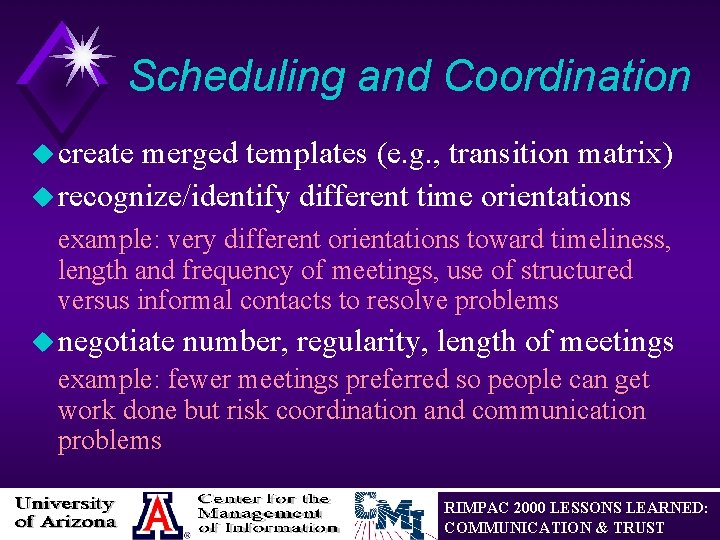
Scheduling and Coordination u create merged templates (e. g. , transition matrix) u recognize/identify different time orientations example: very different orientations toward timeliness, length and frequency of meetings, use of structured versus informal contacts to resolve problems u negotiate number, regularity, length of meetings example: fewer meetings preferred so people can get work done but risk coordination and communication problems RIMPAC 2000 LESSONS LEARNED: COMMUNICATION & TRUST
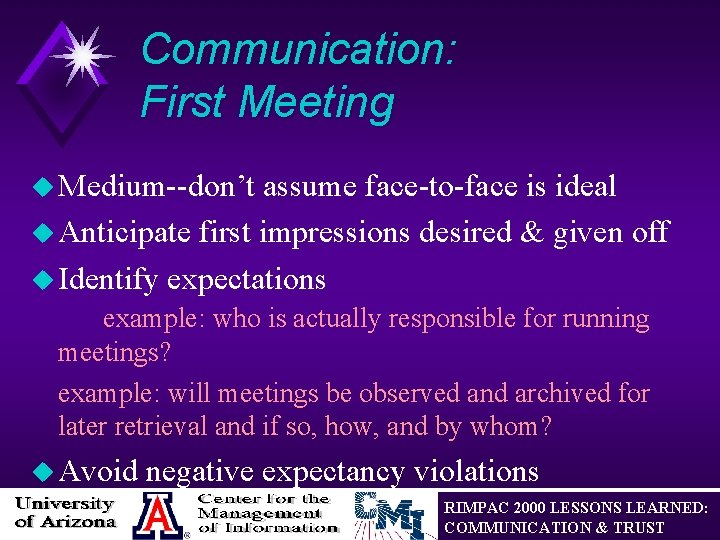
Communication: First Meeting u Medium--don’t assume face-to-face is ideal u Anticipate first impressions desired & given off u Identify expectations example: who is actually responsible for running meetings? example: will meetings be observed and archived for later retrieval and if so, how, and by whom? u Avoid negative expectancy violations RIMPAC 2000 LESSONS LEARNED: COMMUNICATION & TRUST
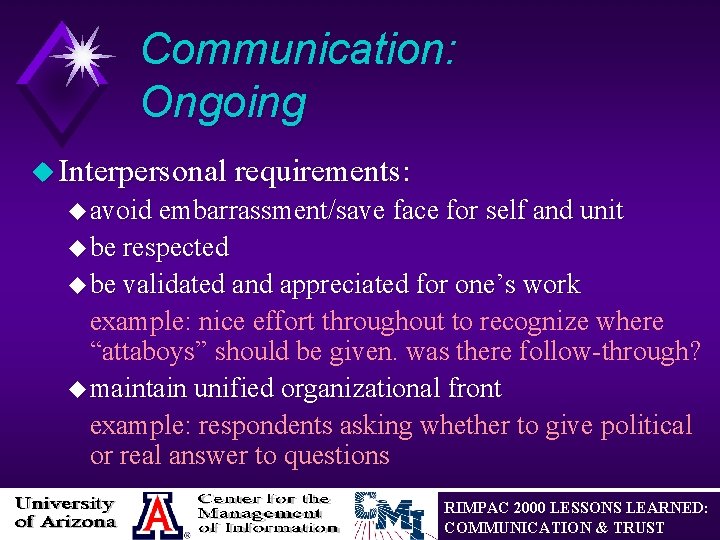
Communication: Ongoing u Interpersonal requirements: u avoid embarrassment/save face for self and unit u be respected u be validated and appreciated for one’s work example: nice effort throughout to recognize where “attaboys” should be given. was there follow-through? u maintain unified organizational front example: respondents asking whether to give political or real answer to questions RIMPAC 2000 LESSONS LEARNED: COMMUNICATION & TRUST
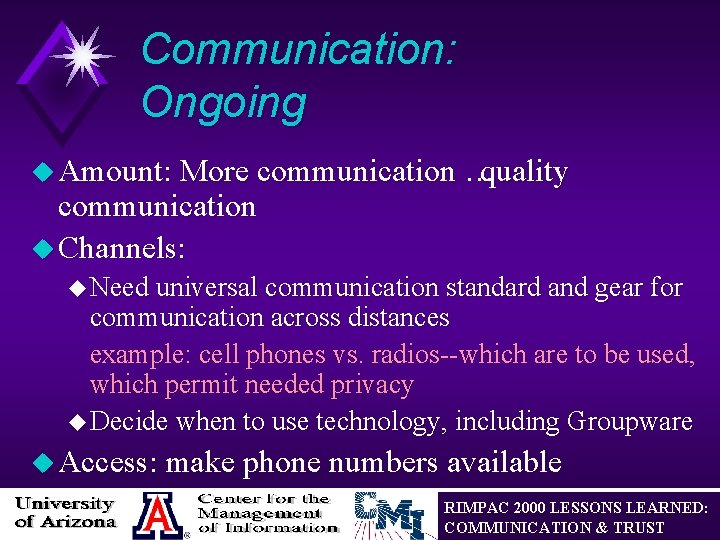
Communication: Ongoing u Amount: More communication … quality communication u Channels: u Need universal communication standard and gear for communication across distances example: cell phones vs. radios--which are to be used, which permit needed privacy u Decide when to use technology, including Groupware u Access: make phone numbers available RIMPAC 2000 LESSONS LEARNED: COMMUNICATION & TRUST
Communication: Ongoing u Language u need to create common culture u includes but goes beyond common vocabulary example: acronyms that create communication barriers, reinforce group differences example: emergence of common terms such as “actual” create understanding and solidarity example: UN prefers language that avoids implying hierarchy and emphasizes interfacing, committees RIMPAC 2000 LESSONS LEARNED: COMMUNICATION & TRUST
Communication: Ongoing u Recognize that nonverbal behavior may be viewed as relational messages example: ignoring people or walking away during a conversation may be viewed as disrespect example: size and centrality of tents taken as indication of degree of authority or importance u Distinguish between relational messages and poor social skills RIMPAC 2000 LESSONS LEARNED: COMMUNICATION & TRUST
Communication: Ongoing u Periodically reassess frequency and format of ongoing meetings and communication u Request input from various members during meetings example: UN explicitly requested input from various representatives whose goals might have been in conflict u Track lessons learned example: some people new to Group. Systems saw real merit in identifying and recording lessons learned RIMPAC 2000 LESSONS LEARNED: COMMUNICATION & TRUST
Communication: Ongoing u Be flexible u Go the extra mile to resolve conflicts example: many military personnel showed great tact and diplomacy in dealing with delicate and potentially offensive situations u Interject humor RIMPAC 2000 LESSONS LEARNED: COMMUNICATION & TRUST
Drinks? RIMPAC 2000 LESSONS LEARNED: COMMUNICATION & TRUST