
Lessons from the riots policing and community engagement
- Slides: 14
Lessons from the riots: policing and community engagement October 2012
Introduction 2
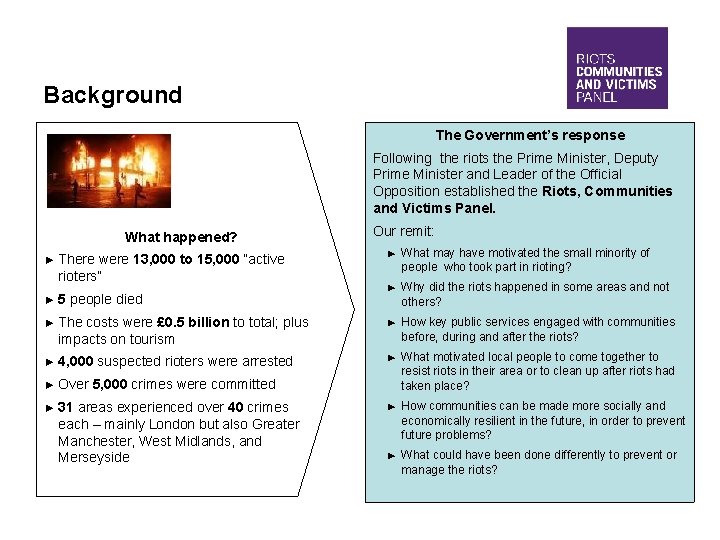
Background The Government’s response Following the riots the Prime Minister, Deputy Prime Minister and Leader of the Official Opposition established the Riots, Communities and Victims Panel. What happened? Our remit: ► What may have motivated the small minority of people who took part in rioting? ► Why did the riots happened in some areas and not others? The costs were £ 0. 5 billion to total; plus impacts on tourism ► How key public services engaged with communities before, during and after the riots? ► 4, 000 suspected rioters were arrested ► ► Over 5, 000 crimes were committed What motivated local people to come together to resist riots in their area or to clean up after riots had taken place? ► 31 areas experienced over 40 crimes each – mainly London but also Greater Manchester, West Midlands, and Merseyside ► How communities can be made more socially and economically resilient in the future, in order to prevent future problems? ► What could have been done differently to prevent or manage the riots? ► There were 13, 000 to 15, 000 “active rioters” ► 5 people died ►
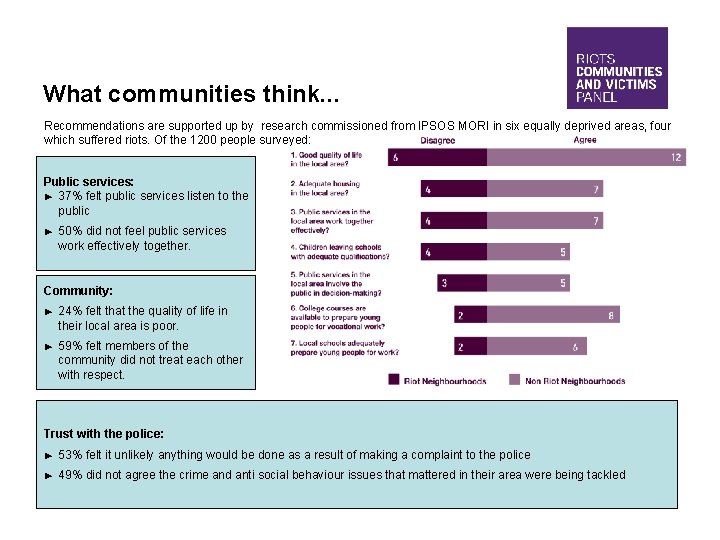
What communities think. . . Recommendations are supported up by research commissioned from IPSOS MORI in six equally deprived areas, four which suffered riots. Of the 1200 people surveyed: Public services: ► 37% felt public services listen to the public ► 50% did not feel public services work effectively together. Community: ► 24% felt that the quality of life in their local area is poor. ► 59% felt members of the community did not treat each other with respect. Trust with the police: ► . 53% felt it unlikely anything would be done as a result of making a complaint to the police ► 49% did not agree the crime and anti social behaviour issues that mattered in their area were being tackled
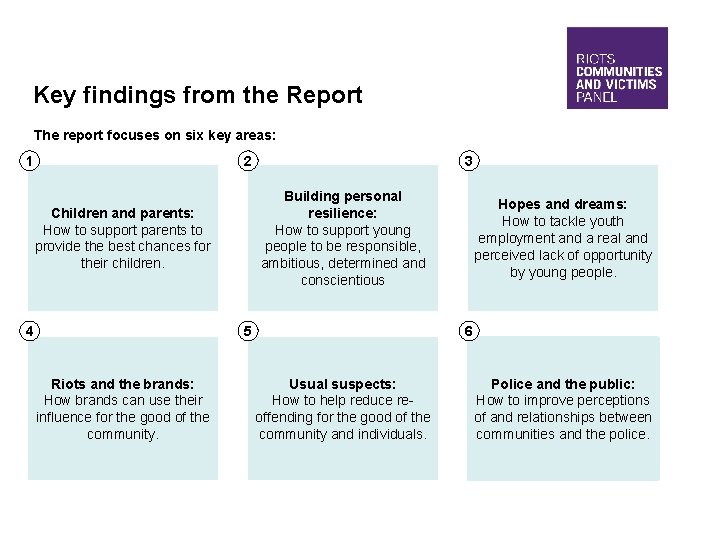
Key findings from the Report The report focuses on six key areas: 1 2 Building personal resilience: How to support young people to be responsible, ambitious, determined and conscientious Children and parents: How to support parents to provide the best chances for their children. 4 3 5 Riots and the brands: How brands can use their influence for the good of the community. Hopes and dreams: How to tackle youth employment and a real and perceived lack of opportunity by young people. 6 Usual suspects: How to help reduce reoffending for the good of the community and individuals. Police and the public: How to improve perceptions of and relationships between communities and the police.
Police and the Public
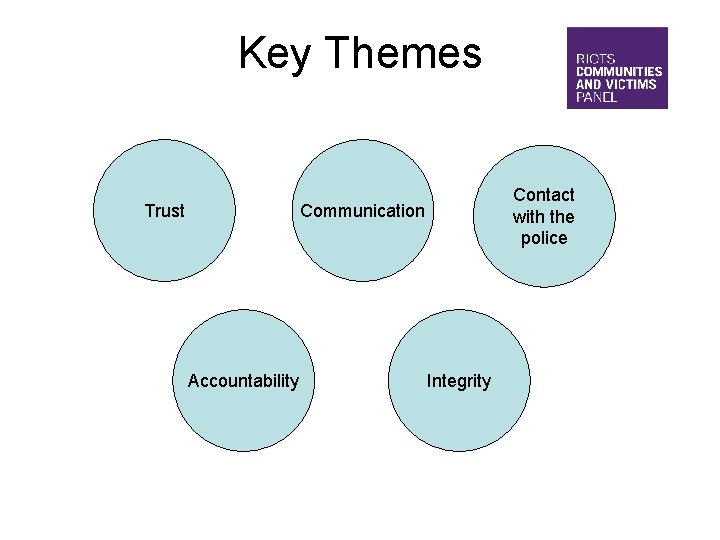
Key Themes Trust Contact with the police Communication Accountability Integrity
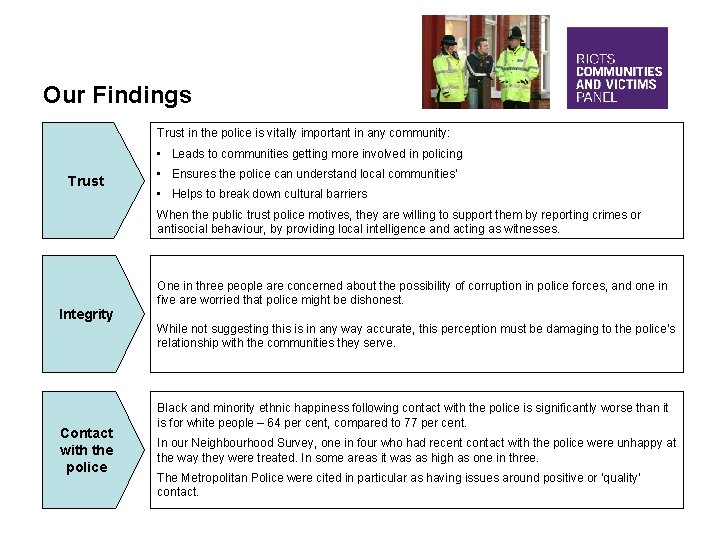
Our Findings Trust in the police is vitally important in any community: • Leads to communities getting more involved in policing Trust • Ensures the police can understand local communities’ • Helps to break down cultural barriers When the public trust police motives, they are willing to support them by reporting crimes or antisocial behaviour, by providing local intelligence and acting as witnesses. Integrity Contact with the police One in three people are concerned about the possibility of corruption in police forces, and one in five are worried that police might be dishonest. While not suggesting this is in any way accurate, this perception must be damaging to the police’s relationship with the communities they serve. Black and minority ethnic happiness following contact with the police is significantly worse than it is for white people – 64 per cent, compared to 77 per cent. In our Neighbourhood Survey, one in four who had recent contact with the police were unhappy at the way they were treated. In some areas it was as high as one in three. The Metropolitan Police were cited in particular as having issues around positive or ‘quality’ contact.
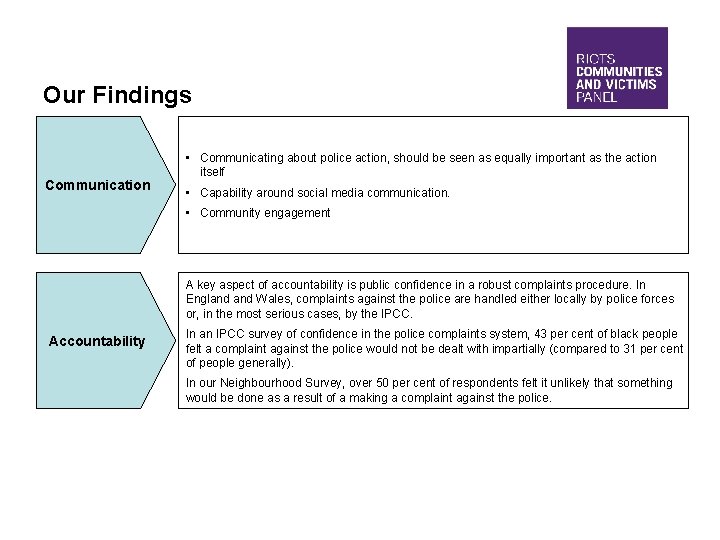
Our Findings Communication • Communicating about police action, should be seen as equally important as the action itself • Capability around social media communication. • Community engagement A key aspect of accountability is public confidence in a robust complaints procedure. In England Wales, complaints against the police are handled either locally by police forces or, in the most serious cases, by the IPCC. Accountability In an IPCC survey of confidence in the police complaints system, 43 per cent of black people felt a complaint against the police would not be dealt with impartially (compared to 31 per cent of people generally). In our Neighbourhood Survey, over 50 per cent of respondents felt it unlikely that something would be done as a result of a making a complaint against the police.
Recommendations
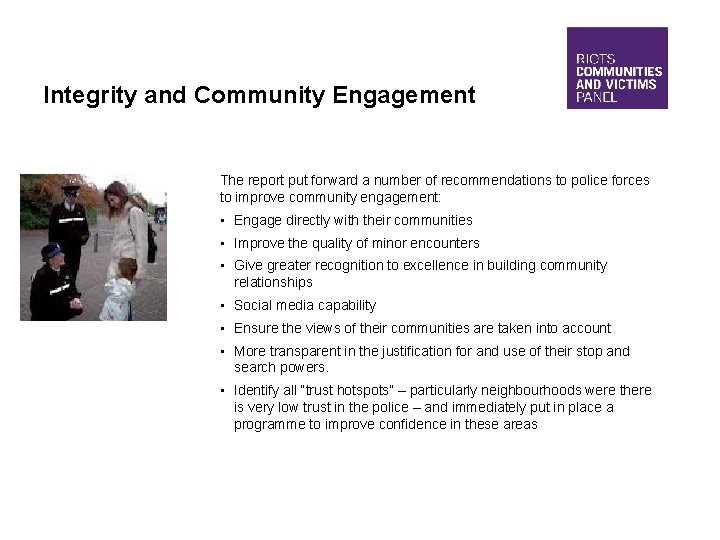
Integrity and Community Engagement The report put forward a number of recommendations to police forces to improve community engagement: • Engage directly with their communities • Improve the quality of minor encounters • Give greater recognition to excellence in building community relationships • Social media capability • Ensure the views of their communities are taken into account • More transparent in the justification for and use of their stop and search powers. • Identify all “trust hotspots” – particularly neighbourhoods were there is very low trust in the police – and immediately put in place a programme to improve confidence in these areas
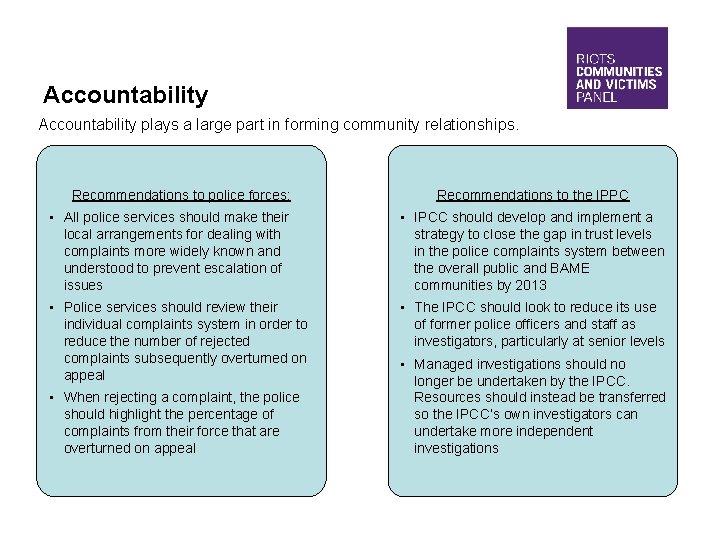
Accountability plays a large part in forming community relationships. Recommendations to police forces: Recommendations to the IPPC • All police services should make their local arrangements for dealing with complaints more widely known and understood to prevent escalation of issues • IPCC should develop and implement a strategy to close the gap in trust levels in the police complaints system between the overall public and BAME communities by 2013 • Police services should review their individual complaints system in order to reduce the number of rejected complaints subsequently overturned on appeal • The IPCC should look to reduce its use of former police officers and staff as investigators, particularly at senior levels • When rejecting a complaint, the police should highlight the percentage of complaints from their force that are overturned on appeal • Managed investigations should no longer be undertaken by the IPCC. Resources should instead be transferred so the IPCC’s own investigators can undertake more independent investigations
One year on. . .
Looking ahead • From November, Police and Crime Commissioners will be responsible for ensuring that local people’s voices are heard and acted upon and make sure that the police are delivering the priorities of the local community • Stop and search • Troubled Families programme • Community Budgets • Riot Damages Act