
Lessons from the history of the Swiss Democracy
- Slides: 12
Lessons from the history of the Swiss Democracy for the Making of a European Constitution Budapest Forum “Towards a More Democratic Europe” November 20 th 2006 by Andreas Gross (Switzerland) Director of the Scientific Institute for Direct Democracy in St. Ursanne (JU/CH) and Swiss MP/PACE www. andigross. ch info@andigross. ch
Every country has specific historical achievements, which may serve the European integration process There integration in the European Constitution allows the European people(s) to recognise and identify themselves with it § This would serve the integration of variety §
Switzerland owes the success of it’s 1848 Revolution and modern existence to Europe now it may offer it’s best back Republican notion of politics § Direct Democracy § Decentralisation of power (Federalism) §
a. The Republican notion of politics is possible Freedom is a opportunity to act, not something to be consumed § The citizen is permanently the last point of reference § The constitution is an open end process; agreements have always to be renewed §
b. Direct Democracy (DD) is possible and serves the transnational integration process DD is a achievement of the Swiss opposition movement(s) in the 1860’s § DD was the answer of an elitist notion of Democracy and an elitist practise of representation § DD serves to integrate differences and diversities §
c. Federalism means sharing and decentralization of power and allows to unite diversity and unity F prevents centralisation and overbureaucratisation § F means to solve problems where it may best serve citizens § F empowers citizens, communes, regions and nations § F allows to cumulate identities §
We should overcome the banalisation of the term “Constitution” Treaties and Constitutions have different potentials ü A constitution is an open agreement between citizens how the power is shared and democracy should be organised ü An agreement has to be made by the people themselves ü When you ask the people at the end , you should integrate them in the process of the making ü
Which are the basic products of Direct Democracy’s best practices ? Those the EU needs most ! Ö Ö Individual / collective communication & deliberations Ö Collective learning potentials Ö Rich public spheres Ö political openness et legitimate polity Ö citizens have to be taken seriously Identification with the DD process ( « Democratic patriotism » )
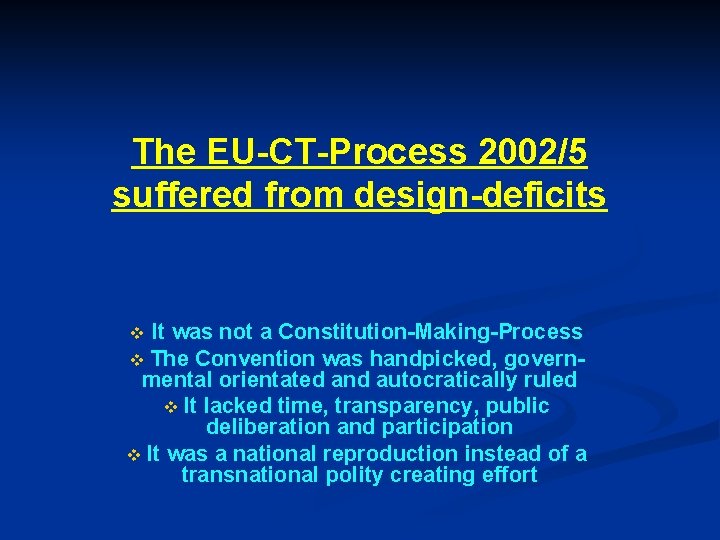
The EU-CT-Process 2002/5 suffered from design-deficits It was not a Constitution-Making-Process v The Convention was handpicked, governmental orientated and autocratically ruled v It lacked time, transparency, public deliberation and participation v It was a national reproduction instead of a transnational polity creating effort v
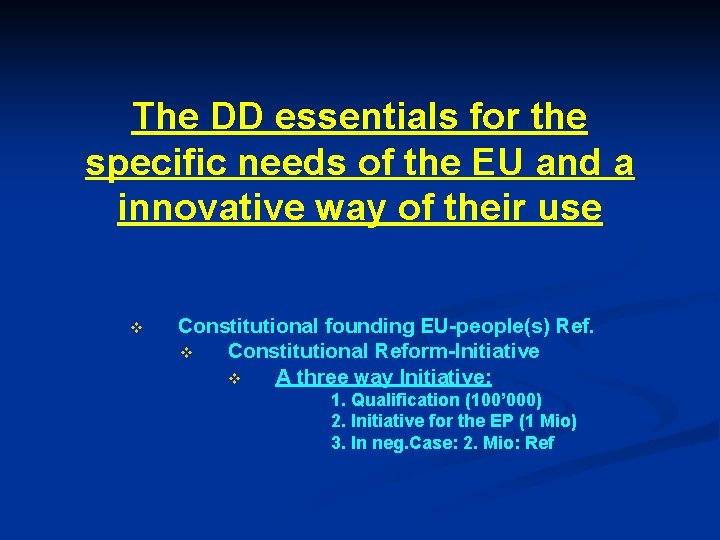
The DD essentials for the specific needs of the EU and a innovative way of their use v Constitutional founding EU-people(s) Ref. v Constitutional Reform-Initiative v A three way Initiative: 1. Qualification (100’ 000) 2. Initiative for the EP (1 Mio) 3. In neg. Case: 2. Mio: Ref
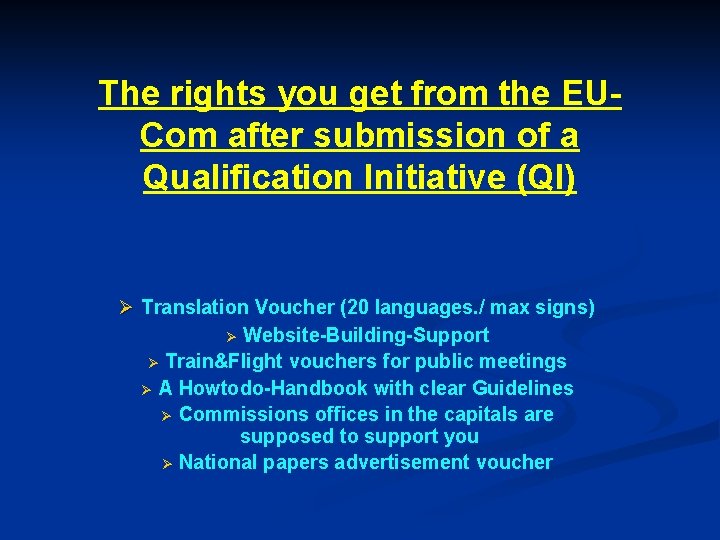
The rights you get from the EUCom after submission of a Qualification Initiative (QI) Ø Translation Voucher (20 languages. / max signs) Website-Building-Support Ø Train&Flight vouchers for public meetings Ø A Howtodo-Handbook with clear Guidelines Ø Commissions offices in the capitals are supposed to support you Ø National papers advertisement voucher Ø
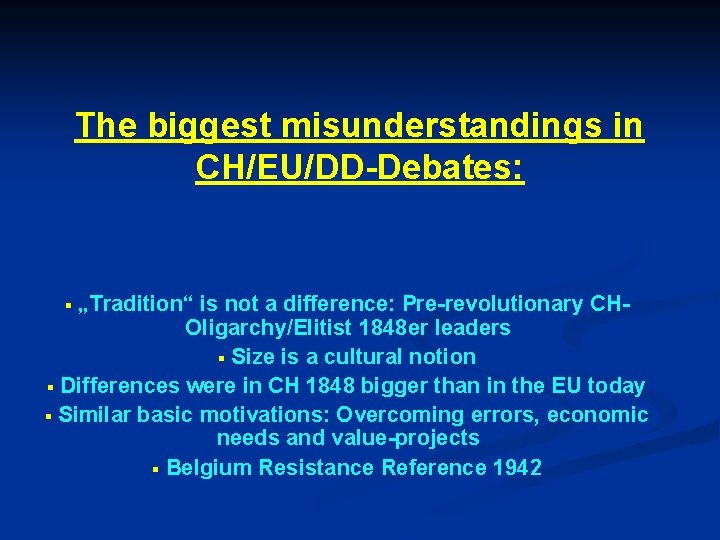
The biggest misunderstandings in CH/EU/DD-Debates: „Tradition“ is not a difference: Pre-revolutionary CHOligarchy/Elitist 1848 er leaders § Size is a cultural notion § Differences were in CH 1848 bigger than in the EU today § Similar basic motivations: Overcoming errors, economic needs and value-projects § Belgium Resistance Reference 1942 §