
Lessons from the Disaster Research Emergency Management Training
- Slides: 48
Lessons from the Disaster Research Emergency Management Training Conference November 28, 2004 112804 Veterans Health Administration 1
Module Objectives • Explain some of the characteristics of disasters. • Discuss some types of disasters and their impacts. • Discuss the findings that underlie the “all hazards” perspective. • Identify some myths about crisis behavior and discuss their application to biological terrorism. 112804 Veterans Health Administration 2
Module Objectives (con’t) • Cite some principles of risk communication. • Explain some of the changes disasters cause within organizations. • Describe some of the factors that contribute to effective crisis leadership. 112804 Veterans Health Administration 3
Characteristics of Disasters 112804 Veterans Health Administration 4
Most Emergencies • 911 Communications Center takes caller(s). • Jurisdictional public safety agencies are dispatched. • First Officer on scene takes Command, establishes an Incident Command Post • Agency resources are sufficient to handle the problems encountered. 112804 Veterans Health Administration 5
More Problems Than Normal • As the number of distinct incident sites and/or the resources required increase, assistance is requested from neighboring jurisdictions. • Significant damage and unusual problems will result in extended operations • When is an emergency called a disaster? 112804 Veterans Health Administration 6
Disaster vs. Emergency • Non-routine tasks are created. • Expansion of normal roles. • New groups get involved. • Damage to infrastructure prevents provision of basic services. • ? ? 112804 Veterans Health Administration 7
Fritz (1961) • Accidental or uncontrollable events, actual or threatened, that are concentrated in time and space, in which a society, or a relatively selfsufficient subdivision of a society, undergoes severe danger, and incurs such losses to its members and physical appurtenances that the social structure is disrupted and the fulfillment of all or some of the essential functions of the society is prevented. Mileti, 1999 112804 Veterans Health Administration 8
During Disasters… Organizations have to: • Quickly relate to more and different groups and organizations. . • Adjust to losing a part of their autonomy • Apply different performance standards • Operate with a closer public and private sector interface. Quarantelli, 1998 112804 Veterans Health Administration 9
Three Types of Hazards • Natural – Floods, Tornadoes, Hurricanes, Earthquakes • Technological – Hazardous Materials, Transportation Accidents • Man-caused – Civil Disorder, Terrorism, War 112804 Veterans Health Administration 10
Flooding • #1 cause of death and property damage • Deaths and injuries on the decline, but property losses on the rise • 1975 -1994: 1, 600 deaths • Worst death tolls: – 156, Big Thompson River, 1976, CO. – 180, Puerto Rico, 1985 Mileti, 1999 112804 Veterans Health Administration 11
Tornadoes • Most violent storms on earth • U. S. has more than any other country • #1 injury-causing natural hazard, #2 hazardrelated cause of death, and #3 cause of property damage • 1975 -1994: 1, 090 killed and 23, 507 injured • Worst death toll: – 1984, 130 people killed – 1994, 83 killed 112804 Veterans Health Administration Mileti, 1999 12
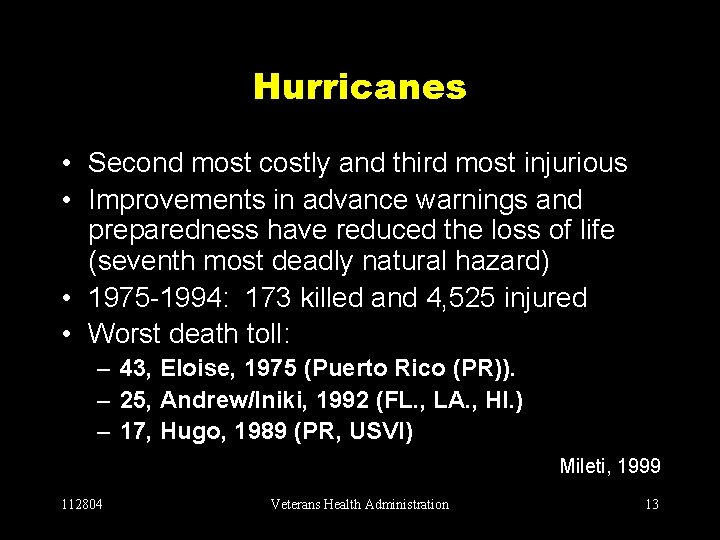
Hurricanes • Second most costly and third most injurious • Improvements in advance warnings and preparedness have reduced the loss of life (seventh most deadly natural hazard) • 1975 -1994: 173 killed and 4, 525 injured • Worst death toll: – 43, Eloise, 1975 (Puerto Rico (PR)). – 25, Andrew/Iniki, 1992 (FL. , LA. , HI. ) – 17, Hugo, 1989 (PR, USVI) Mileti, 1999 112804 Veterans Health Administration 13
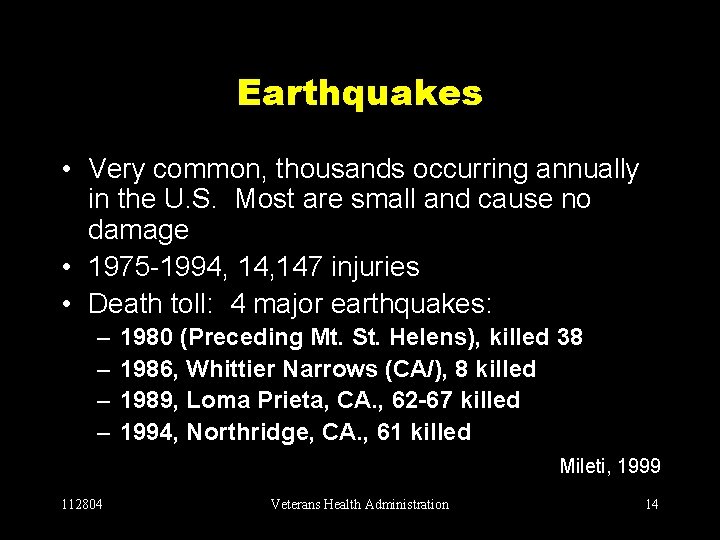
Earthquakes • Very common, thousands occurring annually in the U. S. Most are small and cause no damage • 1975 -1994, 147 injuries • Death toll: 4 major earthquakes: – – 1980 (Preceding Mt. St. Helens), killed 38 1986, Whittier Narrows (CA/), 8 killed 1989, Loma Prieta, CA. , 62 -67 killed 1994, Northridge, CA. , 61 killed Mileti, 1999 112804 Veterans Health Administration 14
Technological Hazards • Events caused by unintentional human error • Data on deaths, injuries and property loss from releases of hazardous materials and wastes are tracked by various Federal agencies • Data tied to relatively recent legislation and varies as changes are made to reportable quantities – Releases concentrated in industrial Northeast, CA. , NC. , TN. and TX. Mileti, 1999 112804 Veterans Health Administration 15
Technological (con’t) • Worst world-wide: – Bhopal, India (1984), 2, 500 died immediately, 8, 000 more died by 1987 and 300, 000 had debilitating injuries – Chernobyl, U. S. S. R. (1986), 250 killed immediately, tens of thousands long-term Mileti, 1999 112804 Veterans Health Administration 16
Man-Caused • Terrorism: – World Trade Center, 1993, 6 dead, 2, 000 hurt – Tokyo Subway, 1995, 12 dead, 5, 500 injured – Alfred P. Murrah Federal Building, 1995, 168 killed, hundreds injured – U. S. Embassy bombings, 1998, 224 killed and thousands injured – WTC/DC/PA, 2001, thousands killed – Anthrax in mail, 2001, several killed Mileti, 1999 112804 Veterans Health Administration 17
Weapons of Mass Destruction “Any weapon or device that is intended, or has the capability, to cause death or serious bodily injury to a significant number of people through the release, dissemination or impact of: (A) toxic or poisonous chemicals or their precursors; (B) a disease organism, or; (C) radiation or radioactivity. ” Nunn-Lugar Act 112804 Veterans Health Administration 18
Our Common Goal • To create and maintain an effective national system to prevent, prepare for, respond to and recover from major threats to lives and livelihoods. • A fundamental assumption is that plans alone are not effective unless they are supported by people and a process brought together by good management skills 112804 Veterans Health Administration 19
All Hazard Orientation • Attempts to distinguish between natural & technological hazards are not productive. • Preparedness activities should not only be focused on the hazard (agent), but also the response to it. Quarantelli 112804 Veterans Health Administration 20
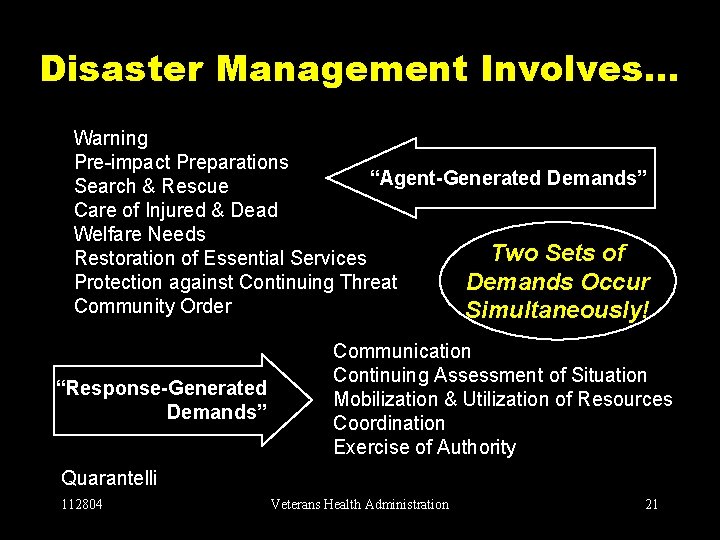
Disaster Management Involves. . . Warning Pre-impact Preparations “Agent-Generated Demands” Search & Rescue Care of Injured & Dead Welfare Needs Two Sets of Restoration of Essential Services Protection against Continuing Threat Demands Occur Community Order Simultaneously! “Response-Generated Demands” Communication Continuing Assessment of Situation Mobilization & Utilization of Resources Coordination Exercise of Authority Quarantelli 112804 Veterans Health Administration 21
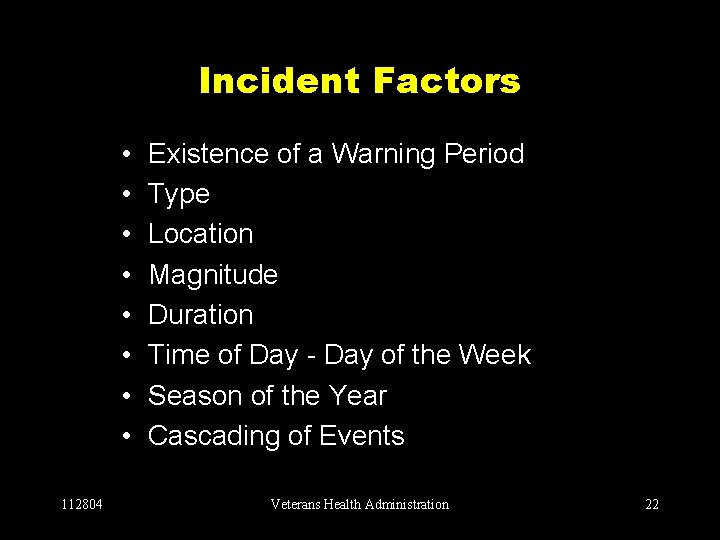
Incident Factors • • 112804 Existence of a Warning Period Type Location Magnitude Duration Time of Day - Day of the Week Season of the Year Cascading of Events Veterans Health Administration 22
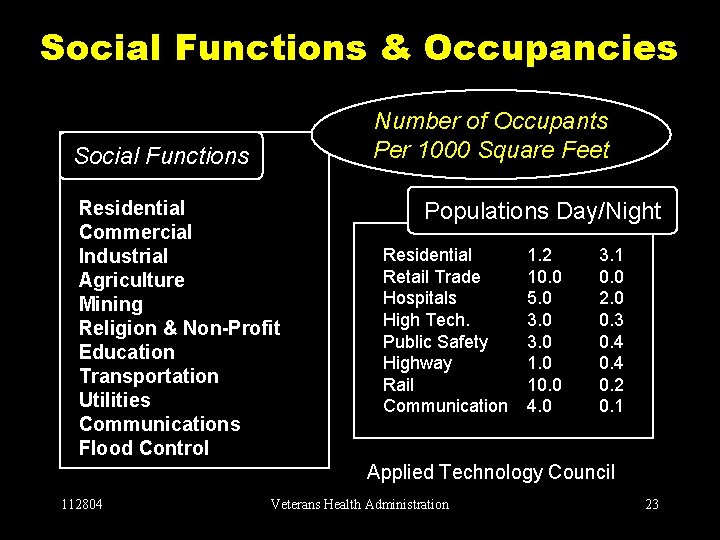
Social Functions & Occupancies Number of Occupants Per 1000 Square Feet Social Functions Residential Commercial Industrial Agriculture Mining Religion & Non-Profit Education Transportation Utilities Communications Flood Control Populations Day/Night Residential Retail Trade Hospitals High Tech. Public Safety Highway Rail Communication 1. 2 10. 0 5. 0 3. 0 10. 0 4. 0 3. 1 0. 0 2. 0 0. 3 0. 4 0. 2 0. 1 Applied Technology Council 112804 Veterans Health Administration 23
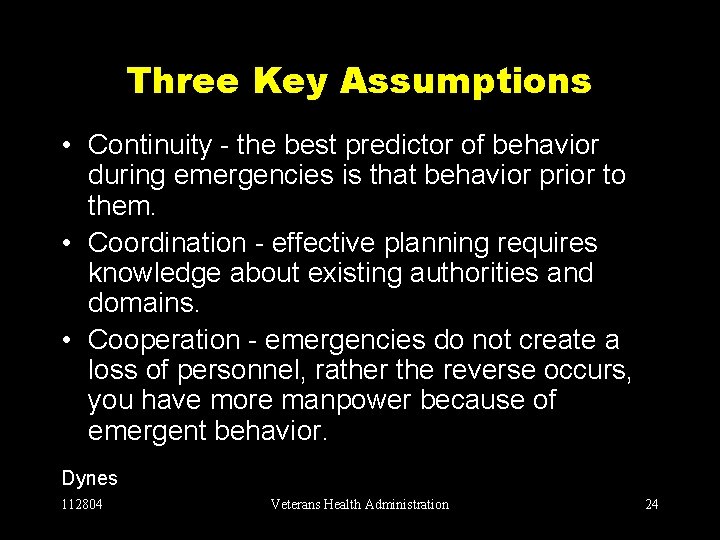
Three Key Assumptions • Continuity - the best predictor of behavior during emergencies is that behavior prior to them. • Coordination - effective planning requires knowledge about existing authorities and domains. • Cooperation - emergencies do not create a loss of personnel, rather the reverse occurs, you have more manpower because of emergent behavior. Dynes 112804 Veterans Health Administration 24
Some Popular “Myths” • Looting and other forms of anti-social behavior always occur after disasters. • People panic when confronted by disasters. • Disaster victims are dazed and incapable of helping themselves or others. Drabek 112804 Veterans Health Administration 25
Myths (con’t) • People don’t listen to official advice. • More communication means better communication. • Officials always know who is in charge. Drabek 112804 Veterans Health Administration 26
Discussion Question • Do the sociologists’ findings on the “myths” match with past experiences? 112804 Veterans Health Administration 27
Getting Ready for Disasters • • • Households Businesses Government agencies Communities States How and why do people prepare? Regions 112804 Veterans Health Administration 28
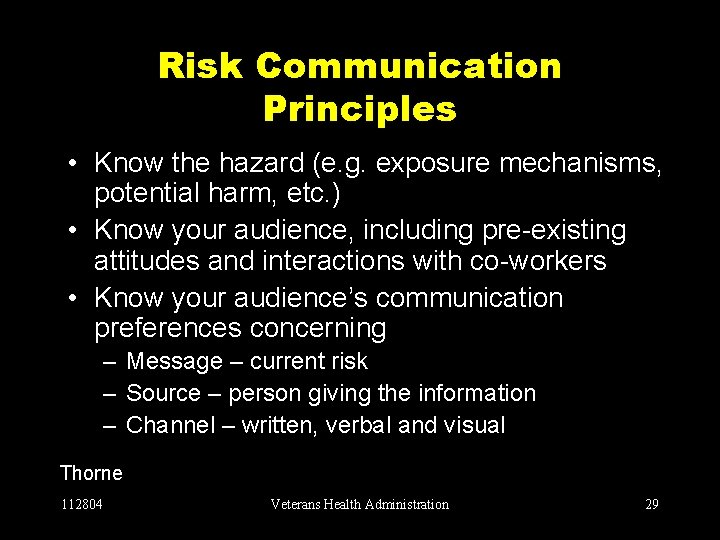
Risk Communication Principles • Know the hazard (e. g. exposure mechanisms, potential harm, etc. ) • Know your audience, including pre-existing attitudes and interactions with co-workers • Know your audience’s communication preferences concerning – Message – current risk – Source – person giving the information – Channel – written, verbal and visual Thorne 112804 Veterans Health Administration 29
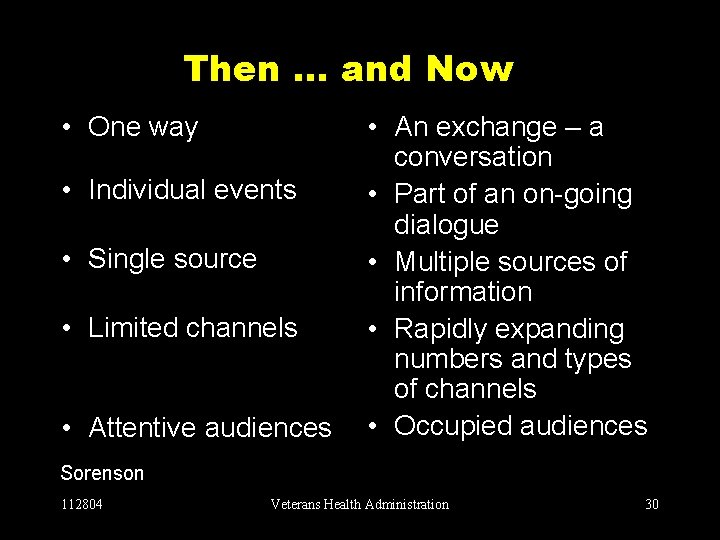
Then … and Now • One way • Individual events • Single source • Limited channels • Attentive audiences • An exchange – a conversation • Part of an on-going dialogue • Multiple sources of information • Rapidly expanding numbers and types of channels • Occupied audiences Sorenson 112804 Veterans Health Administration 30
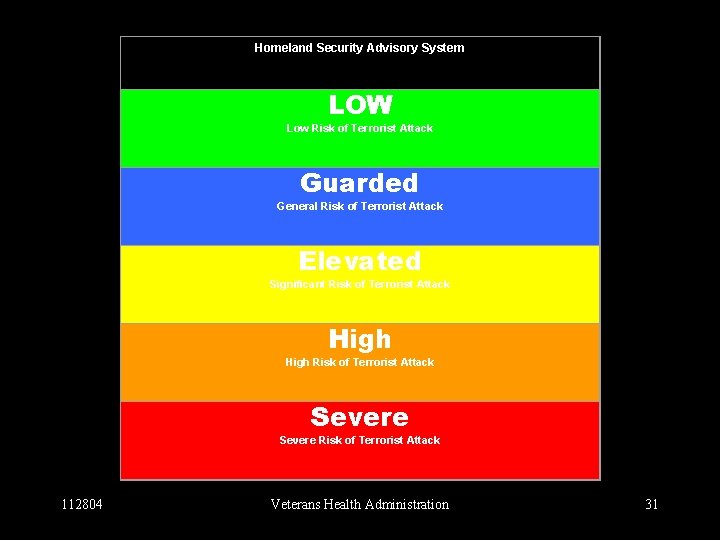
Homeland Security Advisory System LOW Low Risk of Terrorist Attack Guarded General Risk of Terrorist Attack Elevated Significant Risk of Terrorist Attack High Risk of Terrorist Attack Severe Risk of Terrorist Attack 112804 Veterans Health Administration 31
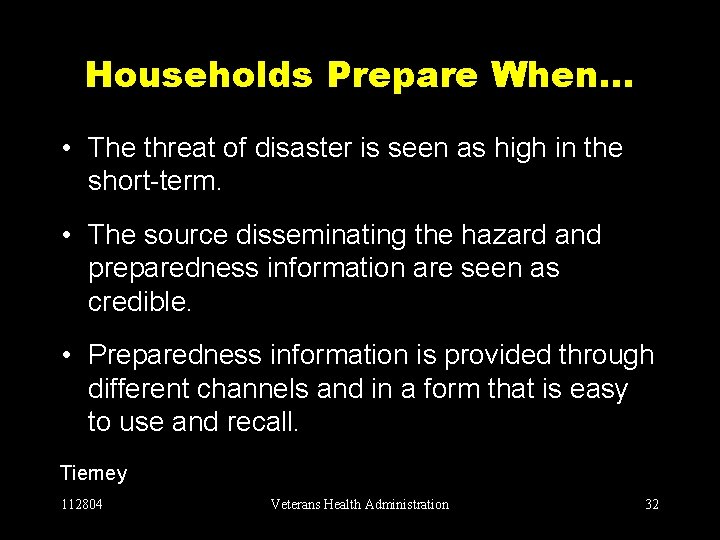
Households Prepare When… • The threat of disaster is seen as high in the short-term. • The source disseminating the hazard and preparedness information are seen as credible. • Preparedness information is provided through different channels and in a form that is easy to use and recall. Tierney 112804 Veterans Health Administration 32
Organizational Preparedness programs are difficult to implement because: • Overall intractability of the disaster problem • Lack of clear and measurable performance objectives • Insufficient resources • Inadequate guidance Unless the organization has a crisis-relevant mission Waugh 112804 Veterans Health Administration 33
Police and Fire Departments, EMS Providers & Hospitals • Tend to see disasters as just big emergencies. • Plan in relative isolation from broader, community-wide efforts. • Problems in EMS-hospital preparedness stem from “everyday” issues – conflicts between the professions involved, status of hospitals and public/private sector roles. Tierney 112804 Veterans Health Administration 34
Emergency Management Agency/Function • Legitimacy is maintained if: – Persistent hazards exist – Function is integrated into daily affairs of the organization – Ability to forge relationships with disparate groups – Concrete examples of preparedness are provided, such a functioning Emergency Operations Center Tierney 112804 Veterans Health Administration 35
Disasters are Different Organizations have to: • Quickly relate to more and different kinds of groups and organizations. • Adjust to losing part of their autonomy. • Apply different performance standards. • Operate within a closer public and private sector interface. Quarantelli 112804 Veterans Health Administration 36
Disasters Change Normal Organizational Routines • Off-duty personnel are called in. • Personnel are re-assigned to new duties. • Everyday procedures & priorities are altered. • Organizations share tasks & resources. Auf der Heide 112804 Veterans Health Administration 37
Disasters Change Routines (con’t) • Involvement of non-emergency responders. • Crossing of jurisdictional boundaries. • Non-routine tasks are created. • Damage to normal response tools & facilities • Formation of new organizations. Auf der Heide 112804 Veterans Health Administration 38
Conditions for Effective Response • Knowledge of crisis behavior • Role specification and consensus • Network integration • Communications • Maintenance of autonomy • Flexibility and the ability to improvise Dynes 112804 Veterans Health Administration 39
Role Specification & Consensus Internal and external • Different hazards • Different timeframes • Different parts of agencies 112804 Veterans Health Administration 40
Network Integration Internal and external • Regular interaction • Collective planning and rehearsal • Establishment of joint facilities • Overlapping membership • Boundary spanners 112804 Veterans Health Administration 41
Communications Internal and external • Being “in the loop” • Technical ability to communicate • Information dissemination • Rumor control 112804 Veterans Health Administration 42
Maintenance of Autonomy Internal and external • Organizations strongly defend authority and autonomy • Should be valued and maintained • Requires a process to ensure/promote interorganizational coordination and common decision-making 112804 Veterans Health Administration 43
Flexibility Part Preparedness and Part Improvisation • Preparedness means to organize a response prior to an event • Improvisation means to organize an event during a response • Planning and preparedness improve the ability to improvise Dynes 112804 Veterans Health Administration 44
Leaders are seen as effective if they accomplish: • Mobilization of personnel and resources. • Communication of information. • Resolution over conflicts, goals and resources. • Interaction/integration with other governmental units. Dynes 112804 Veterans Health Administration 45
Leadership in Bioterrorism: Strategic Goals • Limit death and suffering through prompt preventive, curative and supportive care. • Defend civil liberties using the least restrictive interventions necessary • Preserve economic stability • Discourage scapegoating • Bolster the ability of individuals and society to rebound, through provision of mental health services. Working Group Report 112804 Veterans Health Administration 46
Questions? 112804 Veterans Health Administration 47
Small Group Activity • Gather into groups and discuss how the Homeland Security Advisory System was applied to your organization/community. • Discuss the types of activities that were conducted for “Elevated” (yellow) versus “High” (orange). • Discuss lessons that were learned. 112804 Veterans Health Administration 48