
Lessons from Self Help GroupBank Linkage Program as
Lessons from Self Help Group-Bank Linkage Program as a Medium for Formal Financial access in India May 22 nd, 2018 By: Suraj Jacob

Lessons from India – SHG Bank Linkage Program What is a Self-Help Group? q. A self-help group (SHG) is a financial intermediary owned by the poor. q. Usually comprising of 10 -20 women, it acts as a way of facilitating informal financials services to rural poor. q. It is an intricate social design in which people participate by making themselves socially and financially accountable to each other. q. Similar to ROSCA’s in several other countries , wherein homogeneous group members start similar financial initiatives.
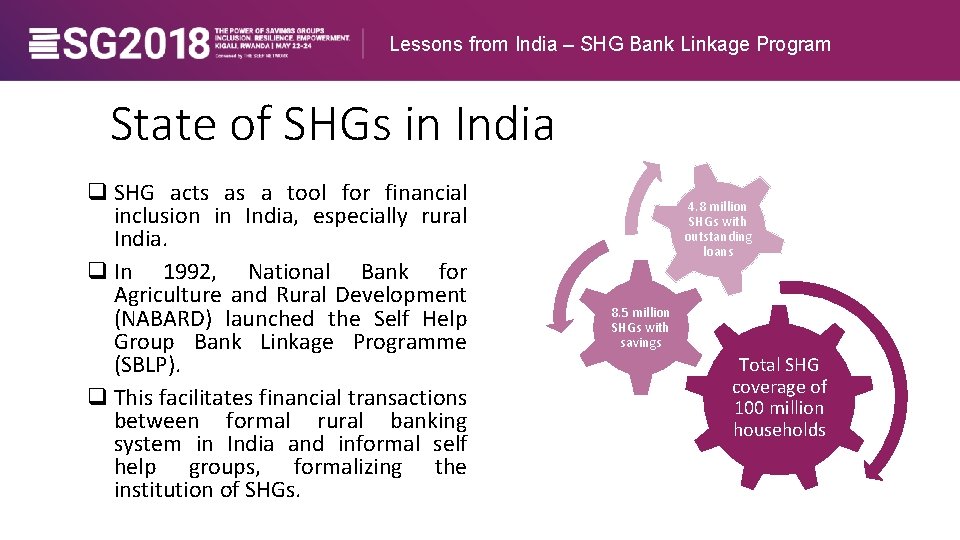
Lessons from India – SHG Bank Linkage Program State of SHGs in India q SHG acts as a tool for financial inclusion in India, especially rural India. q In 1992, National Bank for Agriculture and Rural Development (NABARD) launched the Self Help Group Bank Linkage Programme (SBLP). q This facilitates financial transactions between formal rural banking system in India and informal self help groups, formalizing the institution of SHGs. 4. 8 million SHGs with outstanding loans 8. 5 million SHGs with savings Total SHG coverage of 100 million households
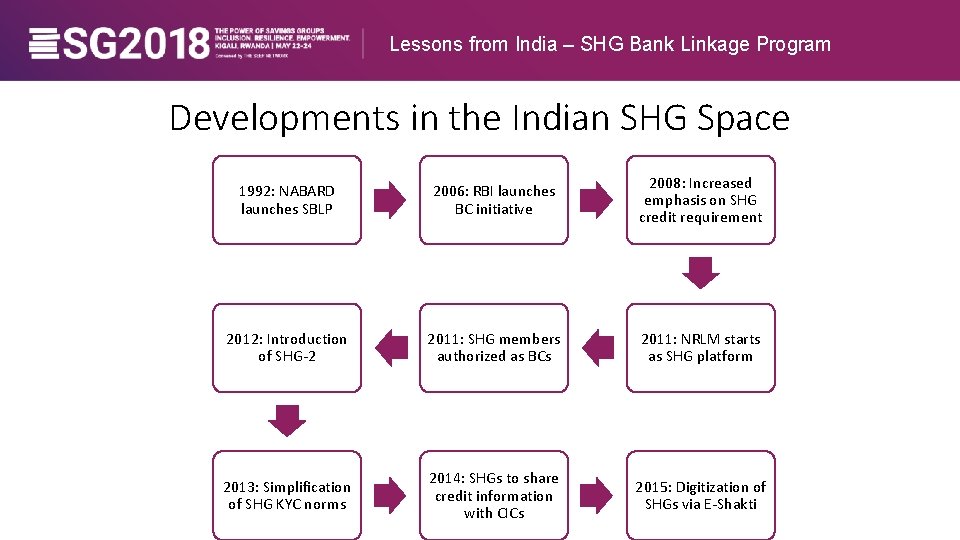
Lessons from India – SHG Bank Linkage Program Developments in the Indian SHG Space 1992: NABARD launches SBLP 2006: RBI launches BC initiative 2008: Increased emphasis on SHG credit requirement 2012: Introduction of SHG-2 2011: SHG members authorized as BCs 2011: NRLM starts as SHG platform 2013: Simplification of SHG KYC norms 2014: SHGs to share credit information with CICs 2015: Digitization of SHGs via E-Shakti
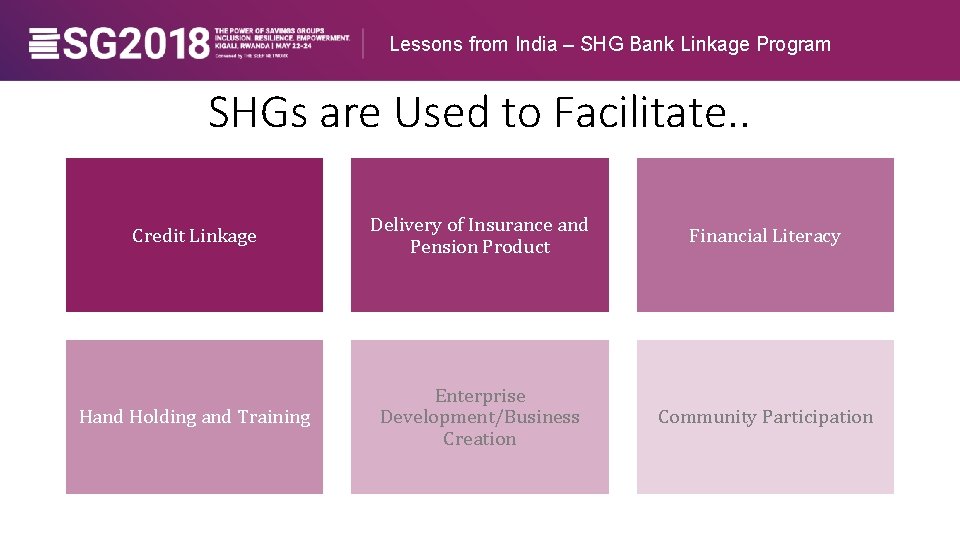
Lessons from India – SHG Bank Linkage Program SHGs are Used to Facilitate. . Credit Linkage Delivery of Insurance and Pension Product Financial Literacy Hand Holding and Training Enterprise Development/Business Creation Community Participation

Lessons from India – SHG Bank Linkage Program Study Context IFMR LEAD in partnership with HIH India conducted a study on evaluating the impact of SHG based microfinance and entrepreneurship training program q Impact was assessed on the socio-economic livelihoods of rural-low income households in Tamil Nadu (a state in India) q Impact was assessed across outcomes such as financial behaviour, business creation and expansion and women empowerment indicators The SHG program was implemented by HIH India q The program consisted of three main components: Group Formation, Business Training and Loan Disbursement q HIH India managed the monitoring and tracking of program implementation that roughly covered 3000 beneficiaries.

Lessons from India – SHG Bank Linkage Program Research Objectives q Is micro-credit combined with entrepreneurial training effective? Does it help poor households increase their well-being, consumption and business profits, and does it have positive impacts on education, health, and women empowerment? q To what extent is the program effective and how do impacts differ for different segments of the population, in particular the poorest, the least educated, and those without a business? q What are households’ characteristics that explain why some take-up microcredit, while others don’t?

Lessons from India – SHG Bank Linkage Program Research Methodology • Randomized Controlled Trial (RCT) approach to evaluate the impact of SHG program q. Helps isolate causal impact of the program q. Minimizes bias in the study q. Identifies nature and extent of impact Randomization was done at the village level q. Some villages received the treatment, while others did not

Lessons from India – SHG Bank Linkage Program Sample Size and Geographical Context Study Geography q. Study was conducted in 3 districts of Tamil Nadu- Sivagangai, Virudhunagar and Tuticorin Study Sample q 303 villages were covered under the study and were randomly assigned into treatment and control groups q 5061 households were selected from these villages as final study sample TREATMENT GROUP N= 3482 household Group Formation Training Loan Disbursement CONTROL GROUP N=1579 households Did not receive intervention

Lessons from India – SHG Bank Linkage Program Study Timeline Village Panchayat Level Survey: June 2010 Baseline Survey: July 2010 to October 2011 Implementation of HIH-SHG Program: Jan 2012 to Jan 2015 Midline Survey: February to May 2015 Endline Survey: March to November 2016
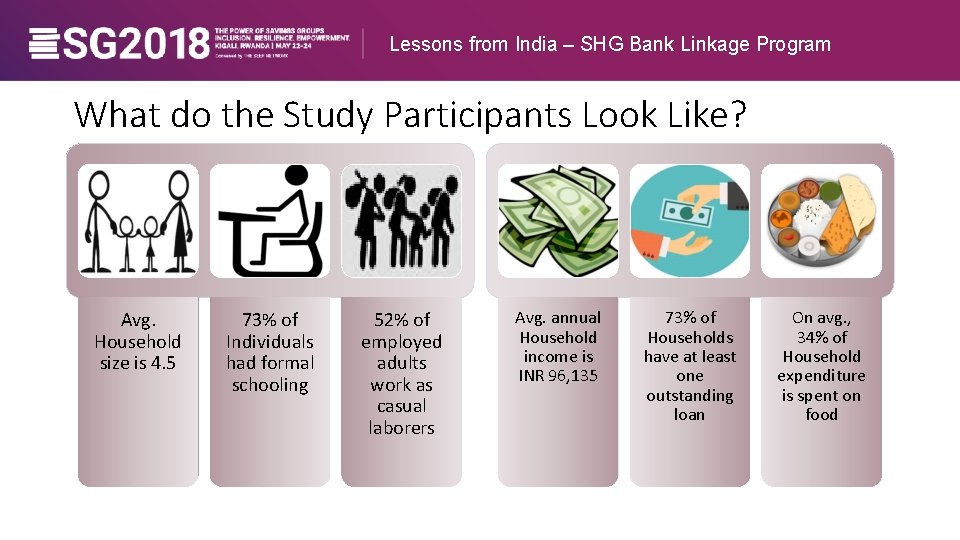
Lessons from India – SHG Bank Linkage Program What do the Study Participants Look Like? Avg. Household size is 4. 5 73% of Individuals had formal schooling 52% of employed adults work as casual laborers Avg. annual Household income is INR 96, 135 73% of Households have at least one outstanding loan On avg. , 34% of Household expenditure is spent on food

Lessons from India – SHG Bank Linkage Program Key Results Variables which showed an effect of the program Notable Variables which did not show an impact – Null Results q Income q Likelihood to Save and Savings Amount q Consumption and Expenditure q Likelihood to have loans and Number of outstanding loans q Asset Accumulation q Business profits in lean/off-season months q Women Empowerment Indicators Key Text Study in line with Lit. Text Study exhibits some differences, but not to a large extent Text Study outcomes not in line with Lit.
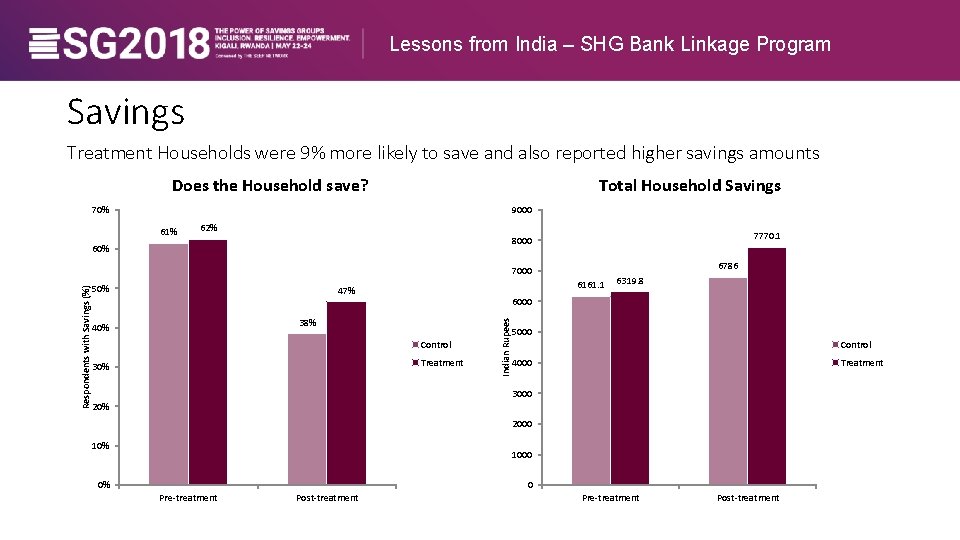
Lessons from India – SHG Bank Linkage Program Savings Treatment Households were 9% more likely to save and also reported higher savings amounts Does the Household save? Total Household Savings 70% 9000 61% 62% 7770. 1 8000 60% 6786 50% 6161. 1 47% 38% 40% Control Treatment 30% 6319. 8 6000 Indian Rupees Respondents with Savings (%) 7000 5000 Control Treatment 4000 3000 20% 2000 10% 1000 0% 0 Pre-treatment Post-treatment
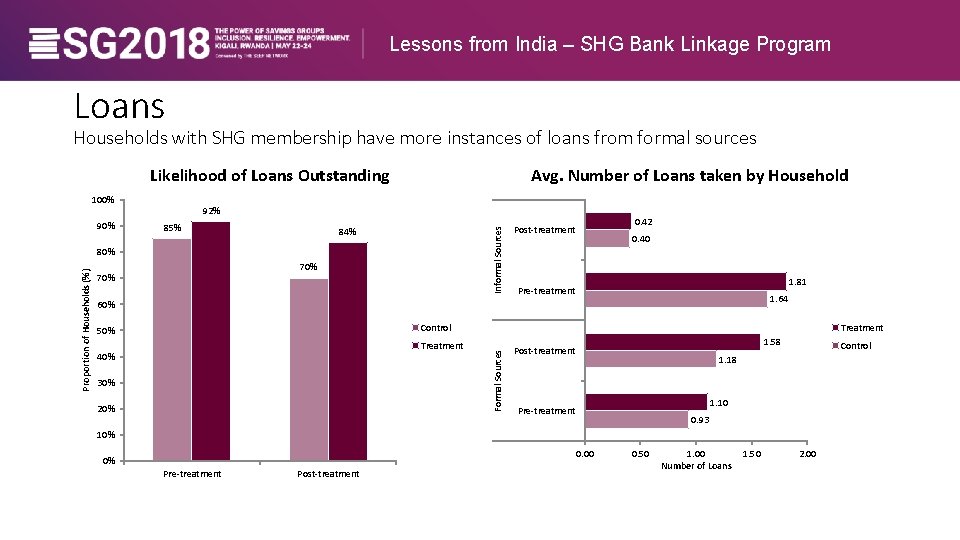
Lessons from India – SHG Bank Linkage Program Loans Households with SHG membership have more instances of loans from formal sources Likelihood of Loans Outstanding 100% 92% 85% 84% Informal Sources 90% Avg. Number of Loans taken by Household 70% 0. 40 1. 81 Pre-treatment 1. 64 60% Control 50% Treatment 40% 30% 20% Treatment Formal Sources Proportion of Households (%) 80% 0. 42 Post-treatment 1. 58 Post-treatment Control 1. 18 1. 10 Pre-treatment 0. 93 10% 0. 00 0% Pre-treatment Post-treatment 0. 50 1. 00 Number of Loans 1. 50 2. 00
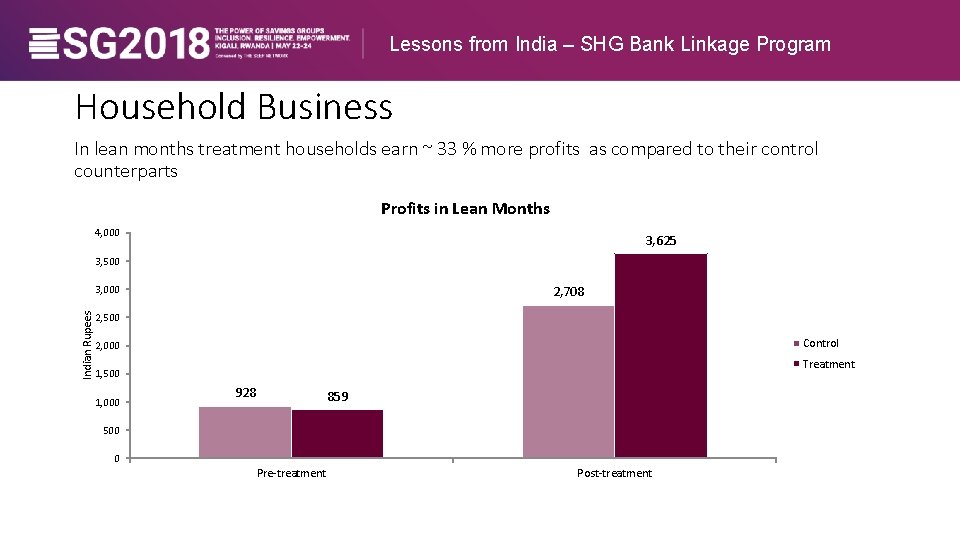
Lessons from India – SHG Bank Linkage Program Household Business In lean months treatment households earn ~ 33 % more profits as compared to their control counterparts Profits in Lean Months 4, 000 3, 625 3, 500 Indian Rupees 3, 000 2, 708 2, 500 Control 2, 000 Treatment 1, 500 1, 000 928 859 500 0 Pre-treatment Post-treatment
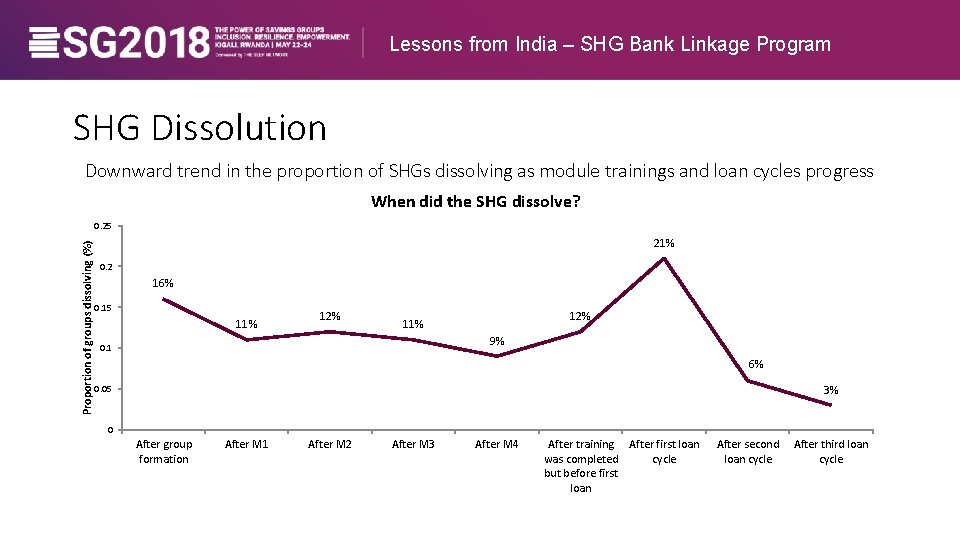
Lessons from India – SHG Bank Linkage Program SHG Dissolution Downward trend in the proportion of SHGs dissolving as module trainings and loan cycles progress When did the SHG dissolve? Proportion of groups dissolving (%) 0. 25 21% 0. 2 16% 0. 15 11% 12% 11% 9% 0. 1 6% 3% 0. 05 0 After group formation After M 1 After M 2 After M 3 After M 4 After training After first loan was completed cycle but before first loan After second loan cycle After third loan cycle
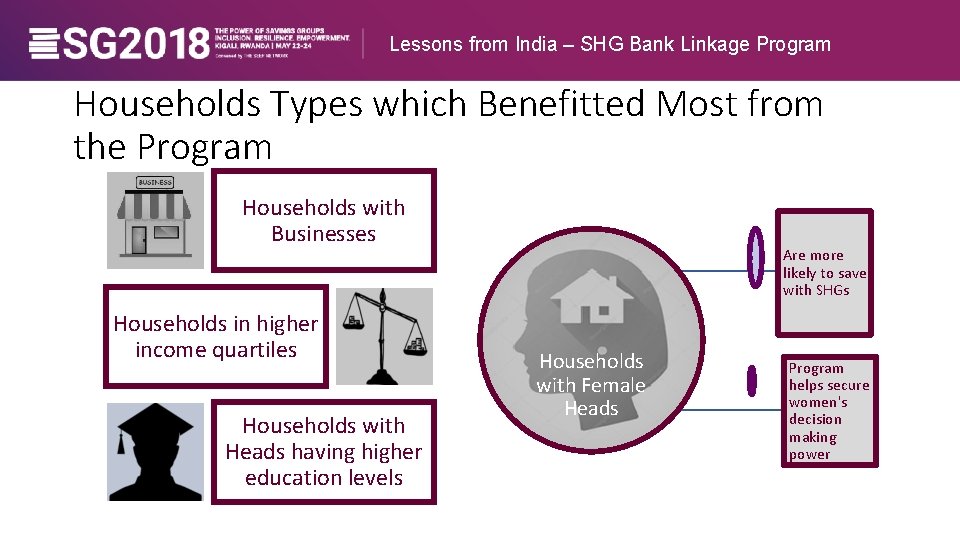
Lessons from India – SHG Bank Linkage Program Households Types which Benefitted Most from the Program Households with Businesses Households in higher income quartiles Households with Heads having higher education levels Are more likely to save with SHGs Households with Female Heads Program helps secure women's decision making power
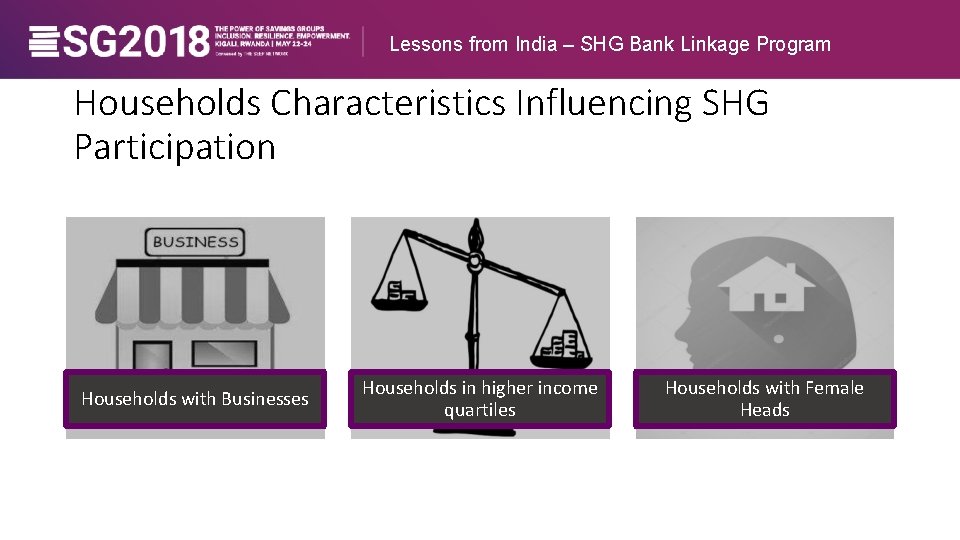
Lessons from India – SHG Bank Linkage Program Households Characteristics Influencing SHG Participation Households with Businesses Households in higher income quartiles Households with Female Heads
Lessons from India – SHG Bank Linkage Program Conclusion q Positive impact of the program on the savings and loans behaviour of households. q No transformational effects q Need for greater hand holding q Better quality of SHG interaction could lead to greater impact of SHG membership on women’s livelihoods. q Digitization holds promise for more transparency and accountability q Leverage SHGs for livelihood promotion as well
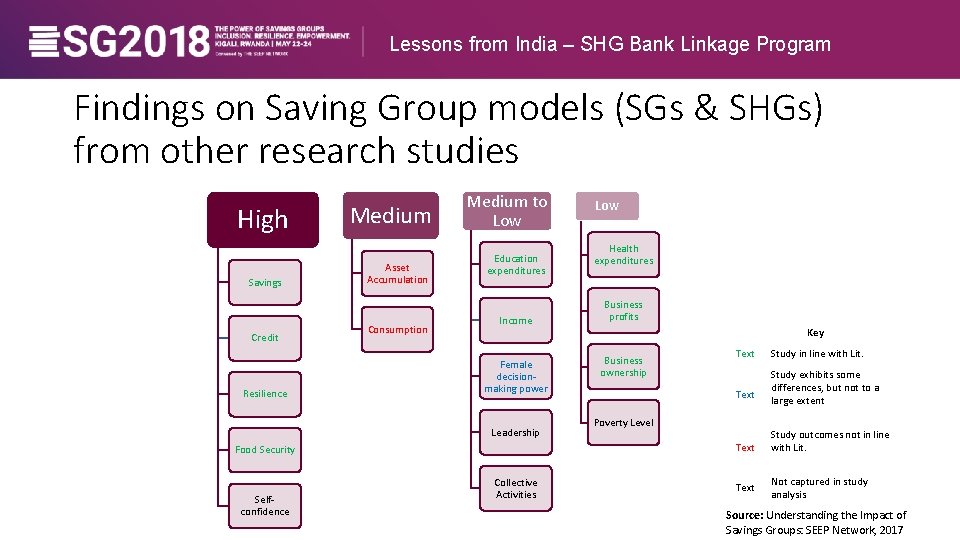
Lessons from India – SHG Bank Linkage Program Findings on Saving Group models (SGs & SHGs) from other research studies High Savings Credit Resilience Medium Asset Accumulation Consumption Medium to Low Education expenditures Income Female decisionmaking power Leadership Health expenditures Business profits Key Business ownership Text Poverty Level Text Food Security Selfconfidence Low Collective Activities Text Study in line with Lit. Study exhibits some differences, but not to a large extent Study outcomes not in line with Lit. Not captured in study analysis Source: Understanding the Impact of Savings Groups: SEEP Network, 2017
Lessons from India – SHG Bank Linkage Program Thank you Panelists Agnes Svensson, Head of Programs, Hand in Hand International Dr. Tara Nair, Professor, Gujarat Institute of Development Research A. Umarani, CEO, Kalanjiam Foundation Moderated by: Sayan Kundu, Research Manager, IFMR-LEAD
Lessons from India – SHG Bank Linkage Program Bibliography 1. 2. 3. 4. Status of Microfinance in India 2016– 17. Mumbai: NABARD, 2017 Inclusive Finance India Report, 2016: Access-Assist, 2016 Understanding the Impact of Savings Groups: SEEP Network, 2017 The Evidence-Based Story of Savings Groups- A Synthesis of Seven Randomized Control Trials: Gash & Odell, 2013 5. Self-Help Groups in Development-A Review of Evidence from South Asia and Sub-Saharan Africa, EPAR Brief No. 283, Anderson et al, 2014 6. Self Help Group Bank Linkage- Through the Responsible Finance Lens: IFMRLEAD, Agarwal, Sharma & Champ, 2013
- Slides: 22