
Lessons from Schrdinger and Pross Tomy Duby and
Lessons from Schrödinger and Pross Tomy Duby and Stewart Fisher Presentation to the Philosophical Society Member’s Weekend 15 and 16 August 2020 15 -Aug-20 Lessons from Schrödinger and Pross by T. Duby and S. Fisher 1
Introduction • This presentation is a report of our intellectual journey: What have we learnt about What is Life? when reading two books having this title. • As most intellectual journeys – it is unfinished and rewarding. • We can only skim the surface – this is the price for being limited to 30 minutes. • We avoid microbiology – it requires too many details. • It turns out that there is a lot of good classical physics that we discovered on this journey. • No quantum mechanics J Al-Khalili and J Mc. Fadden, Life on the Edge: The coming of Age of Quantum Biology. 15 -Aug-20 Lessons from Schrödinger and Pross by T. Duby and S. Fisher 2
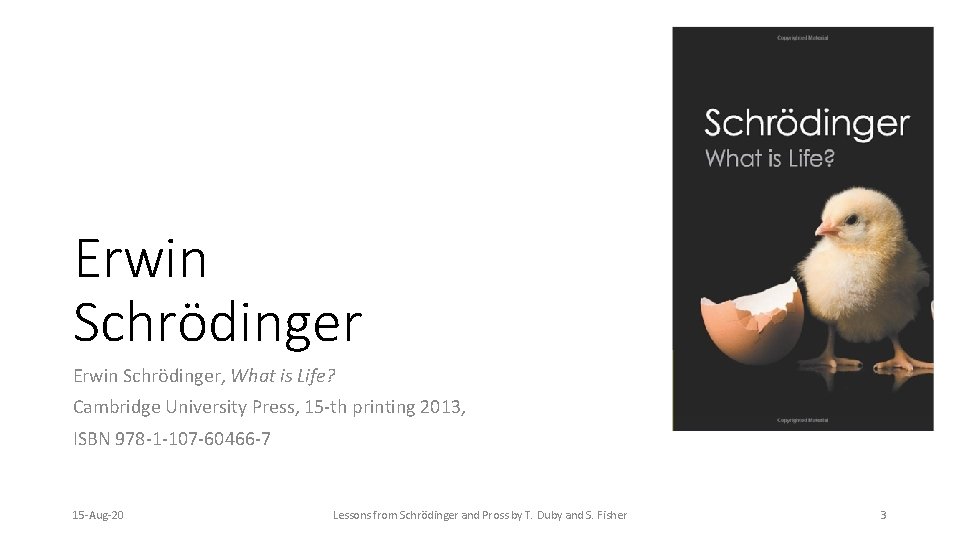
Erwin Schrödinger, What is Life? Cambridge University Press, 15 -th printing 2013, ISBN 978 -1 -107 -60466 -7 15 -Aug-20 Lessons from Schrödinger and Pross by T. Duby and S. Fisher 3
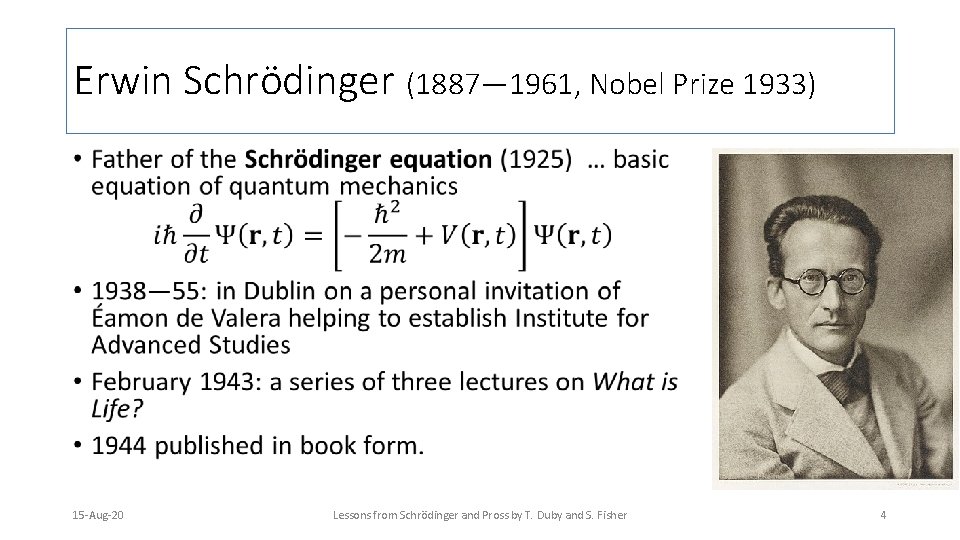
Erwin Schrödinger (1887— 1961, Nobel Prize 1933) • 15 -Aug-20 Lessons from Schrödinger and Pross by T. Duby and S. Fisher 4
ES’s audience and agenda • Popular lectures in Dublin during WW 2 attracted large audiences • ES keeps the number of equations down. • ES is apologetic: • A scientist … is usually expected not to write on any topic of which he is not a master… I can see no escape from this dilemma than that some of us should venture to embark on a synthesis of facts and theories…(p. 1) • The outcome is a 90 page long classic masterpiece mostly physics based… • ES uses more thermodynamics than quantum mechanics! 15 -Aug-20 Lessons from Schrödinger and Pross by T. Duby and S. Fisher 5
ES’s conclusion (1) N W K Timofeeff-Ressovsky, K G Zimmer, M Delbrück, Über die Natur der Genmutation und Genstruktur, 1935 what distinguishes living organisms from inanimate objects? • By 1943 it was accepted that genes carry the hereditary information. • Genes form an aperiodic crystal (hypothesis of ES based on Delbrück 1935, NP 1969). The structure of rock salt (Na. Cl) https: //en. wikipedia. org/wi ki/Sodium_chloride 15 -Aug-20 Lessons from Schrödinger and Pross by T. Duby and S. Fisher https: //en. wikipedia. org/wiki/DNA 6
ES’s conclusion (2) what distinguishes living organisms from inanimate objects? • Inanimate entities follow the order out of disorder rule • Thermodynamic considerations: the relative size of thermal fluctuations decreases as the entity under consideration grows in size. • Living organism follow the order out of order rule • The order in a living organism follows the order encoded in the genes. 15 -Aug-20 Lessons from Schrödinger and Pross by T. Duby and S. Fisher 7
ES’s conclusion (3) what distinguishes living organisms from inanimate objects? • Inanimate objects follow the Second Law of Thermodynamics: an isolated system over time reaches the state of thermodynamic equilibrium. • Living organisms are not isolated systems. They use metabolism to remain in a far-from-equilibrium state. 15 -Aug-20 Lessons from Schrödinger and Pross by T. Duby and S. Fisher 8
ES’s words of wisdom (remember this is 1943!) • From Delbrück’s general picture of the hereditary substance it emerges that living matter, while not eluding the laws of physics as established up to date, is likely to involve other laws of physics hitherto unknown, which, however once they have been revealed, will form just as integral part of this science as the former (ES, p. 68). • But we cannot expect that the laws of physics suffice straightaway to explain the behaviour of living matter, whose most striking features are visibly based to a large extent on the order-from-order-rule (ES, p. 80). 15 -Aug-20 Lessons from Schrödinger and Pross by T. Duby and S. Fisher 9

Addy Pross, What is Life? 2 nd edition, OUP 2016 ISBN 978 -0198782791 15 -Aug-20 Lessons from Schrödinger and Pross by T. Duby and S. Fisher 10

Addy Pross (1945—) • Professor emeritus of theoretical and physical organic chemistry, Ben Gurion University, Beer Sheba (1973—) • http: //www. bgu. ac. il/~pross/ • Starting 2003 he became interested in unifying biology with chemistry 15 -Aug-20 Lessons from Schrödinger and Pross by T. Duby and S. Fisher 11
AP’s audience and agenda • What is Life? is a book intended for the general public. • It is a popular summary of papers AP wrote starting 2003. • Difference between 1 st (2012) and 2 nd (2016) editions • Mainly the new last section Epilogue – the Logic of Life (pp. 192— 199) • Based on R Pascal and A Pross, Stability and its manifestation in the chemical and biological worlds, Chem. Commun. , 51, 16160 (2015) • AP’s aims are to show that: • Biology is grounded in chemistry, • Chemistry became biology some 3. 5 to 4 billion years ago (AP, p. 192) 15 -Aug-20 Lessons from Schrödinger and Pross by T. Duby and S. Fisher 12
SLo. T … Second Law of Thermodynamics Two kinds of chemistry Do you remember Fantasia (1940 film by Walt Disney): Sorcerer’s Apprentice based on a poem by J W Goethe and music by P Ducas? Regular or traditional chemistry Replicative chemistry – chemistry of autocatalytic systems • Organic and inorganic chemistry • All reaction rates at most at a constant rate until an equilibrium set by SLo. T is reached. • Often a catalyst is added to speed up the chemical reaction • Is when catalyst is one of the reactants. • Due to positive feedback the initial reaction rate is exponential and eventually decreases to zero when reactants are depleted. • AP calls this Malthusian kinetics • After Thomas Malthus (1766— 1834), An Essay on the Principle of Population (1798) 15 -Aug-20 Lessons from Schrödinger and Pross by T. Duby and S. Fisher 13
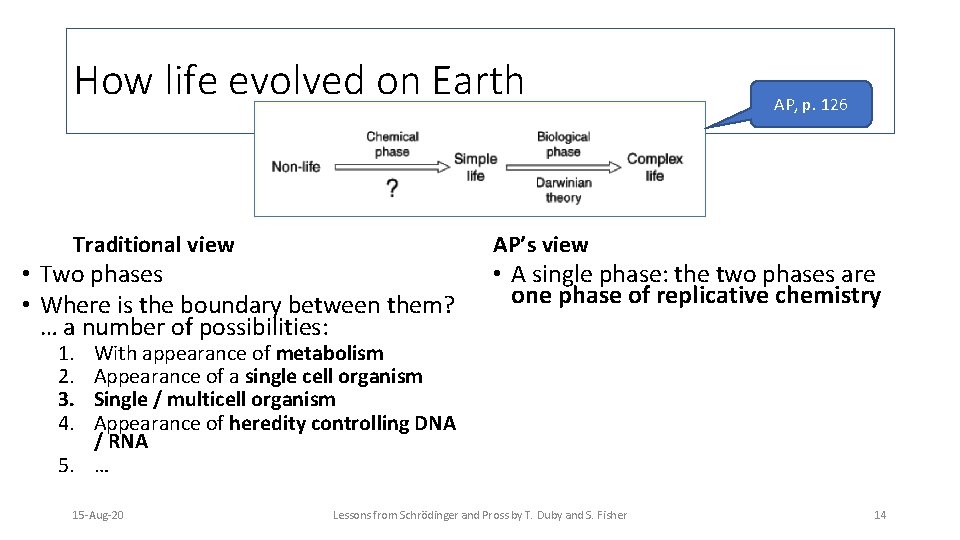
How life evolved on Earth Traditional view • Two phases • Where is the boundary between them? … a number of possibilities: AP, p. 126 AP’s view • A single phase: the two phases are one phase of replicative chemistry 1. 2. 3. 4. With appearance of metabolism Appearance of a single cell organism Single / multicell organism Appearance of heredity controlling DNA / RNA 5. … 15 -Aug-20 Lessons from Schrödinger and Pross by T. Duby and S. Fisher 14
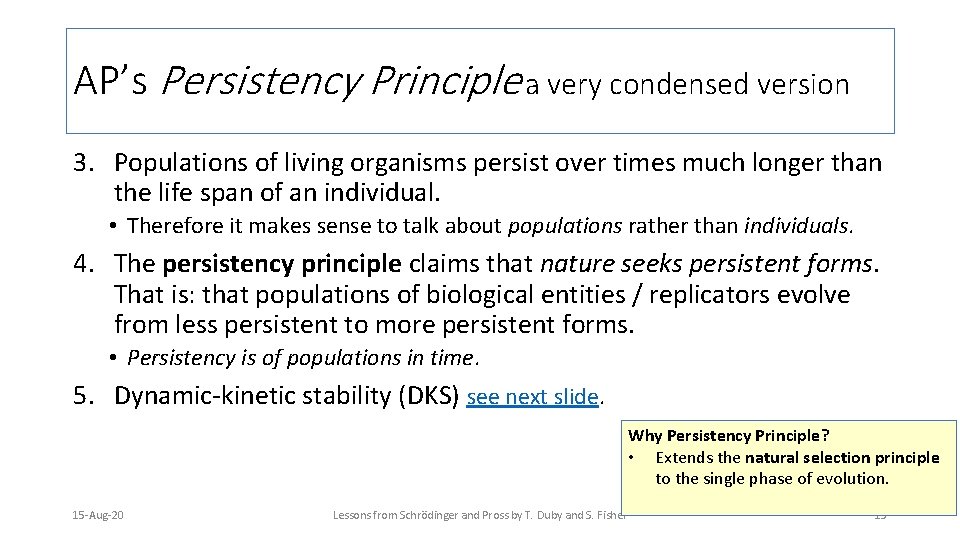
AP’s Persistency Principle a very condensed version 3. Populations of living organisms persist over times much longer than the life span of an individual. • Therefore it makes sense to talk about populations rather than individuals. 4. The persistency principle claims that nature seeks persistent forms. That is: that populations of biological entities / replicators evolve from less persistent to more persistent forms. • Persistency is of populations in time. 5. Dynamic-kinetic stability (DKS) see next slide. Why Persistency Principle? • Extends the natural selection principle to the single phase of evolution. 15 -Aug-20 Lessons from Schrödinger and Pross by T. Duby and S. Fisher 15

DKS – Dynamic Kinetic Stability Introduced by AP • Is a quantitative measure of persistency principle. • Its domain of operation is replicative chemistry. • DKS = the rate of birth minus the rate of death in a population of replicators. • When comparing two related populations, one with greater DKS is more stable (persistent). • Example of persistency principle in operation: in viral / bacterial epidemics there is a tendency for pathogen’s virulence to decrease with time. • This is generally observed in epidemiology. • Examples: Small pox, HIV, syphilis, COVID-19? 15 -Aug-20 Lessons from Schrödinger and Pross by T. Duby and S. Fisher 16
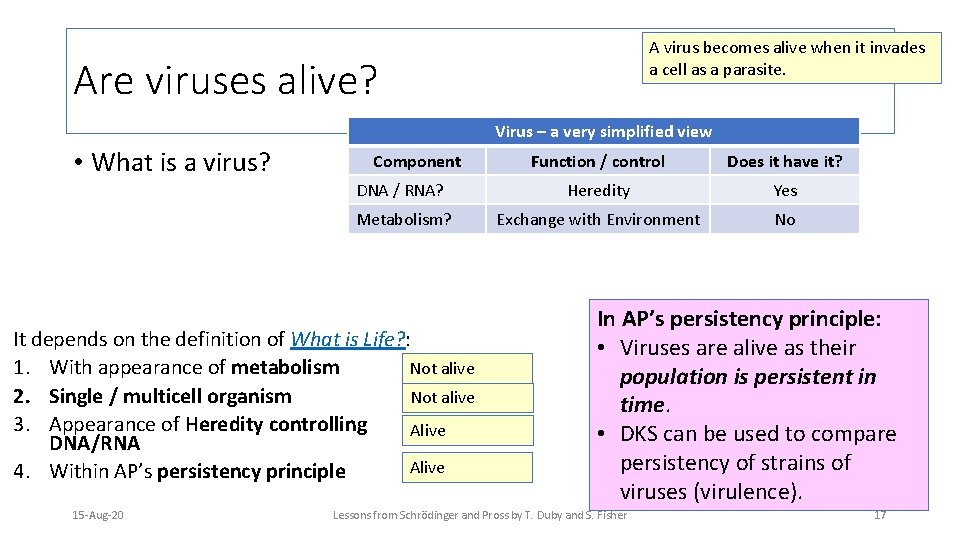
A virus becomes alive when it invades a cell as a parasite. Are viruses alive? Virus – a very simplified view • What is a virus? Component Function / control Does it have it? DNA / RNA? Heredity Yes Metabolism? Exchange with Environment No It depends on the definition of What is Life? : Not alive 1. With appearance of metabolism 2. Single / multicell organism Not alive 3. Appearance of Heredity controlling Alive DNA/RNA Alive 4. Within AP’s persistency principle 15 -Aug-20 In AP’s persistency principle: • Viruses are alive as their population is persistent in time. • DKS can be used to compare persistency of strains of viruses (virulence). Lessons from Schrödinger and Pross by T. Duby and S. Fisher 17

Postscript Work in progress 15 -Aug-20 Lessons from Schrödinger and Pross by T. Duby and S. Fisher 18

We read AP three times Reading 1 st 2 nd 3 rd Outcome We were sceptical about the persistency principle. Yes, persistency principle is great. • Why is this idea not generally accepted? • AP introduced a number of philosophical questions that he did not fully resolve. Oh, something else is missing! • AP mentions briefly metabolism and far-from-equilibrium thermodynamics (p. 118). Then we discovered … see next slides 15 -Aug-20 Lessons from Schrödinger and Pross by T. Duby and S. Fisher 19
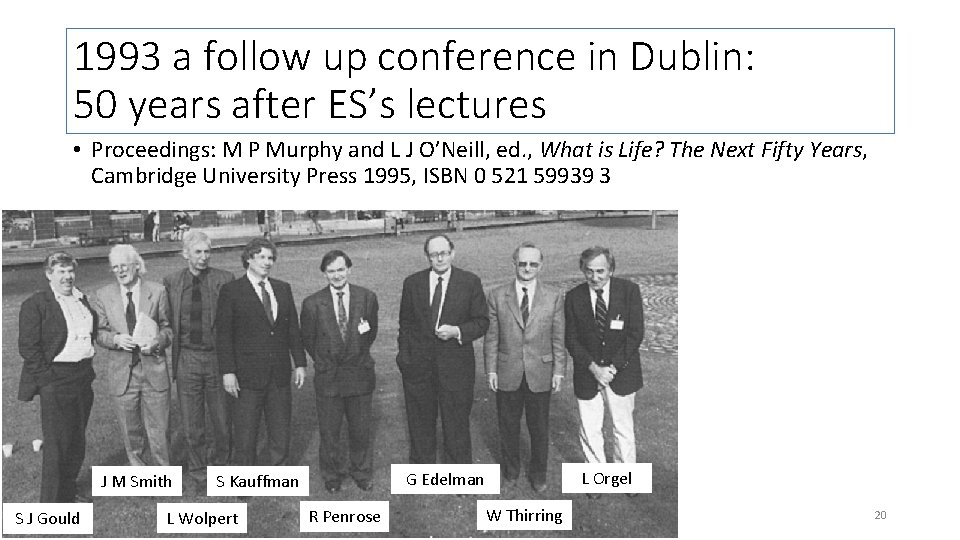
1993 a follow up conference in Dublin: 50 years after ES’s lectures • Proceedings: M P Murphy and L J O’Neill, ed. , What is Life? The Next Fifty Years, Cambridge University Press 1995, ISBN 0 521 59939 3 J M Smith S J Gould 15 -Aug-20 S Kauffman L Wolpert G Edelman L Orgel Lessons from Schrödinger and Pross by T. Duby and S. Fisher W Thirring R Penrose 20
12+1 papers in the conference proceedings • All but one highly critical of ES; • +1 … are reminiscences of ES’ daughter, Ruth Braunizer. 15 -Aug-20 Lessons from Schrödinger and Pross by T. Duby and S. Fisher 21
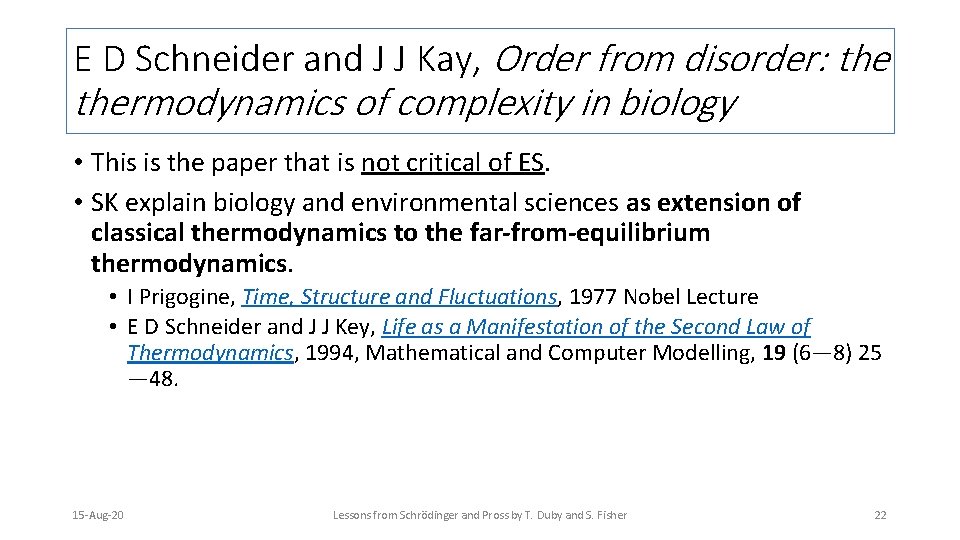
E D Schneider and J J Kay, Order from disorder: thermodynamics of complexity in biology • This is the paper that is not critical of ES. • SK explain biology and environmental sciences as extension of classical thermodynamics to the far-from-equilibrium thermodynamics. • I Prigogine, Time, Structure and Fluctuations, 1977 Nobel Lecture • E D Schneider and J J Key, Life as a Manifestation of the Second Law of Thermodynamics, 1994, Mathematical and Computer Modelling, 19 (6— 8) 25 — 48. 15 -Aug-20 Lessons from Schrödinger and Pross by T. Duby and S. Fisher 22

Why do we need in biology far-fromequilibrium thermodynamics? • Living organisms are all open systems always far-from-equilibrium. • Systems far-from-equilibrium exhibit emergent properties and processes • Philosophically: when the whole is greater when sum of its parts. • Examples: • Bicycle + person = cyclist. • Physics: Bénard cells: response of a liquid heated from below. • Biology: (a hypothesis) emergence of the first cell in the primordial sea of autocatalytic replicators. If this cell structure can capture the heat from the sun better AND replicate it has a good chance to survive and develop further. 15 -Aug-20 Lessons from Schrödinger and Pross by T. Duby and S. Fisher 23

Bénard Cells J M Rubi, The long arm of the second law, Scientific American, November 2008, 40— 45. ! 15 -Aug-20 Lessons from Schrödinger and Pross by T. Duby and S. Fisher 24
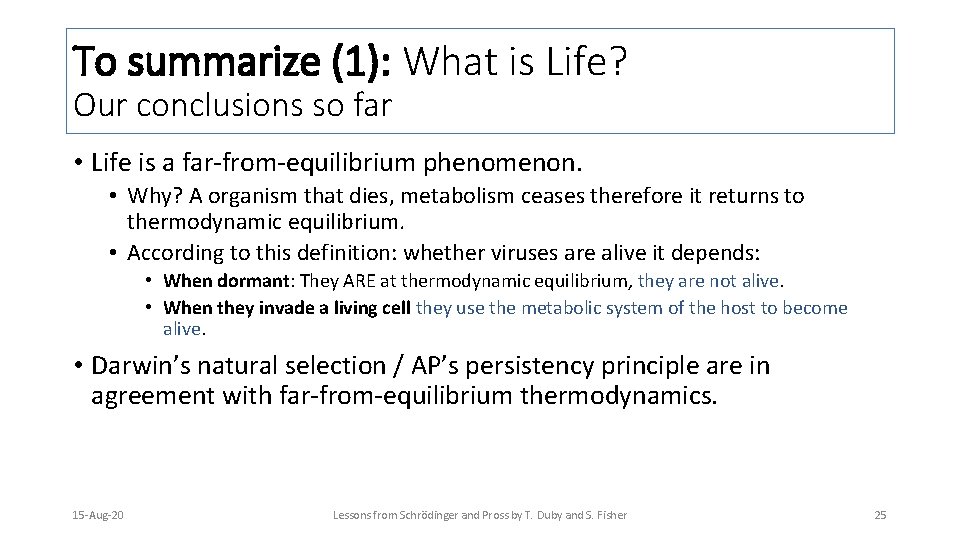
To summarize (1): What is Life? Our conclusions so far • Life is a far-from-equilibrium phenomenon. • Why? A organism that dies, metabolism ceases therefore it returns to thermodynamic equilibrium. • According to this definition: whether viruses are alive it depends: • When dormant: They ARE at thermodynamic equilibrium, they are not alive. • When they invade a living cell they use the metabolic system of the host to become alive. • Darwin’s natural selection / AP’s persistency principle are in agreement with far-from-equilibrium thermodynamics. 15 -Aug-20 Lessons from Schrödinger and Pross by T. Duby and S. Fisher 25
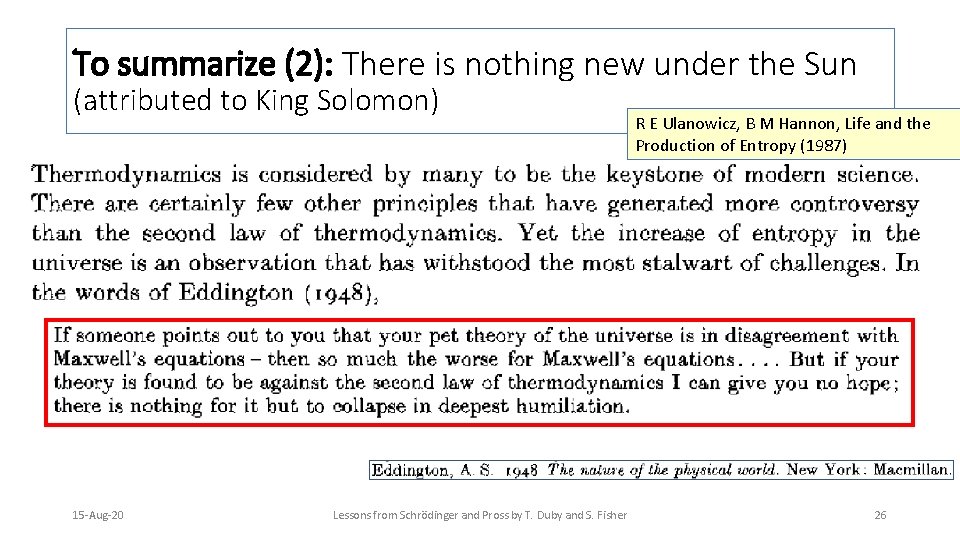
To summarize (2): There is nothing new under the Sun (attributed to King Solomon) 15 -Aug-20 Lessons from Schrödinger and Pross by T. Duby and S. Fisher R E Ulanowicz, B M Hannon, Life and the Production of Entropy (1987) 26
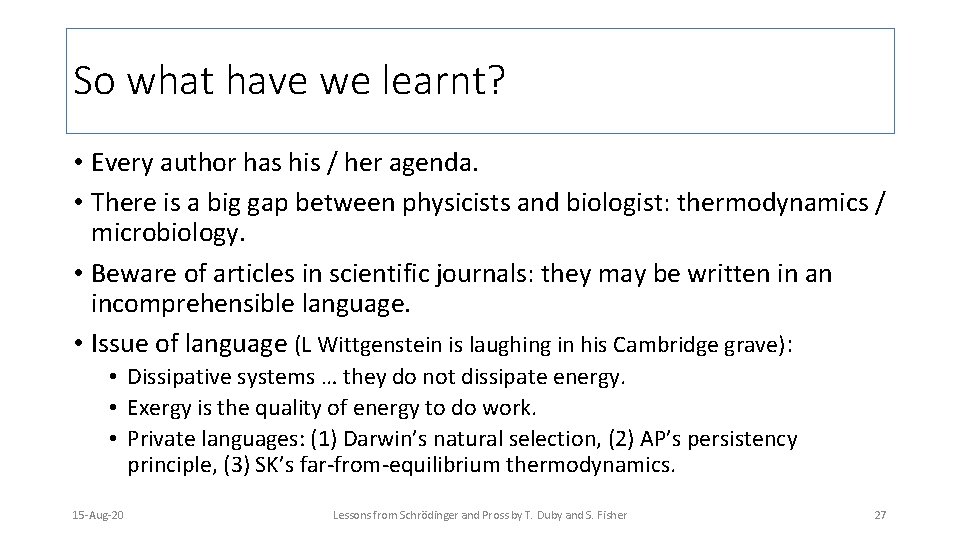
So what have we learnt? • Every author has his / her agenda. • There is a big gap between physicists and biologist: thermodynamics / microbiology. • Beware of articles in scientific journals: they may be written in an incomprehensible language. • Issue of language (L Wittgenstein is laughing in his Cambridge grave): • Dissipative systems … they do not dissipate energy. • Exergy is the quality of energy to do work. • Private languages: (1) Darwin’s natural selection, (2) AP’s persistency principle, (3) SK’s far-from-equilibrium thermodynamics. 15 -Aug-20 Lessons from Schrödinger and Pross by T. Duby and S. Fisher 27
- Slides: 27