
Lessons from a Land Reform Experience A Critical
- Slides: 1
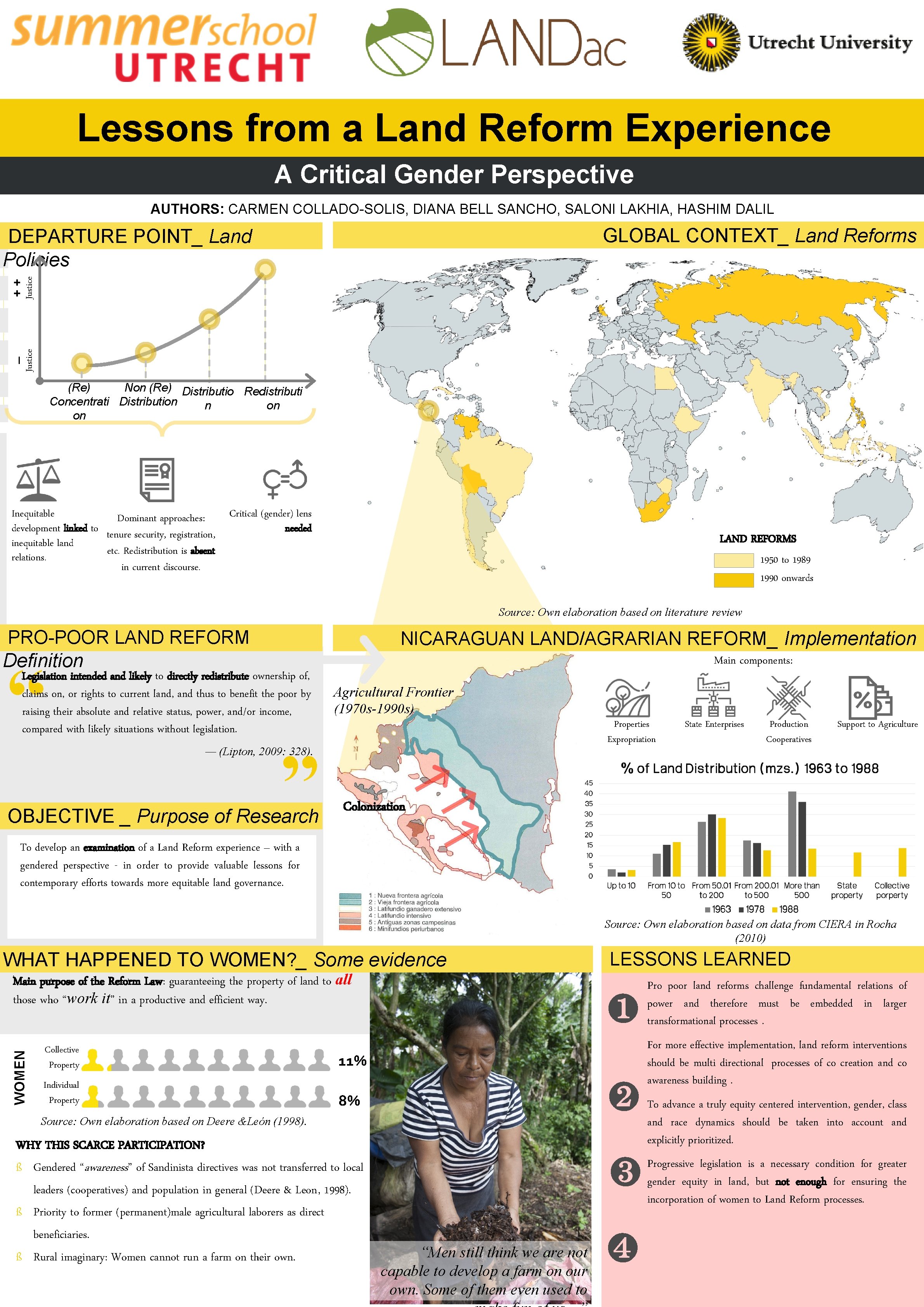
Lessons from a Land Reform Experience A Critical Gender Perspective AUTHORS: CARMEN COLLADO-SOLIS, DIANA BELL SANCHO, SALONI LAKHIA, HASHIM DALIL GLOBAL CONTEXT_ Land Reforms. Justice ++ Justice DEPARTURE POINT_ Land Policies Non (Re) Distributio Redistributi (Re) Concentrati Distribution n on on Inequitable Dominant approaches: development linked to tenure security, registration, inequitable land etc. Redistribution is absent relations. in current discourse. Critical (gender) lens needed LAND REFORMS 1950 to 1989 1990 onwards Source: Own elaboration based on literature review PRO-POOR LAND REFORM Definition NICARAGUAN LAND/AGRARIAN REFORM_ Implementation. “ Legislation intended and likely to directly redistribute ownership of, claims on, or rights to current land, and thus to benefit the poor by raising their absolute and relative status, power, and/or income, compared with likely situations without legislation. ” Main components: Agricultural Frontier (1970 s-1990 s) Properties Expropriation — (Lipton, 2009: 328). OBJECTIVE _ Purpose of Research State Enterprises Production Cooperatives Support to Agriculture Colonization To develop an examination of a Land Reform experience – with a gendered perspective - in order to provide valuable lessons for contemporary efforts towards more equitable land governance. WHAT HAPPENED TO WOMEN? _ Some evidence WOMEN Main purpose of the Reform Law: guaranteeing the property of land to all those who “work it” in a productive and efficient way. Collective Property 11% Individual Property 8% LESSONS LEARNED ❶ Pro poor land reforms challenge fundamental relations of power and therefore must be embedded in larger transformational processes. For more effective implementation, land reform interventions should be multi directional processes of co creation and co awareness building. ❷ To advance a truly equity centered intervention, gender, class Source: Own elaboration based on Deere &León (1998). WHY THIS SCARCE PARTICIPATION? ß Gendered “awareness” of Sandinista directives was not transferred to local leaders (cooperatives) and population in general (Deere & Leon, 1998). ß Priority to former (permanent)male agricultural laborers as direct beneficiaries. ß Rural imaginary: Women cannot run a farm on their own. Source: Own elaboration based on data from CIERA in Rocha (2010) 1 manzana = 0. 70 ha and race dynamics should be taken into account and explicitly prioritized. ❸ “Men still think we are not capable to develop a farm on our own. Some of them even used to ❹ Progressive legislation is a necessary condition for greater gender equity in land, but not enough for ensuring the incorporation of women to Land Reform processes.