
Lessons and Applications in PEMS for onhighway Measurements

- Slides: 13
Lessons and Applications in PEMS for on-highway Measurements 2012 PEMS Conference and Workshop - UCR/CE-CERT
Background (Experience and Equipment) § Most of Cummins PEMS experience from conducting on-highway testing through the EPA HDIUT program – Our group has performed over 350 in-use test missions – Currently employee 4 test engineers in our group § Sensors SEMTECH-DS Gaseous Analyzer – Good reliability and data yield (improvements have been implemented over the years) – Updated NDUV are reliable and stable – Difficult to pass CO linearity § Sensors PPMD (quartz crystal micro balance with proportional dilution) – Gives quick results with no need for filter weighing – Reliability has been an issue but has improved as we have worked through issues – Careful attention to setup is required for quality data and good yield – Remote dilution option offers installation flexibility § Proprietary data logger – Ruggedized PC, data link adapter, and proprietary logging software § Honda 2 k inverter generator (if needed) – This is enough power to run the SEMTECH and PPMD standalone (no vehicle power) at steady state conditions
Transporting Equipment to the Field § Started with a box truck – Difficult to getting in and out and did not function well as a mobile lab/workshop § Moved to ¾ ton pickup pulling 16 foot tag trailer – Worked fairly well and was in service for 6+ years, but outgrew the trailer size § Full ton cab-chassis pickup with 24 foot goose neck trailer – 7 K generator for on site power – Air-conditioned and heated to give PEMS equipment dry environment during service and checks – Customer chassis accommodates boom crane for testing rig lifts
Setup and Equipment Readiness § Good organization is key to expedient setup – Have a plan for setup – If you have more than on engineer or technician working the setup, logically group tasks for efficient work § Be sure your equipment is ready – Analyzers don’t seem to like sitting idle. Best to have them running and fully checked out before the actual setup with the vehicle begins. Some of our missed testing opportunities in the past could have been avoided by better advanced checking of the equipment. – Complete warm-up, calibrations and checks the day before testing is optimal – Automating linearity can save you some time • We automated the functions of a Horiba/STEC SGD-A 10 push button divider
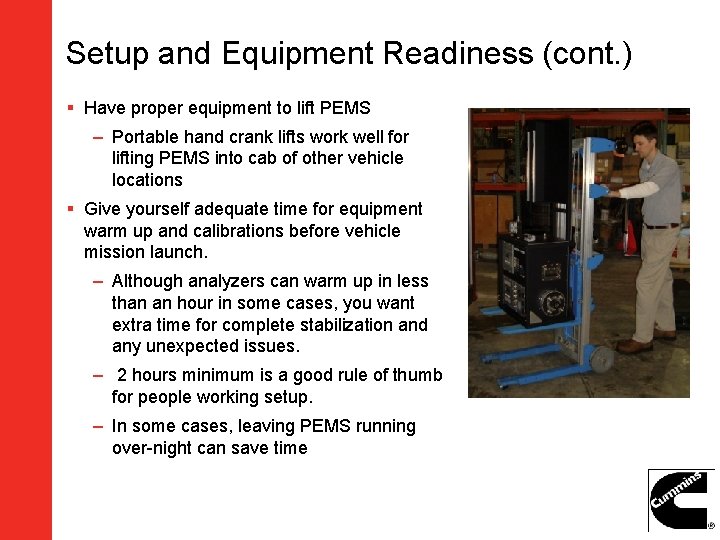
Setup and Equipment Readiness (cont. ) § Have proper equipment to lift PEMS – Portable hand crank lifts work well for lifting PEMS into cab of other vehicle locations § Give yourself adequate time for equipment warm up and calibrations before vehicle mission launch. – Although analyzers can warm up in less than an hour in some cases, you want extra time for complete stabilization and any unexpected issues. – 2 hours minimum is a good rule of thumb for people working setup. – In some cases, leaving PEMS running over-night can save time
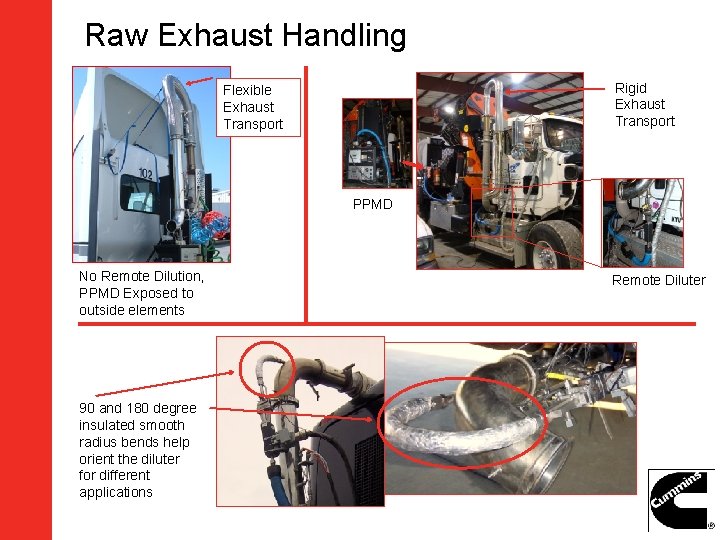
Raw Exhaust Handling Rigid Exhaust Transport Flexible Exhaust Transport PPMD No Remote Dilution, PPMD Exposed to outside elements 90 and 180 degree insulated smooth radius bends help orient the diluter for different applications Remote Diluter
Running Test § Do a thorough review of real time data stream upon start of test/recording. – You can often spot something that is wrong before the vehicle mission is launched and driver can not be stopped. – VI data, concentrations, exhaust flow, power supply voltage etc. – Do an rpm sweep and observe transient response and proportionality § It is advisable to continue monitoring data if possible or make frequent checks in order to catch any problems that might otherwise cause reason for retest (second shift day) § Avoid shutting vehicle off if possible. – Continuous ECM data is easier to work with – Minimizes risk of data logger failure
Data Processing and Quality § Perform quality checks on data • Review 1 hertz report file for accuracy • Check transport delay/time alignment • Compare proprietary ECM data against CAN collect by analyzers • Check torque curves for errors • Check for transcription errors
What can go wrong? § Can’t find adequate customers in time for compliance testing, customer procurement is a big driver in meeting schedule – Start your customer procurement as early as possible – Plan for customer driven delays – Have back up options § PEMS breakdown – Best if you can have back up units available if possible – Arrange for PEMS supplier to provide support § Power supply to PEMS insufficient – If running equipment without a generator, make sure your test vehicles charging system can keep up with the demand § Dilution Proportionality is poor – Carefully setup and choose user set parameters i. e. maximum expected exhaust flow – Eliminate any leaks in sampling systems
What can go wrong? (cont. ) § Vehicle Interface (ECM data) is intermittent, slow, or unavailable. – Be sure to avoid any floating grounds with CAN communication equipment § Exhaust Flow Meter hardware doesn’t fit application – Best if you can investigate the test vehicle in advance of the test day so that you can prepare for any unexpected exhaust configurations – Stock a variety of exhaust hardware § Exhaust stack very rusty or deformed at silencer/after-treatment connection – Use superior penetrating oil products on rusty bolts (off the shelf at local retailers are not as effective as commercial account type products) – Use heat (torch) only if necessary and follow all safety precautions – Cut off exhaust stack using “saws all” then extract the remaining piece of stack
What can go wrong? (cont. ) § Extreme environmental conditions (heavy rain, excessive heat, cold, vibration) – Mount equipment in the cab as much as possible, – When mounting outside environmental enclosures can protect from rain, but can be more difficult to cool in hot weather. – Excessive heat or cold can limit equipments ability to regulate critical temperatures • Avoid heat rejection sources from vehicle or insulate components as needed – Implement vibration dampening as needed § Data processor or report compiling software makes error – Develop data quality check/review process
What recommendations/ improvements should be made? § PEMS reliability has improved substantially in recent years, however we hope for continued improvement § Any emerging technologies that allow for reduction in power consumption and size while not compromising measurement quality § Regulatory language proposed revisions – CFR 86. 1370 -2007(g) after-treatment warm-up
Questions?