
LESSON Translations 9 2 Honors Geometry Today HW
- Slides: 24
LESSON Translations 9 -2 Honors Geometry Today: • HW ? ? • 9. 2 Instruction • Assign HW • Go over tests! • Grades are posted
LESSON 9 -2 Translations 9. 2 Translations Objective: 1. Draw translations. 2. Draw translations in the coordinate plane. Vocabulary: translation vector
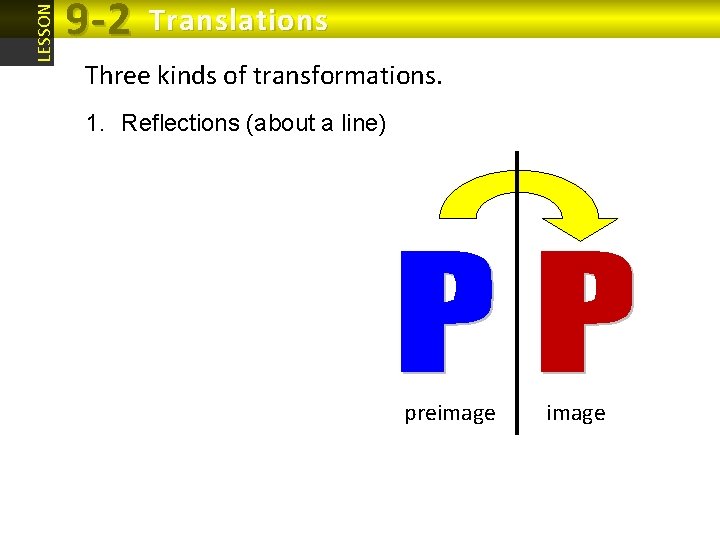
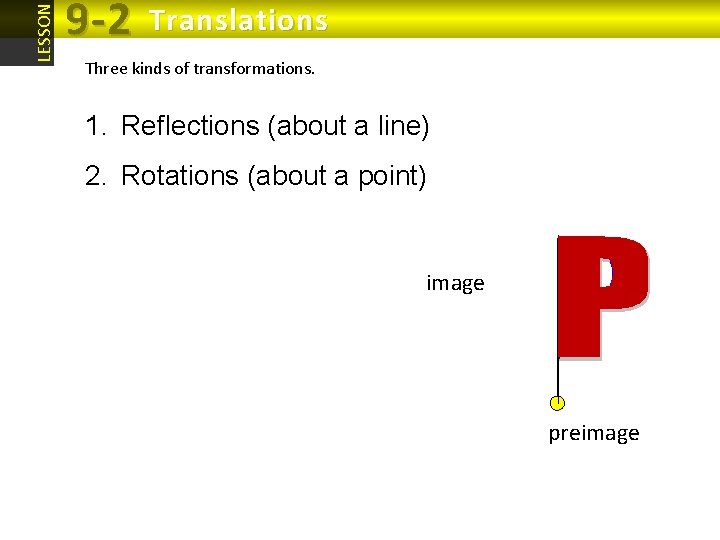
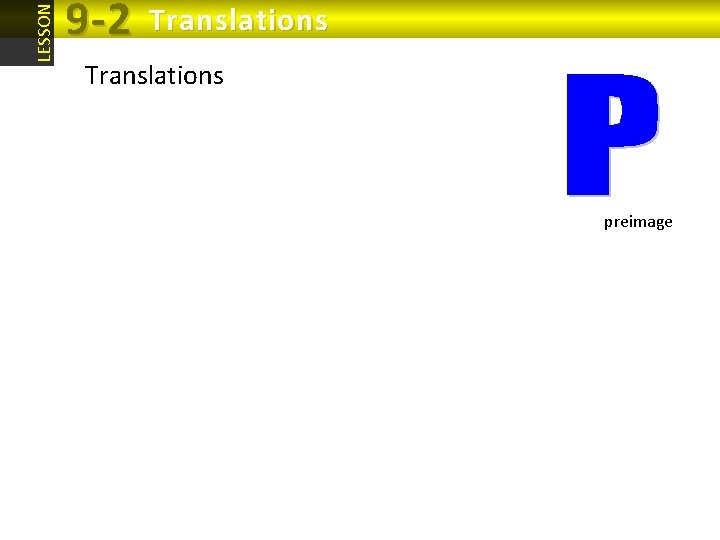
LESSON 9 -2 Translations Three kinds of transformations. 1. Reflections (about a line) preimage
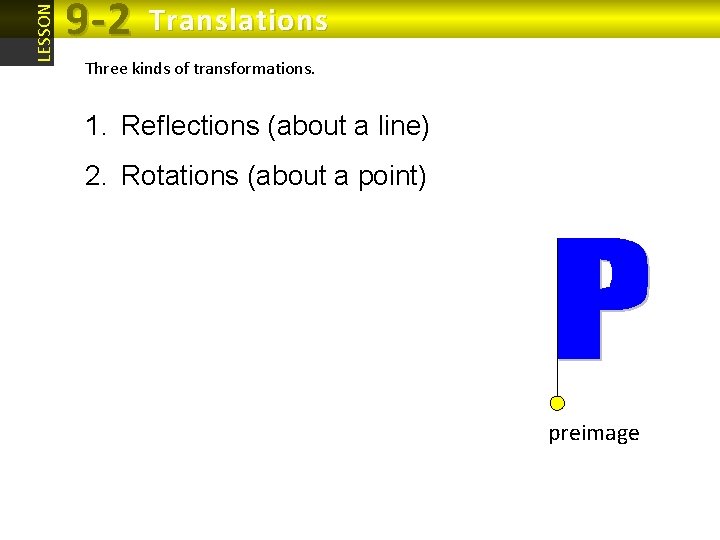
LESSON 9 -2 Translations Three kinds of transformations. 1. Reflections (about a line) 2. Rotations (about a point) preimage
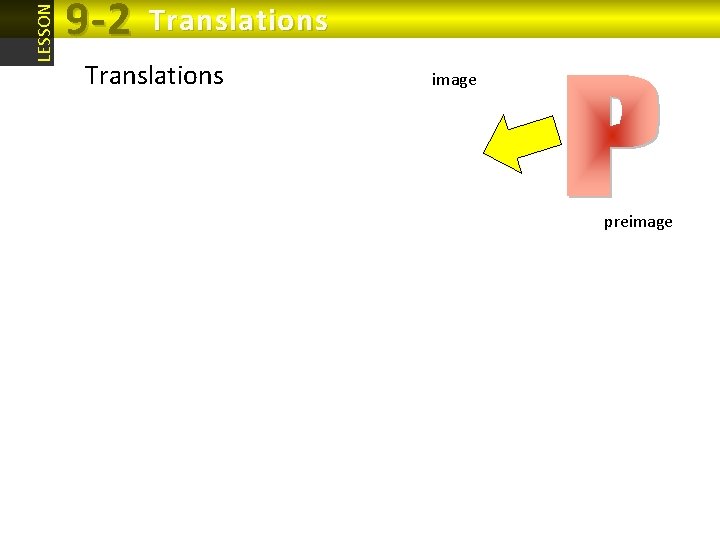
LESSON 9 -2 Translations Three kinds of transformations. 1. Reflections (about a line) 2. Rotations (about a point) image preimage
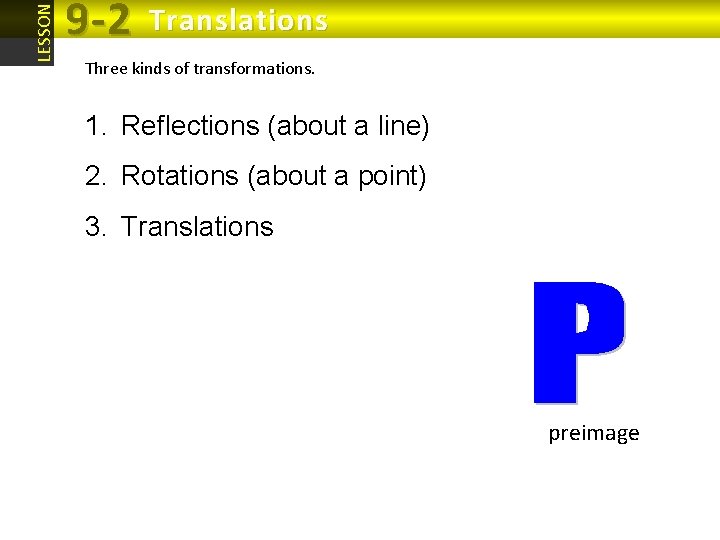
LESSON 9 -2 Translations Three kinds of transformations. 1. Reflections (about a line) 2. Rotations (about a point) 3. Translations preimage
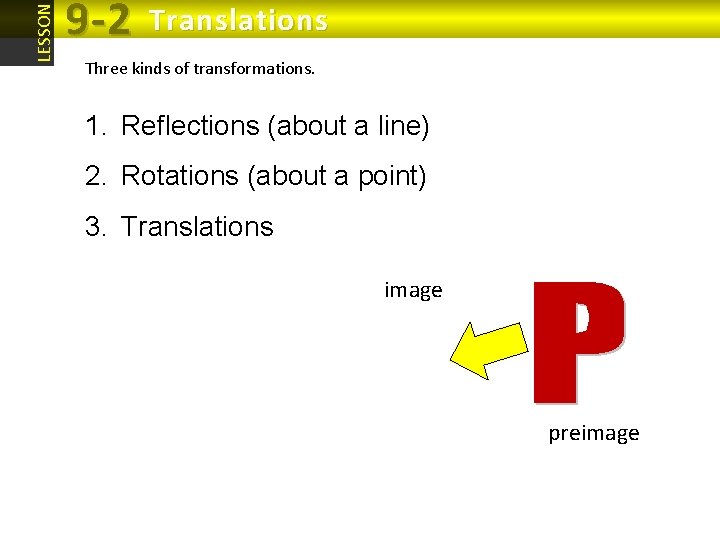
LESSON 9 -2 Translations Three kinds of transformations. 1. Reflections (about a line) 2. Rotations (about a point) 3. Translations image preimage
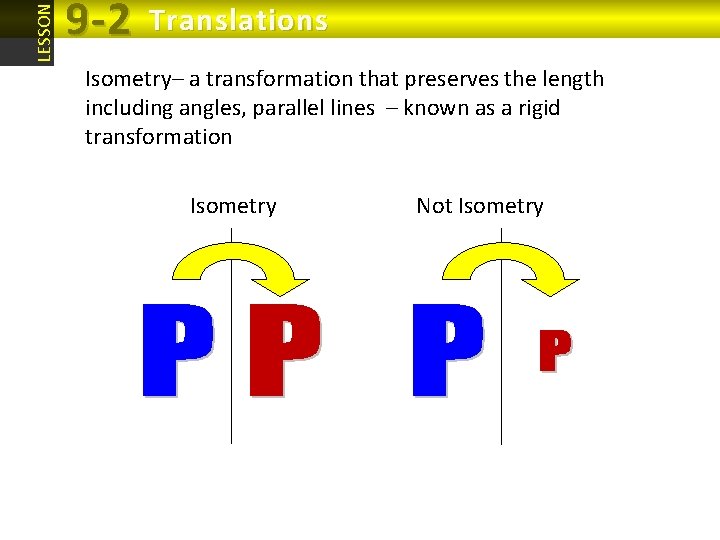
LESSON 9 -2 Translations Isometry– a transformation that preserves the length including angles, parallel lines – known as a rigid transformation Isometry Not Isometry
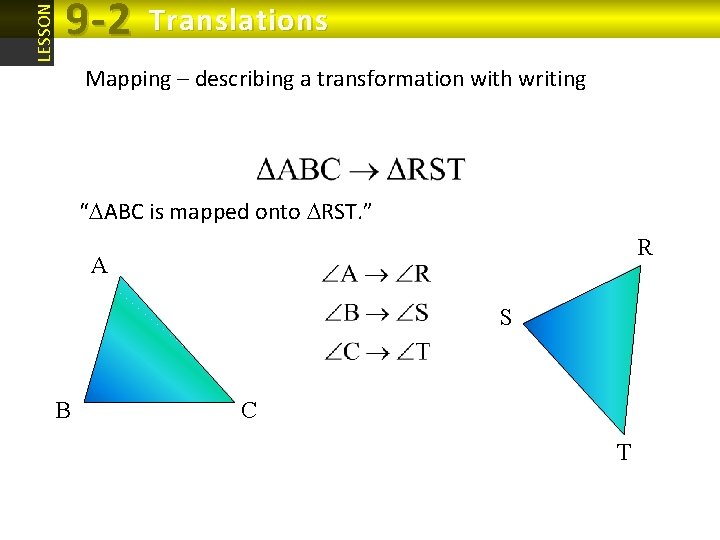
LESSON 9 -2 Translations Mapping – describing a transformation with writing “DABC is mapped onto DRST. ” R A S B C T
LESSON 9 -2 Translations preimage
LESSON 9 -2 Translations image preimage
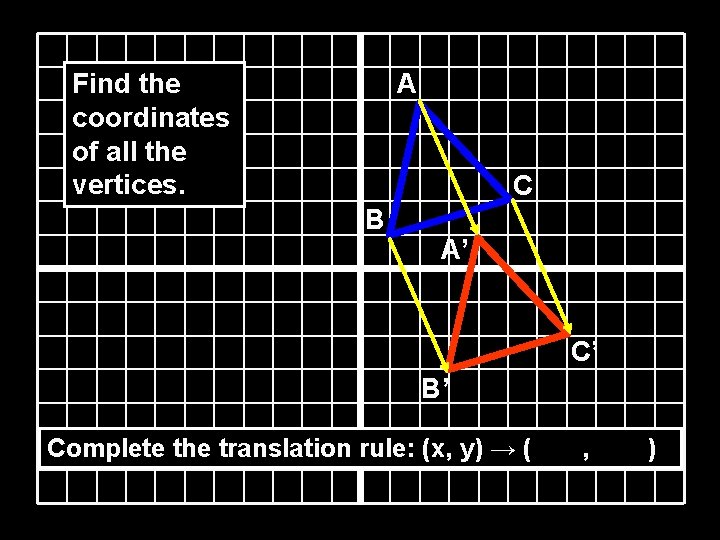
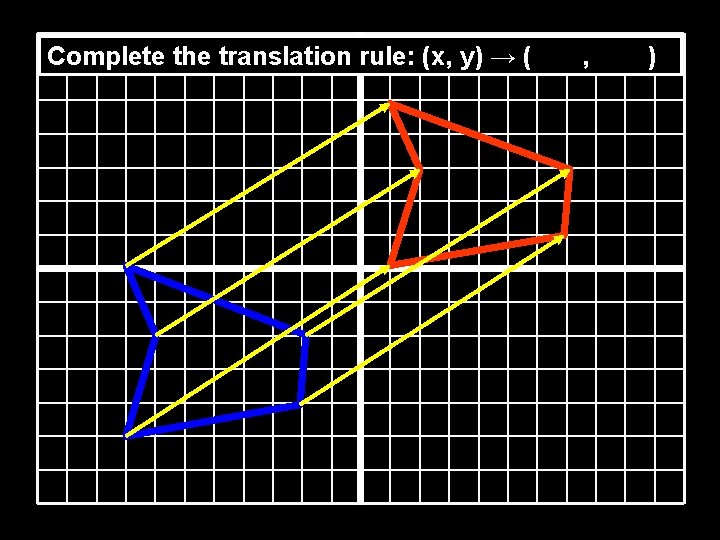
A Find the coordinates of all the vertices. C B A’ C’ B’ Complete the translation rule: (x, y) → ( , )
Complete the translation rule: (x, y) → ( , )
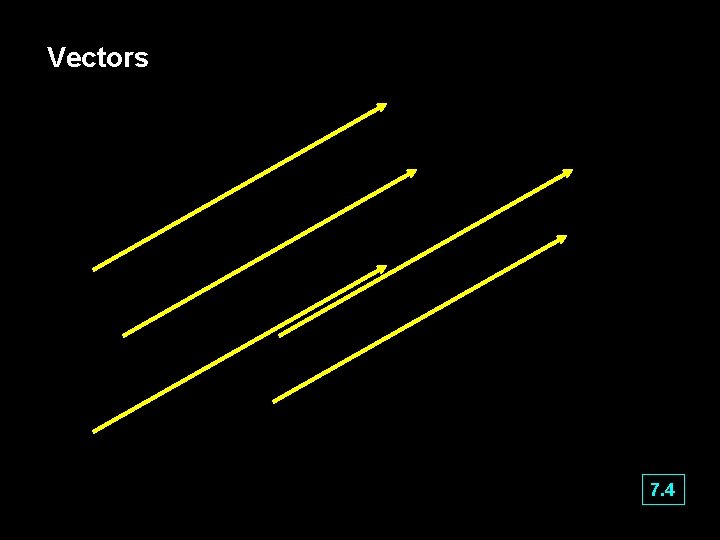
Vectors 7. 4
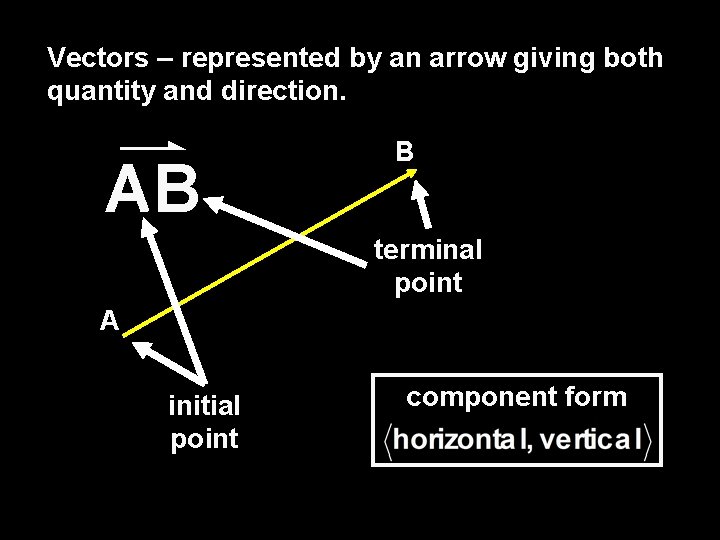
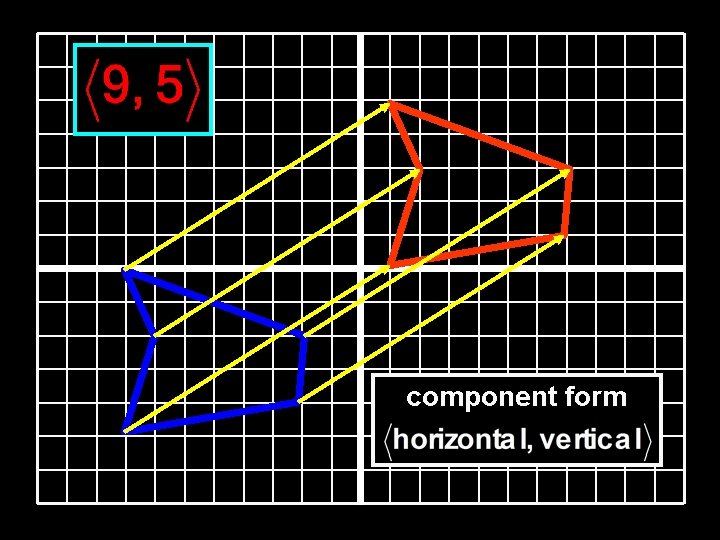
Vectors – represented by an arrow giving both quantity and direction. AB B terminal point A initial point component form
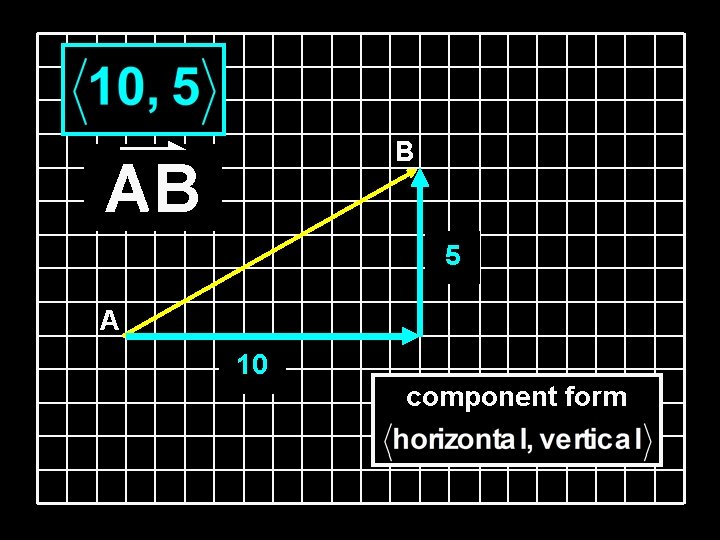
B AB 5 A 10 component form
component form
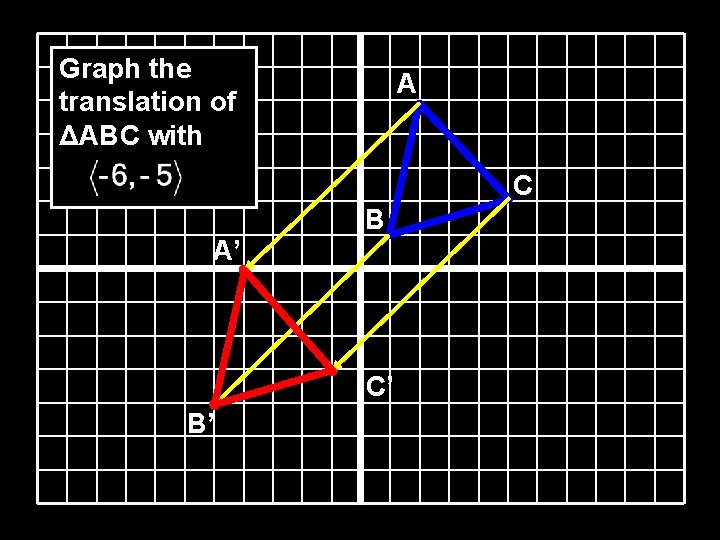
Graph the translation of ΔABC with A C A’ B C’ B’
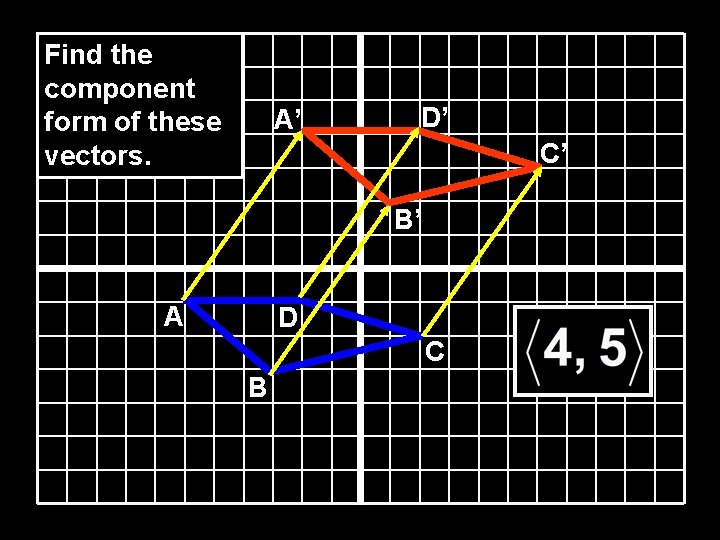
Find the component form of these vectors. A’ D’ C’ B’ A D C B
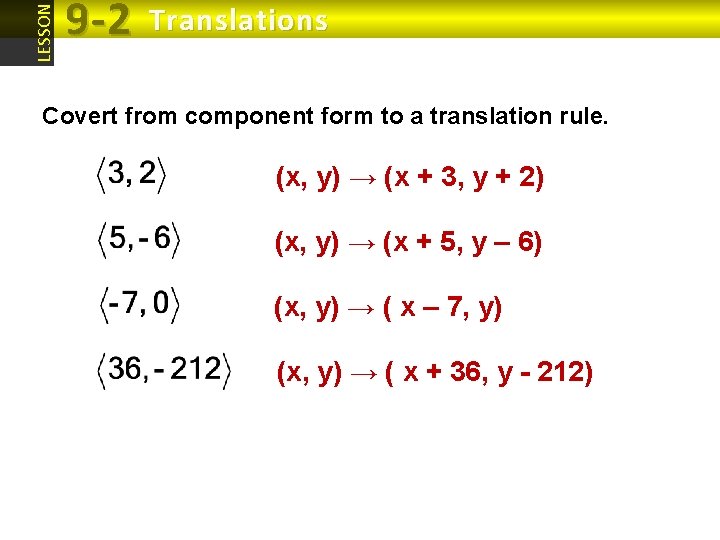
LESSON 9 -2 Translations Covert from component form to a translation rule. (x, y) → (x + 3, y + 2) (x, y) → (x + 5, y – 6) (x, y) → ( x – 7, y) (x, y) → ( x + 36, y - 212)
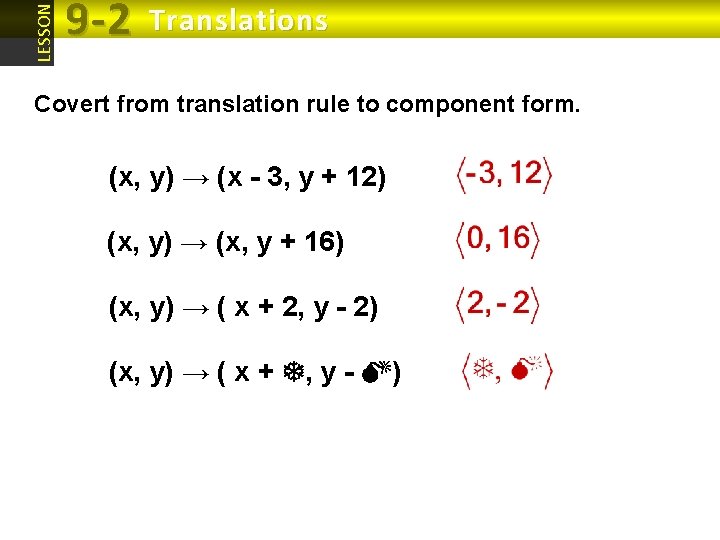
LESSON 9 -2 Translations Covert from translation rule to component form. (x, y) → (x - 3, y + 12) (x, y) → (x, y + 16) (x, y) → ( x + 2, y - 2) (x, y) → ( x + T, y - M)
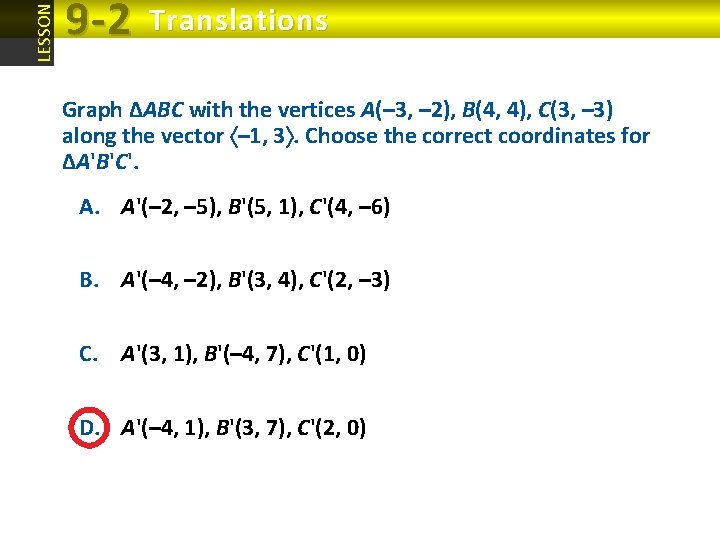
LESSON 9 -2 Translations Graph ΔABC with the vertices A(– 3, – 2), B(4, 4), C(3, – 3) along the vector – 1, 3. Choose the correct coordinates for ΔA'B'C'. A. A'(– 2, – 5), B'(5, 1), C'(4, – 6) B. A'(– 4, – 2), B'(3, 4), C'(2, – 3) C. A'(3, 1), B'(– 4, 7), C'(1, 0) D. A'(– 4, 1), B'(3, 7), C'(2, 0)
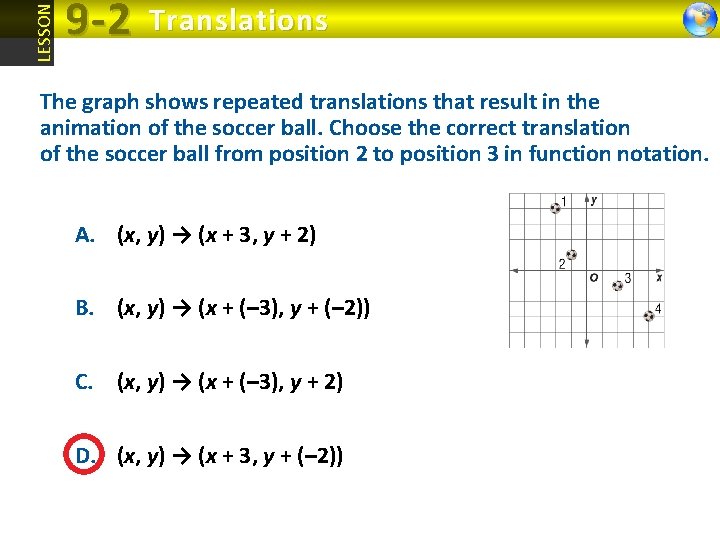
LESSON 9 -2 Translations The graph shows repeated translations that result in the animation of the soccer ball. Choose the correct translation of the soccer ball from position 2 to position 3 in function notation. A. (x, y) → (x + 3, y + 2) B. (x, y) → (x + (– 3), y + (– 2)) C. (x, y) → (x + (– 3), y + 2) D. (x, y) → (x + 3, y + (– 2))
LESSON 9 -2 Translations Assignment Due tomorrow: • 9. 2 P. 635 #9 -23 odd, 24, 26 -28