
Lesson ThreeTransition Metal Compounds Concept Transition metals have
- Slides: 8
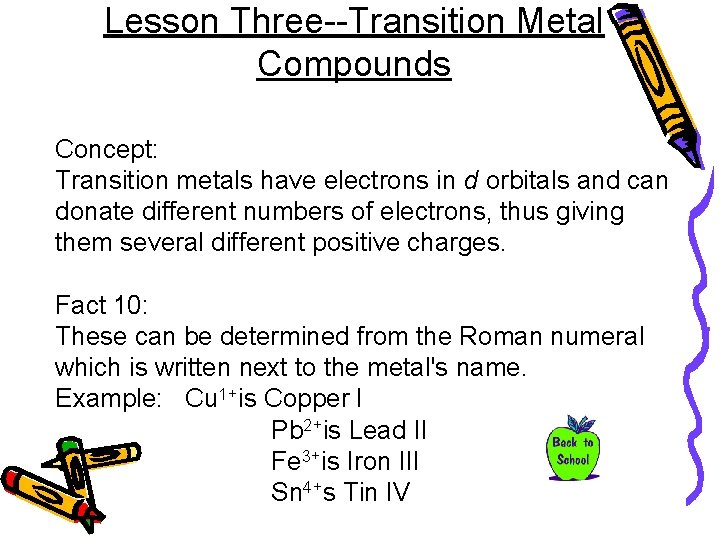
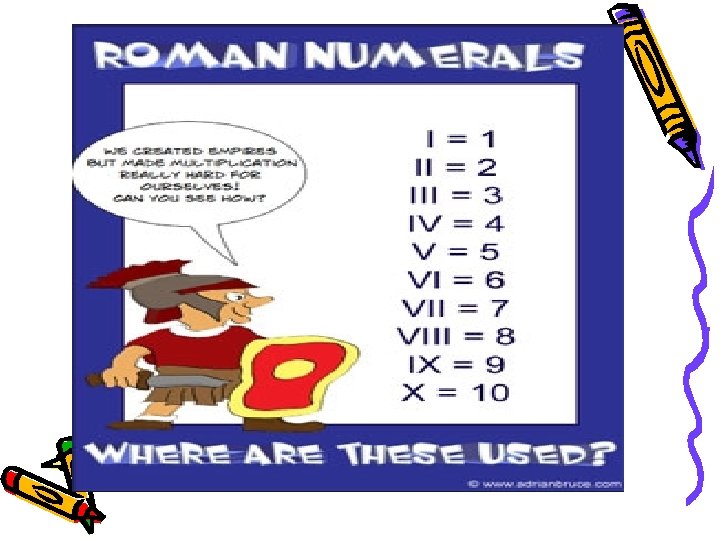
Lesson Three--Transition Metal Compounds Concept: Transition metals have electrons in d orbitals and can donate different numbers of electrons, thus giving them several different positive charges. Fact 10: These can be determined from the Roman numeral which is written next to the metal's name. Example: Cu 1+is Copper I Pb 2+is Lead II Fe 3+is Iron III Sn 4+s Tin IV
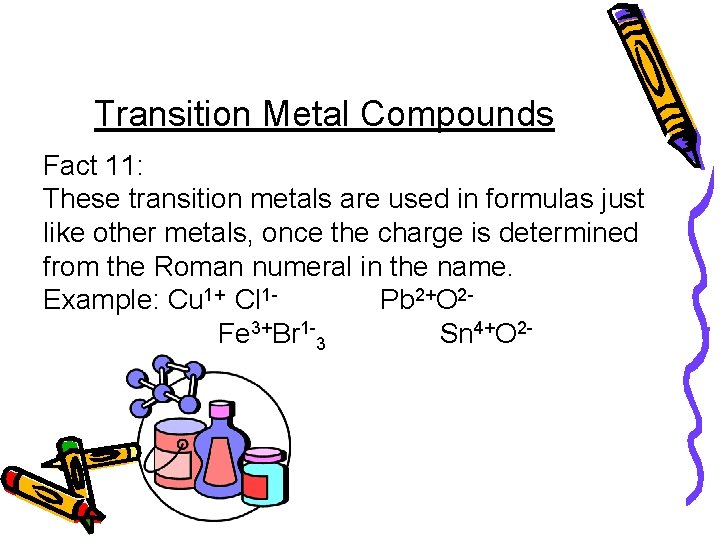
Transition Metal Compounds Fact 11: These transition metals are used in formulas just like other metals, once the charge is determined from the Roman numeral in the name. Example: Cu 1+ Cl 1 Pb 2+O 2 Fe 3+Br 1 -3 Sn 4+O 2 -
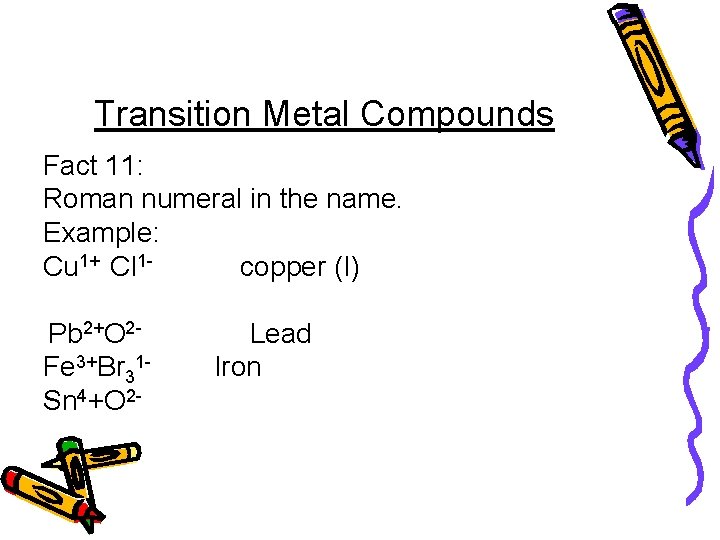
Transition Metal Compounds Fact 11: Roman numeral in the name. Example: Cu 1+ Cl 1 copper (I) Pb 2+O 2 Fe 3+Br 31 Sn 4+O 2 - Lead Iron
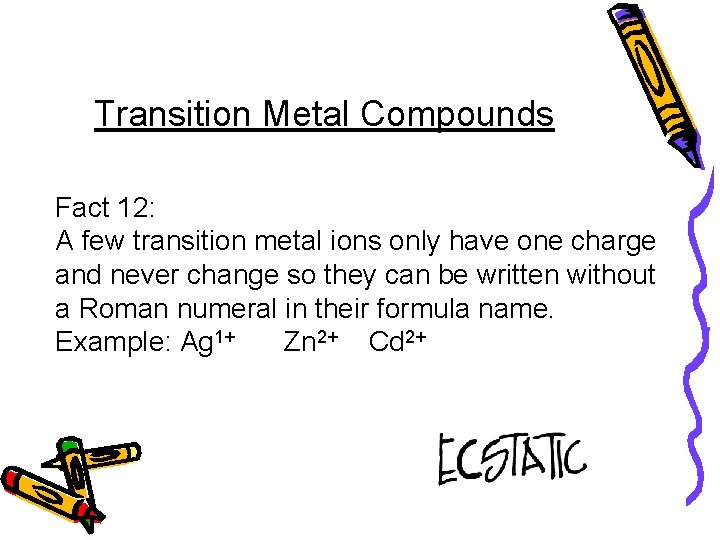
Transition Metal Compounds Fact 12: A few transition metal ions only have one charge and never change so they can be written without a Roman numeral in their formula name. Example: Ag 1+ Zn 2+ Cd 2+
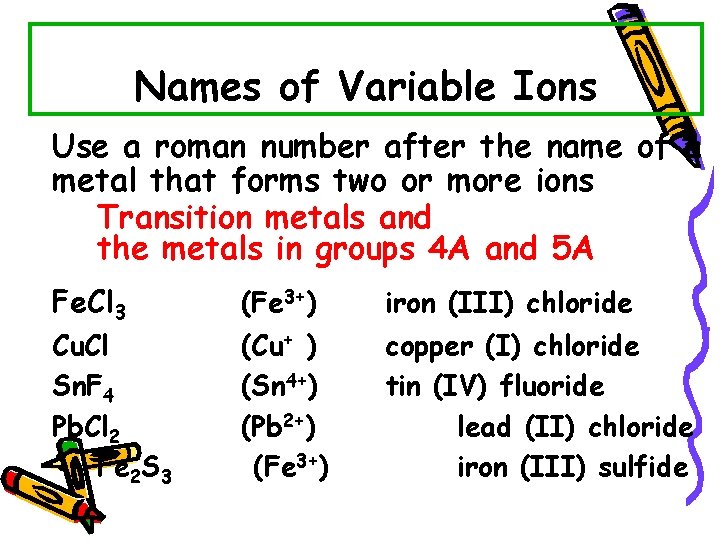
Names of Variable Ions Use a roman number after the name of a metal that forms two or more ions Transition metals and the metals in groups 4 A and 5 A Fe. Cl 3 Cu. Cl Sn. F 4 Pb. Cl 2 Fe 2 S 3 (Fe 3+) iron (III) chloride (Cu+ ) (Sn 4+) (Pb 2+) (Fe 3+) copper (I) chloride tin (IV) fluoride lead (II) chloride iron (III) sulfide
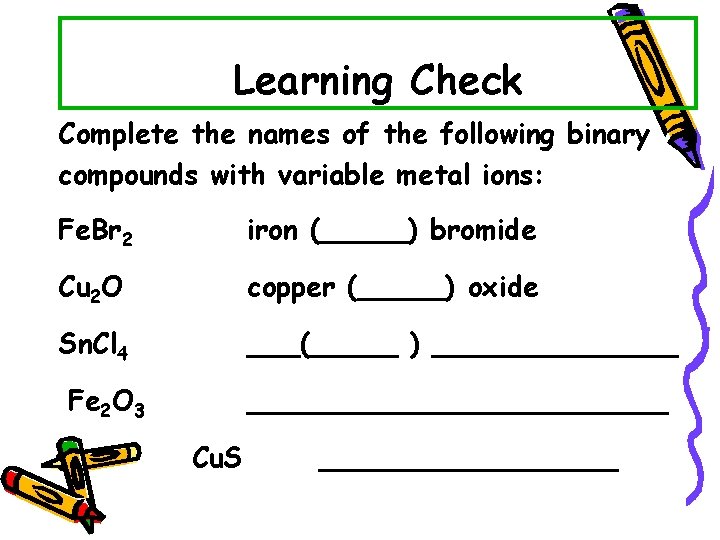
Learning Check Complete the names of the following binary compounds with variable metal ions: Fe. Br 2 iron (_____) bromide Cu 2 O copper (_____) oxide Sn. Cl 4 ___(_____ ) _______ Fe 2 O 3 ____________ Cu. S _________
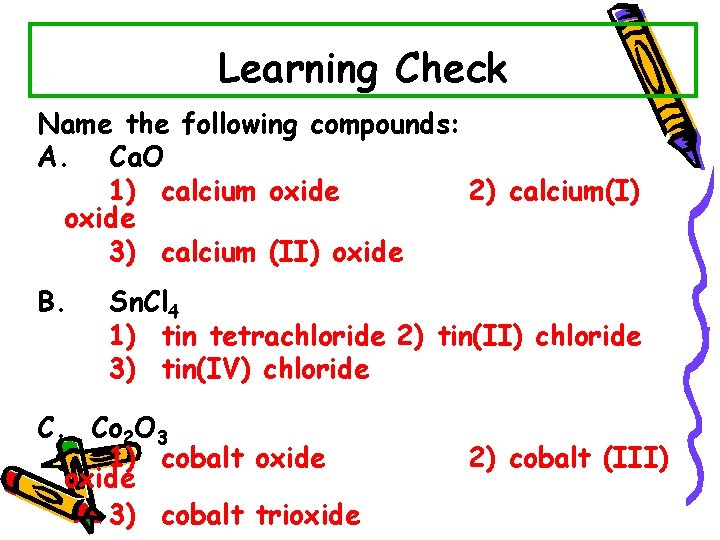
Learning Check Name the following compounds: A. Ca. O 1) calcium oxide 2) calcium(I) oxide 3) calcium (II) oxide B. Sn. Cl 4 1) tin tetrachloride 2) tin(II) chloride 3) tin(IV) chloride C. Co 2 O 3 1) cobalt oxide 3) cobalt trioxide 2) cobalt (III)