
Lesson Thirteen Standardized Test Contents Components of a
- Slides: 14
Lesson Thirteen Standardized Test
Contents • • Components of a Standardized test Reasons for the Name “Standardized” Reasons for Using a Standardized Test Scaling & Norming
What Is a Standardized Test? • Qs for discussion: – What is a standardized test? Why is it called a “standardized” test? – Can you give an example of a standardized test? – Why do we need to use standardized tests? – What’s the advantage and disadvantage of using a standardized test?
What is a Standardized Test? • A standardized test is a test administered and scored in a standard manner. The tests are designed in such a way that the "questions, conditions for administering, scoring procedures, and interpretations are consistent" (Sylvan Learning, 2006[1]) and are "administered and scored in a predetermined, standard manner" (Popham, 1999[2]). • A Standardized test presupppose certain standard objectives, or criteria, that are held constant across one form of the test to another.
Reasons for the Name “Standardized” • • In terms of the format, content In terms of construction procedures In terms of scoring procedures In terms of administration procedures – Time – Location – Price – Condition
Features of Standardized Tests • “Presupposes certain standard objectives, or criteria, that are held constant across one form of the test to another” (Brown 67). • The product of a thorough process of empirical research and development • Standard procedures for administration and scoring • Typical of a norm-referenced test – To place test-takers on a continuum across a range of scores – To differentiate test-takers by their relative ranking
History of Standardized Tests • http: //en. wikipedia. org/wiki/Standardized_t esting • Standardized test v. s public policy http: //en. wikipedia. org/wiki/Standardized_tes ting_and_public_policy
Developing a Standardized Test • A good standardized test – a product of a thorough process of empirical research and development. • Determine the purpose and objectives of the test. • Design test specifications. – Construct validation (e. g. , TOEFL, to define the construct of lang. proficiency) – Specific components of language ability • Design, select, and arrange test items. – Item writing, section, adaptation – Pilot testing
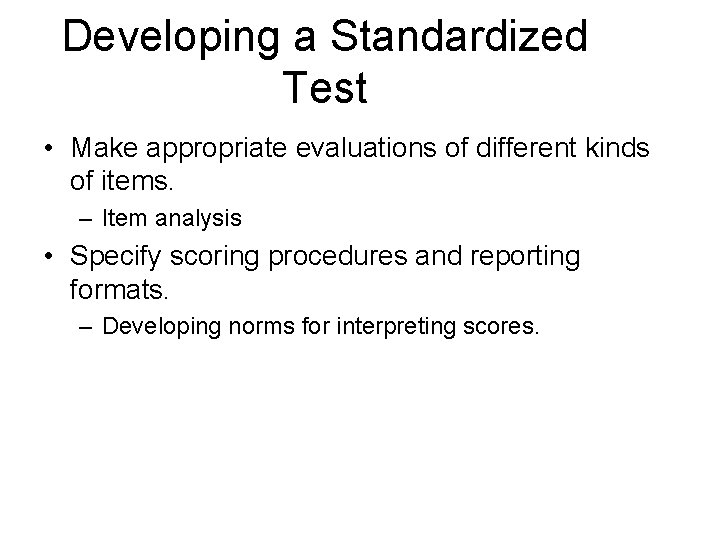
Developing a Standardized Test • Make appropriate evaluations of different kinds of items. – Item analysis • Specify scoring procedures and reporting formats. – Developing norms for interpreting scores.
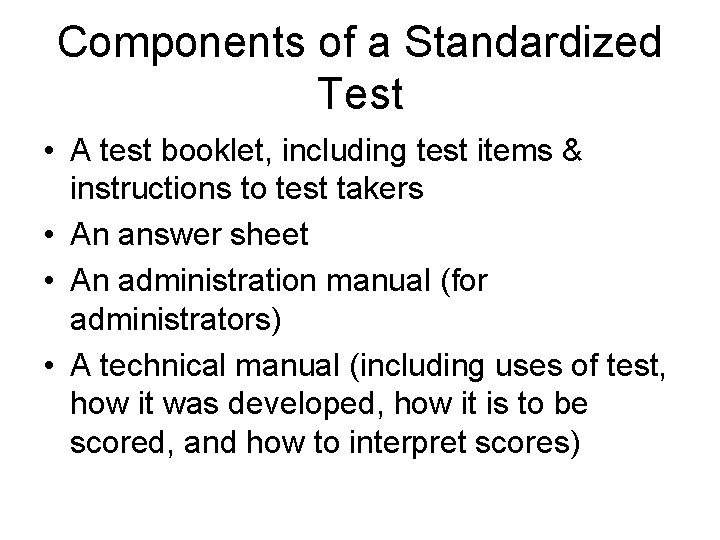
Components of a Standardized Test • A test booklet, including test items & instructions to test takers • An answer sheet • An administration manual (for administrators) • A technical manual (including uses of test, how it was developed, how it is to be scored, and how to interpret scores)
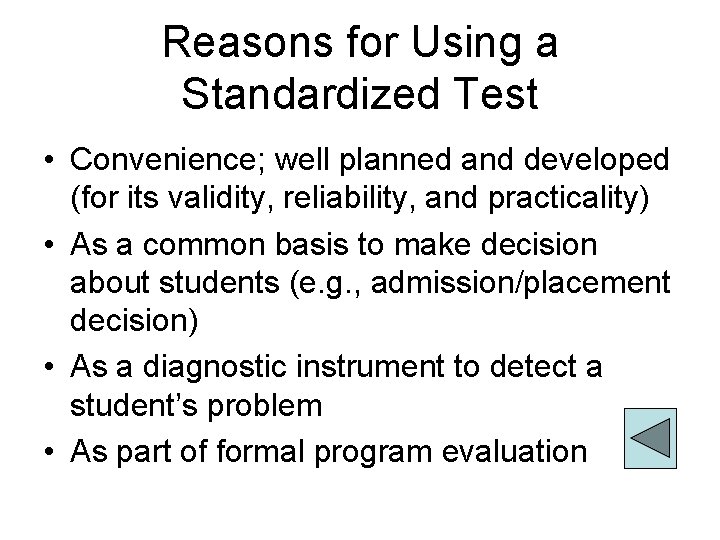
Reasons for Using a Standardized Test • Convenience; well planned and developed (for its validity, reliability, and practicality) • As a common basis to make decision about students (e. g. , admission/placement decision) • As a diagnostic instrument to detect a student’s problem • As part of formal program evaluation
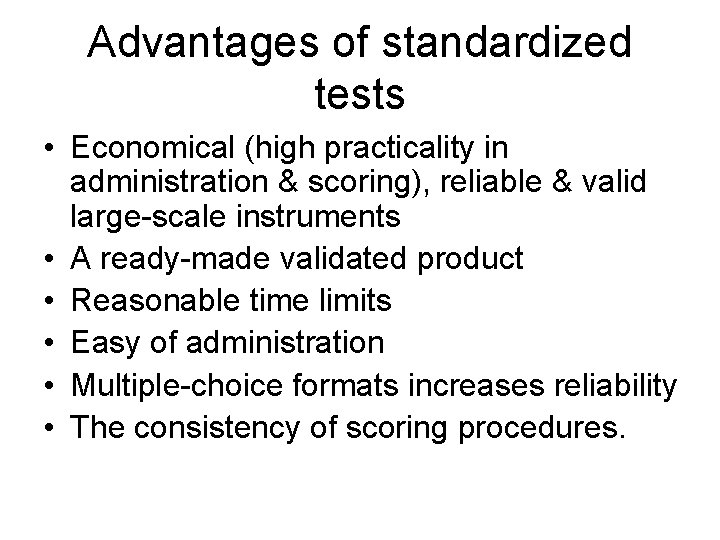
Advantages of standardized tests • Economical (high practicality in administration & scoring), reliable & valid large-scale instruments • A ready-made validated product • Reasonable time limits • Easy of administration • Multiple-choice formats increases reliability • The consistency of scoring procedures.
Disadvantages of standardized tests • Inappropriate use for achievement test • Limitation of indirect tests. • Usually timed, multiple-choice format, likely to be decontextualized
Scaling & Norming • Scaling: adjustment procedures a given score on any form has the same meaning – Adjust the differences between different versions • TOEFL two years ago can be compared with TOEFL this year. • Norming: give meaning to individual scores on standardized tests by reference to norms – – Age or grade Percentile ranks Stanine scale Standardized (z) scores