
Lesson Sufism What is Sufism How Sufism developed



- Slides: 28
Lesson Sufism What is Sufism? How Sufism developed as a movement within existing Islamic traditions?
On whiteboard Think----pair -----Share 1. Why college does 1 - 1 reviews? 2. How would you try to get closer to your friend in order to establish the best friendship? 3. What do we mean by ‘purification’? 4. How can a believer be closer to God?
Sufism – flipped learning • My own version of the origin of Sufism • The Principal Teachings of the Sufis • How Sufism relates to the rest of Islam Similar Sufism
What does the Qur’an say? “Indeed he succeeds who purifies his own self”. (87: 14)
History Is it fair to stay away from political matters and worldly things? • According to Qushayri the term ‘Sufi’ began in 988 CE and some other scholars like Shihabuddin Suhrawardi, the term ‘Sufi’ was first used in the early 9 th century CE. • The Six Authentic Hadith books compiled in the 9 th and 10 th century CE, didn’t mention • The infidelity and immoral rule of the Umayyad immediately following the first four caliphs, created such political and social conditions that many Muslims became disgusted and adopted to asceticism to seek peace of soul. • The focus shifted from material wealth to the lack of desire for possession i. e. a true detachment from all worldly things. The spirituality wasn’t distinguished from the religion and laid great emphasis on the teachings of Qur’an and Traditions.
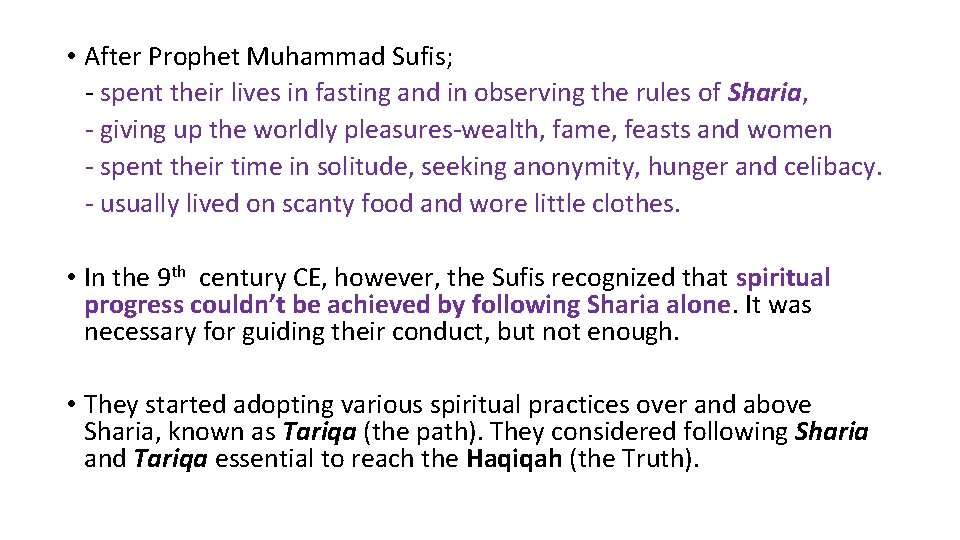
• After Prophet Muhammad Sufis; - spent their lives in fasting and in observing the rules of Sharia, - giving up the worldly pleasures-wealth, fame, feasts and women - spent their time in solitude, seeking anonymity, hunger and celibacy. - usually lived on scanty food and wore little clothes. • In the 9 th century CE, however, the Sufis recognized that spiritual progress couldn’t be achieved by following Sharia alone. It was necessary for guiding their conduct, but not enough. • They started adopting various spiritual practices over and above Sharia, known as Tariqa (the path). They considered following Sharia and Tariqa essential to reach the Haqiqah (the Truth).
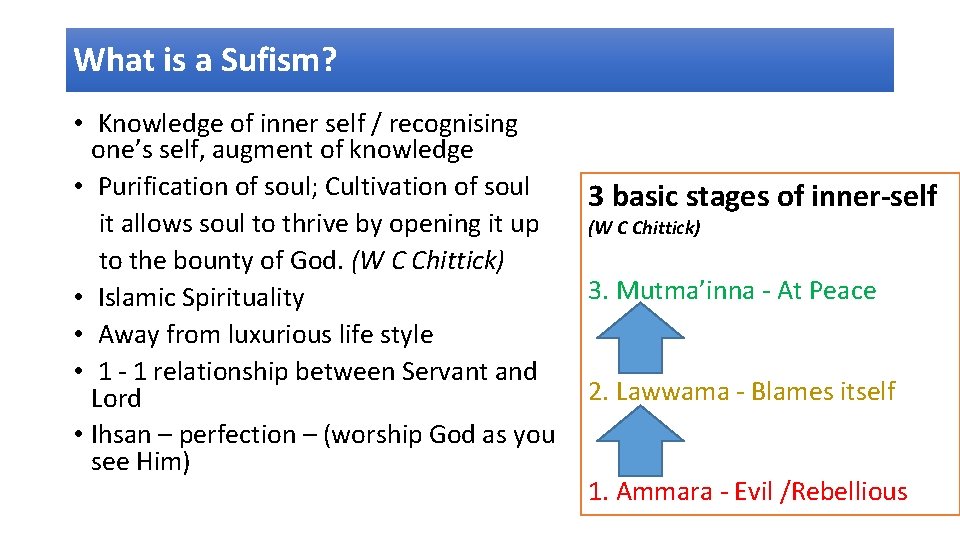
What is a Sufism? • Knowledge of inner self / recognising one’s self, augment of knowledge • Purification of soul; Cultivation of soul it allows soul to thrive by opening it up to the bounty of God. (W C Chittick) • Islamic Spirituality • Away from luxurious life style • 1 - 1 relationship between Servant and Lord • Ihsan – perfection – (worship God as you see Him) 3 basic stages of inner-self (W C Chittick) 3. Mutma’inna - At Peace 2. Lawwama - Blames itself 1. Ammara - Evil /Rebellious
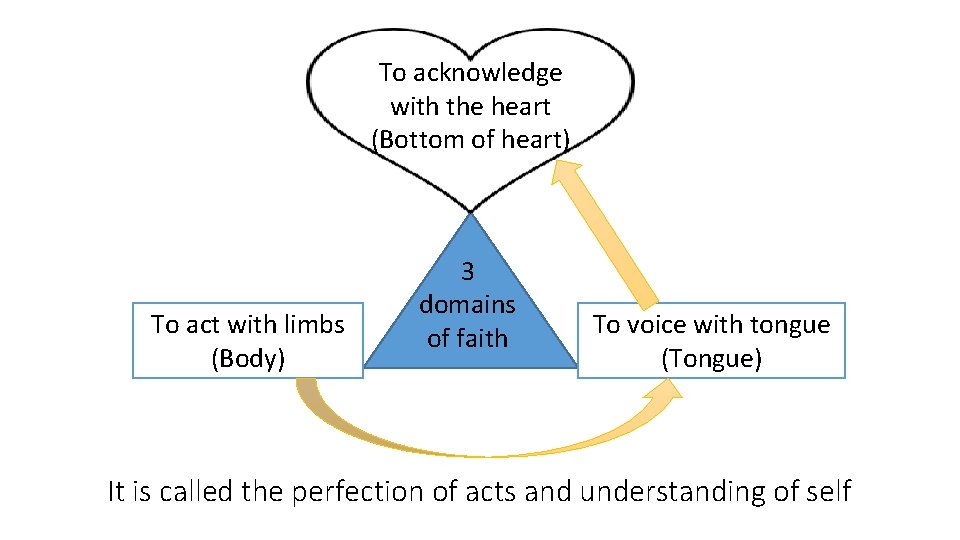
To acknowledge with the heart (Bottom of heart) To act with limbs (Body) 3 domains of faith To voice with tongue (Tongue) It is called the perfection of acts and understanding of self
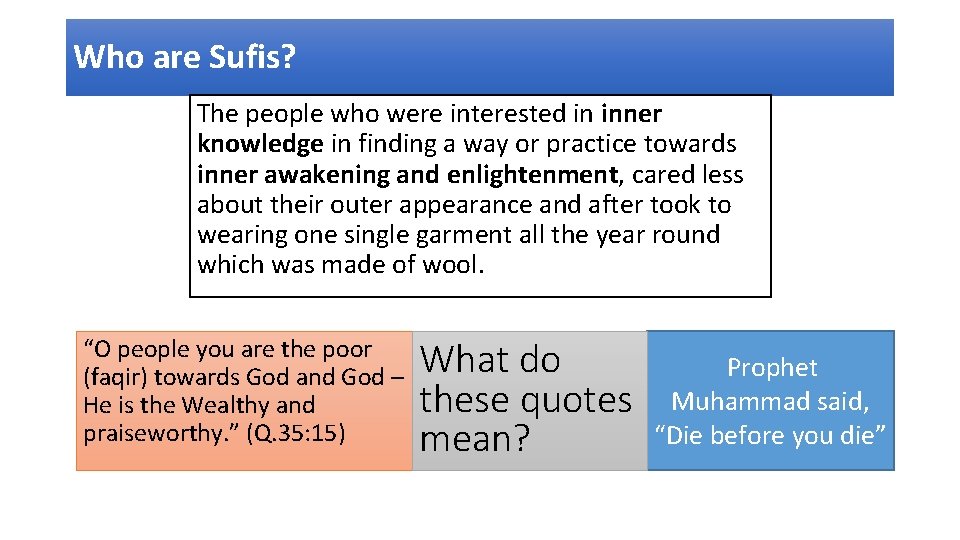
Who are Sufis? The people who were interested in inner knowledge in finding a way or practice towards inner awakening and enlightenment, cared less about their outer appearance and after took to wearing one single garment all the year round which was made of wool. “O people you are the poor (faqir) towards God and God – He is the Wealthy and praiseworthy. ” (Q. 35: 15) What do these quotes mean? Prophet Muhammad said, “Die before you die”
In my notes What is my understanding of Sufism so far?
Famous Sufi Orders • Qadriya • Abdul Qadir al-Jilani (d. 561/1166) • Suhrawardiyya • Abdul Qadir Abu Najib as-Suhrawardi (d. 564/1168) • Shadhiliya • Abul Hasan ash-Shadhli (1196 -1258) • Chishtiya • Muinuddin Chishti (d. 633/1236) • Naqshbandiya • Bahauddin Naqshband (1317 -1389)
Sufi theory • Reality derives from the Qur’an and hadith. • Sufism sets a map of cosmos to understand their situation in respect to God. It also sets down practice to achieve perfection. • Shahadah… ‘God was and nothing was with Him’ (Junaid Baghdadi d. 910) • Inner transformation: Shari’ah is a set of devotional and spiritual exercises. • Human’s normal situation is forgetfulness, carelessness. Perfection is to recognise our own imperfection. Sufism, W C Chittick
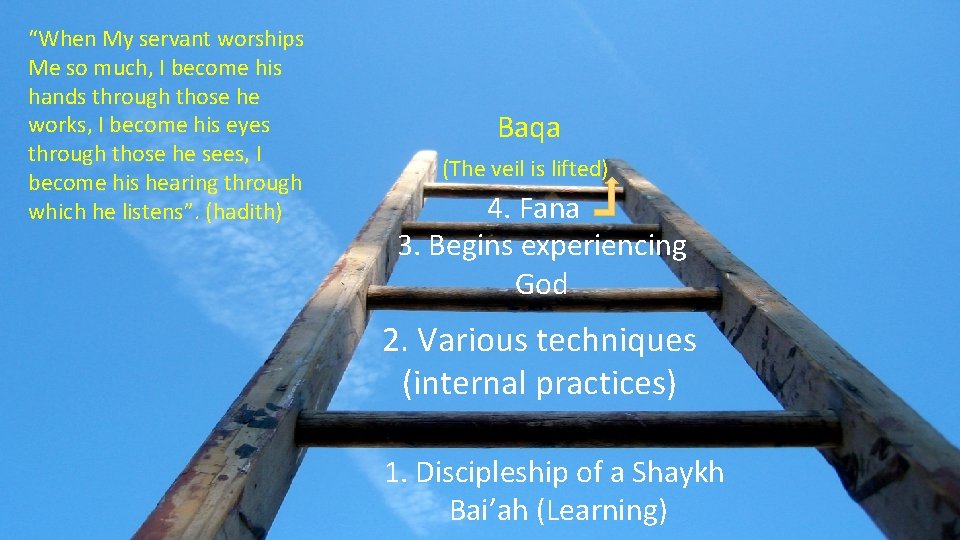
The principal teachings and practices • A Sufi must attach as a disciple (murid) to a ‘Shaykh’, who is a proven Sufi. • ‘Bai’ah’- pledge between Shaykh and disciple • Dhikr (remembrance of Allah) - “Verily in the remembrance of God do hearts find rest” (S, 28) - “I am with my servant when he remembers Me”. (hadith) • Shaykh then will teach various techniques to become a Sufi (eg poverty, solitariness, contentment, abstinence and thankfulness). • Eventually the disciple will attain the Sufi state (hal) where he passes away into God (fana) and will be filled with the love of God that nothing else matters. Then he reaches the highest state where he continues in God (Baqâ). • The distinction between fanâ’ and baqâ’ correlates roughly with that between the states of “drunkenness” and “sobriety”.
The principal teachings and practices • “He who knows himself he knows his Lord”. (Hadith) • Sufism is an art of beingness through the attainment of divine knowledge. It is not an intellectual exercise for scholarly investigations and postgraduate study. • The greatest religion for them is the love for the humanity and not to hurt anyone's feelings. • A Sufi seeker has to complete his journey to self-realisation. He has to find his Beloved within himself, for He can be found only in a heart that has been purified by the fire of love. • Poetry, music and dancing are used to assist in achieving the mystical state. Which one of these relate to the rest of Islam?
Recap what do you remember from last lesson? • When did the term ‘Sufi’ begin? • How did Sufism begin? • What was the Sufi focus shifted to? Why? • What was Sufi life style after Prophet Muhammad? • What is difference between Sharia , Tariqa and Haqiqat
“When My servant worships Me so much, I become his hands through those he works, I become his eyes through those he sees, I become his hearing through which he listens”. (hadith) Baqa (The veil is lifted) 4. Fana 3. Begins experiencing God 2. Various techniques (internal practices) 1. Discipleship of a Shaykh Bai’ah (Learning)
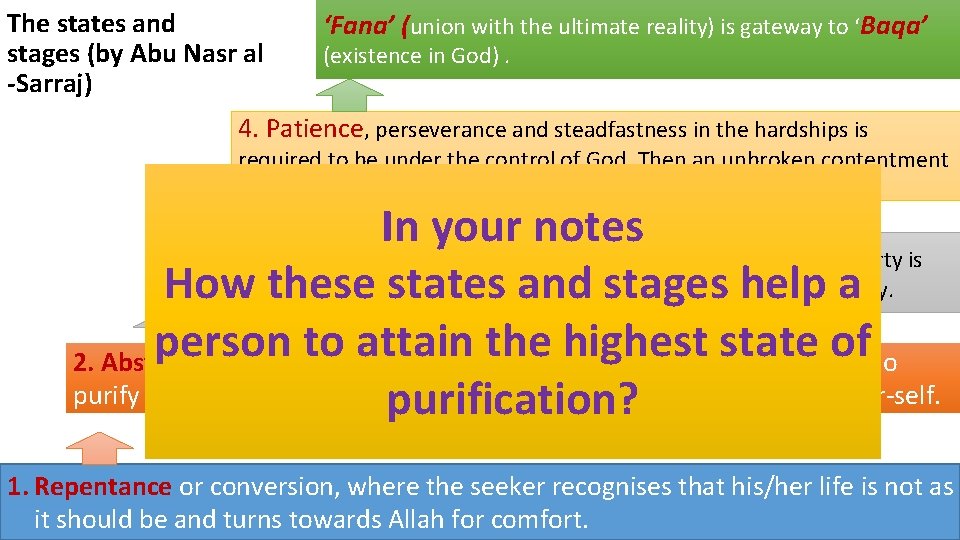
The states and stages (by Abu Nasr al -Sarraj) ‘Fana’ (union with the ultimate reality) is gateway to ‘Baqa’ (existence in God). 4. Patience, perseverance and steadfastness in the hardships is required to be under the control of God. Then an unbroken contentment or satisfaction is cultivated. In your notes 3. Renunciation or detachment worldly desires is cultivated then. Poverty is developed the ‘vacant heart’ can and be filled with Allah’s Grace and Mercy. How and these states stages help a person to attain the highest state of 2. Abstinence or fear, passing their time in prayer and fasting in order to purify the heart and distance from the corrupting influence of the inner-self. purification? 1. Repentance or conversion, where the seeker recognises that his/her life is not as it should be and turns towards Allah for comfort.
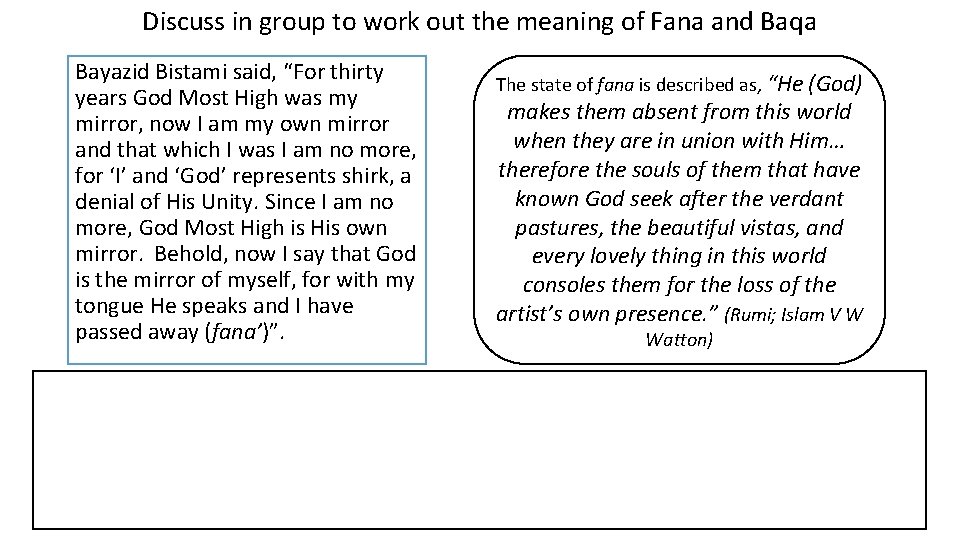
Discuss in group to work out the meaning of Fana and Baqa Bayazid Bistami said, “For thirty years God Most High was my mirror, now I am my own mirror and that which I was I am no more, for ‘I’ and ‘God’ represents shirk, a denial of His Unity. Since I am no more, God Most High is His own mirror. Behold, now I say that God is the mirror of myself, for with my tongue He speaks and I have passed away (fana’)”. The state of fana is described as, “He (God) makes them absent from this world when they are in union with Him… therefore the souls of them that have known God seek after the verdant pastures, the beautiful vistas, and every lovely thing in this world consoles them for the loss of the artist’s own presence. ” (Rumi; Islam V W Watton)
How Sufism relates to the rest of Islam? • Sufis have tried to show Muslims that the heart of Islam is not the practices of faith but the relation of the individual to God. • “A humble soul may be religious even though ignorant of theology and Qur’anic interpretation. (Al’Ghazzali) • The core religion is to repent of one’s sins, purge the heart of all but God and, by the exercises of religion, attain a virtuous character”. (Al’Ghazzali) • Sufis encourage to look at their relationship with God and their religious experience rather than just obeying the rules.
How Sufis are distinguished from other Muslims • Remembrance as instructed by their Shaykh • Why should people pray and fast? • Remembrance means keep God in mind constantly. • “Ihsan is worship God as you see Him” • Zikr implies more than just ritual activities that go by the names • The goal in Zikr is to annihilate everything other than God • No Zikr after the veil has been lifted “witness God”- annihilation • Mutzillites rejected any vision of God whatsoever, “ God is only the necessary ‘Being’ and everything other than God is possible”. Sufism, W C Chittick
What is the problem with Sufism? • Prophet Muhammad went to the cave of Hira to meditate in isolation until the Prophet of God’. • Muhammad practised the duties of Islam for whole of His life (eg 5 pillars). • Muhammad participated in politics, established an Islamic state in Medina. • ‘On no soul doth Allah place a burden greater than it can bear’. (Q 2: 286) • The true Sufi path (tariqa) must be according to the Islamic Sharia.
Are Sufis a separate from OR a part of Islam?
Answer these questions in the handout. • Why these mystical and devotional ideas about a more personal relationship with Allah developed? List some reasons. • To what extent Sufism penetrated existing Muslim-majority societies and the ways in which it did so. • How Sunni and Shi’a have responded to Sufi teachings and practices? • To what extent Sufi might be regarded as a separate tradition?
Homework ………………. . Exam questions • Explore the key teachings and practices of Sufis. [8] • To what extent it is true that Sufi practices are mystical experiences within Islam? Assess. [12]
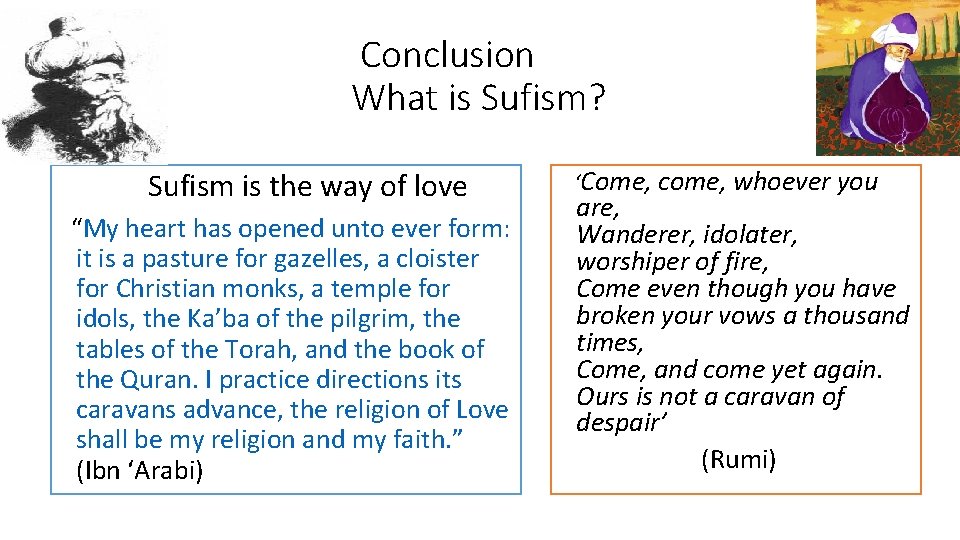
Conclusion What is Sufism? Sufism is the way of love “My heart has opened unto ever form: it is a pasture for gazelles, a cloister for Christian monks, a temple for idols, the Ka’ba of the pilgrim, the tables of the Torah, and the book of the Quran. I practice directions its caravans advance, the religion of Love shall be my religion and my faith. ” (Ibn ‘Arabi) ‘Come, come, whoever you are, Wanderer, idolater, worshiper of fire, Come even though you have broken your vows a thousand times, Come, and come yet again. Ours is not a caravan of despair’ (Rumi)
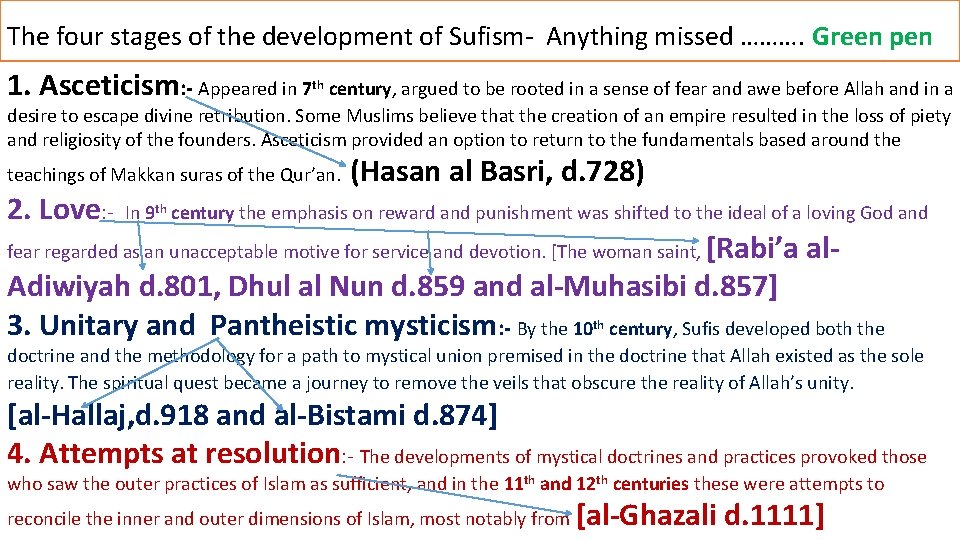
Extension In groups (page 4 -5 of the handout) Discuss how Sufism developed and draw a timeline of its four stages.
What , When, Who
The four stages of the development of Sufism- Anything missed ………. Green pen 1. Asceticism: - Appeared in 7 th century, argued to be rooted in a sense of fear and awe before Allah and in a desire to escape divine retribution. Some Muslims believe that the creation of an empire resulted in the loss of piety and religiosity of the founders. Asceticism provided an option to return to the fundamentals based around the teachings of Makkan suras of the Qur’an. 2. Love: - (Hasan al Basri, d. 728) In 9 th century the emphasis on reward and punishment was shifted to the ideal of a loving God and [Rabi’a al. Adiwiyah d. 801, Dhul al Nun d. 859 and al-Muhasibi d. 857] 3. Unitary and Pantheistic mysticism: - By the 10 th century, Sufis developed both the fear regarded as an unacceptable motive for service and devotion. [The woman saint, doctrine and the methodology for a path to mystical union premised in the doctrine that Allah existed as the sole reality. The spiritual quest became a journey to remove the veils that obscure the reality of Allah’s unity. [al-Hallaj, d. 918 and al-Bistami d. 874] 4. Attempts at resolution: - The developments of mystical doctrines and practices provoked those who saw the outer practices of Islam as sufficient, and in the 11 th and 12 th centuries these were attempts to reconcile the inner and outer dimensions of Islam, most notably from [al-Ghazali d. 1111]