
Lesson Study with Japanese Curriculum Materials A Randomized


- Slides: 46
Lesson Study with Japanese Curriculum Materials: A Randomized Controlled Trial Tsukuba, Japan, February 19, 2011 Catherine Lewis Mills College, Oakland, CA www. lessonresearch. net Clewis@mills. edu
This material is based upon research supported by the Department of Education Institute for Education Sciences, award #R 308 A 960003. Any opinions, findings, and conclusions or recommendations expressed in this website are those of the authors and do not necessarily reflect the views of the grantors.
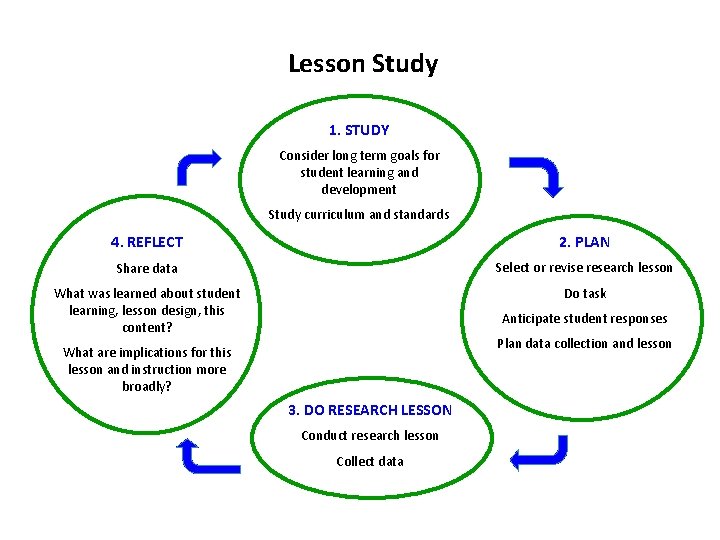
Lesson Study 1. STUDY Consider long term goals for student learning and development Study curriculum and standards 4. REFLECT 2. PLAN Share data Select or revise research lesson What was learned about student learning, lesson design, this content? Do task Anticipate student responses Plan data collection and lesson What are implications for this lesson and instruction more broadly? 3. DO RESEARCH LESSON Conduct research lesson Collect data
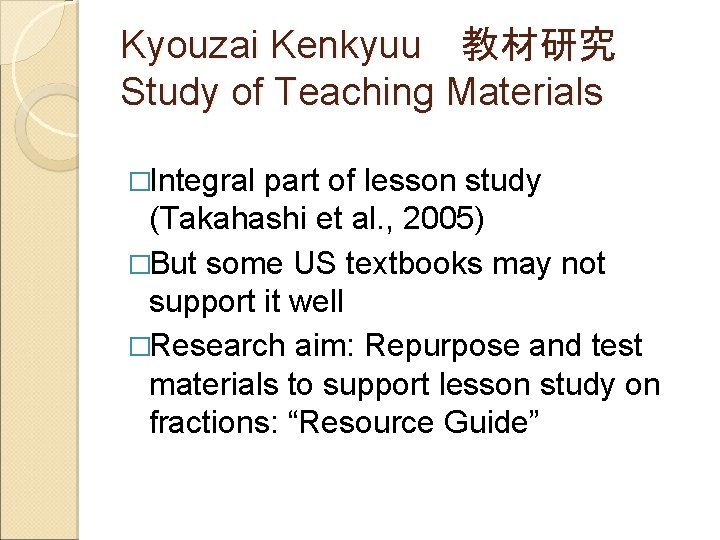
Kyouzai Kenkyuu 教材研究 Study of Teaching Materials �Integral part of lesson study (Takahashi et al. , 2005) �But some US textbooks may not support it well �Research aim: Repurpose and test materials to support lesson study on fractions: “Resource Guide”
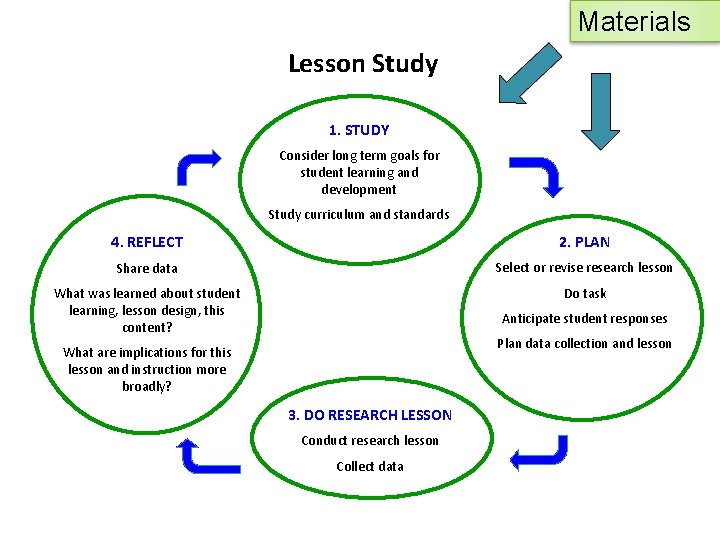
Materials Lesson Study 1. STUDY Consider long term goals for student learning and development Study curriculum and standards 4. REFLECT 2. PLAN Share data Select or revise research lesson What was learned about student learning, lesson design, this content? Do task Anticipate student responses Plan data collection and lesson What are implications for this lesson and instruction more broadly? 3. DO RESEARCH LESSON Conduct research lesson Collect data
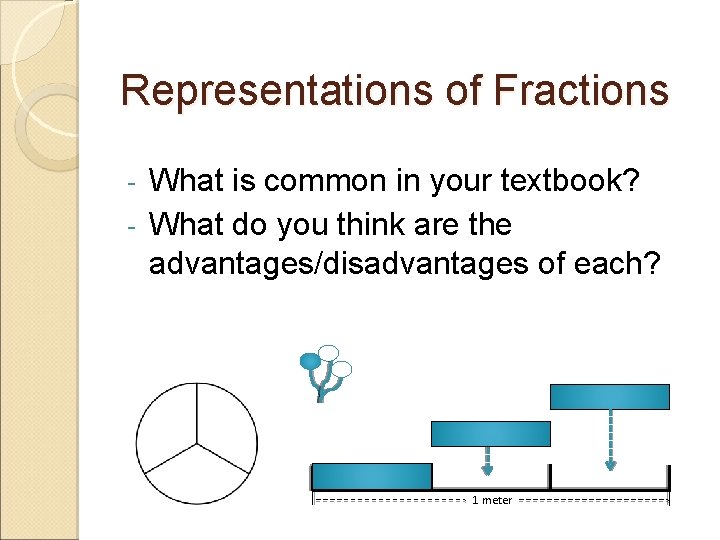
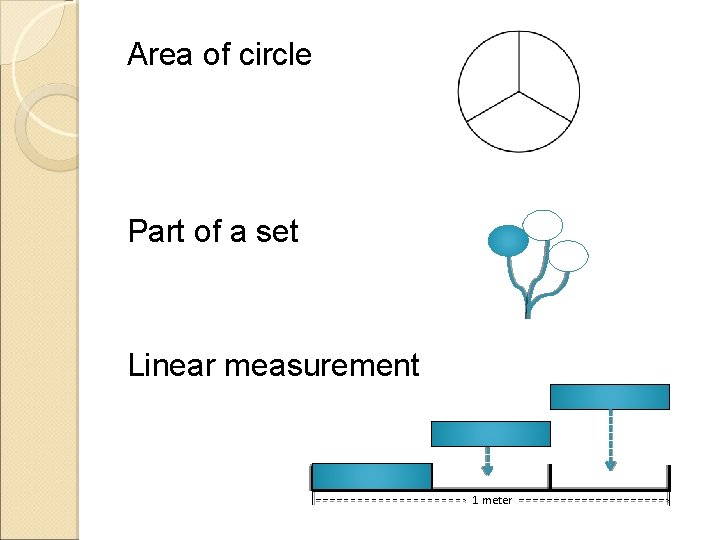
Representations of Fractions What is common in your textbook? - What do you think are the advantages/disadvantages of each? - 1 meter
Area of circle Part of a set Linear measurement 1 meter
Comparison of U. S & Japanese Texts Compared 2 US elementary math series • Investigations (2007) • Harcourt California (2002) 2 Japanese elementary math series • Tokyo Shoseki (Hironaka & Sugiyama) • Gakkou Tosho (Hitotsumatsu et al. )
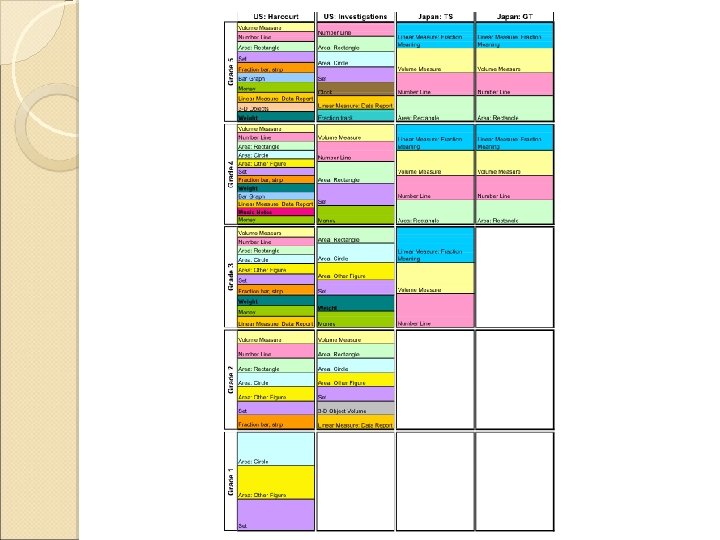
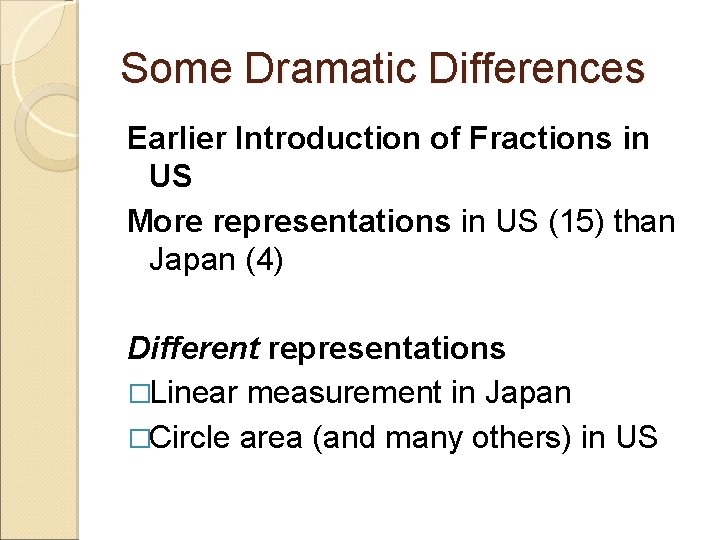
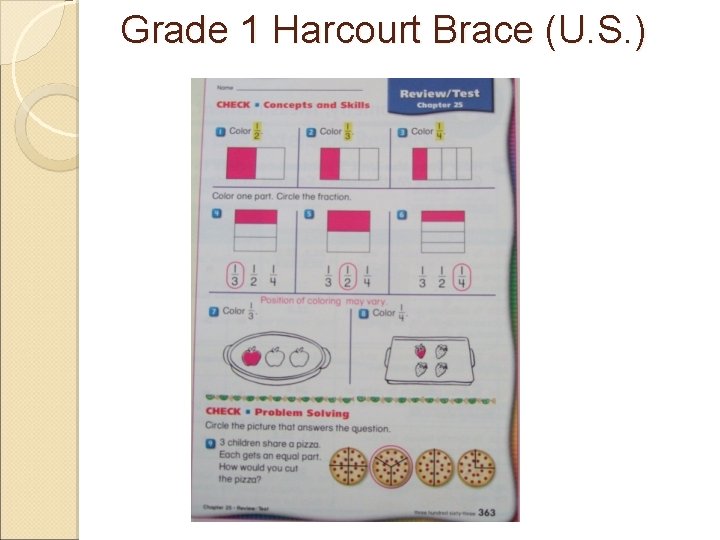
Some Dramatic Differences Earlier Introduction of Fractions in US More representations in US (15) than Japan (4) Different representations �Linear measurement in Japan �Circle area (and many others) in US
Grade 1 Harcourt Brace (U. S. )
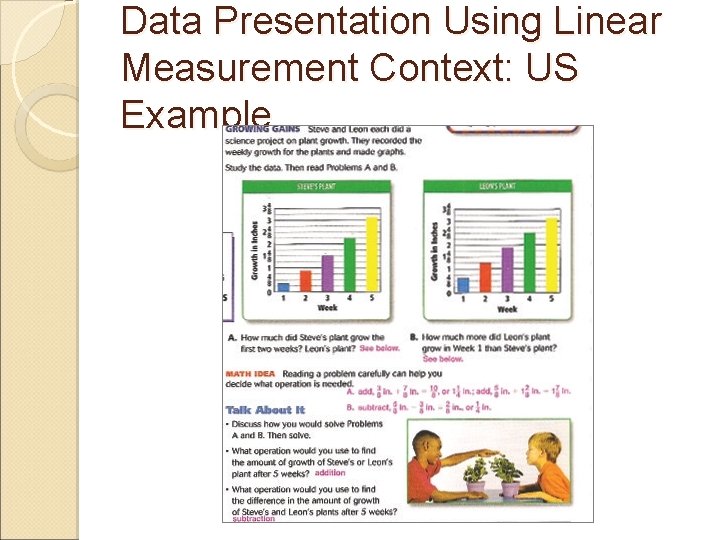
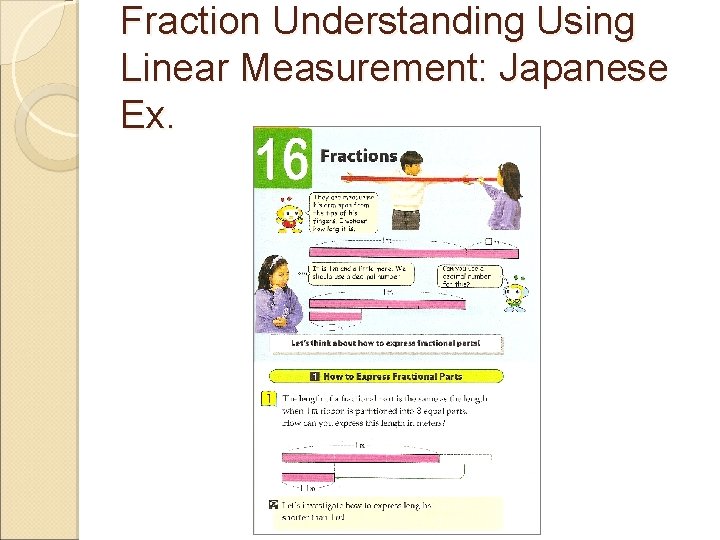
What we mean by using linear measurement context to develop concept of fractions �Not just measuring with ruler or using fractions to record data. .
Data Presentation Using Linear Measurement Context: US Example
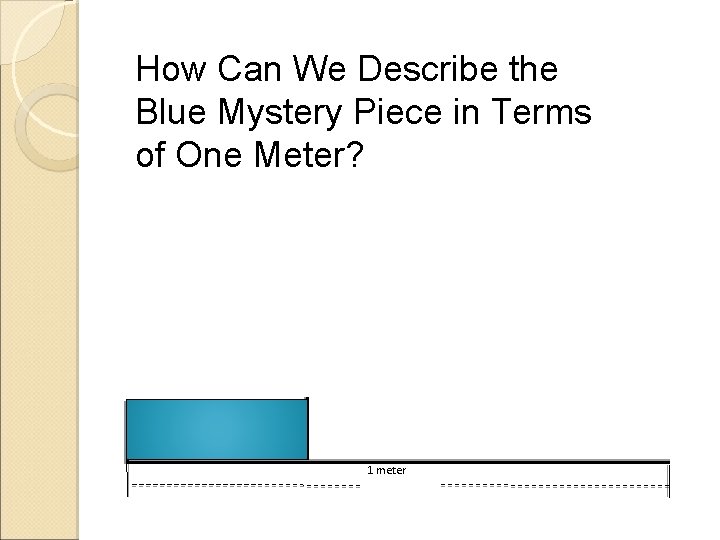
How Can We Describe the Blue Mystery Piece in Terms of One Meter? 1 meter
Fraction Understanding Using Linear Measurement: Japanese Ex.
3 Days of Research Lessons, Based on Japanese Textbook
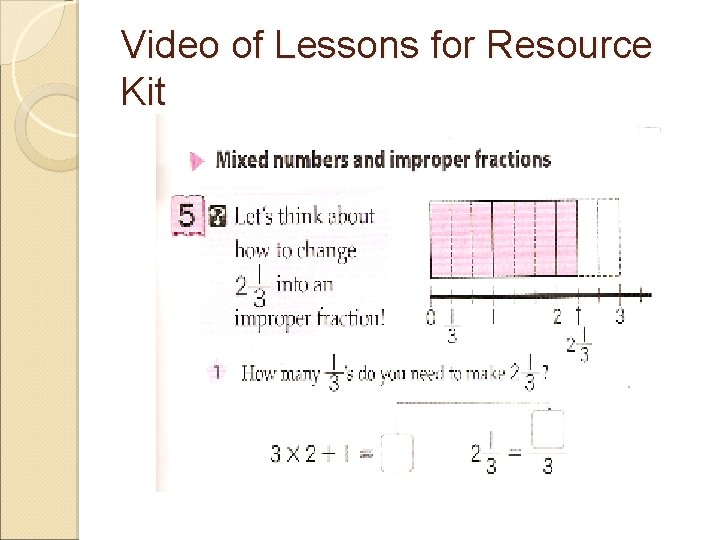
Video of Lessons for Resource Kit
Research Literature & Field Studies Suggested Affordances of Linear Measurement Context for Learning Fractions �Davydov & Tsvetkovich (1991) �Saxe et al. , (2007, 2009) �Dougherty (2008) �Watanabe (1996, 2002, 2006, 2007)
Common Challenges in Understanding Fractions �Seeing fraction as number (“I can’t put 2/3 on number line because it’s two different numbers”) �Understanding the meaning of the denominator (that 1/6 is smaller than 1/5) �Knowing what is the whole (construct a whole from a fraction) �Seeing that fractions can be greater than one
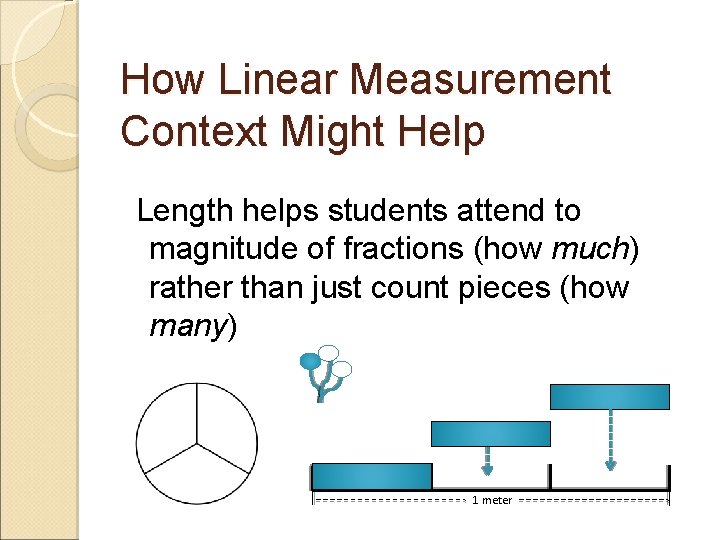
How Linear Measurement Context Might Help Length helps students attend to magnitude of fractions (how much) rather than just count pieces (how many) 1 meter
Seeing Fraction as Number Linear measurement context helps students transition to see fractions as numbers on number line, not just as pieces or as situation
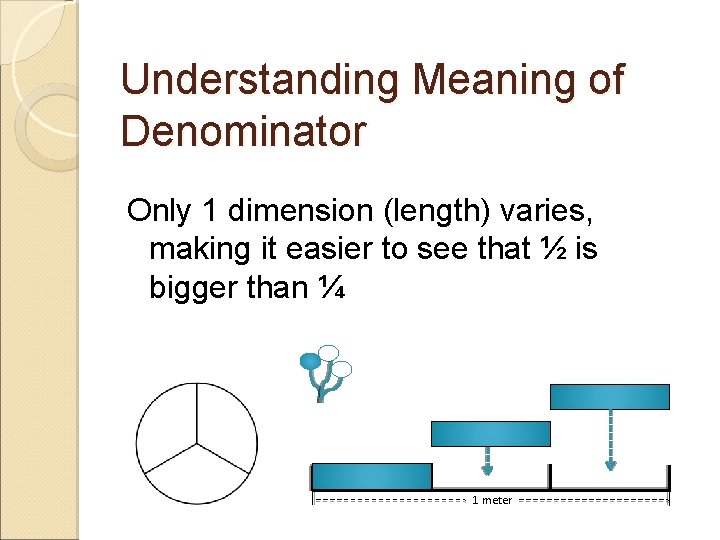
Understanding Meaning of Denominator Only 1 dimension (length) varies, making it easier to see that ½ is bigger than ¼ 1 meter
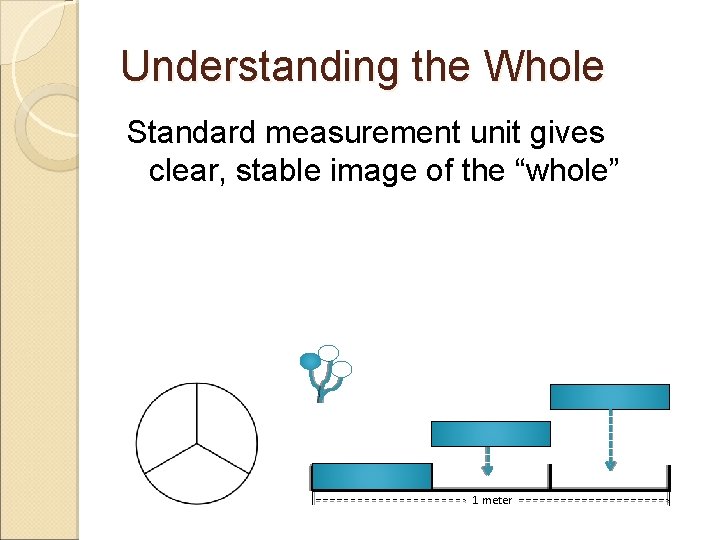
Understanding the Whole Standard measurement unit gives clear, stable image of the “whole” 1 meter
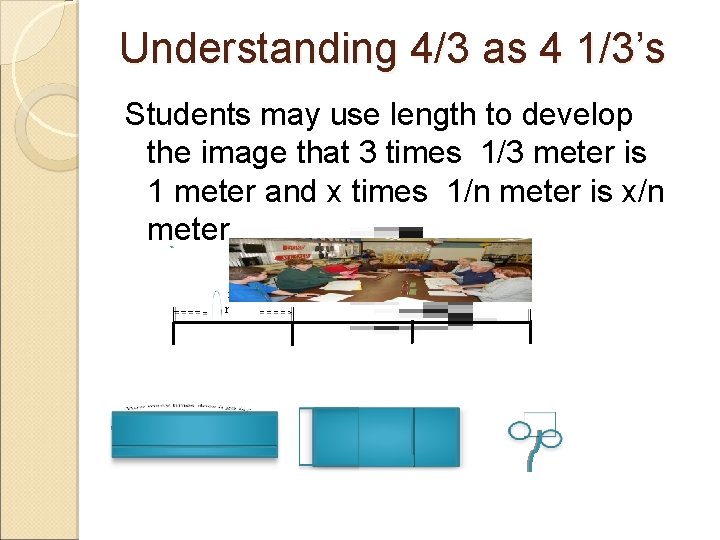
Understanding 4/3 as 4 1/3’s Students may use length to develop the image that 3 times 1/3 meter is 1 meter and x times 1/n meter is x/n meter mete r
Lesson Study Resource Kit Mathematics tasks to solve and discuss (& related student work to analyze) 2. Curriculum inquiry: Japanese textbook, lesson video, teachers’ materials 3. Lesson study materials (template for lesson plan, protocol for discussion, etc. ) 4. Suggested process to explore and 1.
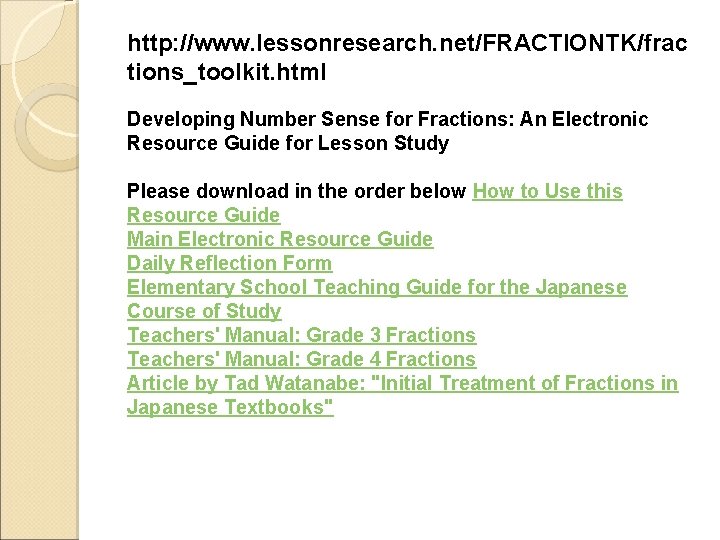
http: //www. lessonresearch. net/FRACTIONTK/frac tions_toolkit. html Developing Number Sense for Fractions: An Electronic Resource Guide for Lesson Study Please download in the order below How to Use this Resource Guide Main Electronic Resource Guide Daily Reflection Form Elementary School Teaching Guide for the Japanese Course of Study Teachers' Manual: Grade 3 Fractions Teachers' Manual: Grade 4 Fractions Article by Tad Watanabe: "Initial Treatment of Fractions in Japanese Textbooks"
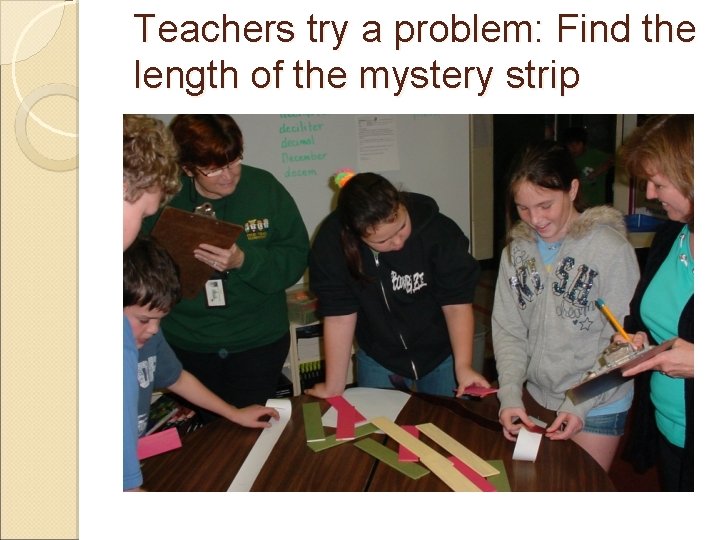
Teachers try a problem: Find the length of the mystery strip
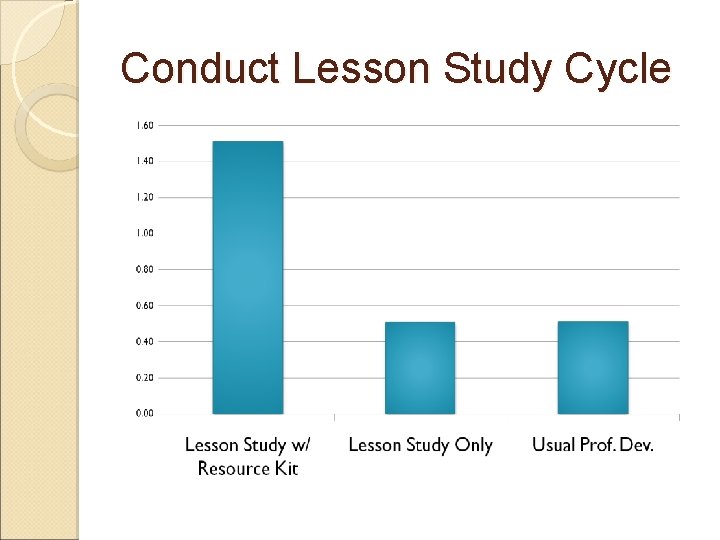
Conduct Lesson Study Cycle
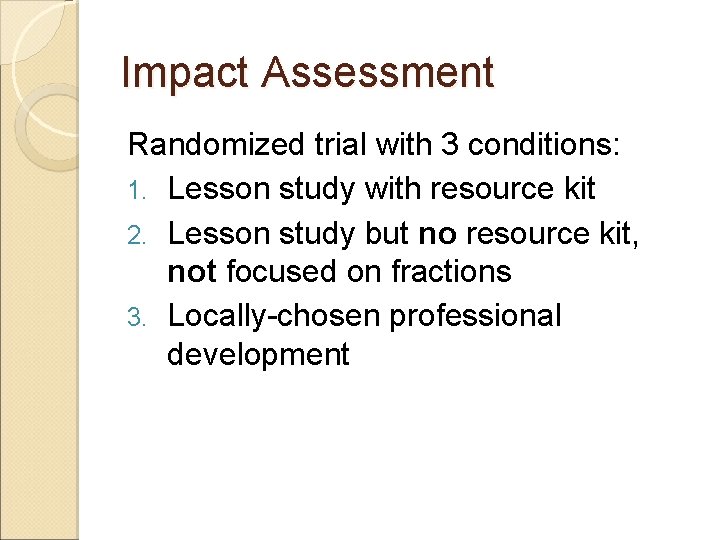
Impact Assessment Randomized trial with 3 conditions: 1. Lesson study with resource kit 2. Lesson study but no resource kit, not focused on fractions 3. Locally-chosen professional development
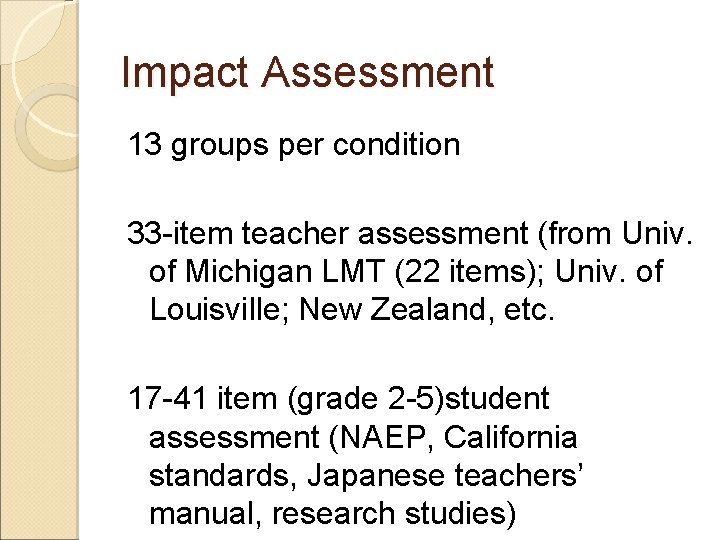
Impact Assessment 13 groups per condition 33 -item teacher assessment (from Univ. of Michigan LMT (22 items); Univ. of Louisville; New Zealand, etc. 17 -41 item (grade 2 -5)student assessment (NAEP, California standards, Japanese teachers’ manual, research studies)
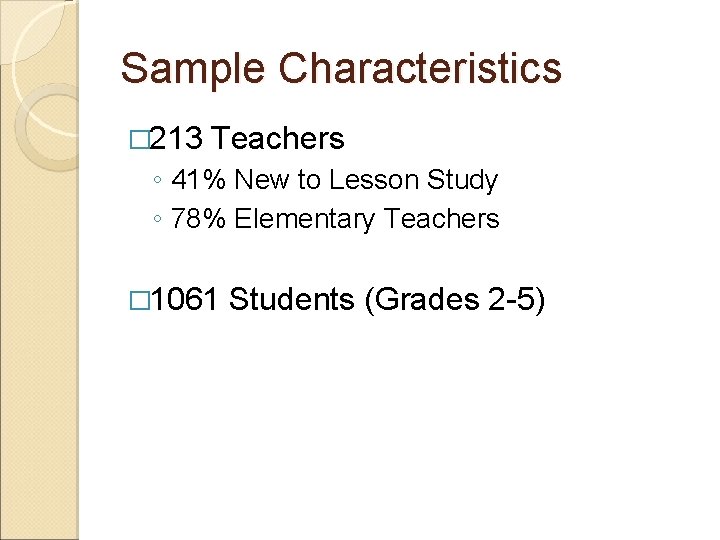
Sample Characteristics � 213 Teachers ◦ 41% New to Lesson Study ◦ 78% Elementary Teachers � 1061 Students (Grades 2 -5)
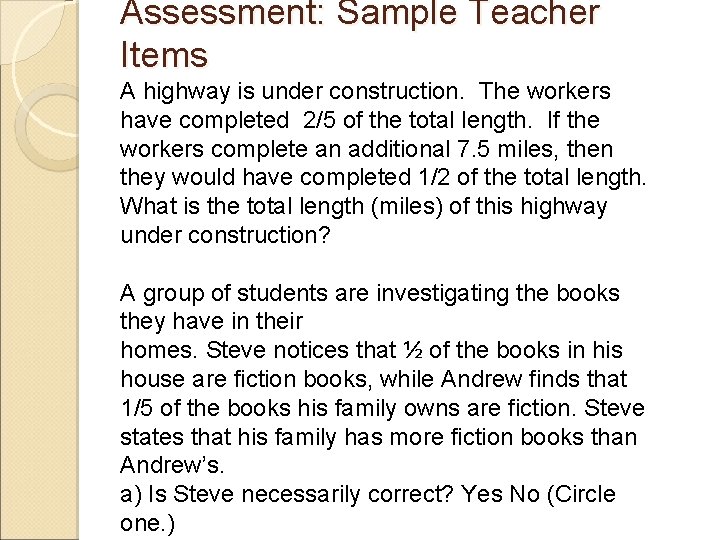
Assessment: Sample Teacher Items A highway is under construction. The workers have completed 2/5 of the total length. If the workers complete an additional 7. 5 miles, then they would have completed 1/2 of the total length. What is the total length (miles) of this highway under construction? A group of students are investigating the books they have in their homes. Steve notices that ½ of the books in his house are fiction books, while Andrew finds that 1/5 of the books his family owns are fiction. Steve states that his family has more fiction books than Andrew’s. a) Is Steve necessarily correct? Yes No (Circle one. )
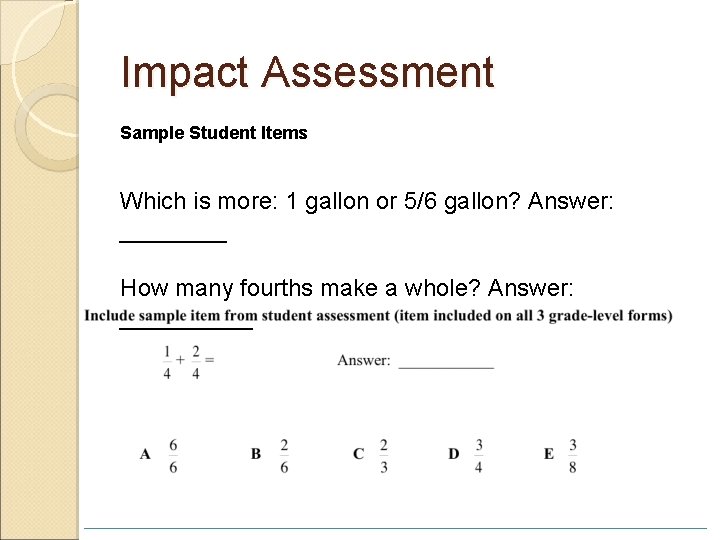
Impact Assessment Sample Student Items Which is more: 1 gallon or 5/6 gallon? Answer: ____ How many fourths make a whole? Answer: _____
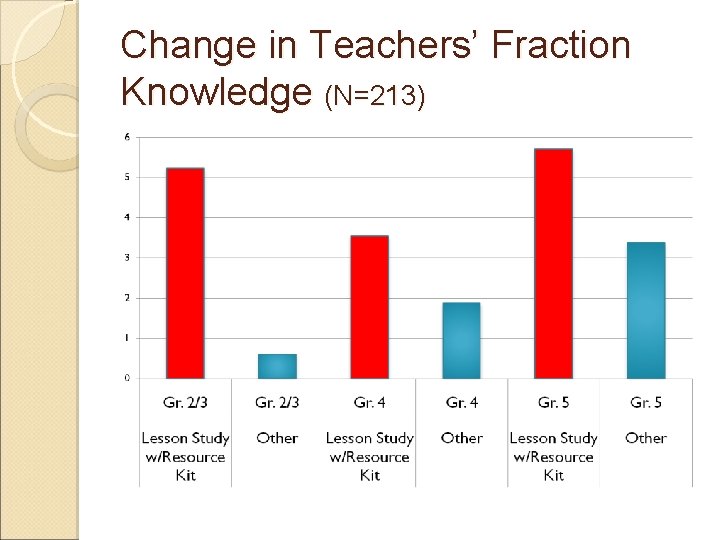
Change in Teachers’ Fraction Knowledge (N=213)
Teachers’ Reflections “The way American schools have traditionally taught fractions is by using circles, pizzas, etc. I have never heard of introducing fractions through linear measurement. The idea of starting with a unit (e. g. , meter) and having students explore fractions in this manner is very interesting and new for me. This lesson helped broaden my own understanding of fractions by seeing them as parts of a whole and numbers. ”
Teachers’ Reflections “The question of linear versus a “pie” understanding was really compelling for me. It’s a distinction in the concept of fractions that I hadn’t considered and I wonder what my own understanding of fractions would be like if I had been first introduced that way. ”
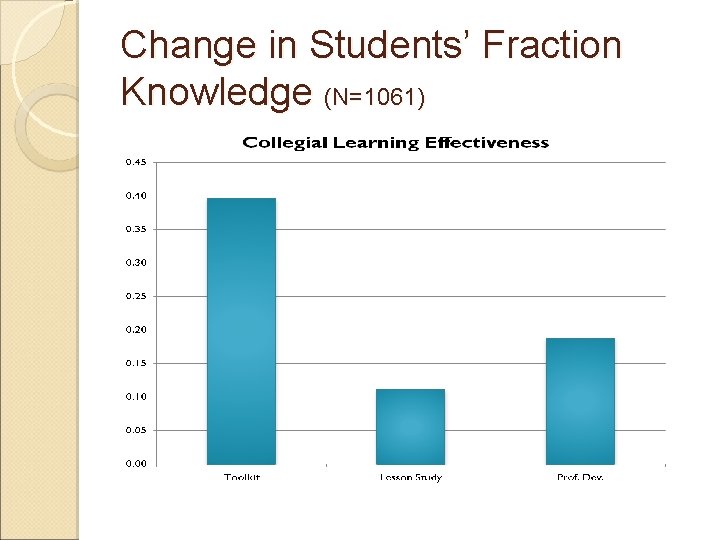
Change in Students’ Fraction Knowledge (N=1061)
Teachers’ Reflections “The linear approach to teaching fractions was a far, far superior method to use to introduce fractions. The students saw that three 1/3 meter equaled a meter. The language the students used during the lesson was very similar to that shown in the Japanese students lesson books without any instruction toward that end. Furthermore, this ‘talk’ extended into future fraction lessons…[students] showed an understanding of fractions beyond what we usually see…”
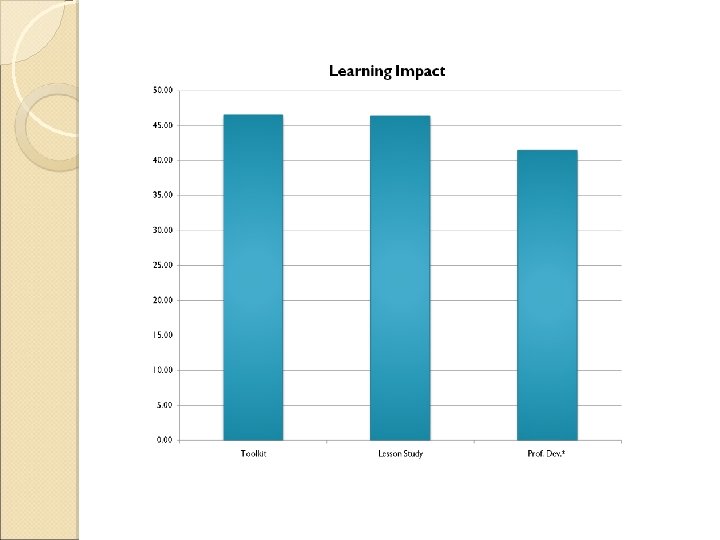
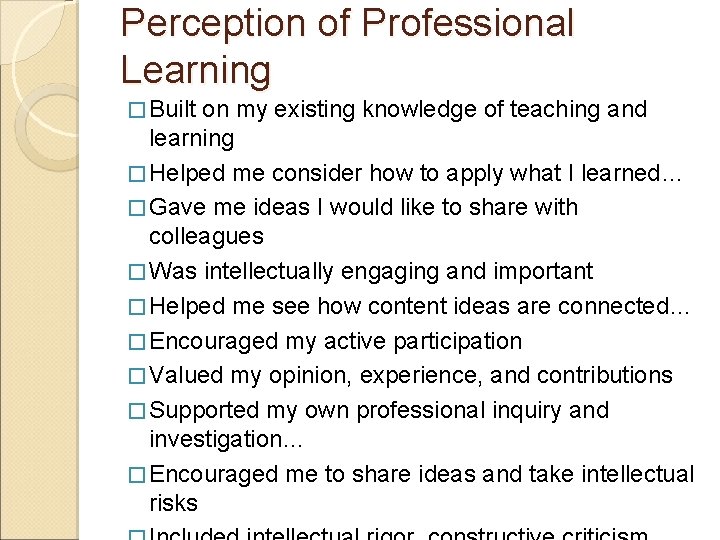
Teachers’ Responses to Professional Learning �Teachers in both lesson study conditions rated their professional learning significantly more positively on a variety of indicators (e. g. , intellectual rigor, usefulness in classroom, encouragement of leadership, etc. )
Collegial Learning Effectiveness I have learned a lot about student thinking by working with colleagues Working on mathematics tasks with colleagues is often unpleasant I have good opportunities to learn about the mathematics taught at different grade levels I have learned a great deal about mathematics teaching from colleagues I find it useful to solve mathematics problems with colleagues
Perception of Professional Learning � Built on my existing knowledge of teaching and learning � Helped me consider how to apply what I learned… � Gave me ideas I would like to share with colleagues � Was intellectually engaging and important � Helped me see how content ideas are connected… � Encouraged my active participation � Valued my opinion, experience, and contributions � Supported my own professional inquiry and investigation… � Encouraged me to share ideas and take intellectual risks
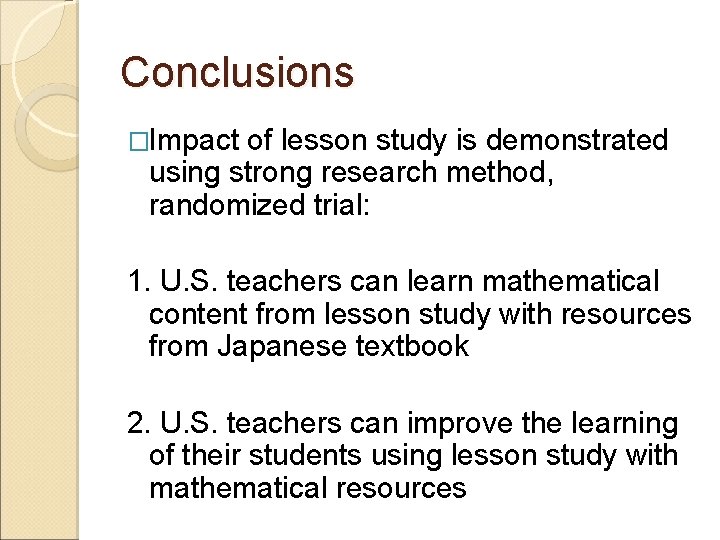
Conclusions �Impact of lesson study is demonstrated using strong research method, randomized trial: 1. U. S. teachers can learn mathematical content from lesson study with resources from Japanese textbook 2. U. S. teachers can improve the learning of their students using lesson study with mathematical resources
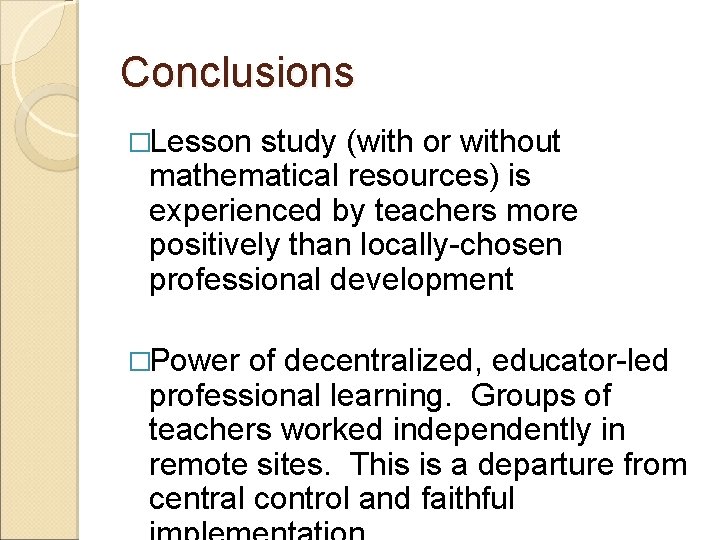
Conclusions �Lesson study (with or without mathematical resources) is experienced by teachers more positively than locally-chosen professional development �Power of decentralized, educator-led professional learning. Groups of teachers worked independently in remote sites. This is a departure from central control and faithful
Fractions Resource Kit (Electronic Version) http: //www. lessonresearch. net/FRACTI ONTK/fractions_toolkit. html Thank you! Catherine Lewis clewis@mills. edu www. lessonresearch. net