
Lesson Starter What 3 things to seeds need
- Slides: 38
Lesson Starter • What 3 things to seeds need in order to germinate? • What does germination mean? • What are the 3 parts of the seed and their function?
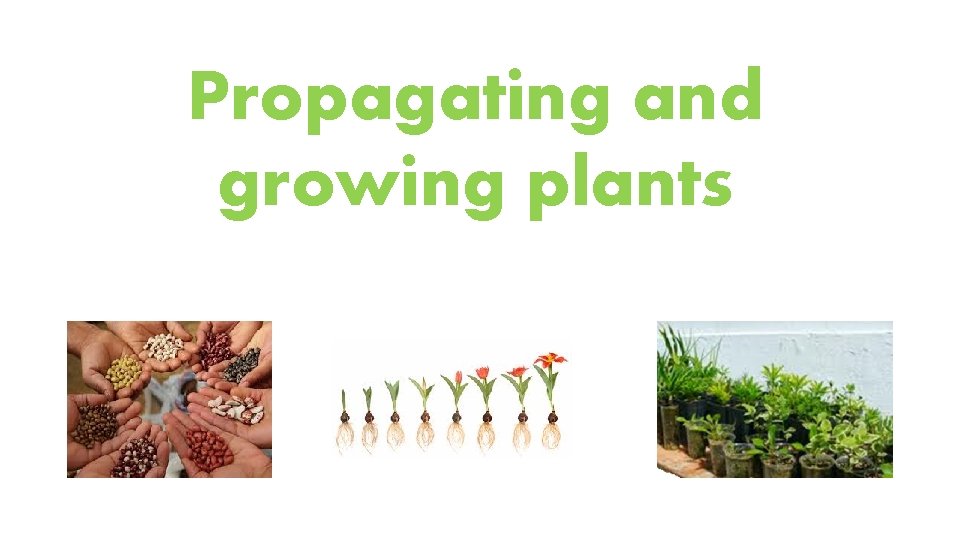
Propagating and growing plants
Learning intention • To Investigate germination
Seed Dormancy • Seeds are prevented from germinating when the environment is unsuitable (and their chances of survival is low) • They remain DORMANT until the conditions are favourable
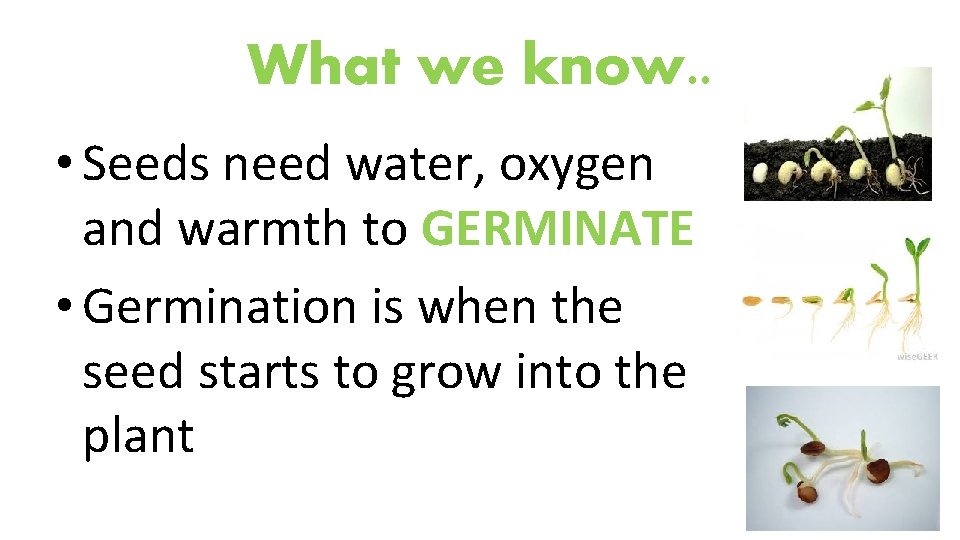
What we know. . • Seeds need water, oxygen and warmth to GERMINATE • Germination is when the seed starts to grow into the plant
Investigation 1. Will seeds germinate in the absence of WATER? 2. Will seeds germinate in the absence of WARMTH?
Plan • Using seeds, cotton wool, petri dishes and water- how could we carry out the two investigations? • With the person next to you write a plan for what you are going to do • REMEMBER YOU MUST HAVE A CONTROL
Without water • Collect two petri dishes, cotton wool and seeds • Line each of the petri dishes with cotton wool • Into each dish place 10 seeds- spread them out as evenly as possible • Water the seeds in ONE OF THE DISHES • Place both dishes along the window
Without warmth • • Collect two petri dishes, cotton wool and seeds Line each of the dishes with cotton wool Place 10 seeds in each dish- spread out evenly Water both dishes- place one at the window and give one to me to go in the fridge
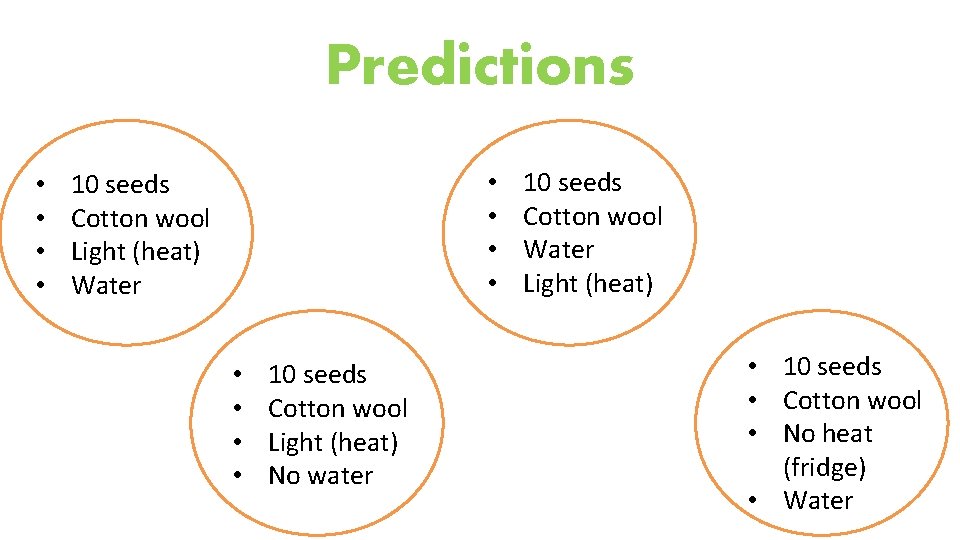
Predictions • • 10 seeds Cotton wool Light (heat) Water • • 10 seeds Cotton wool Light (heat) No water 10 seeds Cotton wool Water Light (heat) • 10 seeds • Cotton wool • No heat (fridge) • Water
Learning Intention • Vegetative Propagation
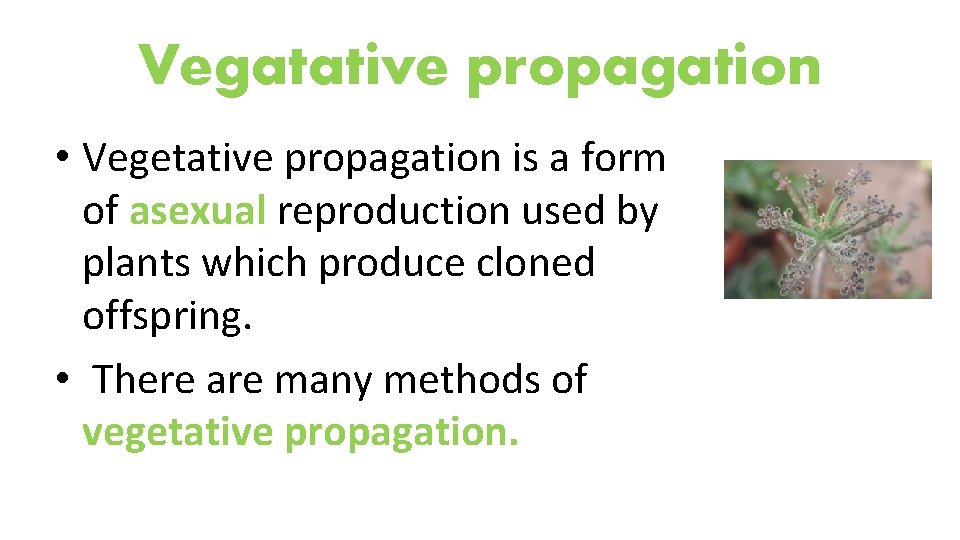
Vegatative propagation • Vegetative propagation is a form of asexual reproduction used by plants which produce cloned offspring. • There are many methods of vegetative propagation.
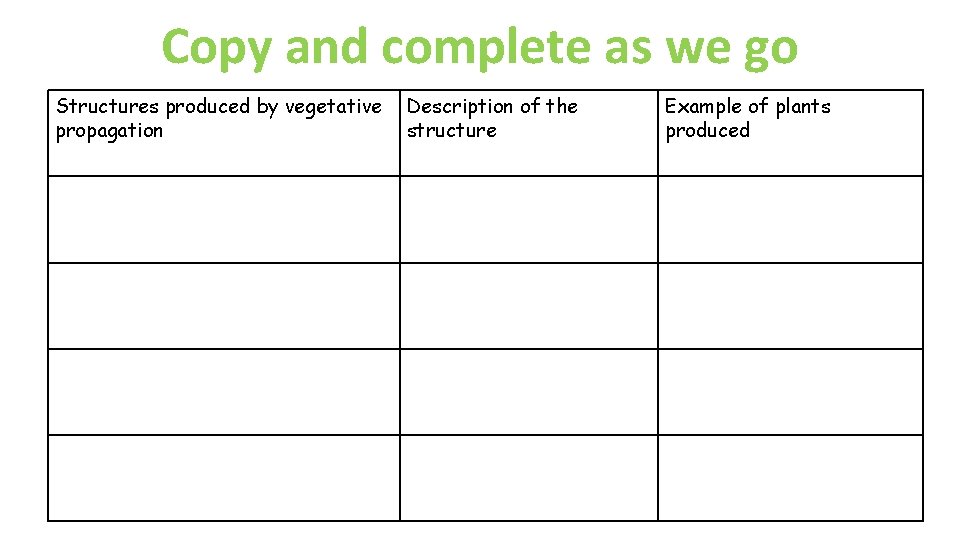
Copy and complete as we go Structures produced by vegetative propagation Description of the structure Example of plants produced
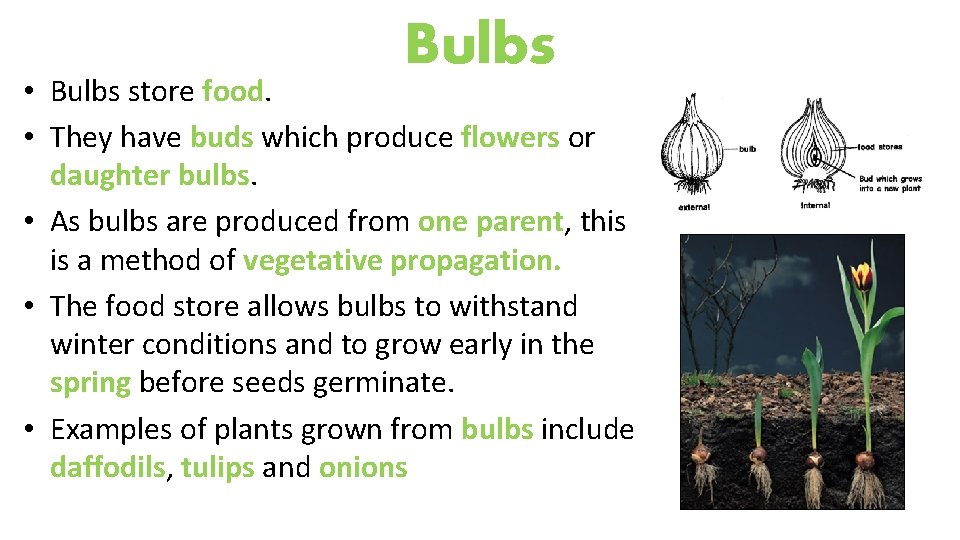
Bulbs • Bulbs store food. • They have buds which produce flowers or daughter bulbs. • As bulbs are produced from one parent, this is a method of vegetative propagation. • The food store allows bulbs to withstand winter conditions and to grow early in the spring before seeds germinate. • Examples of plants grown from bulbs include daffodils, tulips and onions
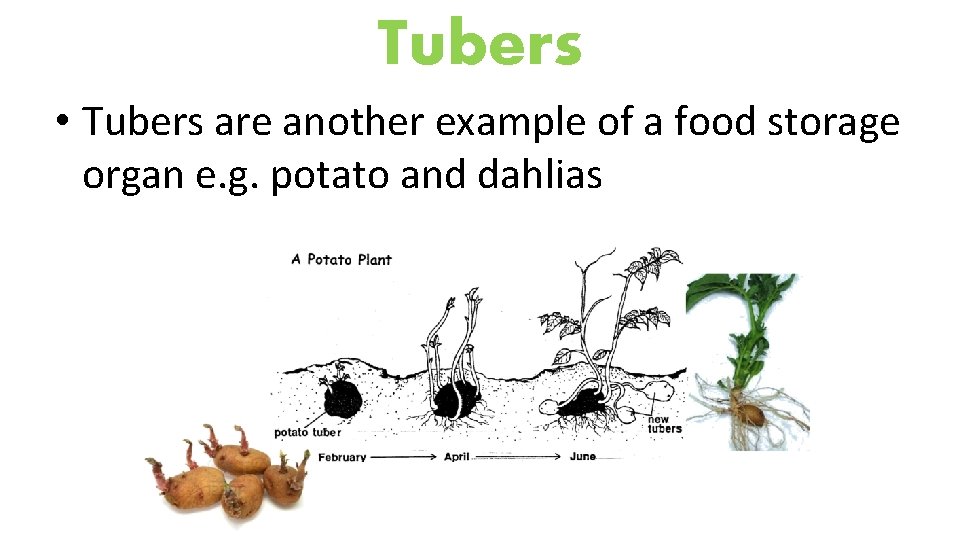
Tubers • Tubers are another example of a food storage organ e. g. potato and dahlias
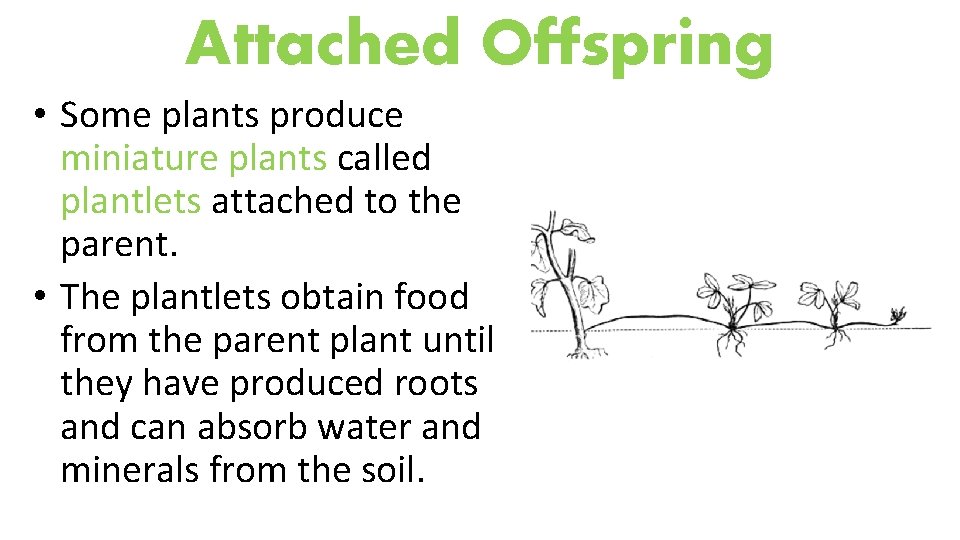
Attached Offspring • Some plants produce miniature plants called plantlets attached to the parent. • The plantlets obtain food from the parent plant until they have produced roots and can absorb water and minerals from the soil.
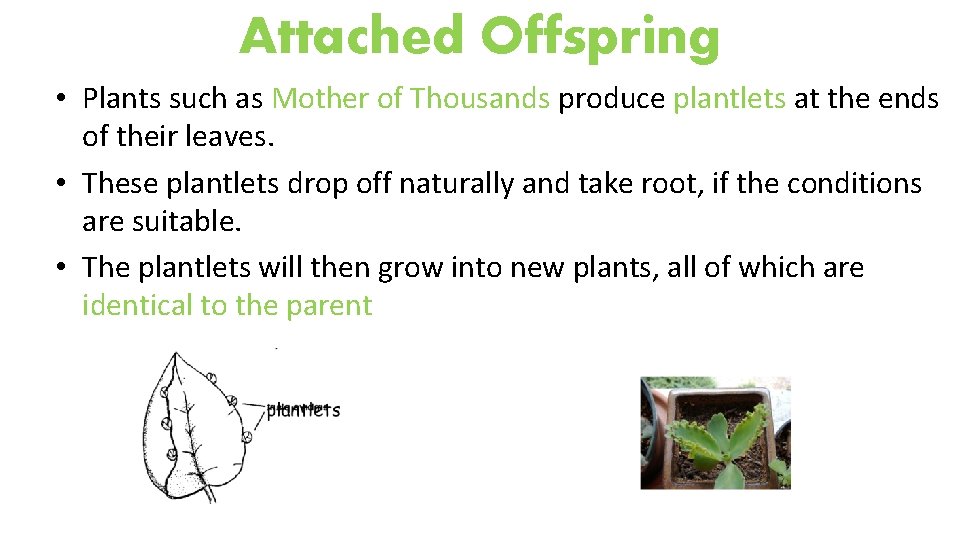
Attached Offspring • Plants such as Mother of Thousands produce plantlets at the ends of their leaves. • These plantlets drop off naturally and take root, if the conditions are suitable. • The plantlets will then grow into new plants, all of which are identical to the parent
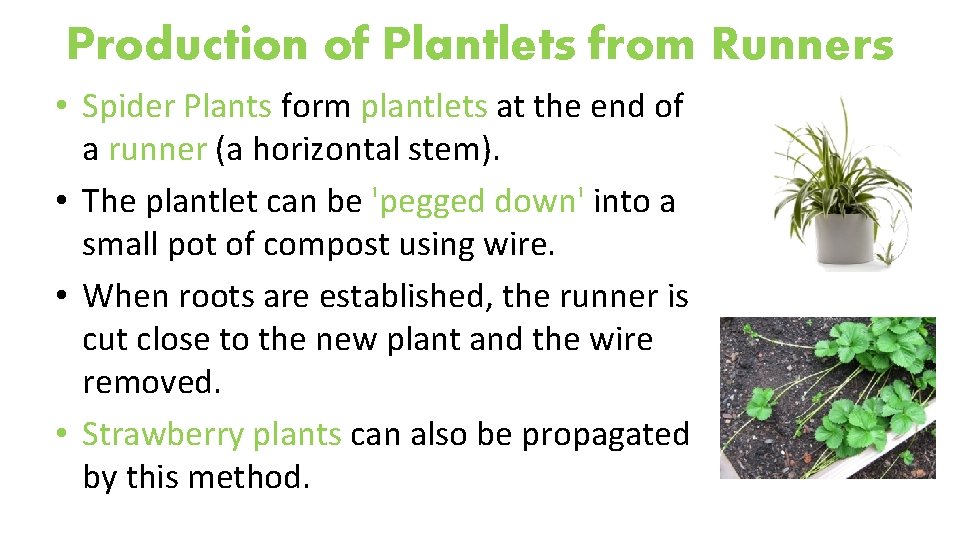
Production of Plantlets from Runners • Spider Plants form plantlets at the end of a runner (a horizontal stem). • The plantlet can be 'pegged down' into a small pot of compost using wire. • When roots are established, the runner is cut close to the new plant and the wire removed. • Strawberry plants can also be propagated by this method.
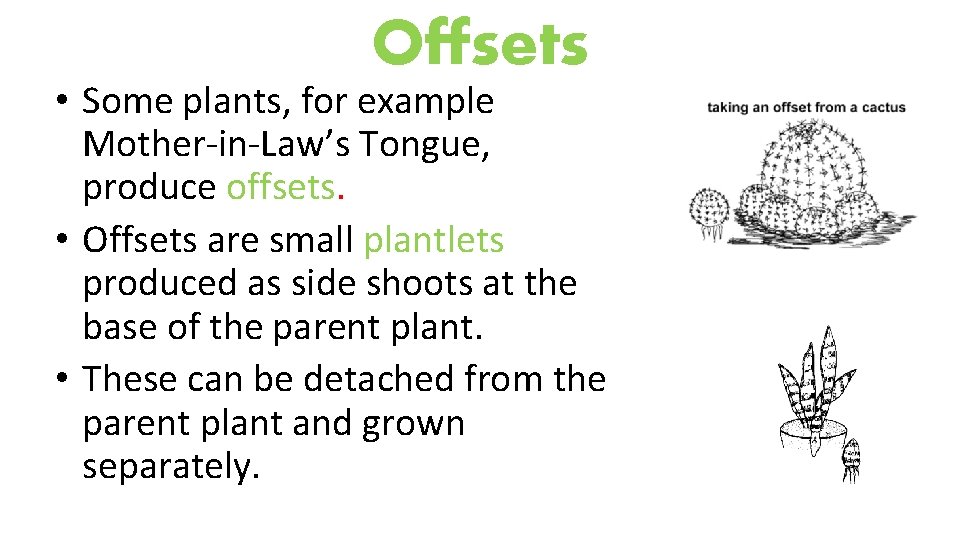
Offsets • Some plants, for example Mother-in-Law’s Tongue, produce offsets. • Offsets are small plantlets produced as side shoots at the base of the parent plant. • These can be detached from the parent plant and grown separately.
Learning Intention • Artificial Propagation
Artificial Propagation • A new plant can be grown from part of the original plant. • Artificial propagation means that part of a plant, for example a stem or leaf, is cut off from its parent and treated so that it grows into a new plant. • This method is quicker than waiting for the parent plant to produce seeds and all new plants will be exactly like the parent plant e. g. same colour of flower and leaves.
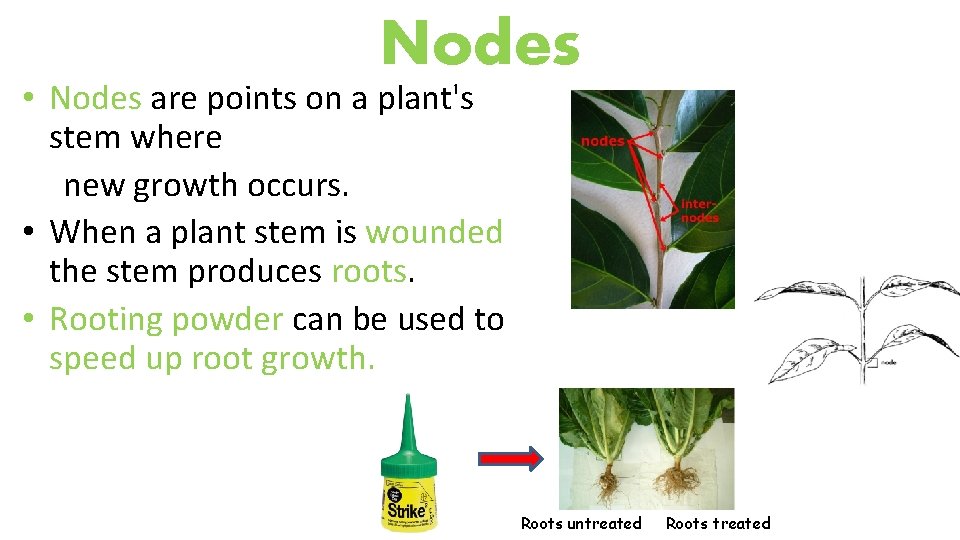
Nodes • Nodes are points on a plant's stem where new growth occurs. • When a plant stem is wounded the stem produces roots. • Rooting powder can be used to speed up root growth. Roots untreated Roots treated
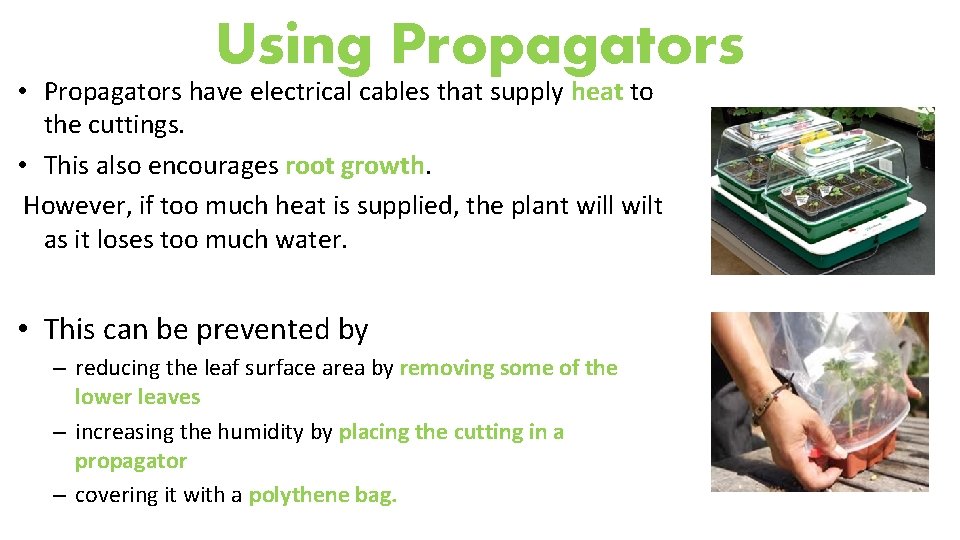
Using Propagators • Propagators have electrical cables that supply heat to the cuttings. • This also encourages root growth. However, if too much heat is supplied, the plant will wilt as it loses too much water. • This can be prevented by – reducing the leaf surface area by removing some of the lower leaves – increasing the humidity by placing the cutting in a propagator – covering it with a polythene bag.
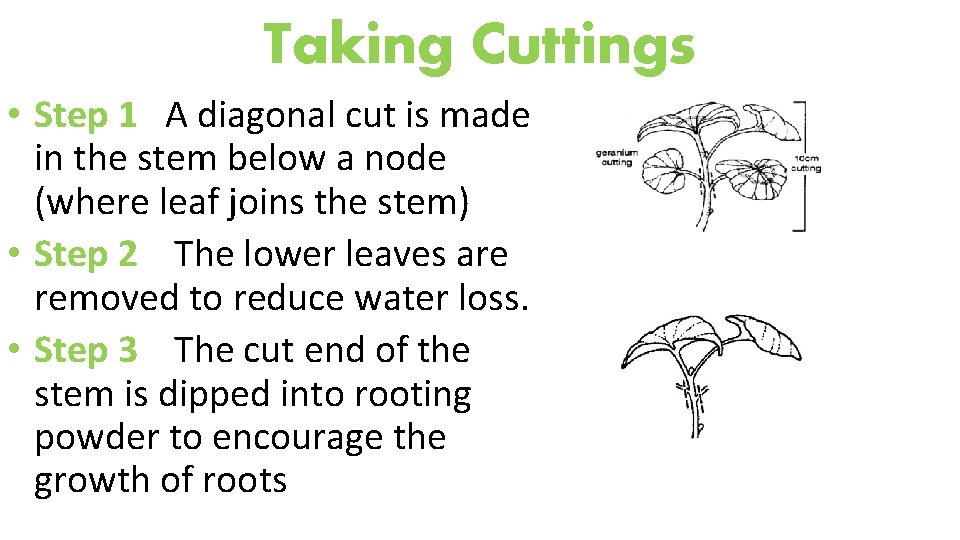
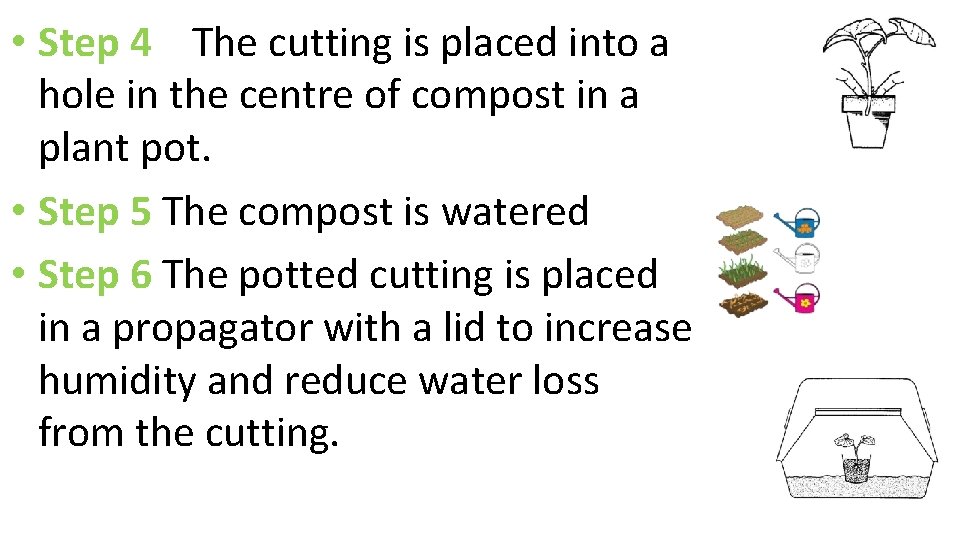
Taking Cuttings • Step 1 A diagonal cut is made in the stem below a node (where leaf joins the stem) • Step 2 The lower leaves are removed to reduce water loss. • Step 3 The cut end of the stem is dipped into rooting powder to encourage the growth of roots
• Step 4 The cutting is placed into a hole in the centre of compost in a plant pot. • Step 5 The compost is watered • Step 6 The potted cutting is placed in a propagator with a lid to increase humidity and reduce water loss from the cutting.
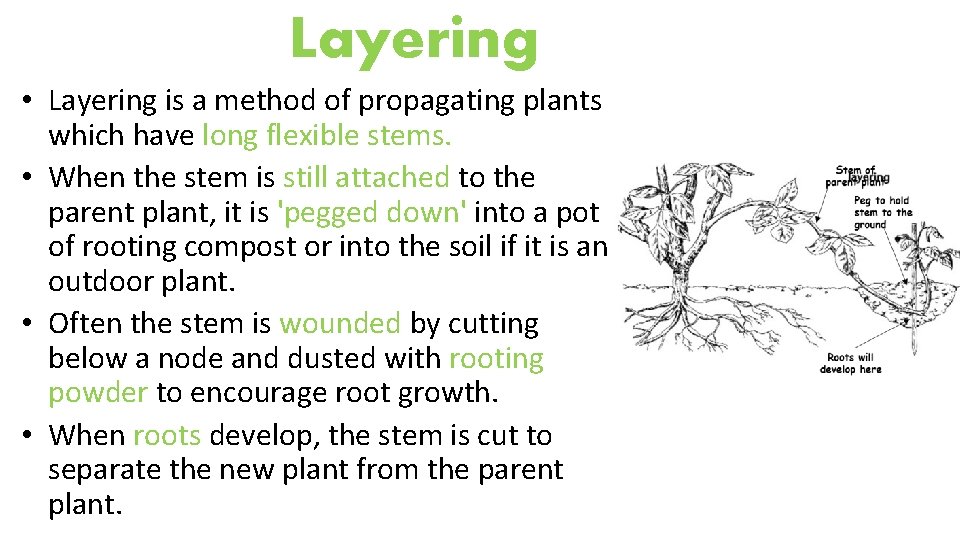
Layering • Layering is a method of propagating plants which have long flexible stems. • When the stem is still attached to the parent plant, it is 'pegged down' into a pot of rooting compost or into the soil if it is an outdoor plant. • Often the stem is wounded by cutting below a node and dusted with rooting powder to encourage root growth. • When roots develop, the stem is cut to separate the new plant from the parent plant.
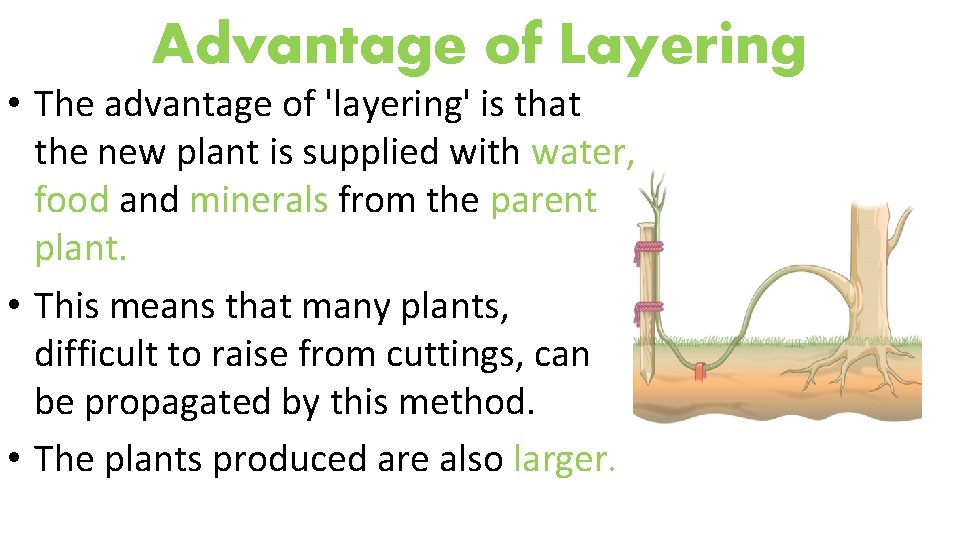
Advantage of Layering • The advantage of 'layering' is that the new plant is supplied with water, food and minerals from the parent plant. • This means that many plants, difficult to raise from cuttings, can be propagated by this method. • The plants produced are also larger.
Questions: Answer in sentences • Give two examples of how artificial methods can be used to grow plants • Give two methods used to encourage the growth of roots in new plants • Give an advantage of layering as a means of propagating plants
Learning Intention • Cultivating plants
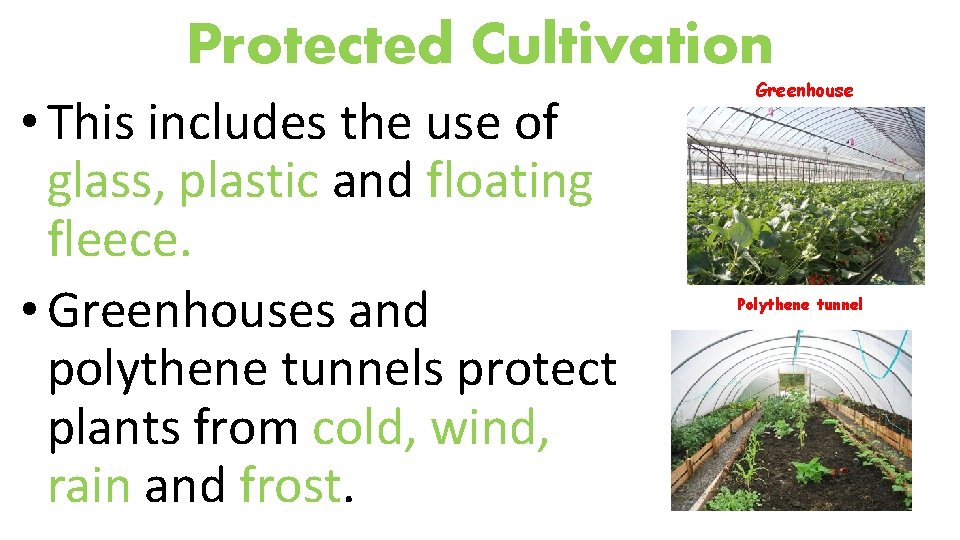
Protected Cultivation • This includes the use of glass, plastic and floating fleece. • Greenhouses and polythene tunnels protect plants from cold, wind, rain and frost. Greenhouse Polythene tunnel
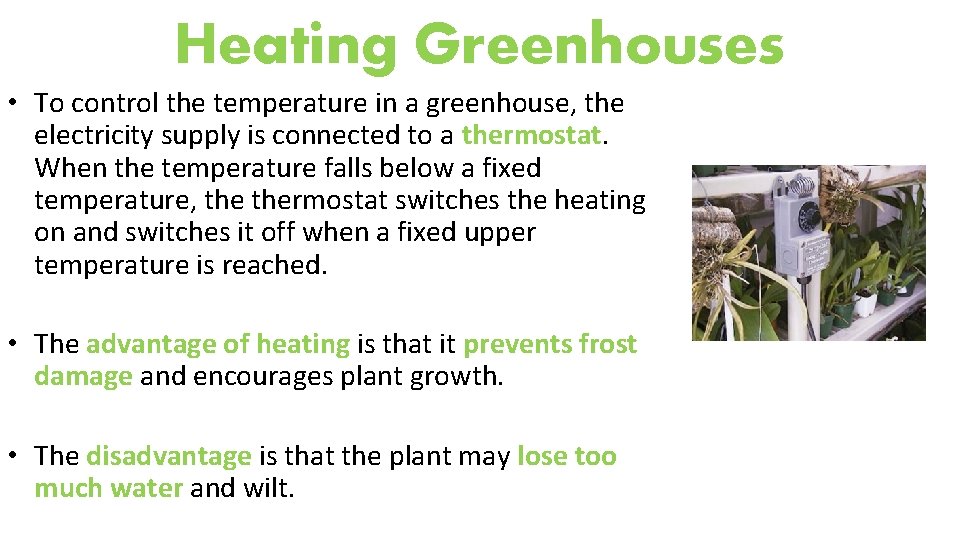
Heating Greenhouses • To control the temperature in a greenhouse, the electricity supply is connected to a thermostat. When the temperature falls below a fixed temperature, thermostat switches the heating on and switches it off when a fixed upper temperature is reached. • The advantage of heating is that it prevents frost damage and encourages plant growth. • The disadvantage is that the plant may lose too much water and wilt.
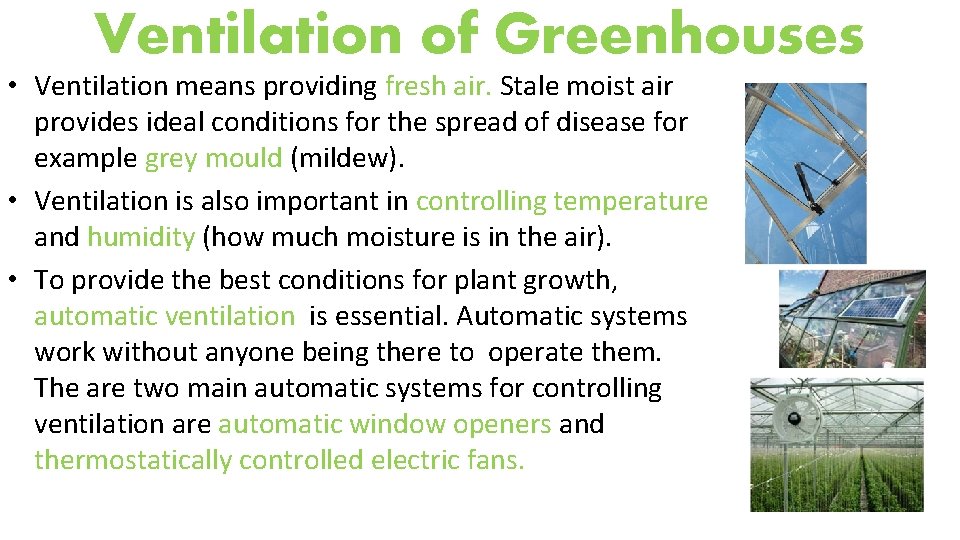
Ventilation of Greenhouses • Ventilation means providing fresh air. Stale moist air provides ideal conditions for the spread of disease for example grey mould (mildew). • Ventilation is also important in controlling temperature and humidity (how much moisture is in the air). • To provide the best conditions for plant growth, automatic ventilation is essential. Automatic systems work without anyone being there to operate them. The are two main automatic systems for controlling ventilation are automatic window openers and thermostatically controlled electric fans.
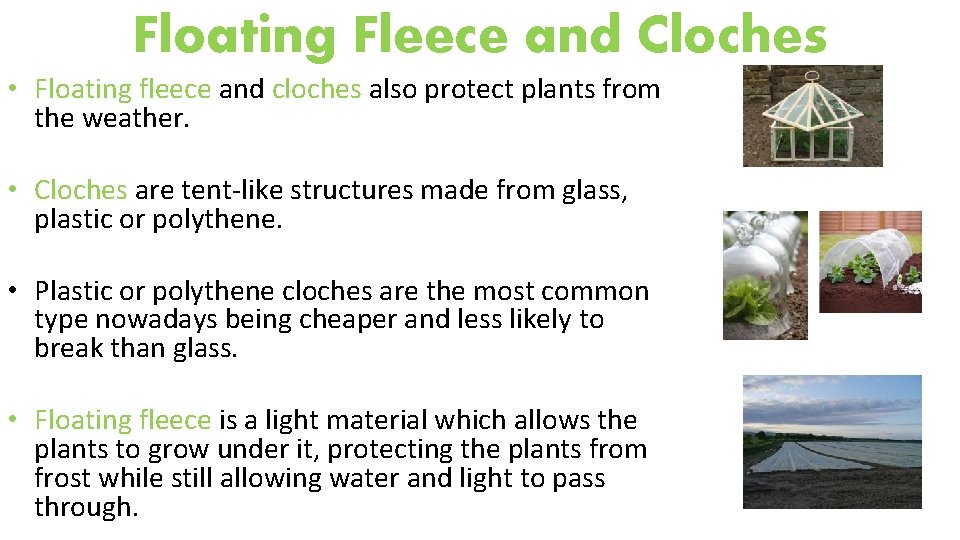
Floating Fleece and Cloches • Floating fleece and cloches also protect plants from the weather. • Cloches are tent-like structures made from glass, plastic or polythene. • Plastic or polythene cloches are the most common type nowadays being cheaper and less likely to break than glass. • Floating fleece is a light material which allows the plants to grow under it, protecting the plants from frost while still allowing water and light to pass through.
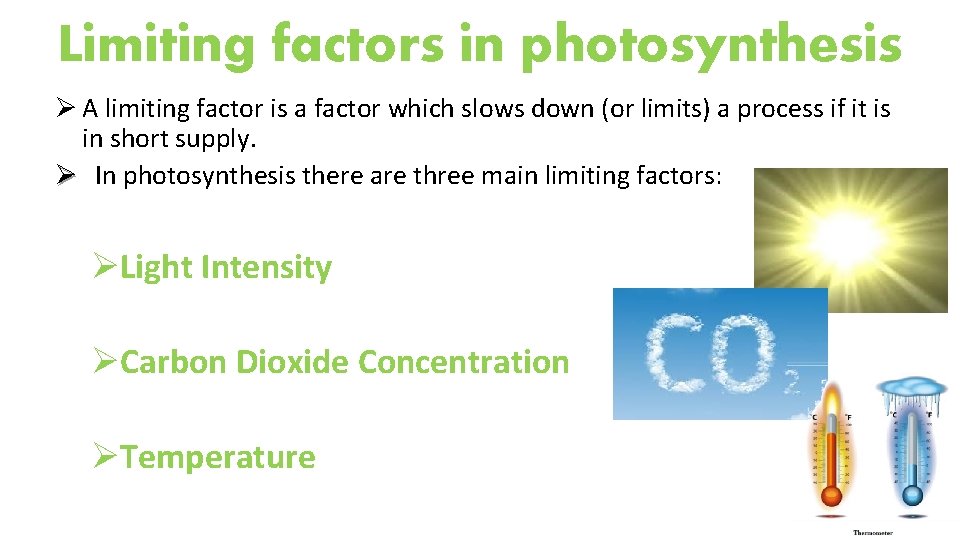
Limiting factors in photosynthesis Ø A limiting factor is a factor which slows down (or limits) a process if it is in short supply. Ø In photosynthesis there are three main limiting factors: ØLight Intensity ØCarbon Dioxide Concentration ØTemperature
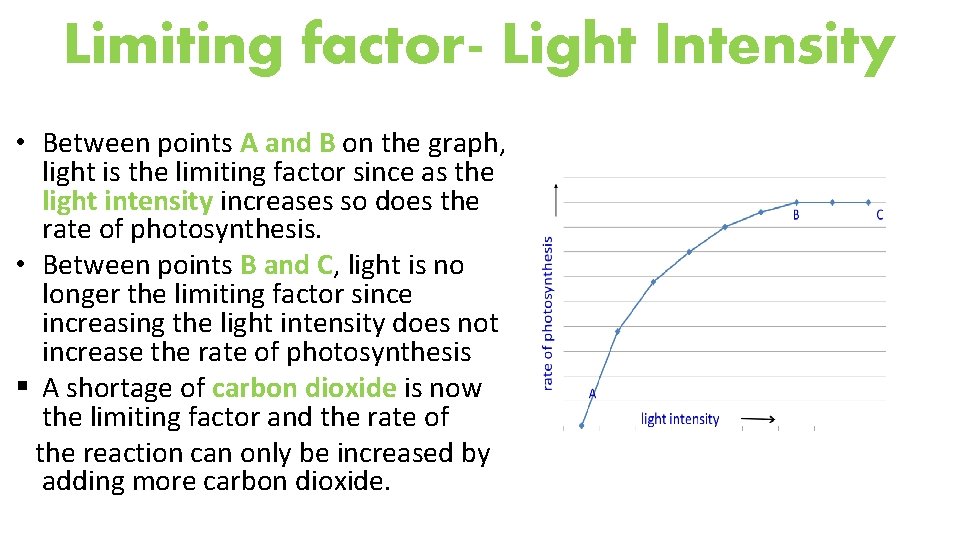
Limiting factor- Light Intensity • Between points A and B on the graph, light is the limiting factor since as the light intensity increases so does the rate of photosynthesis. • Between points B and C, light is no longer the limiting factor since increasing the light intensity does not increase the rate of photosynthesis § A shortage of carbon dioxide is now the limiting factor and the rate of the reaction can only be increased by adding more carbon dioxide.
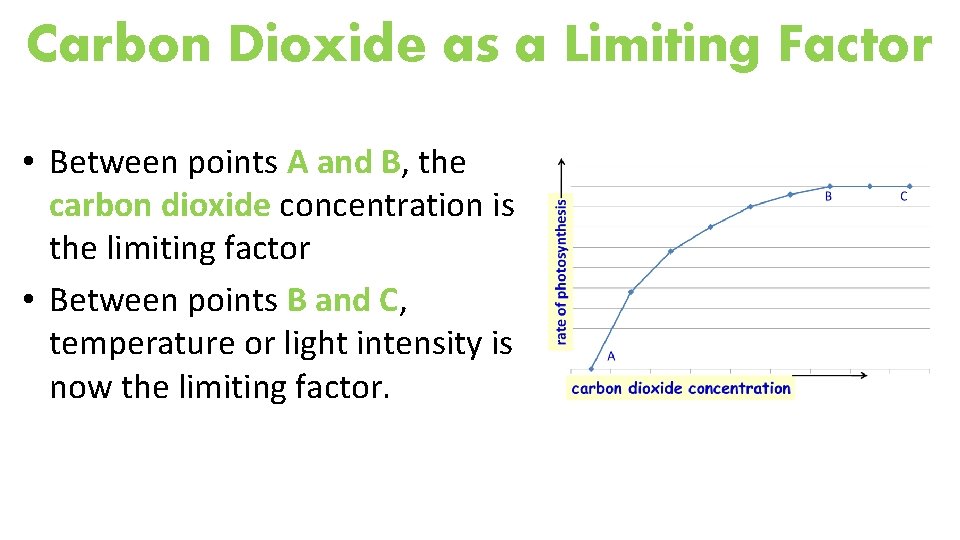
Carbon Dioxide as a Limiting Factor • Between points A and B, the carbon dioxide concentration is the limiting factor • Between points B and C, temperature or light intensity is now the limiting factor.
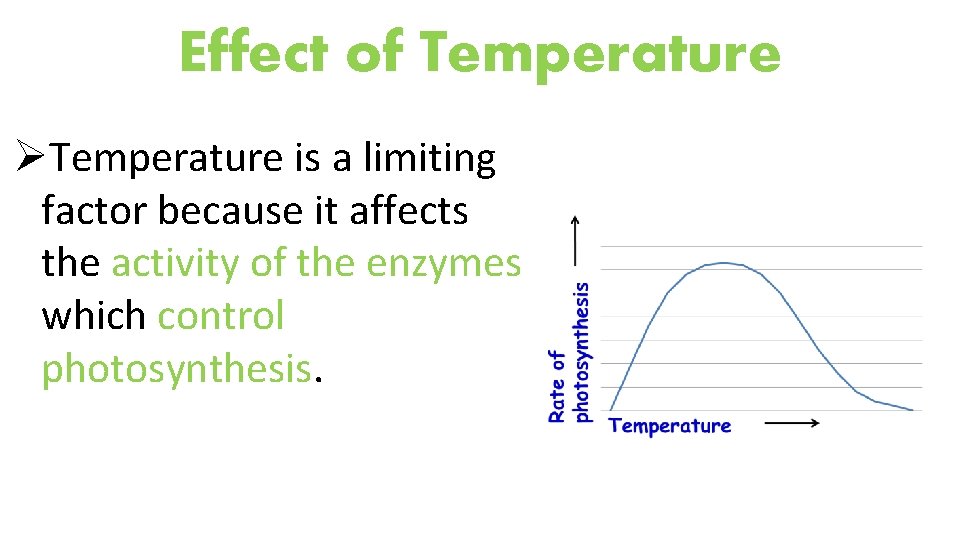
Effect of Temperature ØTemperature is a limiting factor because it affects the activity of the enzymes which control photosynthesis.
Questions 1. Name two different structures used for protected cultivation 2. What is the effect on plant growth of adding additional carbon dioxide? 3. How can a gardener control heat in a greenhouse?