
Lesson Section 6 1 Constructing Antiderivatives Graphically Numerically



- Slides: 12
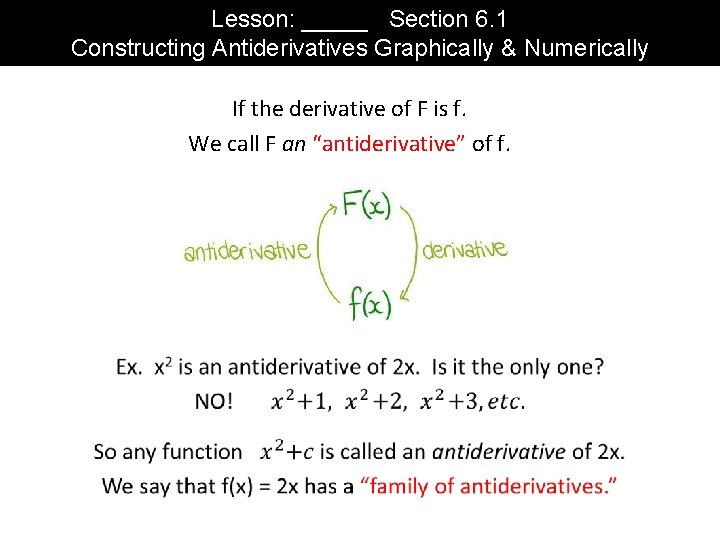
Lesson: _____ Section 6. 1 Constructing Antiderivatives Graphically & Numerically If the derivative of F is f. We call F an “antiderivative” of f.
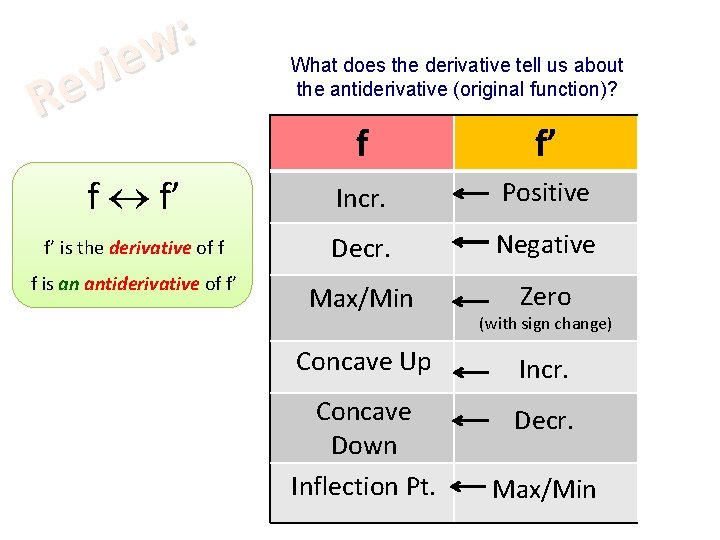
: w e i v Re What does the derivative tell us about the antiderivative (original function)? f f’ f f’ Incr. Positive f’ is the derivative of f Decr. Negative f is an antiderivative of f’ Max/Min Zero (with sign change) Concave Up Incr. Concave Down Inflection Pt. Decr. Max/Min
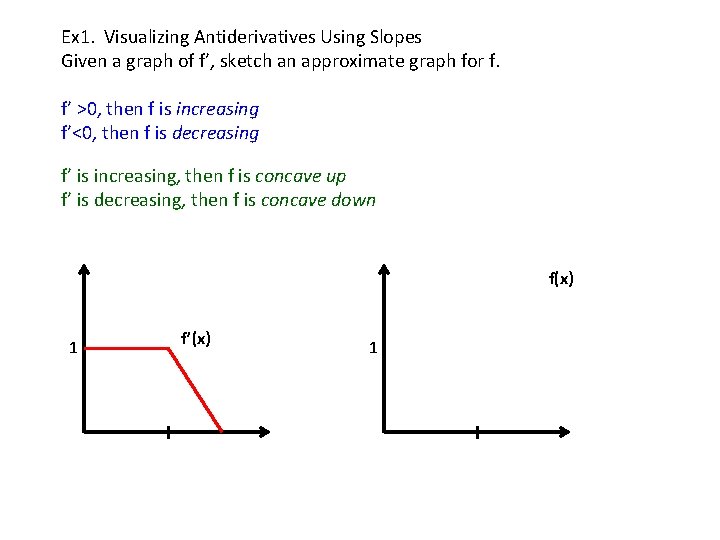
Ex 1. Visualizing Antiderivatives Using Slopes Given a graph of f’, sketch an approximate graph for f. f’ >0, then f is increasing f’<0, then f is decreasing f’ is increasing, then f is concave up f’ is decreasing, then f is concave down f(x) 1 f’(x) 1
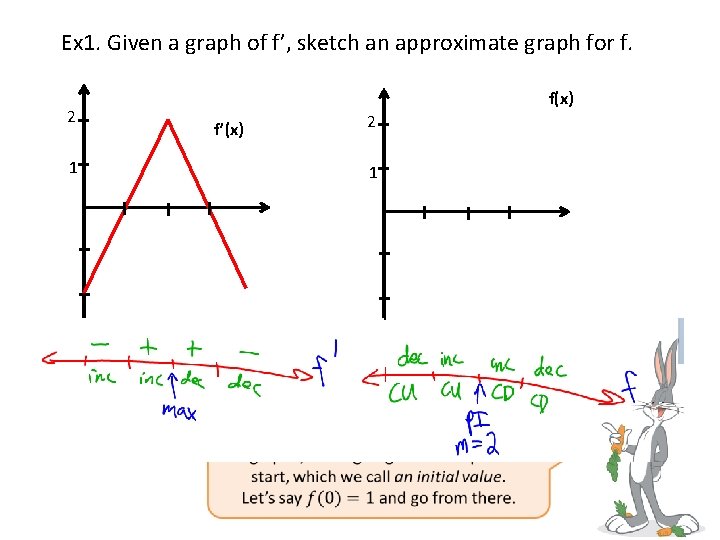
Ex 1. Given a graph of f’, sketch an approximate graph for f. 2 f(x) f’(x) 1 2 1 Nice try doc, but the derivative can’t give us the value of f, only the change in f.
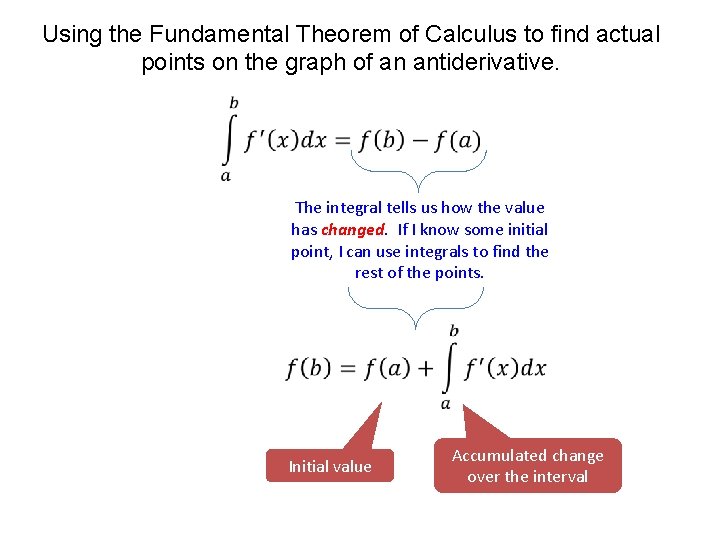
Using the Fundamental Theorem of Calculus to find actual points on the graph of an antiderivative. The integral tells us how the value has changed. If I know some initial point, I can use integrals to find the rest of the points. Initial value Accumulated change over the interval
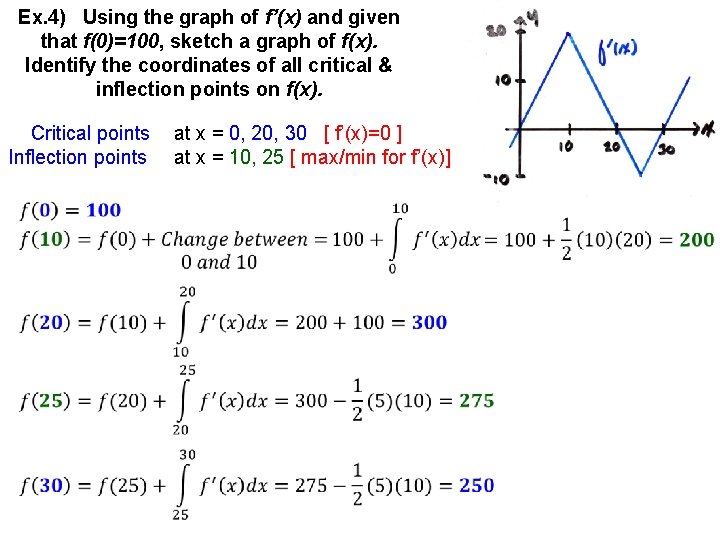
Ex. 4) Using the graph of f’(x) and given that f(0)=100, sketch a graph of f(x). Identify the coordinates of all critical & inflection points on f(x). Critical points Inflection points at x = 0, 20, 30 [ f’(x)=0 ] at x = 10, 25 [ max/min for f’(x)]
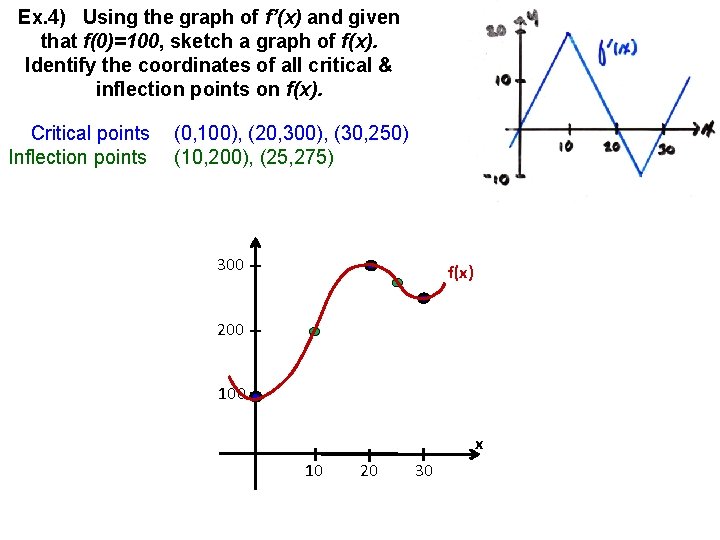
Ex. 4) Using the graph of f’(x) and given that f(0)=100, sketch a graph of f(x). Identify the coordinates of all critical & inflection points on f(x). Critical points Inflection points (0, 100), (20, 300), (30, 250) (10, 200), (25, 275) 300 f(x) 200 100 x 10 20 30
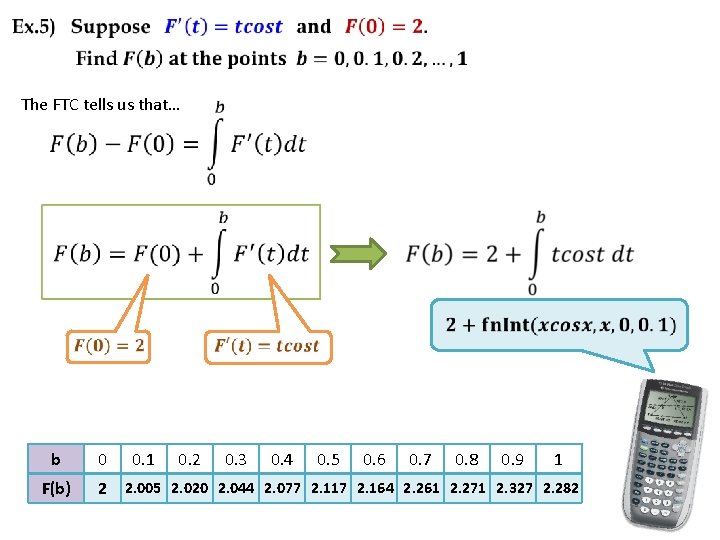
The FTC tells us that… b 0 F(b) 2 0. 1 0. 2 0. 3 0. 4 0. 5 0. 6 0. 7 0. 8 0. 9 1 2. 005 2. 020 2. 044 2. 077 2. 117 2. 164 2. 261 2. 271 2. 327 2. 282
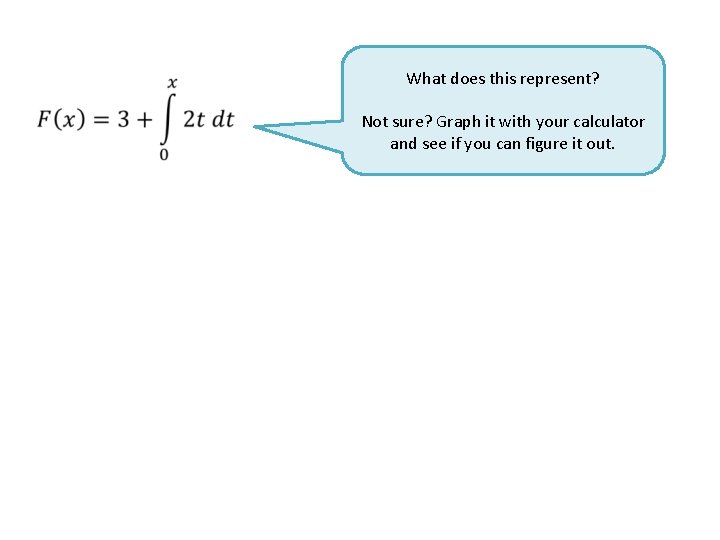
What does this represent? Not sure? Graph it with your calculator and see if you can figure it out.