
LESSON PLANS YOU CAN USE NOW W Lynne

- Slides: 66
LESSON PLANS YOU CAN USE NOW! W. Lynne Clarke, Ed. D. , RN President Georgia Health Science Technology Educators Association Health Science Educator, Thinc College and Career Academy, La. Grange, GA
Lesson and Activities Correlated with National Consortium for Health Science Education Foundation Standards
Lesson Plan #1 Cultural Diversity Standards Co-curricular connection: Sociology ■ 2. 12 Identify common barriers to communication. b. Psychological barriers (attitudes, bias, prejudice, stereotyping) ■ 2. 31 Utilize proper elements of written and electronic communication (spelling, grammar, and formatting). ■ 2. 32 Prepare examples of technical, informative, and creative writing. ■ 6. 21 Discuss religious and cultural values as they impact healthcare (such as: ethnicity, race, religion, gender). ■ 6. 22 Demonstrate respectful and empathetic treatment of ALL patients/clients (such as: customer service, patient satisfaction, civility).
Cultural Diversity Activities 1. Short lecture introducing major concepts and terminology OR Have students read chapter from text and complete worksheets 2. Cultural Diversity Project Students pretend they are working at a large hospital and have been assigned to produce a 2 page fact sheet or a tri-fold brochure to help educate the staff about a group of persons from a different country/culture that will soon be moving into the area and may be seeking healthcare.
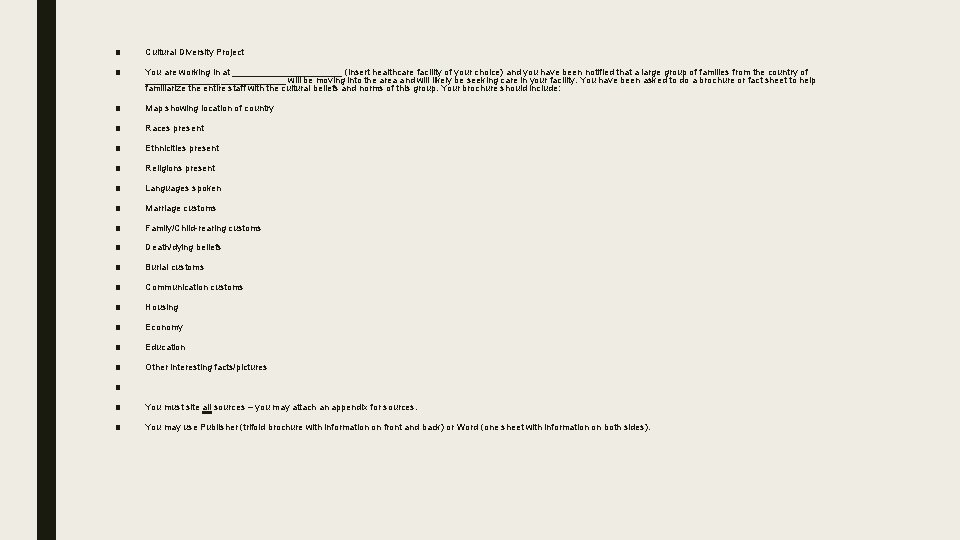
■ Cultural Diversity Project ■ You are working in at ___________ (insert healthcare facility of your choice) and you have been notified that a large group of families from the country of ______________ will be moving into the area and will likely be seeking care in your facility. You have been asked to do a brochure or fact sheet to help familiarize the entire staff with the cultural beliefs and norms of this group. Your brochure should include: ■ Map showing location of country ■ Races present ■ Ethnicities present ■ Religions present ■ Languages spoken ■ Marriage customs ■ Family/Child-rearing customs ■ Death/dying beliefs ■ Burial customs ■ Communication customs ■ Housing ■ Economy ■ Education ■ Other interesting facts/pictures ■ ■ You must site all sources – you may attach an appendix for sources. ■ You may use Publisher (trifold brochure with information on front and back) or Word (one sheet with information on both sides).
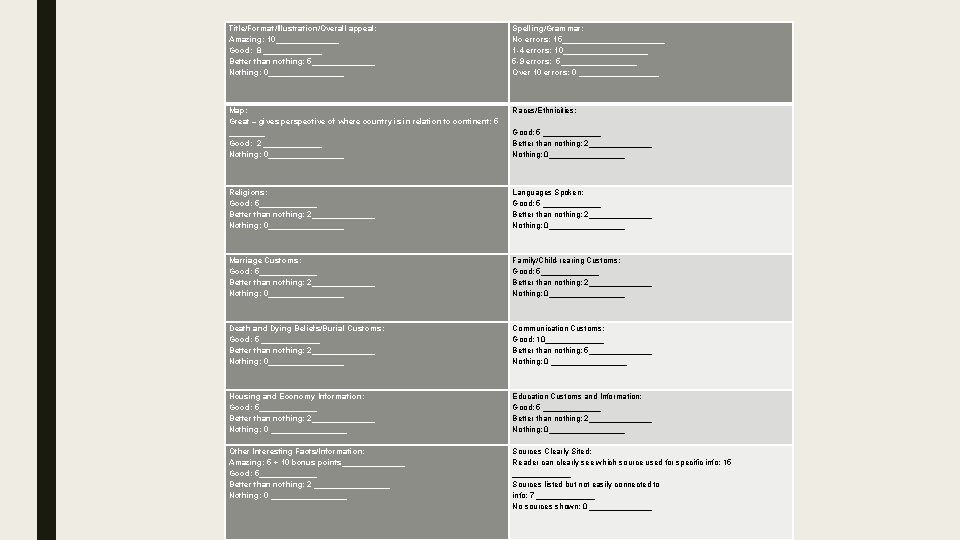
Title/Format/Illustration/Overall appeal: Amazing: 10_______ Good: 8 _______ Better than nothing: 5_______ Nothing: 0_________ Spelling/Grammar: No errors: 15____________ 1 -4 errors: 10__________ 5 -9 errors: 5_________ Over 10 errors: 0 _________ Map: Great – gives perspective of where country is in relation to continent: 5 ____ Good: 2 _______ Nothing: 0_________ Races/Ethnicities: Good: 5 _______ Better than nothing: 2_______ Nothing: 0_________ Religions: Good: 5_______ Better than nothing: 2_______ Nothing: 0_________ Languages Spoken: Good: 5 _______ Better than nothing: 2_______ Nothing: 0_________ Marriage Customs: Good: 5_______ Better than nothing: 2_______ Nothing: 0_________ Family/Child-rearing Customs: Good: 5_______ Better than nothing: 2_______ Nothing: 0_________ Death and Dying Beliefs/Burial Customs: Good: 5 _______ Better than nothing: 2_______ Nothing: 0_________ Communication Customs: Good: 10_______ Better than nothing: 5_______ Nothing: 0 _________ Housing and Economy Information: Good: 5_______ Better than nothing: 2_______ Nothing: 0 _________ Education Customs and Information: Good: 5 _______ Better than nothing: 2_______ Nothing: 0_________ Other Interesting Facts/Information: Amazing: 5 + 10 bonus points_______ Good: 5_______ Better than nothing: 2 _________ Nothing: 0 _________ Sources Clearly Sited: Reader can clearly see which source used for specific info: 15 _______ Sources listed but not easily connected to info: 7 _______ No sources shown: 0 _______
Lesson Plan #2 Career Exploration Co-curricular connection: ELA ■ 4. 31 Research levels of education, credentialing requirements, and employment trends in health professions
Career Exploration Activities 1. Short lecture on concepts and terminology related to career exploration OR Have students read chapter from text and complete worksheets 2. Explain Career Path Project – - you may give entire packet at one time or give it out as sections - students may submit electronically or paper copy
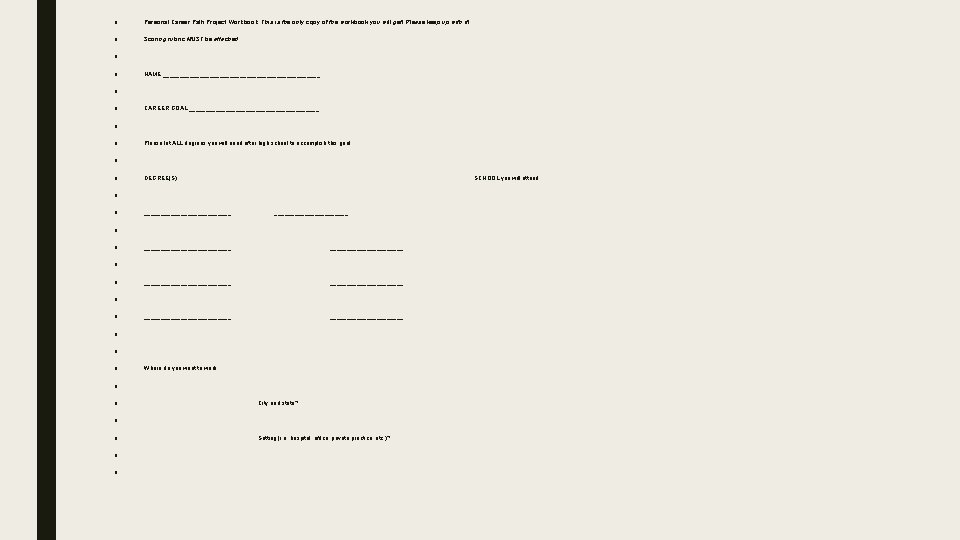
■ Personal Career Path Project Workbook This is the only copy of the workbook you will get! Please keep up with it! ■ Scoring rubric MUST be attached. ■ ■ NAME ________________________ ■ ■ CAREER GOAL ____________________ ■ ■ Please let ALL degrees you will need after high school to accomplish this goal: ■ ■ DEGREE(S) ■ ■ _____________ ■ ■ __________________________ ■ ■ ■ Where do you want to work: ■ ■ ■ ______________________ City and state? : ■ Setting (i. e. hospital, office, private practice, etc. )? : ■ ■ SCHOOL you will attend
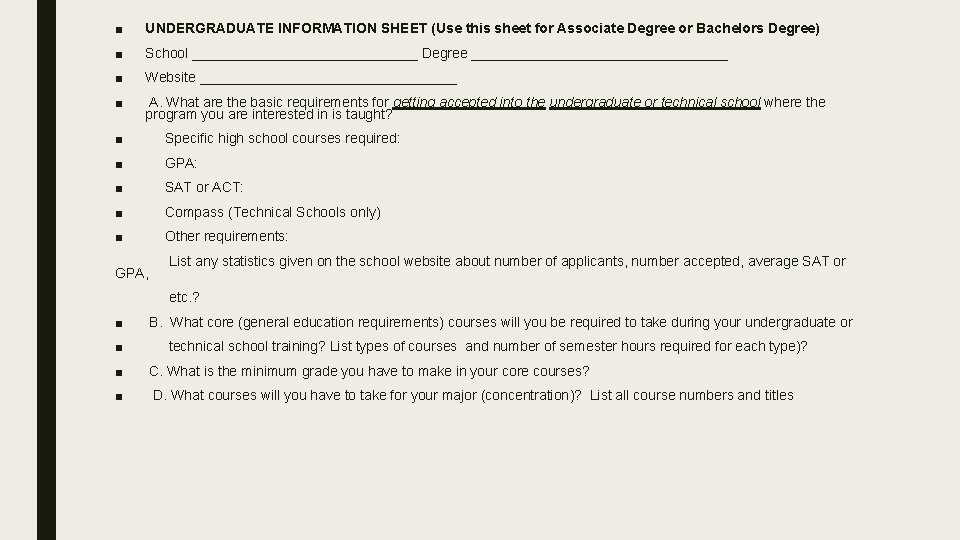
■ UNDERGRADUATE INFORMATION SHEET (Use this sheet for Associate Degree or Bachelors Degree) ■ School _______________ Degree _________________ ■ Website _________________ ■ A. What are the basic requirements for getting accepted into the undergraduate or technical school where the program you are interested in is taught? ■ Specific high school courses required: ■ GPA: ■ SAT or ACT: ■ Compass (Technical Schools only) ■ Other requirements: List any statistics given on the school website about number of applicants, number accepted, average SAT or GPA, etc. ? ■ B. What core (general education requirements) courses will you be required to take during your undergraduate or ■ technical school training? List types of courses and number of semester hours required for each type)? ■ C. What is the minimum grade you have to make in your core courses? ■ D. What courses will you have to take for your major (concentration)? List all course numbers and titles
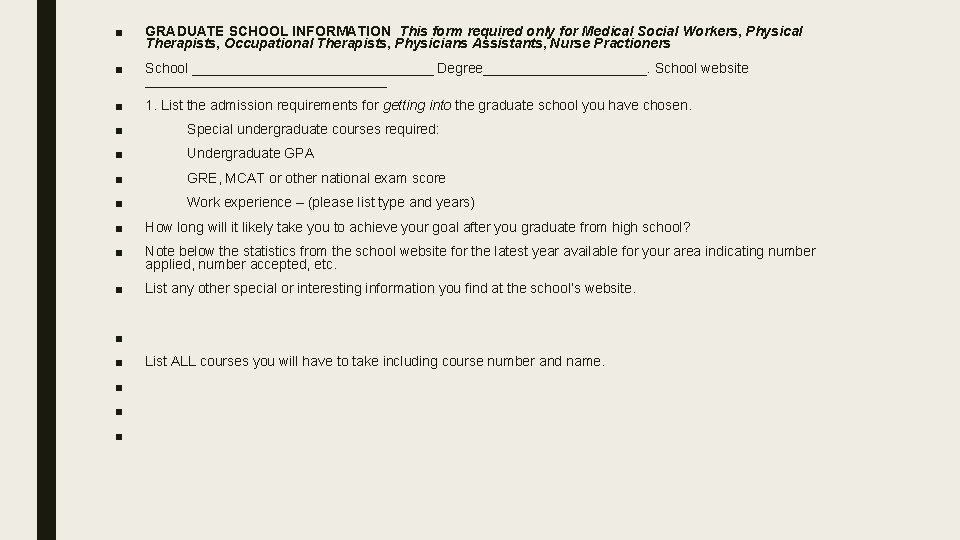
■ GRADUATE SCHOOL INFORMATION This form required only for Medical Social Workers, Physical Therapists, Occupational Therapists, Physicians Assistants, Nurse Practioners ■ School ________________ Degree___________. School website ________________ ■ 1. List the admission requirements for getting into the graduate school you have chosen. ■ Special undergraduate courses required: ■ Undergraduate GPA ■ GRE, MCAT or other national exam score ■ Work experience – (please list type and years) ■ How long will it likely take you to achieve your goal after you graduate from high school? ■ Note below the statistics from the school website for the latest year available for your area indicating number applied, number accepted, etc. ■ List any other special or interesting information you find at the school’s website. ■ ■ List ALL courses you will have to take including course number and name. ■ ■ ■
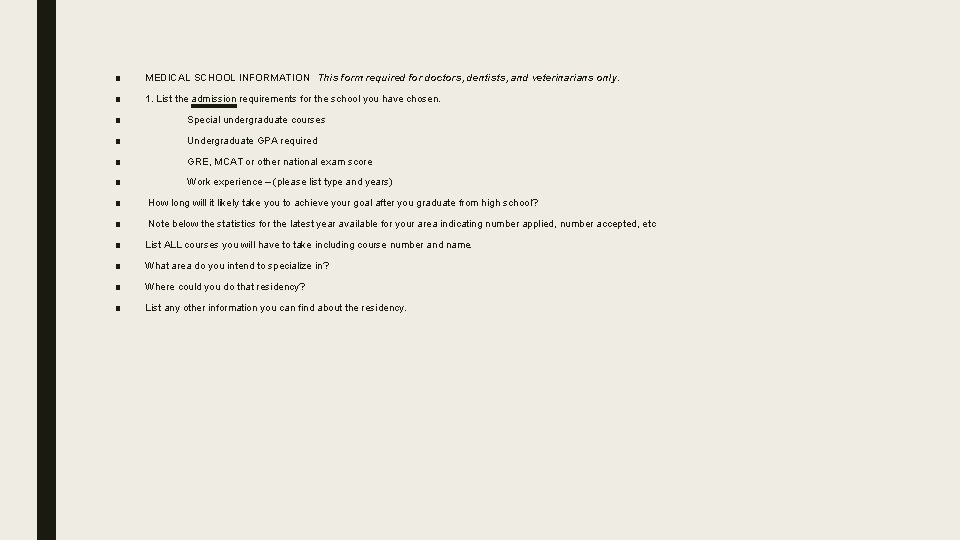
■ MEDICAL SCHOOL INFORMATION This form required for doctors, dentists, and veterinarians only. ■ 1. List the admission requirements for the school you have chosen. ■ Special undergraduate courses ■ Undergraduate GPA required ■ GRE, MCAT or other national exam score ■ Work experience – (please list type and years) ■ How long will it likely take you to achieve your goal after you graduate from high school? ■ Note below the statistics for the latest year available for your area indicating number applied, number accepted, etc. ■ List ALL courses you will have to take including course number and name. ■ What area do you intend to specialize in? ■ Where could you do that residency? ■ List any other information you can find about the residency.
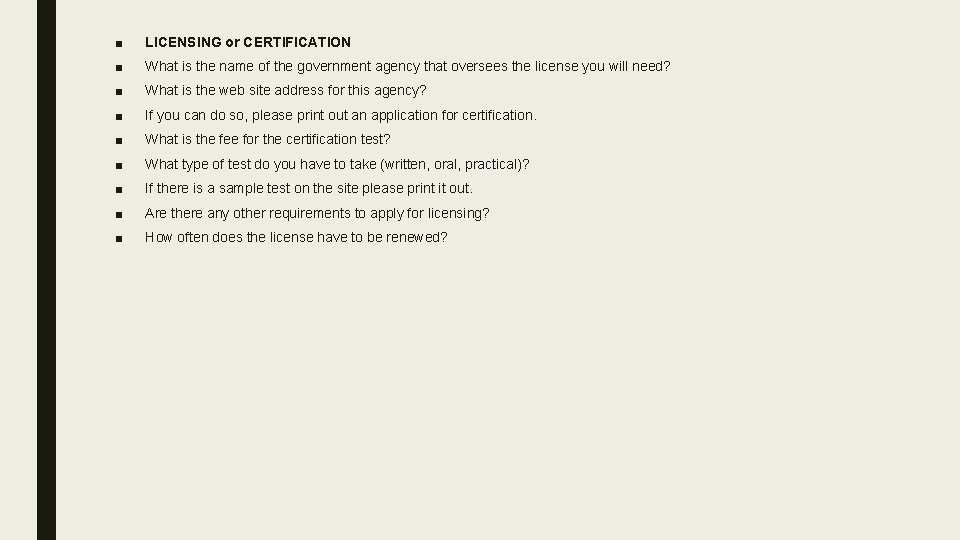
■ LICENSING or CERTIFICATION ■ What is the name of the government agency that oversees the license you will need? ■ What is the web site address for this agency? ■ If you can do so, please print out an application for certification. ■ What is the fee for the certification test? ■ What type of test do you have to take (written, oral, practical)? ■ If there is a sample test on the site please print it out. ■ Are there any other requirements to apply for licensing? ■ How often does the license have to be renewed?
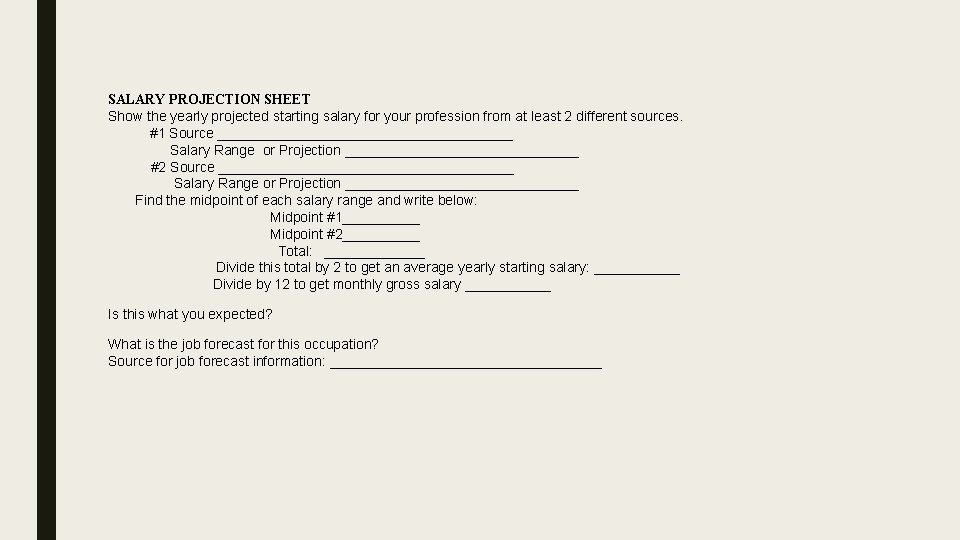
SALARY PROJECTION SHEET Show the yearly projected starting salary for your profession from at least 2 different sources. #1 Source ___________________ Salary Range or Projection _______________ #2 Source ___________________ Salary Range or Projection _______________ Find the midpoint of each salary range and write below: Midpoint #1_____ Midpoint #2_____ Total: _______ Divide this total by 2 to get an average yearly starting salary: ______ Divide by 12 to get monthly gross salary ______ Is this what you expected? What is the job forecast for this occupation? Source for job forecast information: __________________
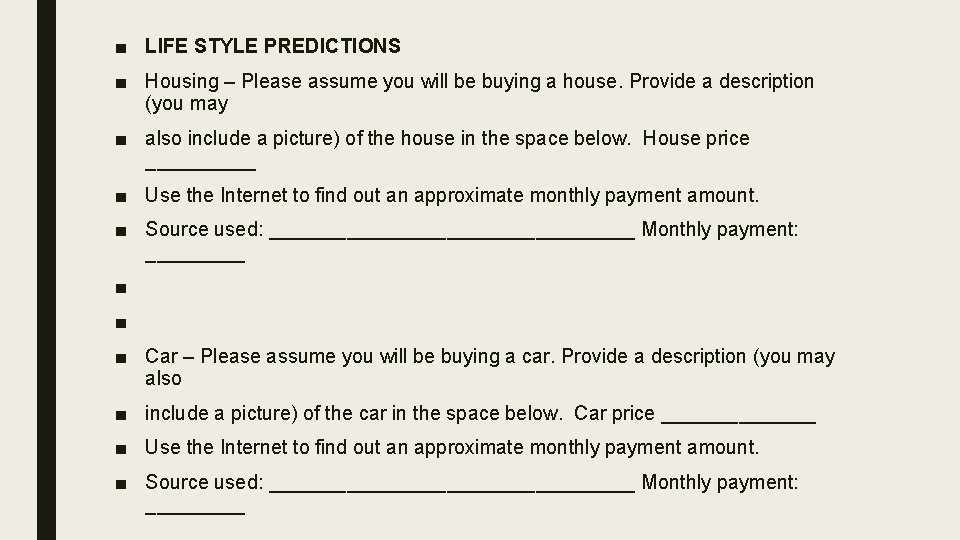
■ LIFE STYLE PREDICTIONS ■ Housing – Please assume you will be buying a house. Provide a description (you may ■ also include a picture) of the house in the space below. House price _____ ■ Use the Internet to find out an approximate monthly payment amount. ■ Source used: _________________ Monthly payment: _____ ■ ■ ■ Car – Please assume you will be buying a car. Provide a description (you may also ■ include a picture) of the car in the space below. Car price _______ ■ Use the Internet to find out an approximate monthly payment amount. ■ Source used: _________________ Monthly payment: _____
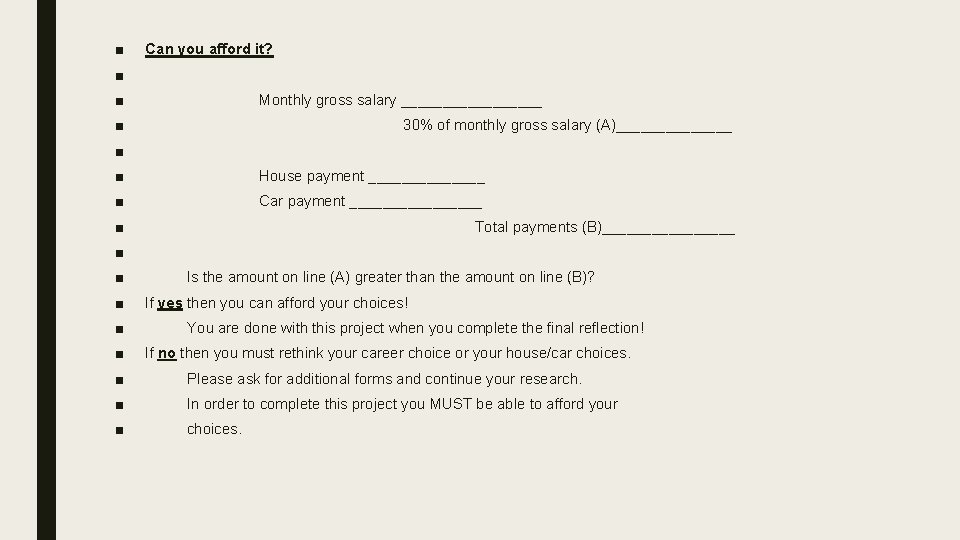
■ Can you afford it? ■ ■ Monthly gross salary _________ ■ ■ 30% of monthly gross salary (A)_______ ■ House payment _______ ■ Car payment ________ ■ ■ ■ Total payments (B)________ Is the amount on line (A) greater than the amount on line (B)? If yes then you can afford your choices! You are done with this project when you complete the final reflection! ■ If no then you must rethink your career choice or your house/car choices. ■ Please ask for additional forms and continue your research. ■ In order to complete this project you MUST be able to afford your ■ choices.
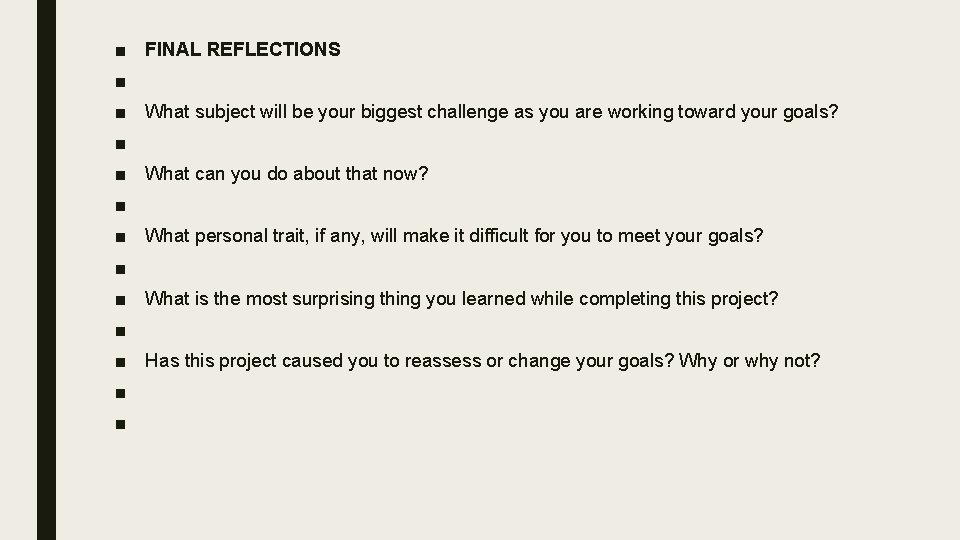
■ FINAL REFLECTIONS ■ ■ What subject will be your biggest challenge as you are working toward your goals? ■ ■ What can you do about that now? ■ ■ What personal trait, if any, will make it difficult for you to meet your goals? ■ ■ What is the most surprising thing you learned while completing this project? ■ ■ Has this project caused you to reassess or change your goals? Why or why not? ■ ■
Lesson Plan #3 Human Growth and Development Co-curricular connection: Psychology ■ 2. 16 Modify communication to meet the needs of the patient/client and be appropriate to the situation.
Human Growth and Development Activities 1. Short lecture on concepts and terminology related to Human Growth and Development OR Have students read chapter from text and complete worksheets OR Have students define terms 2. Explain HGD Booklet –
Human Growth and Development Booklet ■ You are to make a book to help you understand Human Growth and Development. Your book must include the seven life stages and information about the four main types of growth and development that occur in each stage. Your book must be put together as follows: ■ Book covers- Front and Back with art work (please put your name on back cover ONLY) ■ At least one page on each life stage. ■ No more than 10 words should be visible at one time on any page. You may use flip ups and other interactive to cover up some of your words. Be creative! ■ NO cutting or pasting of text – information must be handwritten. You may print pictures. ■ We will be working on the book in class, but you must also work on the project at home to be able to get it done correctly and on time. Your reference will be Chapter 8 – Human Growth and Development (pp 228 -249) in our textbook
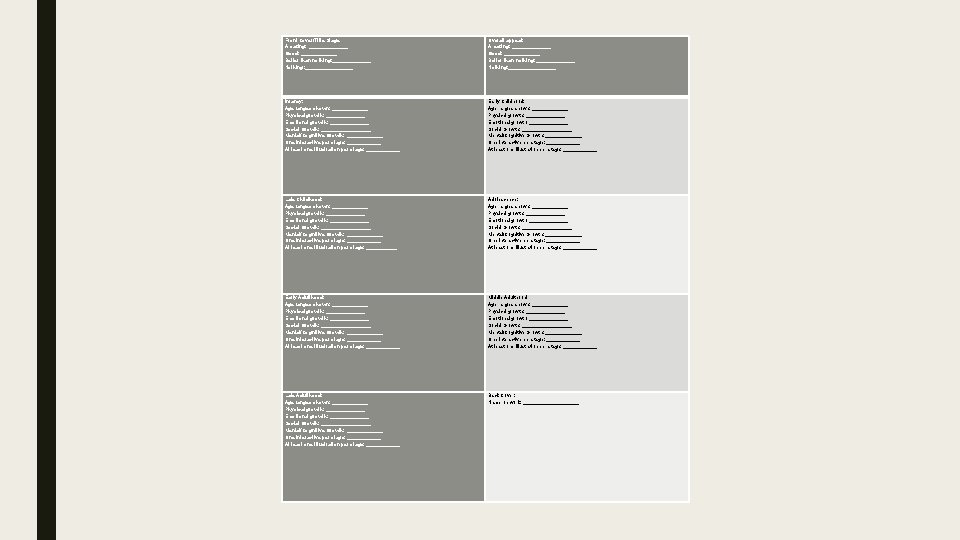
Front Cover/Title Stage Amazing: _______ Good: _______ Better than nothing: _______ Nothing: _________ Overall appeal: Amazing: _______ Good: _______ Better than nothing: _______ Nothing: _________ Infancy: Age ranges shown: _______ Physical growth: _______ Emotional growth: _______ Social Growth: _________ Mental/Cognitive Growth: _______ One interactive per stage: ______ At least one illustration per stage: ______ Early Childhood: Age ranges shown: _______ Physical growth: _______ Emotional growth: _______ Social Growth: _________ Mental/Cognitive Growth: _______ One interactive per stage: ______ At least one illustration per stage: ______ Late Childhood: Age ranges shown: _______ Physical growth: _______ Emotional growth: _______ Social Growth: _________ Mental/Cognitive Growth: _______ One interactive per stage: ______ At least one illustration per stage: ______ Adolescence: Age ranges shown: _______ Physical growth: _______ Emotional growth: _______ Social Growth: _________ Mental/Cognitive Growth: _______ One interactive per stage: ______ At least one illustration per stage: ______ Early Adulthood: Age ranges shown: _______ Physical growth: _______ Emotional growth: _______ Social Growth: _________ Mental/Cognitive Growth: _______ One interactive per stage: ______ At least one illustration per stage: ______ Middle Adulthood: Age ranges shown: _______ Physical growth: _______ Emotional growth: _______ Social Growth: _________ Mental/Cognitive Growth: _______ One interactive per stage: ______ At least one illustration per stage: ______ Late Adulthood: Age ranges shown: _______ Physical growth: _______ Emotional growth: _______ Social Growth: _________ Mental/Cognitive Growth: _______ One interactive per stage: ______ At least one illustration per stage: ______ Back Cover: Name on work: __________
Additional Ideas (if time permits) ■ Have students add information about the implications for healthcare providers ■ Have students add information about growth and development theories ■ Allow students to use their booklets on test
Lesson Plan #4 Personal Portfolio ■ 4. 41 Develop components of a personal portfolio. ■ 2. 31 Utilize proper elements of written and electronic communication (spelling, grammar, and formatting). ■ 2. 32 Prepare examples of technical, informative, and creative writing.
Personal Portfolio ■ Discuss with senior students at the beginning of the year ■ Assign due dates for various parts of the projects throughout the school year ■ Can be done electronically ■ Students must present portfolio to community panel
Portfolio Content ■ 1. Letter of Introduction ■ 2. Resume ■ 3. Project ■ 4. Writing Sample ■ 5. Work-Based Learning ■ 6. Service Learning (Community Service) ■ 8. Credentials ■ 9. Technology ■ 10. Leadership
Letter of Introduction ■ Narrative format ■ Includes information on the contents of the portfolio and any other relevant information of interest to the portfolio evaluators.
LOI tips ■ Don’t talk about what you don’t have – highlight what you DO have! ■ Don’t use abbreviations – i. e. C. N. A. , PCT, CPT, CMLA ■ Use complete school name ■ Use proper grammar
Resume ■ One or two page resume ■ Should include career goals, educational and work experiences, awards, honors and other activities.
Project ■ Student should plan and carry out a healthcare knowledge/skills application project ■ Will be required to use HOSA rubric if they wish to do intensive shadowing or an educational presentation ■ A student who competes at the HOSA state level can use their competitive event as the project portion of the portfolio
HOSA Rubrics ■ The following slides are variations of HOSA rubrics to be used by students who are NOT competing in HOSA
HOSA Project – Clinical Specialty (for Intensive Shadowing) ■ Page 1 - Career Summary ■ Page 2 - Education, Training, Credentialing, and Career-related Data and Statistics ■ (Including resources) ■ Page 3 - Professional Association ■ Page 4 - Interview (Summary of interview conducted by the competitor with a ■ professional in the chosen career field. ) ■ Page 5 - Career Evaluation (List/explain 5 strengths and 5 weaknesses of the career. ) ■ Page 6 - Work-based Learning Summary (Who, what, where, when, and for how long. ) ■ Page 7 - Learning Outcomes (What you learned in the work-based learning experience. ) ■ Page 8 - Professional Verification (One page evaluation of work performance from the ■ professional you shadowed on letterhead of the facility) ■ Pages 9 – 10 Other information that you feel might add to your project
HOSA Project – Community Awareness ■ Page 1: Title page must include the name of the project, chapter, school address and state. ■ Page 2: Table of Contents (Maximum of one page) ■ Pages 3 – 4: A summary (Maximum of 2 pages) reflecting the selection of the project issue, ■ goals and objectives of the project and accomplishments, effectiveness and ■ impact of the project. (Included in page count) The summary should be typed or word processed, double spaced with 12 pt. Times New Roman font and have 1 inch margins. ■ Pages 5 – 14: The following items must be included as a part of portfolio documentation section: (Maximum of 10 pages) • Documentation of the activities conducted as a part of the community awareness project. • Publicity regarding the community awareness project activities, the local HOSA chapter and Health Science program, which may include newspaper articles, flyers, website announcements, etc. • Programs, pictures or other verification of students presenting the project should be included and dated. - a maximum of three (3) items. o Pamphlets o Copies of media articles, radio or TV spot and the program script.
HOSA Project – Community Awareness or Health Education ■ MUST use HOSA rubric for Health Education or Community Awareness ■ Develop a project to promote community awareness using health issues that may be of local, state, and/or national interest. ■ Assist communities to become more aware of the pros and cons of the health issue selected. ■ Promote goodwill and public relations for local HOSA chapters. ■ Evaluate the effectiveness and impact of the project on the community. ■ See format and requirements for this type of project on attached file or see Dr. Clarke ■ Be aware – this is much more than just collecting a box of “stuff”
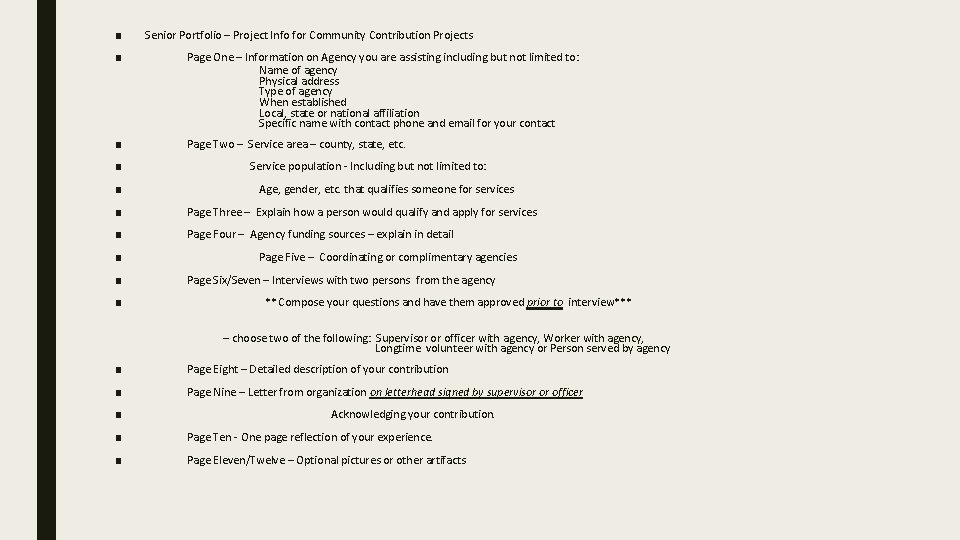
■ Senior Portfolio – Project Info for Community Contribution Projects ■ Page One – Information on Agency you are assisting including but not limited to: Name of agency Physical address Type of agency When established Local, state or national affiliation Specific name with contact phone and email for your contact ■ Page Two – Service area – county, state, etc. ■ Service population - Including but not limited to: ■ Age, gender, etc. that qualifies someone for services ■ Page Three – Explain how a person would qualify and apply for services ■ ■ ■ ■ Page Four – Agency funding sources – explain in detail Page Five – Coordinating or complimentary agencies Page Six/Seven – Interviews with two persons from the agency ** Compose your questions and have them approved prior to interview*** – choose two of the following: Supervisor or officer with agency, Worker with agency, Longtime volunteer with agency or Person served by agency ■ Page Eight – Detailed description of your contribution ■ Page Nine – Letter from organization on letterhead signed by supervisor or officer ■ Acknowledging your contribution. ■ Page Ten - One page reflection of your experience. ■ Page Eleven/Twelve – Optional pictures or other artifacts
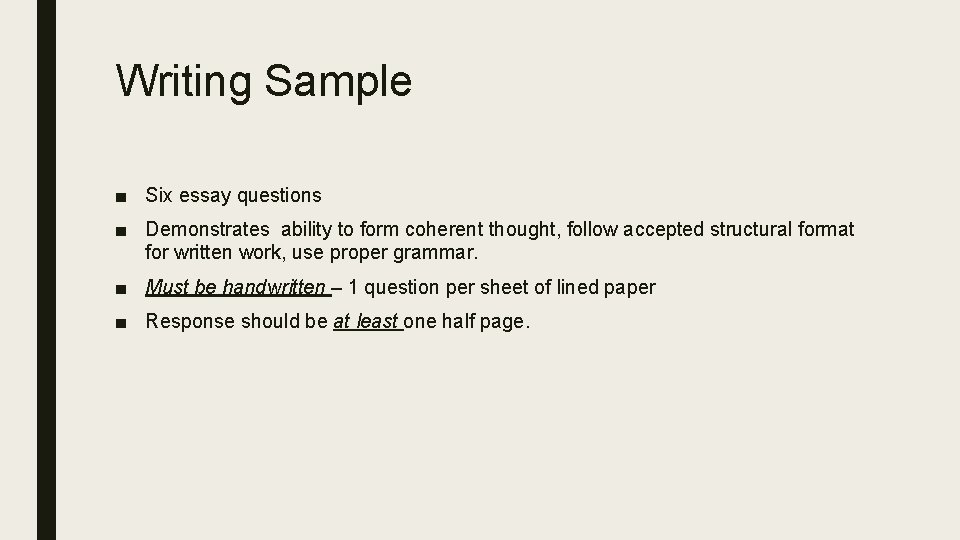
Writing Sample ■ Six essay questions ■ Demonstrates ability to form coherent thought, follow accepted structural format for written work, use proper grammar. ■ Must be handwritten – 1 question per sheet of lined paper ■ Response should be at least one half page.
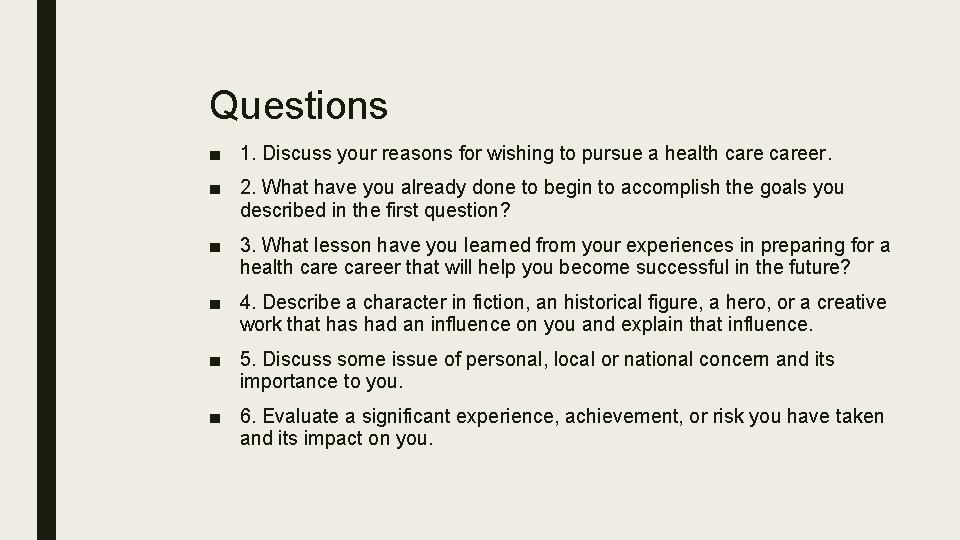
Questions ■ 1. Discuss your reasons for wishing to pursue a health career. ■ 2. What have you already done to begin to accomplish the goals you described in the first question? ■ 3. What lesson have you learned from your experiences in preparing for a health career that will help you become successful in the future? ■ 4. Describe a character in fiction, an historical figure, a hero, or a creative work that has had an influence on you and explain that influence. ■ 5. Discuss some issue of personal, local or national concern and its importance to you. ■ 6. Evaluate a significant experience, achievement, or risk you have taken and its impact on you.
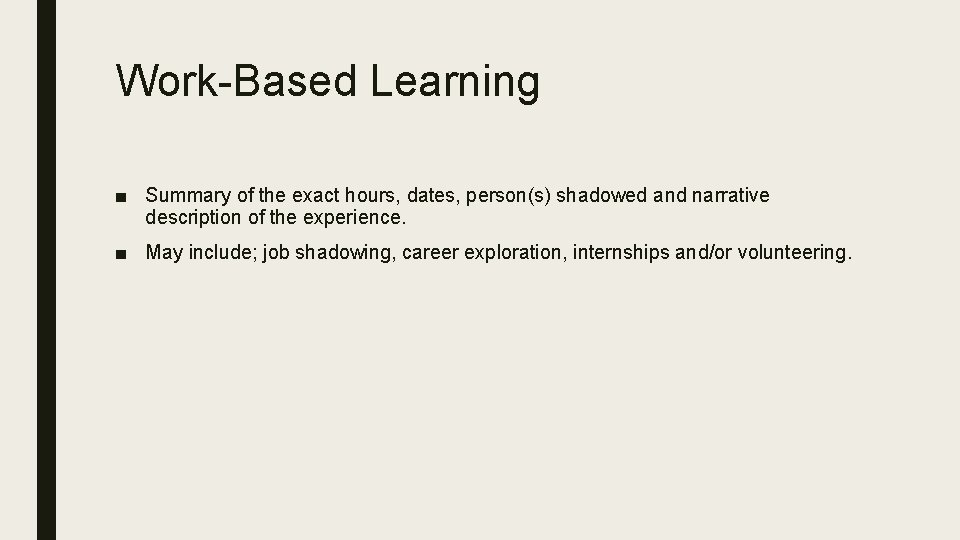
Work-Based Learning ■ Summary of the exact hours, dates, person(s) shadowed and narrative description of the experience. ■ May include; job shadowing, career exploration, internships and/or volunteering.
Service Learning/Community Service ■ Must be documented by a summary of the experience to include dates, hours, location, learning outcomes, and benefits to the community at large. ■ May include newspaper coverage, brochures, certificates, letters, etc.
Service Learning/Community Service Opportunities through HOSA or school ■ Multiple events available though the year ■ Must sign up prior to event ■ Must follow though with commitment you make ■ Must meet dress code ■ No call no show may result in loss of opportunity to participate in HOSA/School sponsored events ■ Do not bring friends, siblings, etc. to event
Technology ■ Evidence will be examples of technology created by the student such as a web site, electronic newsletter, Power. Point presentation, or other evidence of advanced technology skills certificate. ■ Must be from senior year!
Technology ■ Evidence will be examples of technology created by the student such as a web site, electronic newsletter, Power. Point presentation, or other evidence of advanced technology skills certificate. ■ Must be from senior year!
Leadership ■ Demonstrated by participation as a HOSA officer, class officer, student council, church or scout officer, or other leadership position in the arts, athletics, or other organized school or community activities. ■ Must be verified by adult in charge of organization ■ Alternative Leadership – Volunteer for a leadership role in an event sponsored by HOSA/School – Must request Leadership role PRIOR to day of event
Other content ■ May be added to strengthen the portfolio ■ May include; high school diploma, special awards, recognitions and/or certificates.
Notebook ■ 1 to 1 ½ 3 ring binder ■ Page protectors ■ Dividers for sections ■ Table of contents suggested ■ May do cover but should be professional
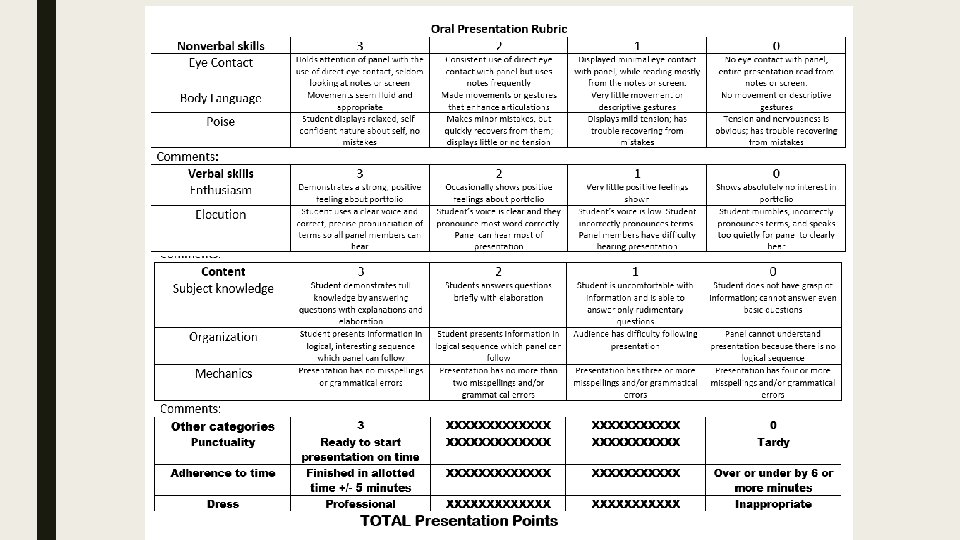
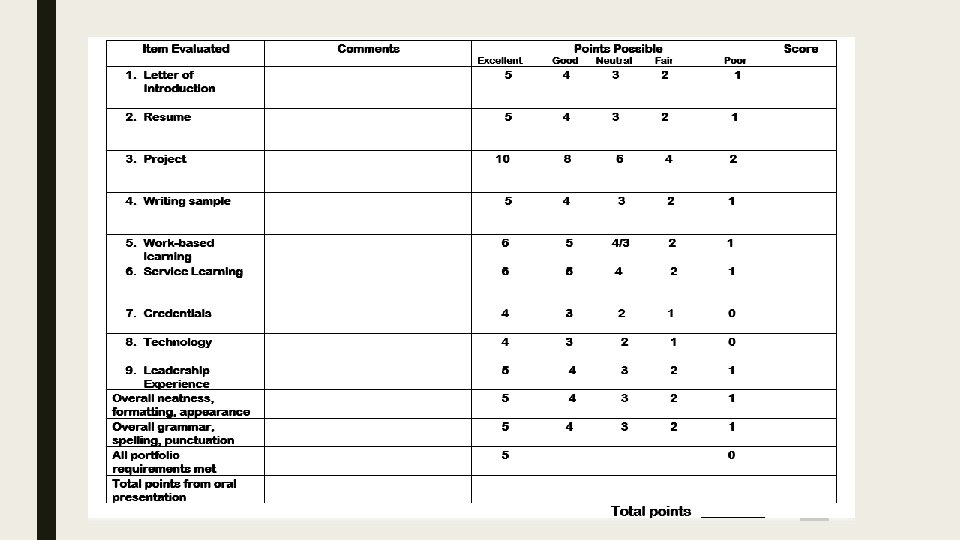
Presentation of Portfolio ■ Will be presented to panel of 2 -4 professionals from community ■ Professional dress required ■ May do short Power Point ■ Be sure to see rubrics for portfolio and presentation
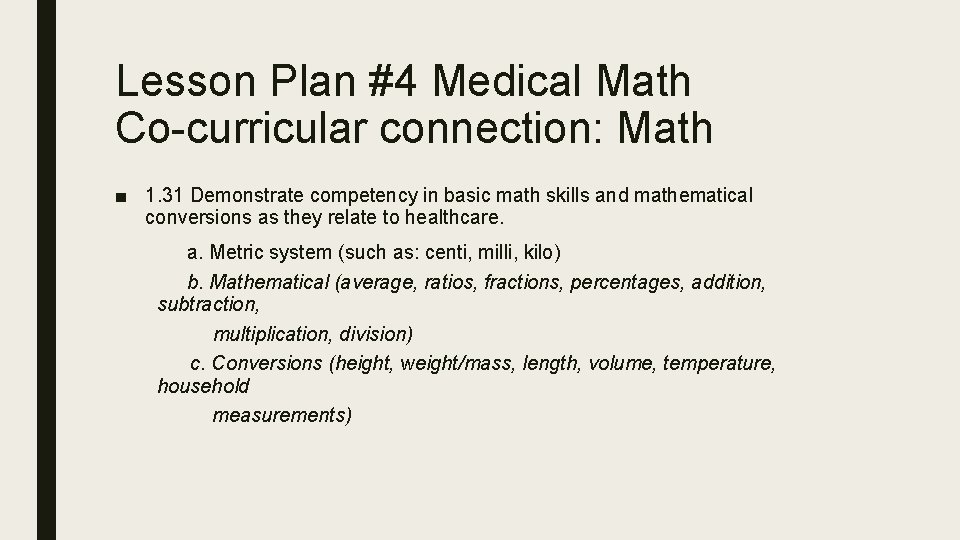
Lesson Plan #4 Medical Math Co-curricular connection: Math ■ 1. 31 Demonstrate competency in basic math skills and mathematical conversions as they relate to healthcare. a. Metric system (such as: centi, milli, kilo) b. Mathematical (average, ratios, fractions, percentages, addition, subtraction, multiplication, division) c. Conversions (height, weight/mass, length, volume, temperature, household measurements)
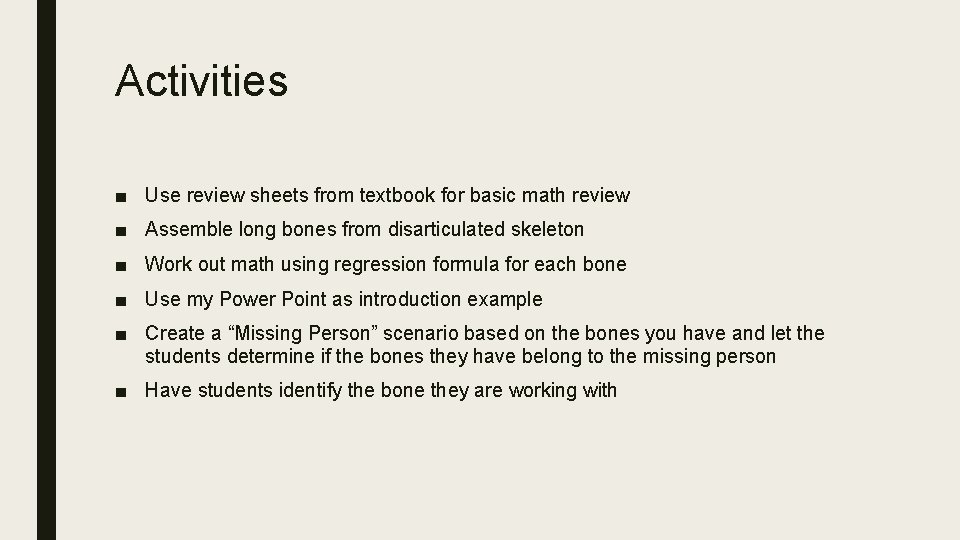
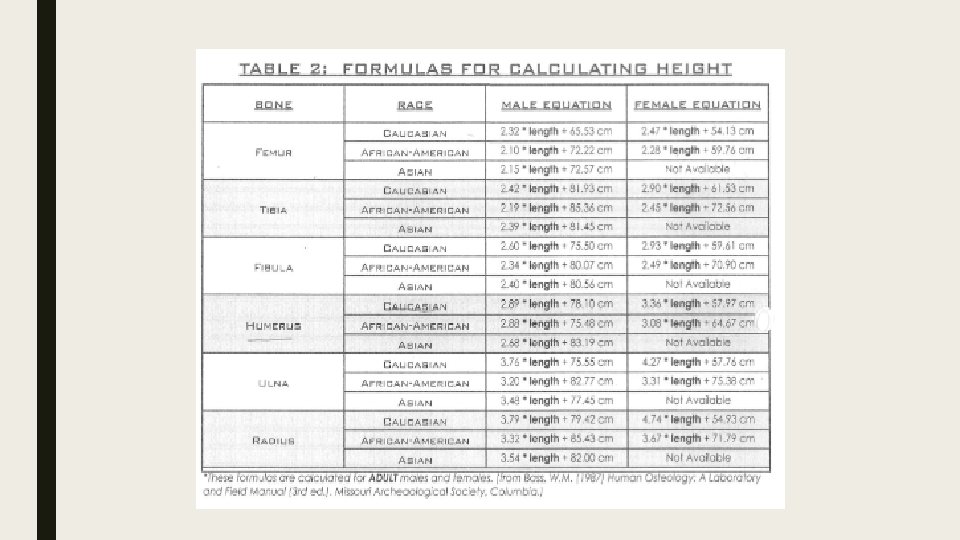
Activities ■ Use review sheets from textbook for basic math review ■ Assemble long bones from disarticulated skeleton ■ Work out math using regression formula for each bone ■ Use my Power Point as introduction example ■ Create a “Missing Person” scenario based on the bones you have and let the students determine if the bones they have belong to the missing person ■ Have students identify the bone they are working with
Regression Formula for Body ID ■ Height of individual can be approximated by length of long bones in arms or legs ■ Tables and formulas developed after years of research with human bodies
Lesson #5 Healthy Behaviors Co-curricular connection: Health, Visual Arts ■ 9. 11 Promote behaviors of health and wellness (such as: nutrition, weight control, exercise, sleep habits). ■ 9. 12 Describe strategies for prevention of disease. a. Routine physical exams b. Medical, dental, and mental health screenings c. Community health education outreach programs d. Immunizations e. Stress management f. Avoid risky behaviors
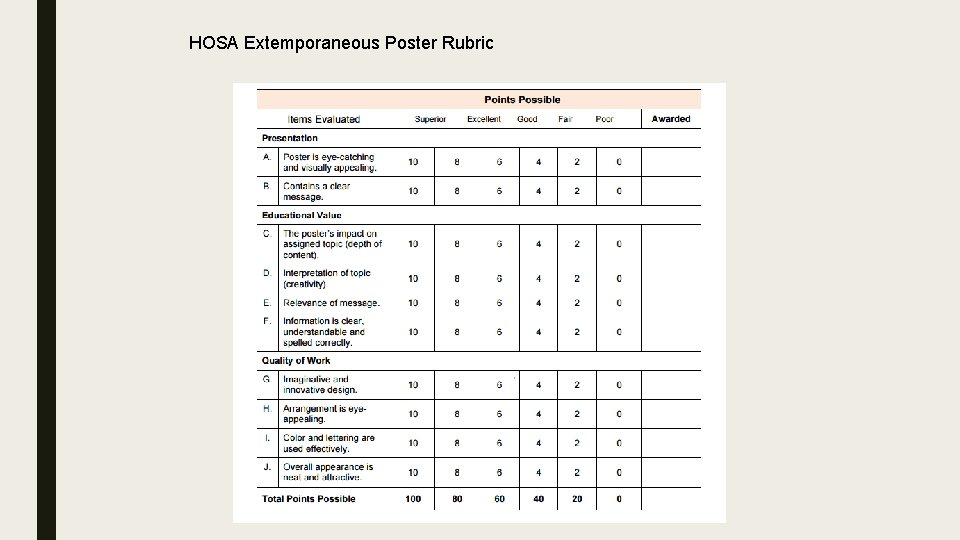
Healthy Behavior Activities ■ Students can research issues related to healthy behaviors using the CDC, NIH, or your state health department websites OR ■ Teacher can research list of unhealthy behaviors common to teenagers in the county/state/etc. OR ■ Have students brainstorm to make list of common unhealthy behaviors ■ Form students into teams of 3 or 4 (You will need a different topic for each group) ■ Place topics in envelopes and give students their “mission” ■ Use HOSA Extemporaneous Health Poster rubric to judge posters
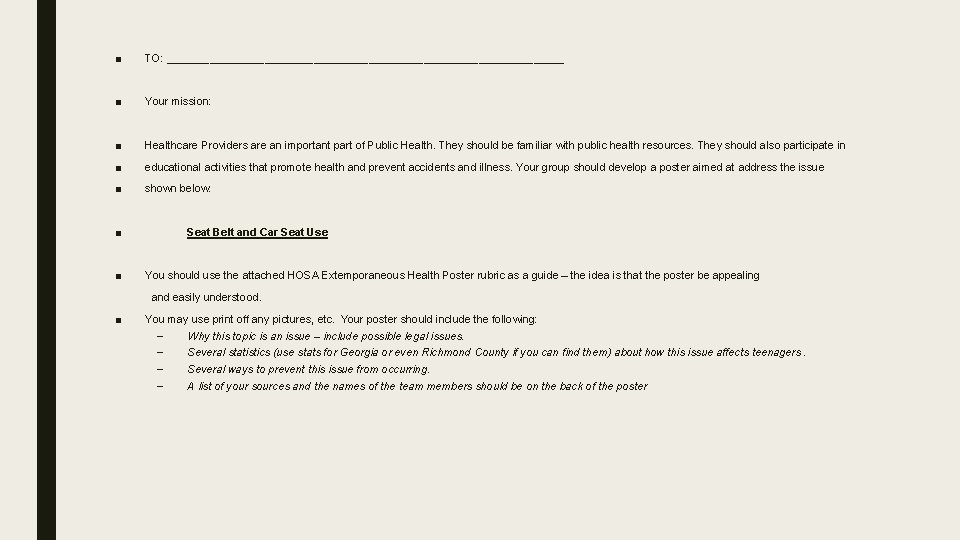
■ TO: _________________________________ ■ Your mission: ■ Healthcare Providers are an important part of Public Health. They should be familiar with public health resources. They should also participate in ■ educational activities that promote health and prevent accidents and illness. Your group should develop a poster aimed at address the issue ■ shown below: ■ Seat Belt and Car Seat Use ■ You should use the attached HOSA Extemporaneous Health Poster rubric as a guide – the idea is that the poster be appealing and easily understood. ■ You may use print off any pictures, etc. Your poster should include the following: – – Why this topic is an issue – include possible legal issues. Several statistics (use stats for Georgia or even Richmond County if you can find them) about how this issue affects teenagers. Several ways to prevent this issue from occurring. A list of your sources and the names of the team members should be on the back of the poster
HOSA Extemporaneous Poster Rubric
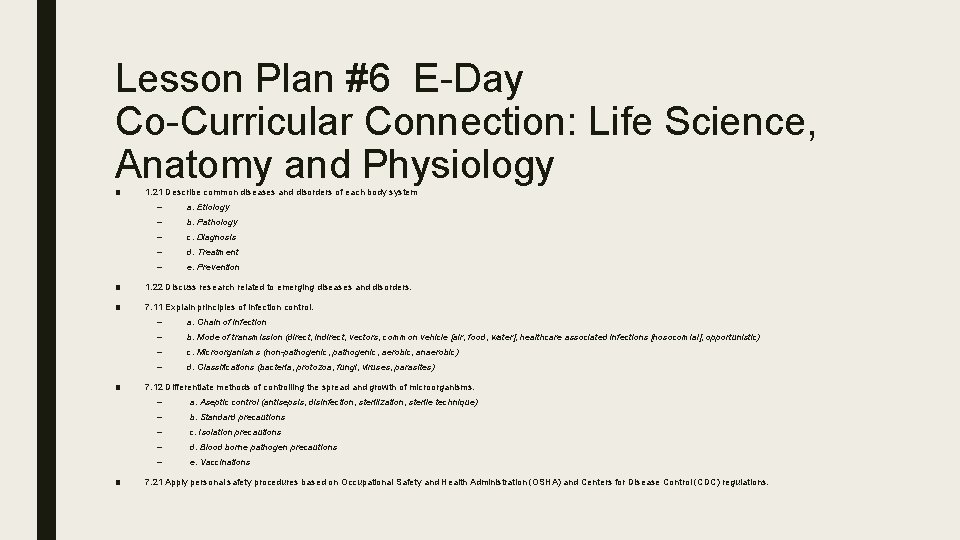
Lesson Plan #6 E-Day Co-Curricular Connection: Life Science, Anatomy and Physiology ■ 1. 21 Describe common diseases and disorders of each body system – a. Etiology – b. Pathology – c. Diagnosis – d. Treatment – e. Prevention ■ 1. 22 Discuss research related to emerging diseases and disorders. ■ 7. 11 Explain principles of infection control. ■ ■ – a. Chain of infection – b. Mode of transmission (direct, indirect, vectors, common vehicle [air, food, water], healthcare associated infections [nosocomial], opportunistic) – c. Microorganisms (non-pathogenic, aerobic, anaerobic) – d. Classifications (bacteria, protozoa, fungi, viruses, parasites) 7. 12 Differentiate methods of controlling the spread and growth of microorganisms. – a. Aseptic control (antisepsis, disinfection, sterilization, sterile technique) – b. Standard precautions – c. Isolation precautions – d. Blood borne pathogen precautions – e. Vaccinations 7. 21 Apply personal safety procedures based on Occupational Safety and Health Administration (OSHA) and Centers for Disease Control (CDC) regulations.
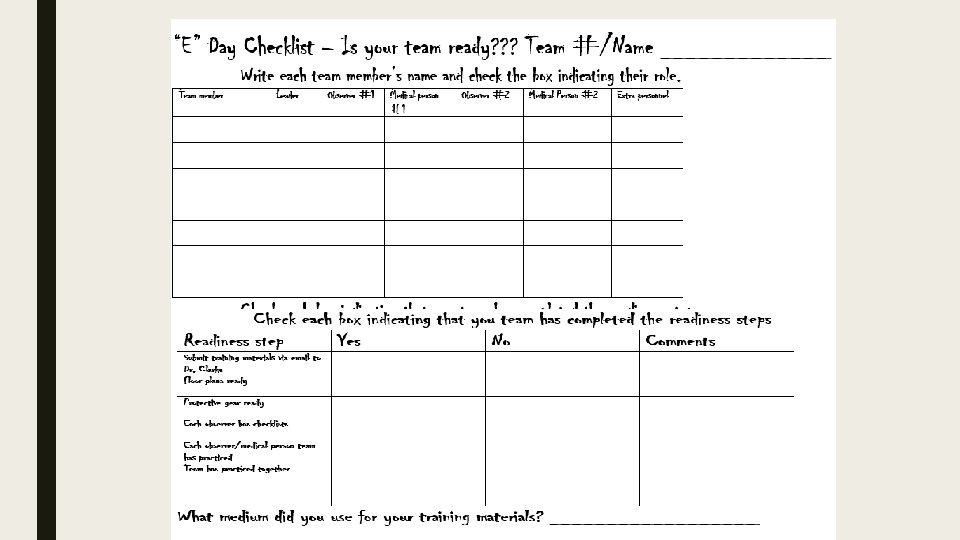
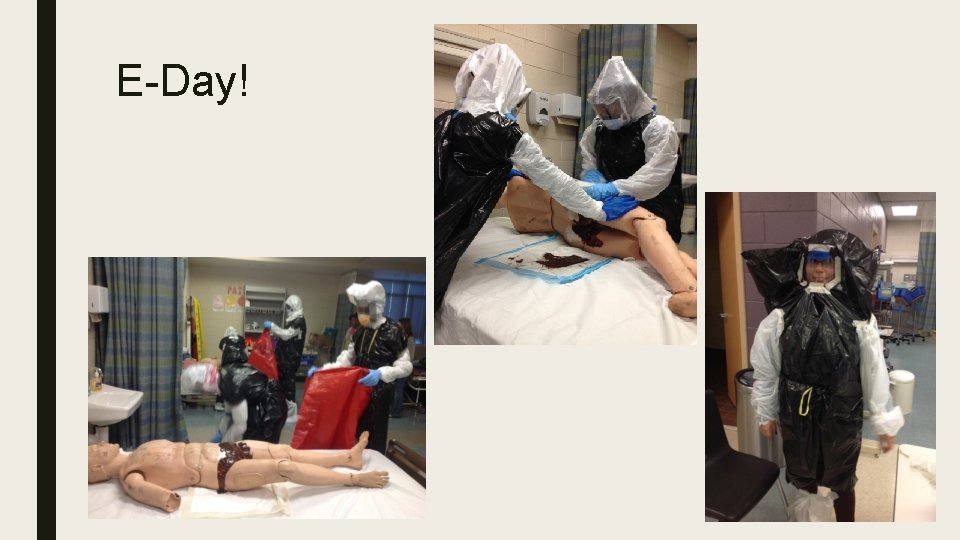
E-Day Activities 1. Short lecture on concepts and terminology related to Infection Control OR Have students read chapter from text and complete worksheets OR Have students define terms related to Infection Control 2. Show “Ebola” documentary 3. Explain E-Day Project ■
Project Directions ■ You and your team should assume you are in area where there has been an unexpected Ebola outbreak. You have minimal supplies – some gloves and masks – but no other PPE. You do have access to trash bags, tape, etc. You have some basic knowledge of infection control but not specifically familiar with Ebola. Your facility team must research information to train others as well as take care of persons stricken with Ebola. Your plan should include isolation precautions, facility modifications, training materials, improvised PPE, etc. You will test your preparations on E-Day!
Training Materials ■ http: //prezi. com/hgwtpwnyxhg/? utm_campaign=share&utm_medium=copy&rc=ex 0 share
Teacher Prep ■ Supplies – large trash bags, small trash bags, duct tape or package tape, masks, gloves ■ Cover beds with paint drop cloths ■ Have students use masking tape on floor to mark various areas or rooms they would like to have ■ Use old manikins or allow students to make life-size, disposable human forms ■ Add small portion of Glo-germ powder into chocolate pudding/water mixture ■ Pour mixture over manikins to simulate body fluids ■ Have students simulate care of patient – check for Glo-germ when they are done
E-Day!
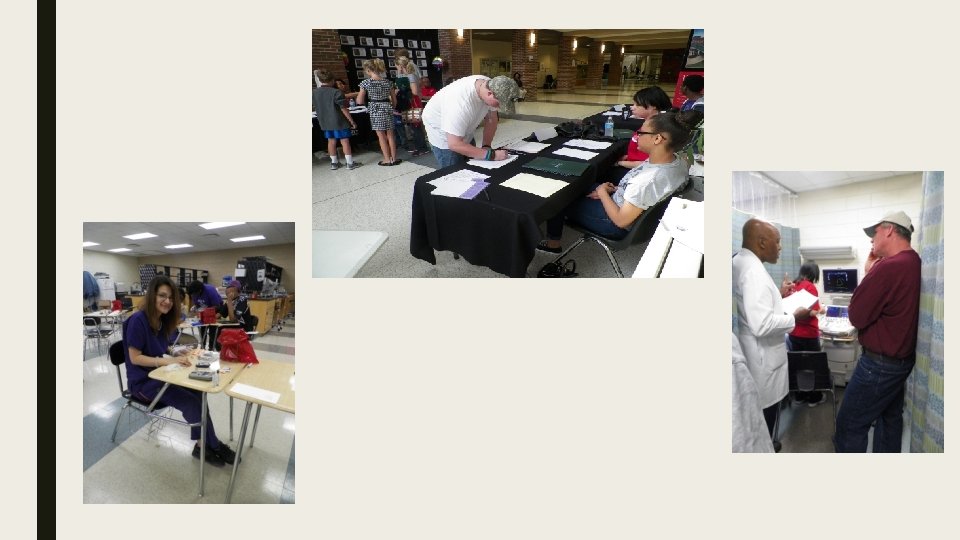
Lesson Plan #7 Health Screening Co-curricular connection: Health, Anatomy and Physiology ■ 1. 13 Analyze basic structures and functions of – Cardiovascular (components of blood, structures and functions of blood components, structures and functions of the cardiovascular system, conduction system of the heart, cardiac cycle) of eye, ear, nose and tongue; identify senses for sight, hearing, smell, taste, touch) – Endocrine (endocrine versus exocrine, structures and functions of endocrine system, hormones, regulation of hormones) ■ 5. 24 Define informed consent. ■ 7. 21 Apply personal safety procedures based on Occupational Safety and Health Administration (OSHA) and Centers for Disease Control (CDC) regulations. ■ 7. 31 Apply safety techniques in the work environment. – a. Ergonomics – b. Safe operation of equipment – c. Patient/client safety measures (check area for safety) ■ 9. 11 Promote behaviors of health and wellness (such as: nutrition, weight control, exercise, sleep habits).
Activities ■ Students complete textbook chapter on Cardiovascular System ■ Students complete textbook chapter on Endocrine System related to diabetes ■ Students learn basic EKG terminology and rhythm identification ■ Students learn to do blood pressure ■ Students learn to do height, weight and BMI ■ Students learn to perform 12 -lead EKG ■ Students learn to perform finger stick glucose, total cholesterol and A 1 C
Teacher Prep ■ Order supplies – Moore Medical www. mooremedical. com – Hanson Medical http: //www. hansonmedicalsystems. com/ ■ Offer free use of machines when you purchase supplies – must reserve in advance ■ Coordinate with local cardiologists and/or hospitals ■ Some companies will loan 12 lead machines for the screening ■ Consider screening echocardiograms if you can get volunteers to perform and cardiologist on-site to read ■ Let students develop forms, etc. ■ Assign student leaders