
LESSON PLANNING DELIVERY WNMU What makes a good
- Slides: 12
LESSON PLANNING & DELIVERY WNMU
What makes a good lesson?
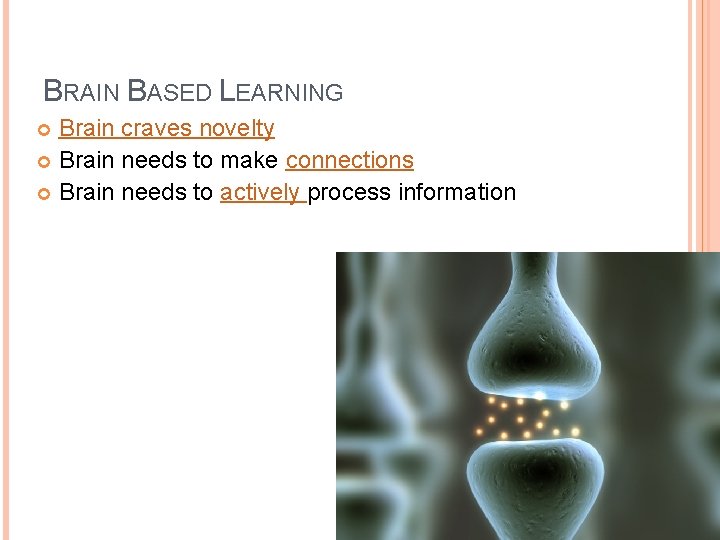
BRAIN BASED LEARNING Brain craves novelty Brain needs to make connections Brain needs to actively process information
SETTING THE STAGE HOW DO YOU PROVIDE OPPORTUNITIES FOR THE BRAIN TO ACTIVELY PROCESS INFORMATION : Student Choice? Collaboration? Reflection?
WHY DO YOU NEED A LESSON PLAN? Communicate. To whom? The lesson plans you develop are to guide you in organizing your material and yourself for the purpose of helping your students achieve intended learning outcomes.
KEY PRINCIPLE #1 Specificity – Provide explicit detail about how your students will achieve specific outcomes. Detailed enough so that someone else could teach and evaluate you r lesson.
KEY PRINCIPLE #2 The plan must contain a set of elements that are descriptive of the process. Video
PLANNING TO ENGAGE LEARNERS Sample UBD Unit Plans
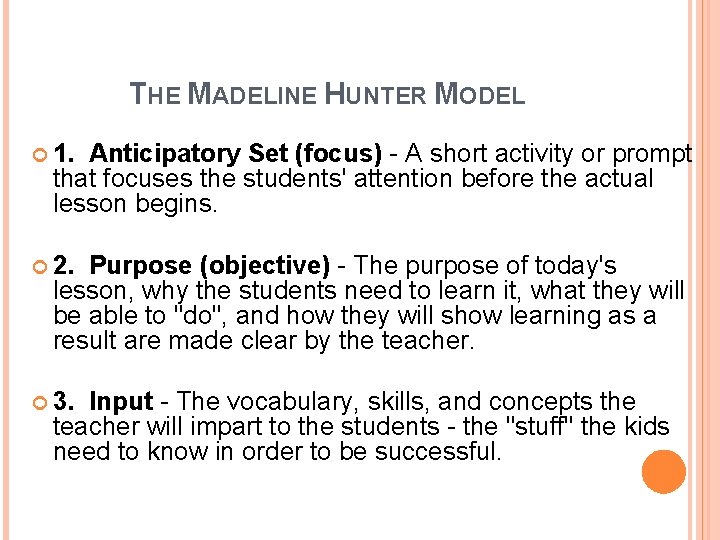
THE MADELINE HUNTER MODEL 1. Anticipatory Set (focus) - A short activity or prompt that focuses the students' attention before the actual lesson begins. 2. Purpose (objective) - The purpose of today's lesson, why the students need to learn it, what they will be able to "do", and how they will show learning as a result are made clear by the teacher. 3. Input - The vocabulary, skills, and concepts the teacher will impart to the students - the "stuff" the kids need to know in order to be successful.
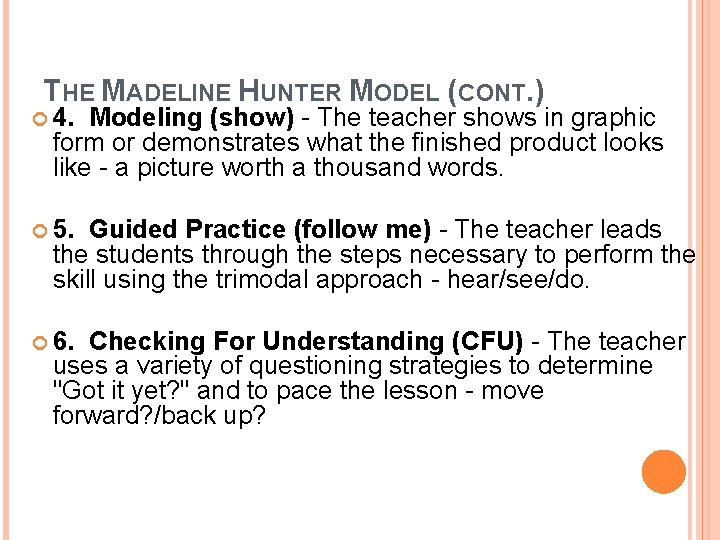
THE MADELINE HUNTER MODEL (CONT. ) 4. Modeling (show) - The teacher shows in graphic form or demonstrates what the finished product looks like - a picture worth a thousand words. 5. Guided Practice (follow me) - The teacher leads the students through the steps necessary to perform the skill using the trimodal approach - hear/see/do. 6. Checking For Understanding (CFU) - The teacher uses a variety of questioning strategies to determine "Got it yet? " and to pace the lesson - move forward? /back up?
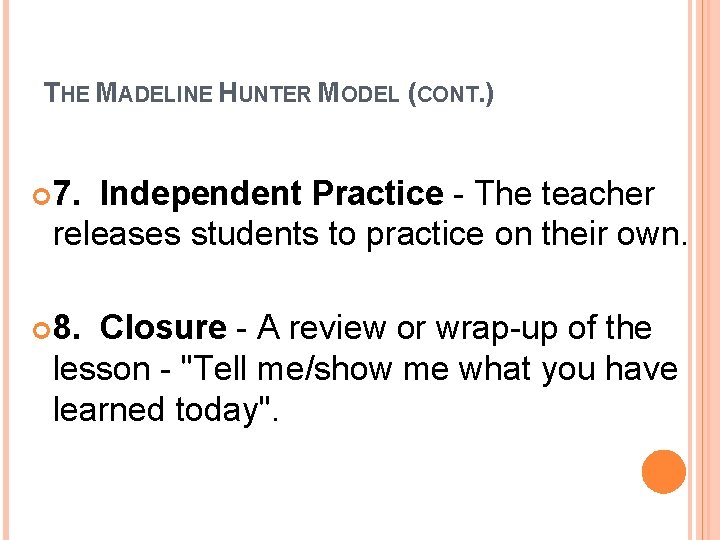
THE MADELINE HUNTER MODEL (CONT. ) 7. Independent Practice - The teacher releases students to practice on their own. 8. Closure - A review or wrap-up of the lesson - "Tell me/show me what you have learned today".
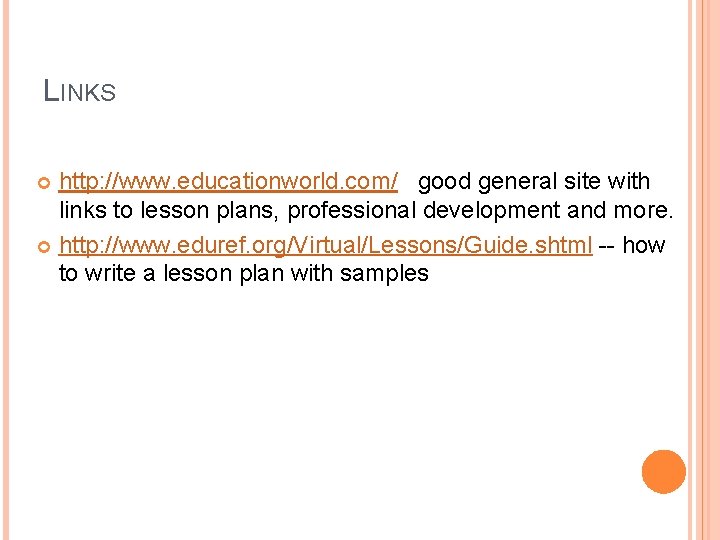
LINKS http: //www. educationworld. com/ good general site with links to lesson plans, professional development and more. http: //www. eduref. org/Virtual/Lessons/Guide. shtml -- how to write a lesson plan with samples