
Lesson Planning and Placing Concrete Student Learning Objectives
Lesson Planning and Placing Concrete

Student Learning Objectives n Describe how to plan the job. n Discuss preparation for the concrete pour. n Explain placing, finishing, and curing concrete.
Terminology n n n Bag mix Broom finish Bull float Calcium chloride Coarse aggregate Concrete drag Concrete edger Concrete form Concrete jointer Curing n n n n n Darby Earthen form Fine aggregate Float finish Floating Form nails Gallon mix Magnesium or wooden hand float Portland cement Power trowel
Terminology Reinforcing bars n Reinforcing wire n Steel hand concrete finishing trowel n Striking off n Troweled finish n
Anticipated Problem: What do you need to know before pouring concrete?
Concrete n Is a mixture of coarse aggregate, fine aggregate, portland cement, and water.
Concrete n Coarse aggregate: Gravel n Fine aggregate: Coarse sand n Portland cement: Cement made from burning lime, silica, iron oxide, and alumina together. n Gypsum is then added, which acts as a glue that holds everything together
Cubic Yards n Concrete is figured and sold by the cubic yard n Commonly drop the word “cubic” and refer to concrete by the yard n To calculate the amount needed convert the length, width, and thickness into feet, multiply them together, and divide by 27 n One cubic yard is 27 cubic feet.
Cubic Yards n For example a concrete driveway 18 foot × 30 foot poured six inches thick would be 10 cubic yards (18 × 30 ×. 5 ÷ 27 = 10 cubic yards).

Selecting Materials n Use quality materials n If soil is present in the sand or gravel, the result will be weak concrete
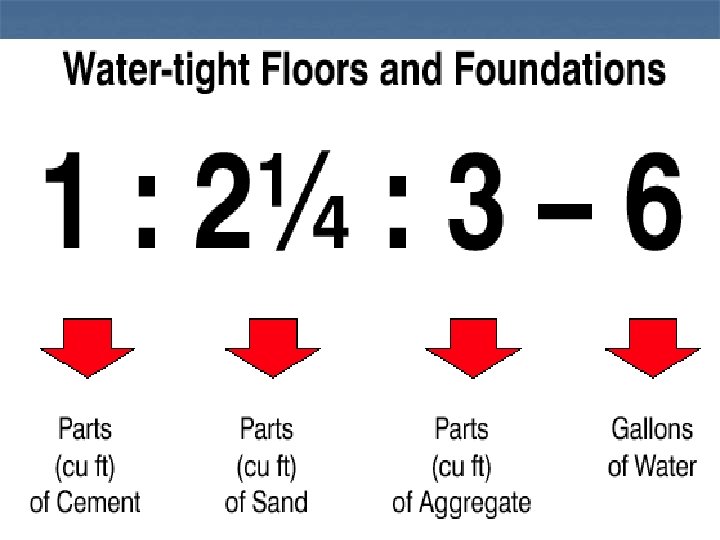
Mixing Ingredients n Mix in correct proportions n Driveways, walks, floors, and watertight foundations should be a six gallon mix n Foundation walls, footing, and mass concrete can be a seven gallon mix.
Mixing Ingredients n Gallon mix: Number of gallons of water used with a bag of cement. n Less water means stronger concrete
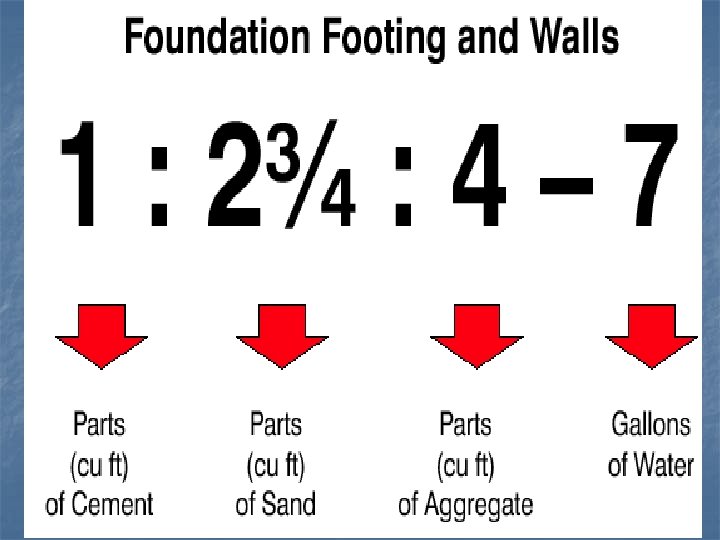
Mixing Ingredients n Bag mix: Number of bags or sacks of cement used per cubic yard of concrete. n Example: Six bag mix - Six bags of cement per cubic yard n Correct proportions for a six bag mix n One part cement to 2¼ parts fine aggregate to 3 parts coarse aggregate.
Planning n Purchase material to build concrete forms n Assembling tools needed for n Digging, n Building and setting forms, n Installing reinforcement, n Pouring concrete, and n Finishing concrete

Anticipated Problem: What do I need to do before the concrete arrives?
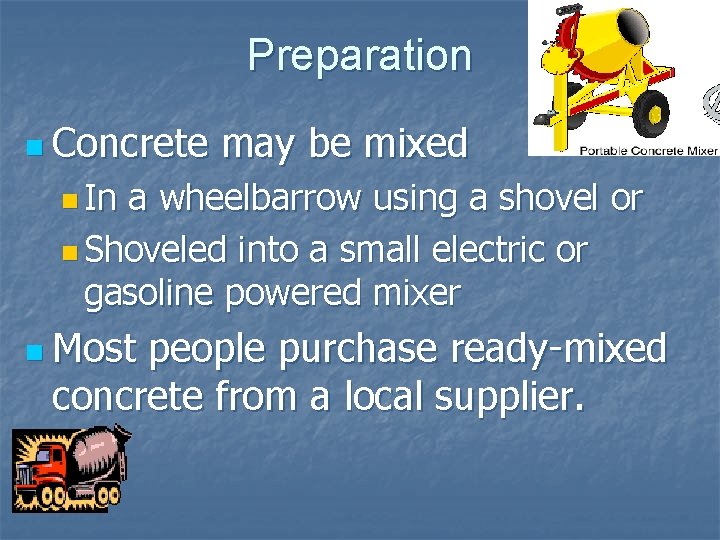
Preparation n Concrete may be mixed n In a wheelbarrow using a shovel or n Shoveled into a small electric or gasoline powered mixer n Most people purchase ready-mixed concrete from a local supplier.
Digging n In many cases the area where concrete is to be poured or placed must be dug out. n Example: Driveways and sidewalks are generally one inch above the ground level when finished. n Small areas: A shovel may be used
Digging n Larger areas need a backhoe, grader blade, or loader bucket to speed up the job n In some cases, like a floor, the concrete should be level while in other situations, like a driveway, the concrete should slope away from the house
Forms n Concrete form: Frame or mold that holds new concrete in shape until it has set or hardened. n The forms must be strong and rigid to prevent sagging, bulging, and spreading
Forms n Freshly poured concrete exerts great pressure n Earthen form: Trench dug in the ground with solid walls n Used for concrete footing
n When Forms wooden forms are used they must be tight to prevent the escape of the water-cement paste n. A tightly stretched nylon line is useful to set the forms in a straight line n Wooden stakes are used to hold the form boards in position
Forms n Small jobs: Four foot level on top of the form can be used to set the forms level or sloping n Surveying level: Needed to set larger jobs.
Forms n Form nails (or scaffold nails): Double-headed nail used to fasten the boards to the stakes n Coating forms with used motor oil or diesel fuel and using form nails make form removal much easier
Fill n Fill sand or rock should be added if the area is too deep. n Drag board can be used as fill is added so that the recommended thickness of concrete will be poured
Fill n Fill, especially sand, should be packed or tamped down so that it is solid. n Do not use soil as fill because it will settle later leaving a void or hole under the concrete
Plastic n Place sheet of plastic on top of the fill if the weather is very warm and you would like to slow down drying and curing time n Also concrete floors with plastic under them are less likely to be damp.
Reinforcing Bars and Wire n If heavy equipment will drive over concrete or freezing and thawing will be a problem, concrete should be reinforced n Reinforcing bars: Steel bars with ridges that bond with the concrete n Commonly seen in the construction of highways and bridge decks
Reinforcing Bars and Wire n Reinforcing wire: Rolls with wire rectangles or squares approximately 6 inches on center n Used in lighter construction such as patios and sidewalks.
Hot Weather n Consider spraying the area to be poured with water when the concrete arrives
Moisture Content n Be sure there are no dry clumps and the concrete is thoroughly mixed whether you mix or buy ready-mixed. n Water content is very important
Moisture Content n Extra water will result in weak concrete but concrete that is too dry is very difficult to pour and level off. n Watch experienced concrete finishers or hire one to help the first time you pour concrete.

Fiberglass fibers n May be added to the concrete as it is mixed at the ready-mix plant as a way to reinforce it.
Calcium Chloride n If concrete is poured in cold weather calcium chloride is added to prevent the concrete from freezing as it cures n Building paper or straw can be used to cover the concrete after it is finished and while it is curing

Anticipated Problem: How is concrete placed, finished, and cured?
Placing and Finishing concrete n Should not be attempted without having plenty of labor n After concrete is mixed the drying and curing process begins you are working against the clock n Be sure all placing and finishing tools are on hand
Moving and Spreading Concrete n Common tools used to move and spread material: n Shovels, n Spades, n Rakes, and n Concrete drags
Moving and Spreading Concrete n Since concrete is so heavy: Move it downhill with a chute n Closer the concrete chute is to where the concrete is needed, the less work is required n Areas where the chute cannot reach: use wheelbarrow n Concrete should be pushed, pulled, or lowered rather than lifted
Moving and Spreading Concrete n Concrete drag: Solid blade with a handle used to push or drag concrete into low spots n Striking off: Using a drag board that is usually a 2 × 4 or a 2 × 6 that is used to “saw” back and forth to level the concrete.
Moving and Spreading Concrete n Work n One team for placing concrete: person needed at each end of the drag board n Third person with rubber boots and a concrete drag in middle of the concrete make a good team for placing concrete n Other workers are needed to operate the wheelbarrows and shovels
Moving and Spreading Concrete n. A drag board vibrator can be clamped to two drag boards n One person with the drag board vibrator can do the same work as two people without it. n The concrete should be dragged twice before going on to the next step.
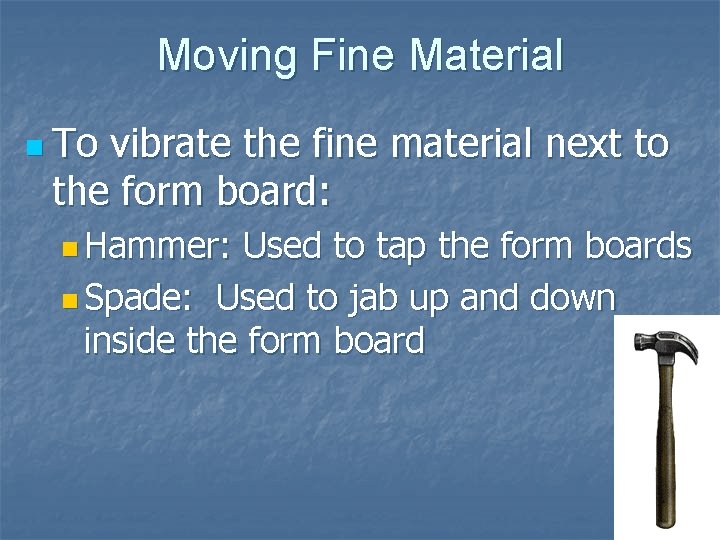
Moving Fine Material n To vibrate the fine material next to the form board: n Hammer: Used to tap the form boards n Spade: Used to jab up and down inside the form board
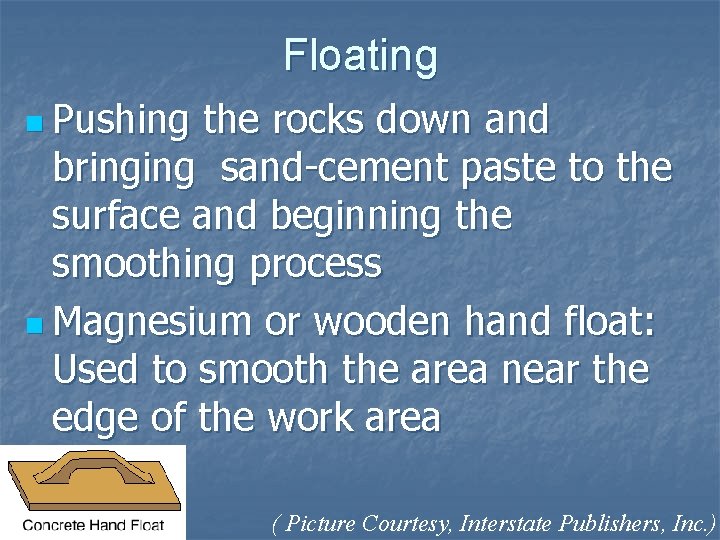
Floating n Pushing the rocks down and bringing sand-cement paste to the surface and beginning the smoothing process n Magnesium or wooden hand float: Used to smooth the area near the edge of the work area ( Picture Courtesy, Interstate Publishers, Inc. )
Floating n Darby: Two handed float usually 18” long that is also used near the edge n Bull float: 36 or 42 inch float with long round handle used to reach areas away from the edge
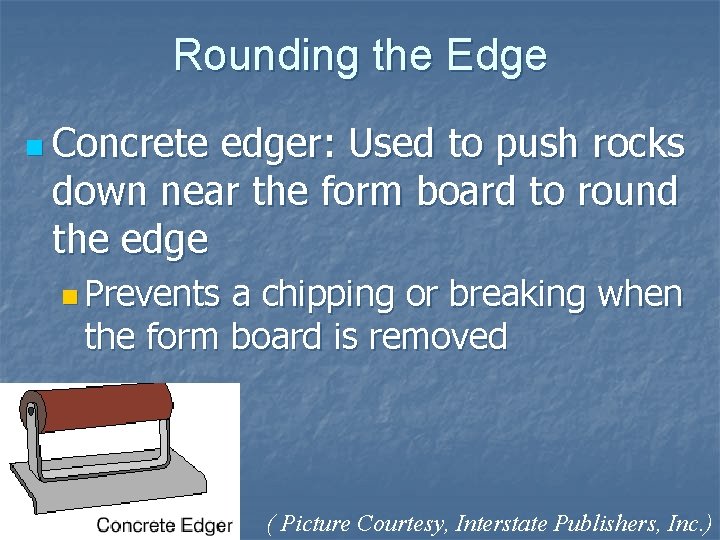
Rounding the Edge n Concrete edger: Used to push rocks down near the form board to round the edge n Prevents a chipping or breaking when the form board is removed ( Picture Courtesy, Interstate Publishers, Inc. )
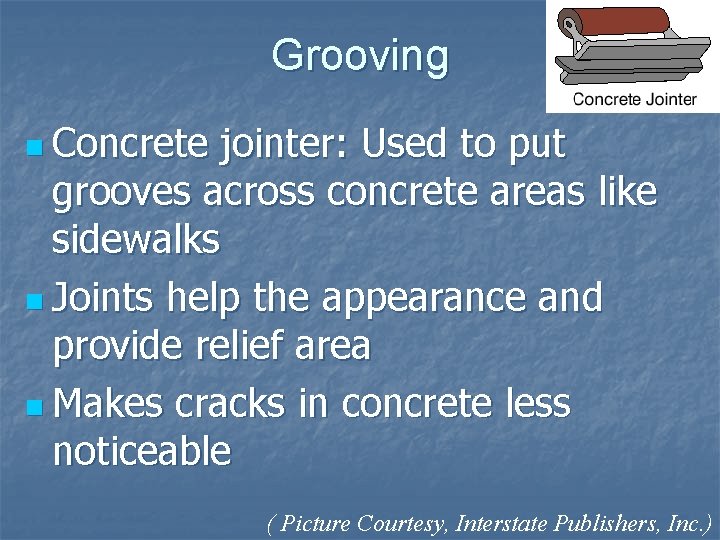
Grooving n Concrete jointer: Used to put grooves across concrete areas like sidewalks n Joints help the appearance and provide relief area n Makes cracks in concrete less noticeable ( Picture Courtesy, Interstate Publishers, Inc. )
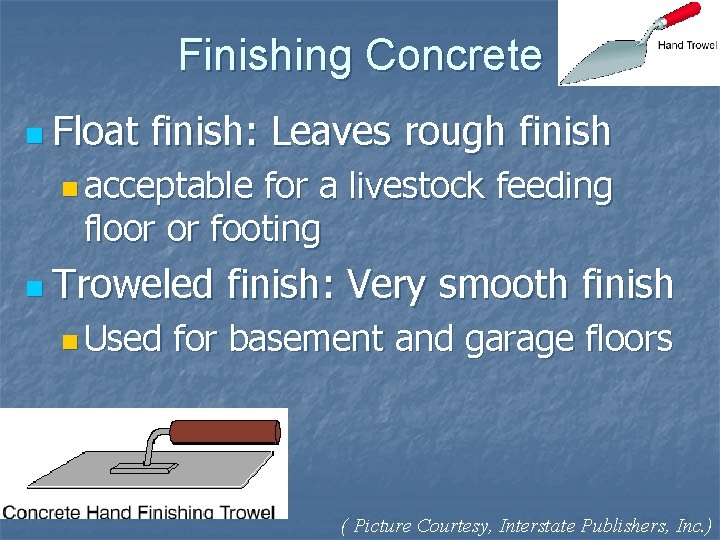
Finishing Concrete n Float finish: Leaves rough finish n acceptable for a livestock feeding floor or footing n Troweled n Used finish: Very smooth finish for basement and garage floors ( Picture Courtesy, Interstate Publishers, Inc. )
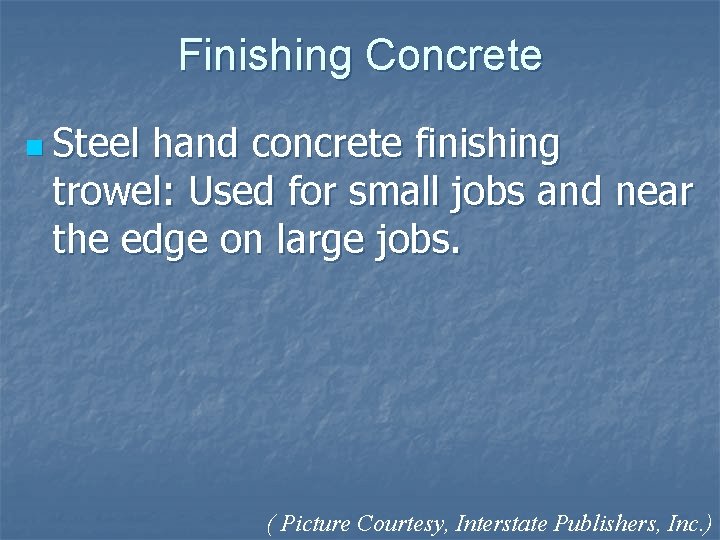
Finishing Concrete n Steel hand concrete finishing trowel: Used for small jobs and near the edge on large jobs. ( Picture Courtesy, Interstate Publishers, Inc. )
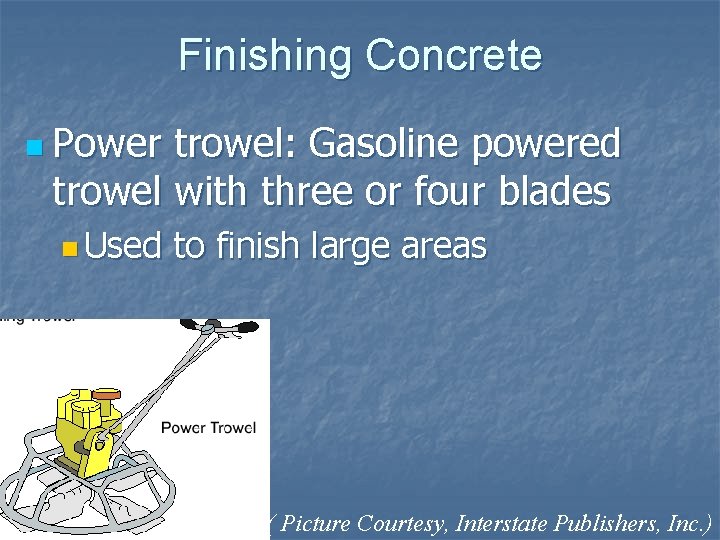
Finishing Concrete n Power trowel: Gasoline powered trowel with three or four blades n Used to finish large areas ( Picture Courtesy, Interstate Publishers, Inc. )
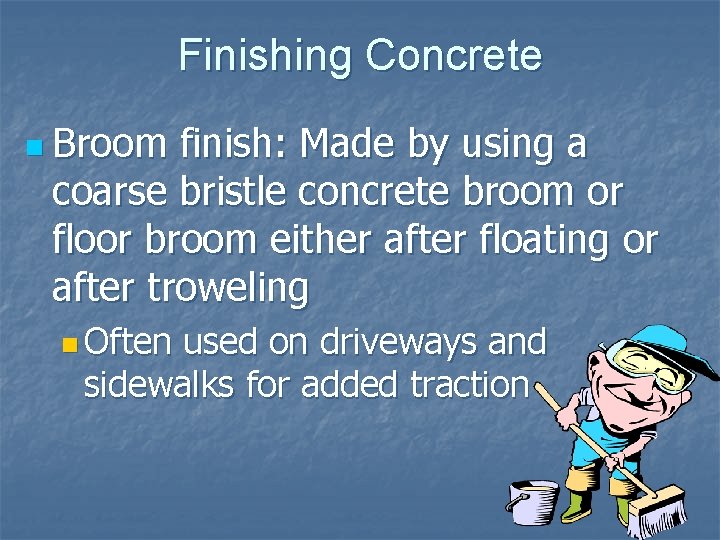
Finishing Concrete n Broom finish: Made by using a coarse bristle concrete broom or floor broom either after floating or after troweling n Often used on driveways and sidewalks for added traction
Curing n Process of concrete drying and hardening. n Slower the moisture leaves, the stronger the concrete will become.
Curing n Helpful Hints: n Spray concrete with water every day of the first week n Covering the concrete with plastic or a tarp n Allow the concrete to cure for at least 7 days prior to driving vehicles on it.
Review / Summary n Describe how to plan the job. n Discuss preparation for the concrete pour. n Explain placing, finishing, and curing concrete.
- Slides: 54