
Lesson Plan Water Tower Challenge RealWorld Application How


- Slides: 33
Lesson Plan: Water Tower Challenge
Real-World Application
How Does a Water Tower Work? • Learn how a water tower works with the use of pressure. Source: City of Bloomington MN You. Tube Channel: https: //www. youtube. com/watch? v=ZI 8 WOzq. Hl 7 w (Video 2: 20)
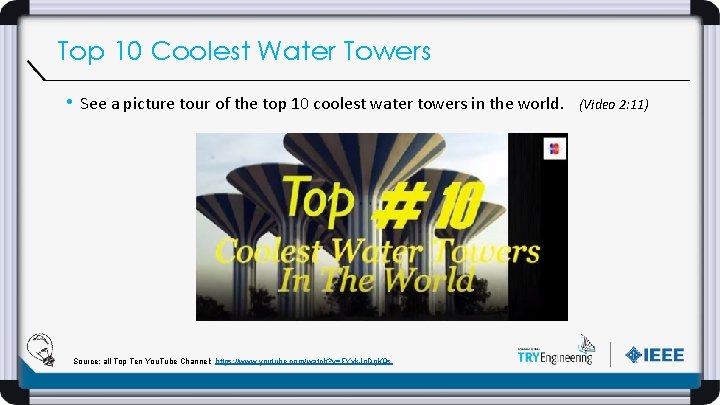
Top 10 Coolest Water Towers • See a picture tour of the top 10 coolest water towers in the world. Source: all Top Ten You. Tube Channel: https: //www. youtube. com/watch? v=FYxk. Jn. Dg. K 9 s (Video 2: 11)
The Design Challenge
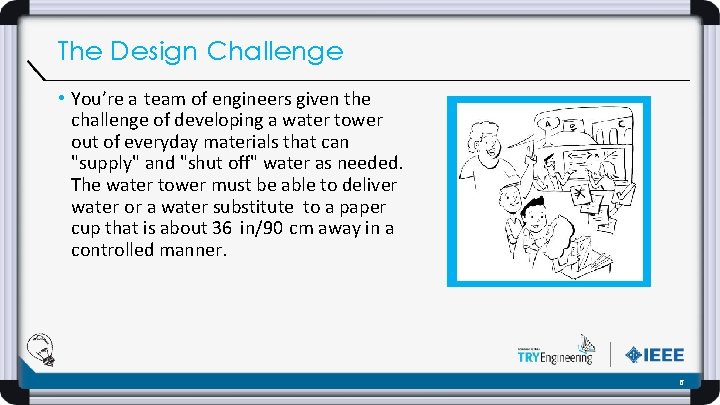
The Design Challenge • You’re a team of engineers given the challenge of developing a water tower out of everyday materials that can "supply" and "shut off" water as needed. The water tower must be able to deliver water or a water substitute to a paper cup that is about 36 in/90 cm away in a controlled manner. 6
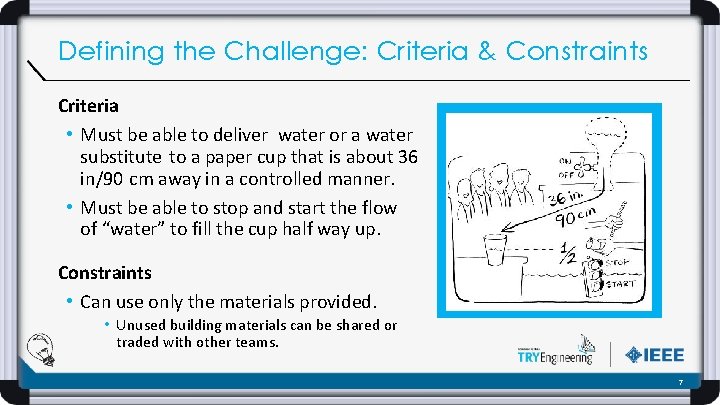
Defining the Challenge: Criteria & Constraints Criteria • Must be able to deliver water or a water substitute to a paper cup that is about 36 in/90 cm away in a controlled manner. • Must be able to stop and start the flow of “water” to fill the cup half way up. Constraints • Can use only the materials provided. • Unused building materials can be shared or traded with other teams. 7
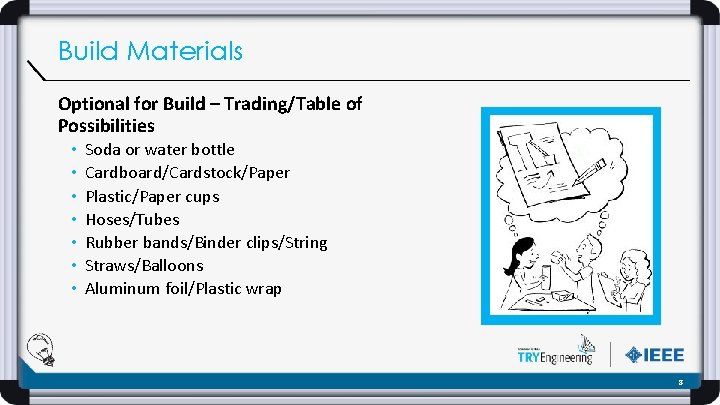
Build Materials Optional for Build – Trading/Table of Possibilities • • Soda or water bottle Cardboard/Cardstock/Paper Plastic/Paper cups Hoses/Tubes Rubber bands/Binder clips/String Straws/Balloons Aluminum foil/Plastic wrap 8
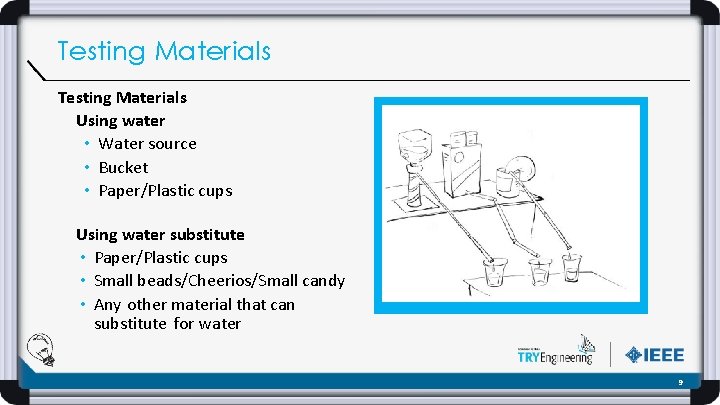
Testing Materials Using water • Water source • Bucket • Paper/Plastic cups Using water substitute • Paper/Plastic cups • Small beads/Cheerios/Small candy • Any other material that can substitute for water 9
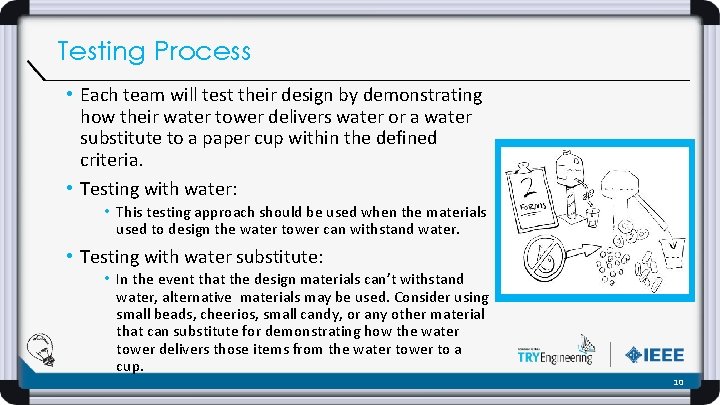
Testing Process • Each team will test their design by demonstrating how their water tower delivers water or a water substitute to a paper cup within the defined criteria. • Testing with water: • This testing approach should be used when the materials used to design the water tower can withstand water. • Testing with water substitute: • In the event that the design materials can’t withstand water, alternative materials may be used. Consider using small beads, cheerios, small candy, or any other material that can substitute for demonstrating how the water tower delivers those items from the water tower to a cup. 10
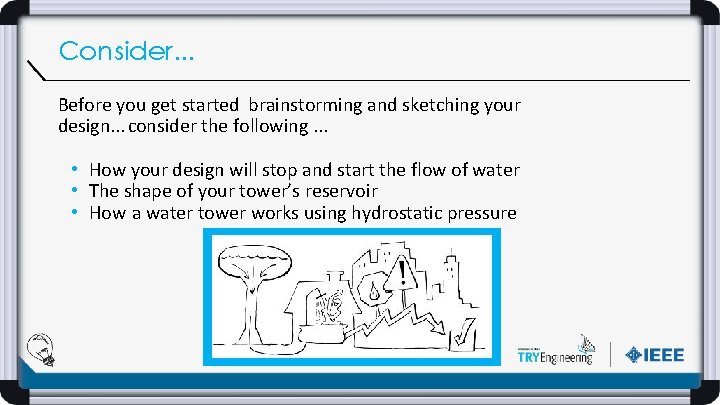
Consider. . . Before you get started brainstorming and sketching your design. . . consider the following. . . • How your design will stop and start the flow of water • The shape of your tower’s reservoir • How a water tower works using hydrostatic pressure
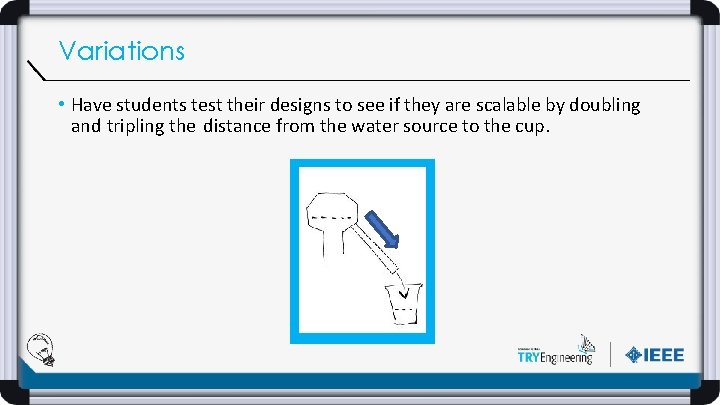
Variations • Have students test their designs to see if they are scalable by doubling and tripling the distance from the water source to the cup.
Reflect & Debrief
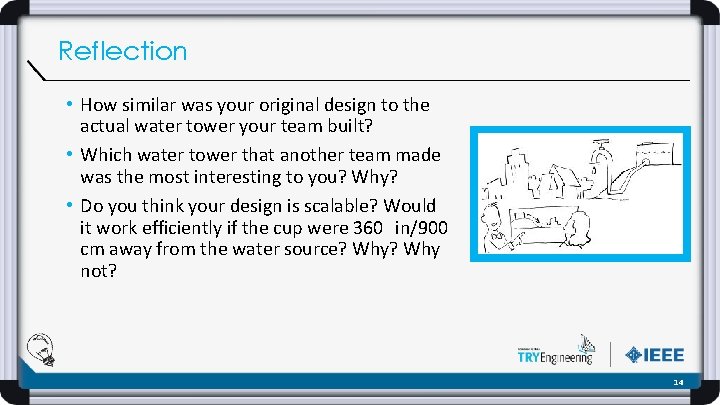
Reflection • How similar was your original design to the actual water tower your team built? • Which water tower that another team made was the most interesting to you? Why? • Do you think your design is scalable? Would it work efficiently if the cup were 360 in/900 cm away from the water source? Why not? 14
Engineering Design Process
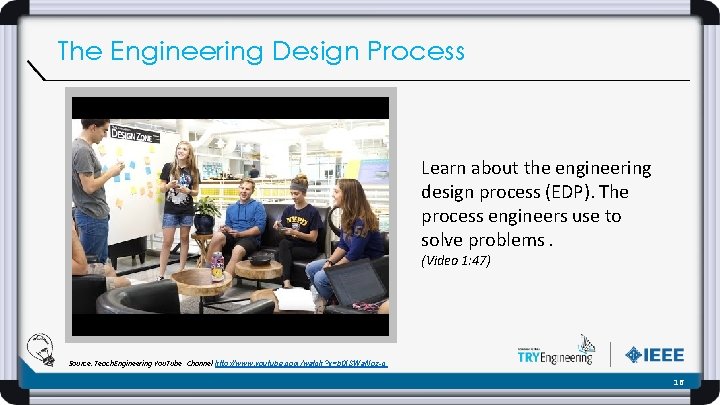
The Engineering Design Process Learn about the engineering design process (EDP). The process engineers use to solve problems. (Video 1: 47) Source: Teach. Engineering You. Tube Channel http: //www. youtube. com/watch? v=b 0 ISWa. Noz-c 16
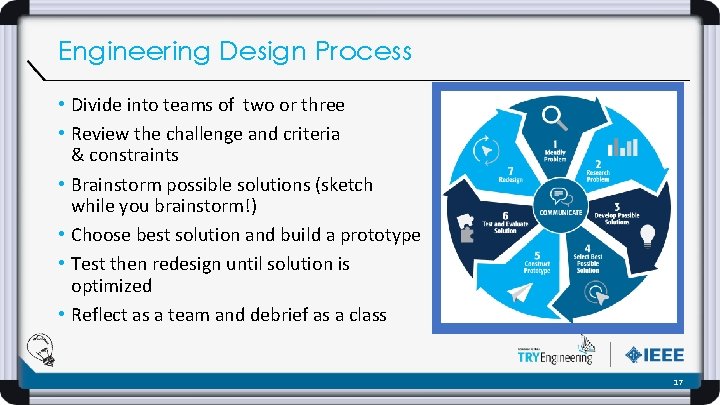
Engineering Design Process • Divide into teams of two or three • Review the challenge and criteria & constraints • Brainstorm possible solutions (sketch while you brainstorm!) • Choose best solution and build a prototype • Test then redesign until solution is optimized • Reflect as a team and debrief as a class 17
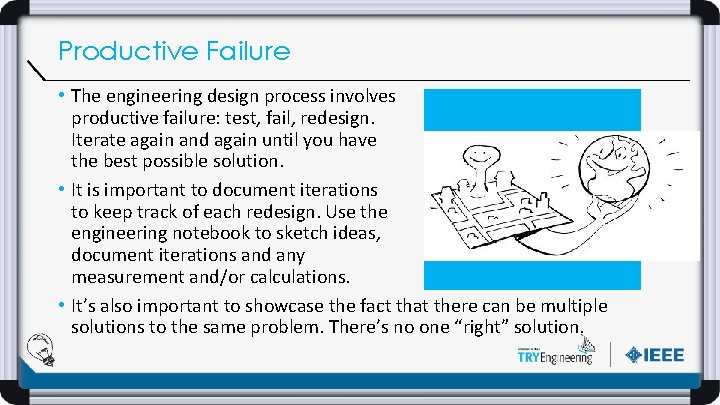
Productive Failure • The engineering design process involves productive failure: test, fail, redesign. Iterate again and again until you have the best possible solution. • It is important to document iterations to keep track of each redesign. Use the engineering notebook to sketch ideas, document iterations and any measurement and/or calculations. • It’s also important to showcase the fact that there can be multiple solutions to the same problem. There’s no one “right” solution.
Vocabulary
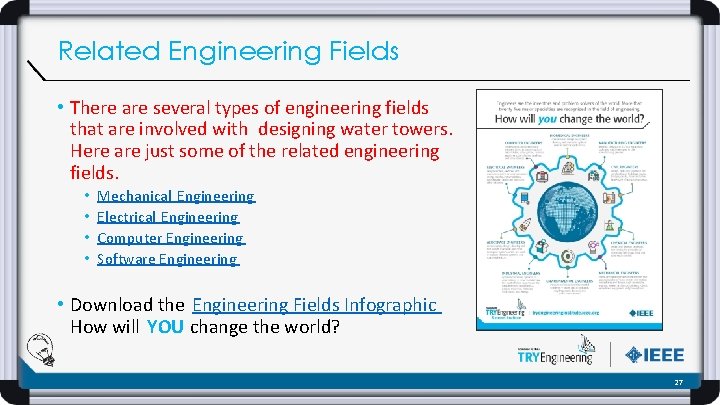
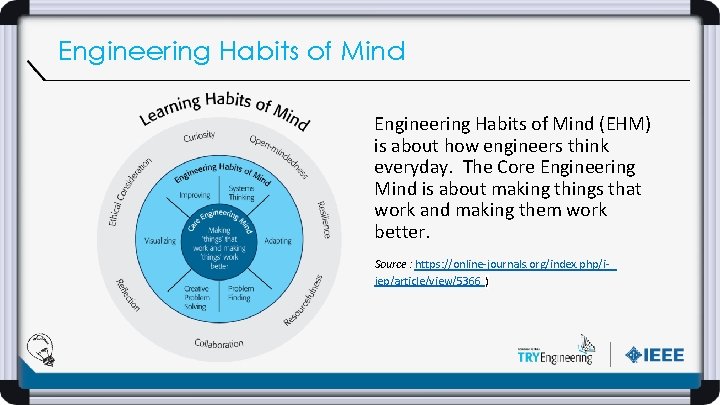
Vocabulary • Constraints : Limitations with material, time, size of team, etc. • Criteria: Conditions that the design must satisfy like its overall size, etc. • Engineers: Inventors and problem-solvers of the world. Twenty-five major specialties are recognized in engineering ( see infographic ). • Engineering Design Process: Process engineers use to solve problems. • Engineering Habits of Mind (EHM): Six unique ways that engineers think. • Hydrostatic Pressure: Pressure exerted by a fluid at equilibrium due to the force of gravity. It is the pressure of the water that forces water to flow through pipes into homes. 20
Vocabulary • • Iteration: Test & redesign is one iteration. Repeat (multiple iterations ). Potable Water : Fit or suitable for drinking. Pressurize: Exerting a steady force upon a surface. Prototype: A working model of the solution to be tested. Pumping Station: A house where pumps are installed and operated. Reservoir: A place where large amounts of water get stored. Scalable: Capable of being easily expanded or upgraded on demand. 21
Vocabulary • Water Distribution System: P art of water supply network with components that carry potable water from a centralized treatment plant or wells to water consumers. • Water Tower: A large elevated drinking water storage container that is engineered to safely hold a water supply at a height sufficient to pressurize a water distribution system. 22
Dig Deeper
Dig Deeper into the Topic Internet Connections • Water Towers Recommended Reading • • Water Towers (ISBN: 978 -0262022774) Design for Water: Rainwater Harvesting, Stormwater Catchment, and Alternate Water Reuse (ISBN: 978 -0865715806) Writing Activity Write an essay or a paragraph about environmental challenges to a water tower design. Consider how the weather, topography, the population of an area, or other factors might impact the design of a new water tower. 24
Engineering Fields
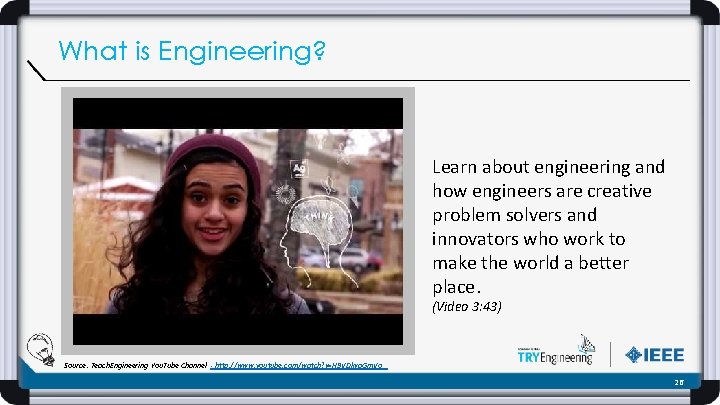
What is Engineering? Learn about engineering and how engineers are creative problem solvers and innovators who work to make the world a better place. (Video 3: 43) Source: Teach. Engineering You. Tube Channel - http: //www. youtube. com/watch? v=H 9 VDkvg. Gm. Vo 26
Related Engineering Fields • There are several types of engineering fields that are involved with designing water towers. Here are just some of the related engineering fields. • • Mechanical Engineering Electrical Engineering Computer Engineering Software Engineering • Download the Engineering Fields Infographic How will YOU change the world? 27
Engineering Habits of Mind (EHM) is about how engineers think everyday. The Core Engineering Mind is about making things that work and making them work better. Source : https: //online-journals. org/index. php/ijep/article/view/5366 )
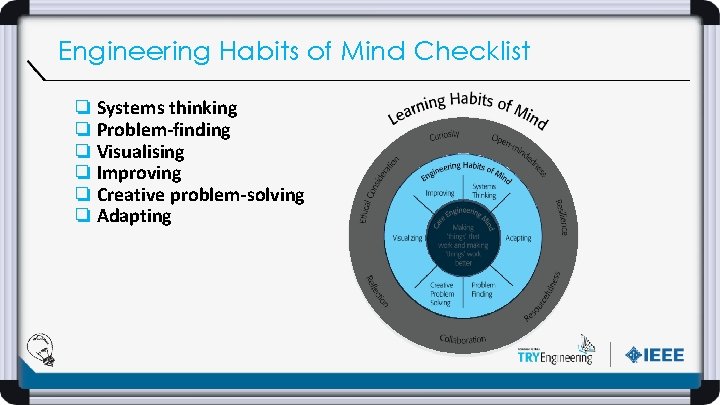
Engineering Habits of Mind Checklist ❏ Systems thinking ❏ Problem-finding ❏ Visualising ❏ Improving ❏ Creative problem-solving ❏ Adapting
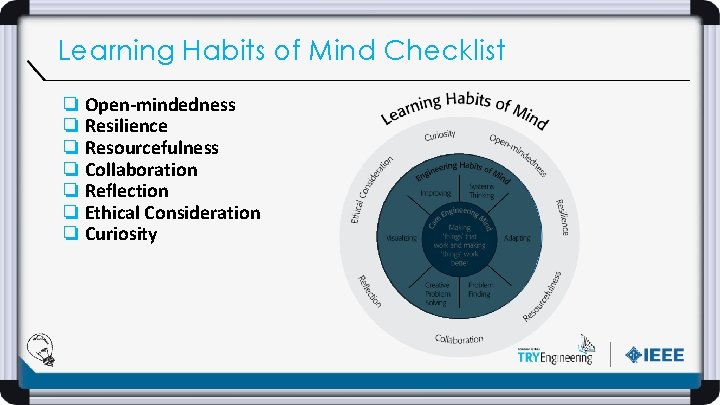
Learning Habits of Mind Checklist ❏ Open-mindedness ❏ Resilience ❏ Resourcefulness ❏ Collaboration ❏ Reflection ❏ Ethical Consideration ❏ Curiosity
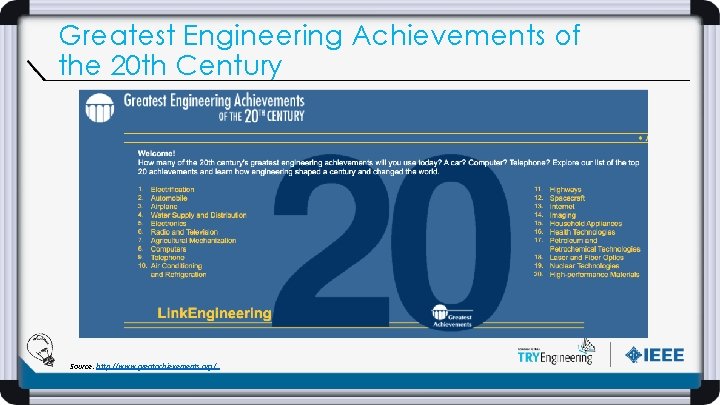
Greatest Engineering Achievements of the 20 th Century Source: http: //www. greatachievements. org/
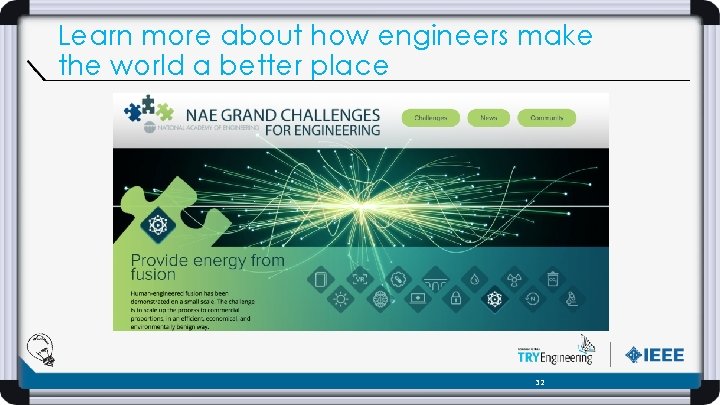
Learn more about how engineers make the world a better place 32
For more engineering lesson plans and resources like games, engineering careers, and STEM opportunities visit IEEE’s Try. Engineering. org