
Lesson Plan Models for Differentiation Responding to students





- Slides: 29
Lesson Plan Models for Differentiation Responding to students’ educational needs, learning styles, personality profiles, and interests Heather J. Pinedo-Burns, Ed. D. Teachers College, Columbia University
There is an Ebb & a Flow to Differentiated Instruction
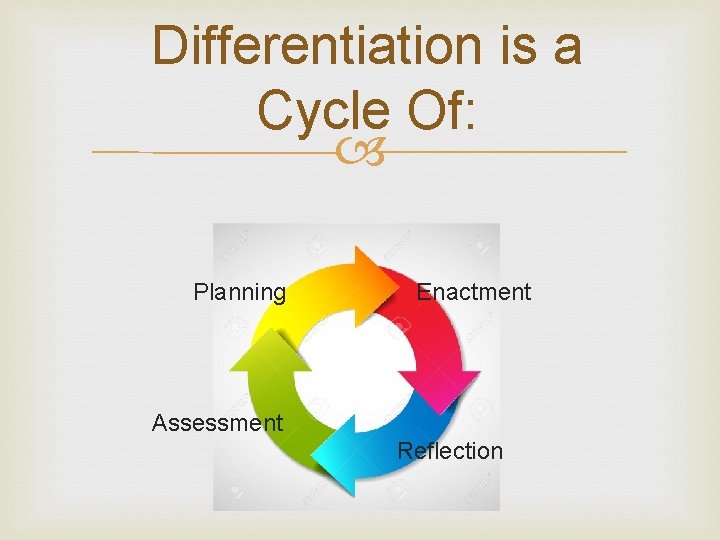
Differentiation is a Cycle Of: Planning Enactment Assessment Reflection
We can differentiate our: Content What do you want your students to learn? Process How do you want your students to learn? Product How will your students demonstrate their knowledge?
Differentiating Content, Process & Product Begins with the students.
Often Differentiation is in response to Student’s academic needs: reading level content skill level pacing
We can differentiate in response to student: Readiness Skill level Learning Profile. Interests Personality & more
Differentiation Always Begins with the children What are your students’ needs?
Encouraging Learning Working within children’s Zone of Proximal Development (Vygotsky) We want all children to feel a comfortable level of challenge.
Most Basic DI-Tiered Lessons are levels that work to meet the various academic needs within your class. Often (but not always!) tiered lessons are based on Bloom’s Taxonomy
What can be tiered? Assignments Lesson Plans Homework Experiments Assessments Writing Prompts
ESSENTIAL ELEMENTS OF A TIERED LESSON PLAN Tiers are leveled in cognitive complexity Each tier engaged is matched to the learner’s level of readiness and level of mastery Each task is respectful and engaging Each task moves toward the same essential understanding
TIERED ASSIGNMENTS Select a concept, skills or understanding Consider students readiness, interest or learning profile Create one activity that is interesting, requires high-level thinking & is clearly focused on the key concept, skill or generalization
THEN… REVISE THE ACTIVITY TO PROVIDE DIFFERENT VERSIONS AT DIFFERENT LEVELS OF DIFFICULTY CONSIDER USING BLOOMS TAXONOMY MATCH STUDENTS
Consider… How does this look for content? How does this look for process? How does this look for product? (Complexity, depth, reading level)
Watching Video Examples Use your PMI Chart to support your notes during the videos
Differentiating by Student Interest Know your learners
PRE-ASSESSEMENT AS THE TEACHER WHAT DO YOU NEED TO KNOW SPECIFICALLY GOING INTO THIS UNIT OF STUDY? You as the teacher – what information, methods, etc. do you need? For your students – what information do you have about your students’ interests, abilities, previous knowledge, experiences, learning profiles? HOW IS IT BEST TO LEARN THIS INFORMATION?
Interest Inventories General – Get to Know You Specific to Content Learning Style Personality Profile
I can learn best about a subject by listening to the teacher talk Almost never Sometimes Often I like to take notes Almost never Sometimes Often I enjoy touching objects and working with my hands in class Almost never Sometimes Often I remember best by writing things down Almost never Sometimes Often Maps are easy for me to understand Almost never Sometimes Often The best way to remember things is to picture them in your head. Almost never Sometimes Often I learn to spell words by “finger spelling. ” Almost never Sometimes Often I enjoy listening to speeches rather than reading them. Almost never Sometimes Often I follow oral directions better than written directions. Almost never Sometimes Often I enjoy giving hugs and shaking hands with people Almost never Sometimes Often
Based on the students responses and content, then we must ask… How are students learning in your classroom? Is there choice? How do students demonstrate their knowledge?
Looking at Sample Lessons Plans Exploring Differentiated Instruction by: Content Process Product
Beginning with the Public Policy Analyst 1. What is the problem? 2. Where is the evidence? 3. What are the causes? 4. What is the existing policy? 5. What policies can you create to correct the problem? 6. What is the best policy to correct the problem?
Your Questions about Lesson Planning Ticket Out the Door