
Lesson Plan Goals and Objectives 1 Define your
Lesson Plan Goals and Objectives
1 - Define your topic and goals The first step in planning an instructional lesson is to have a very accurate idea of exactly what learning you want to take place This should be based on the needs of the specific audience you are trying to teach.
Example of a goal, Many of our students have bicycles. Most of them ride after school. In warm weather many ride them to and from school. We need to instill in our students proper and safe ways to operate their bikes.
Define the Audience Accurately define the characteristics of your audience. The motivation, age, prior knowledge or training, and the environment in which they live must be taken into account in this audience definition
Example of Audience Description, The audience will be second graders of average to above average Intelligence. They live in a large, urban, community in New York City. The students are curious and very interested in environmental matters. The school lacks well equipped Audio-Visual resource room. Students have already learned how to…. .
3 - Develop your objectives Students usually do not know what is important to focus on During the instruction. They need some specific, concrete, and measurable, Objectives.
An instructional objective is a statement not of what the instructor plans to put into the lesson but of what the learner ought to get out of the lesson
The statement of objectives should be as specific as possible. For example, ‘My students will improve their mathematical skills” Is far too general to qualify as a specific lesson objective. it does, however, qualify as a goal- a broad statement of the purpose.
A good example, The second-grade students will be able to solve correctly any single-digit addition problem.
Why should we state instructional objectives? 1 - In order to make appropriate selection of methods (sequence of activities)and media selection. 2 - to prepare the environment an equipments. 3 - to help assure proper evaluation. The teacher will have a criterion to evaluate whether students have achieved an objective. 4 - students will know what is expected of them. 5 - the objectives is contract between the teacher and the learner.
Four characteristics of Well-Stated Objectives 1 - Audience 2 - Behavior 3 - Conditions 4 - Degree
Behavior What the learner be able to do after completing instruction?
Words open to many interpretations Know, understand, really understand, appreciate, fully appreciate, grasp the significance of, enjoy, believe, have faith in, Internalize, learn Vague terms such as do not communicate your aim clearly.
Verbs open to fewer interpretations Write, recite, define, identify, sort, predict, solve, state, construct, demonstrate, build, classify, compare, contrast, smile, describe, categorize, name. which denote observable performance
More examples Add, alphabetize, analyze, apply, arrange, assemble, attend, bisect, Build, carve, categorize, choose, classify, color, compare, complete, compose, compute, conduct, construct, Contrast, convert, correct, cut Page 38,
Four characteristics of Well-Stated Objectives 1 - Audience 2 - Behavior 3 - Conditions 4 - Degree
A statement of objectives should include the conditions under which the performance is to be observed. What tools or equipment will the student be allowed or not allowed to use in demonstrating mastery of the objectives
For example, are students allowed to use notes in describing the consequences of excessive use of alcohol?

More Examples Given a political map of Europe, the student will be able to mark the major coal-producing areas Without notes, textbook, or any library materials, the student will be able to write a 300 -word essay on the relationship of nutrition to learning.
Four characteristics of Well-Stated Objectives 1 - Audience 2 - Behavior 3 - Conditions 4 - Degree
Degree Well-stated objectives should indicate the standard, or criterion, by which acceptable performance will be judged.
Example What degree of accuracy or proficiency must the learner display? How well a student should perform the task How quickly must the observable behavior be performed? How accurate must a behavior be performed? How perfect should a task be performed? Sometimes qualitative criteria, should be used such as Originality, flexibility, fluency, …etc.
Classification of objectives Three categories (or domains), of learning are widely used Cognitive Skills Affective Skills Motor Skills
Cognitive Skills
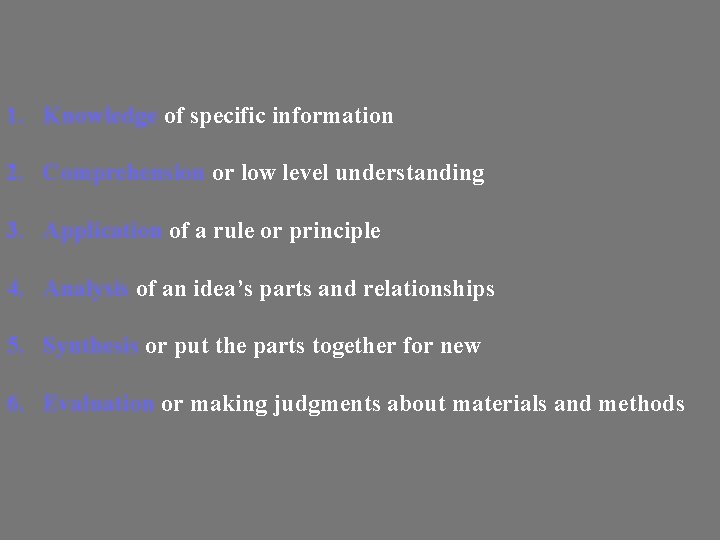
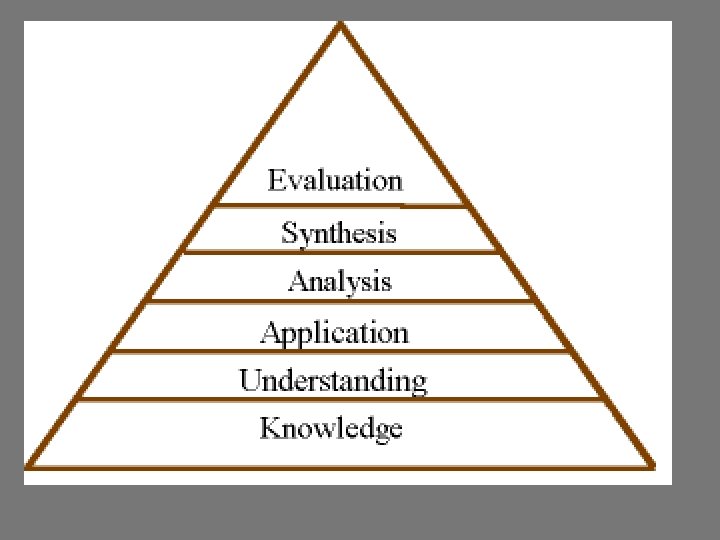
1. Knowledge of specific information 2. Comprehension or low level understanding 3. Application of a rule or principle 4. Analysis of an idea’s parts and relationships 5. Synthesis or put the parts together for new 6. Evaluation or making judgments about materials and methods
LEVEL 1: KNOWLEDGE Knowledge of: • specifics • ways or means of dealing with specifics • the universals and abstractions in a field You're expecting the learner to: • remember an idea phenomenon, or a fact in somewhat the same form in which they learned it.
For example you might design a learning objective which requires the learner to: • Write (or tell) the formula for the area of a triangle • Spell the word "taxonomy" • List the names of U. S. presidents since 1980. • Recite the poem "Auto Wreck"
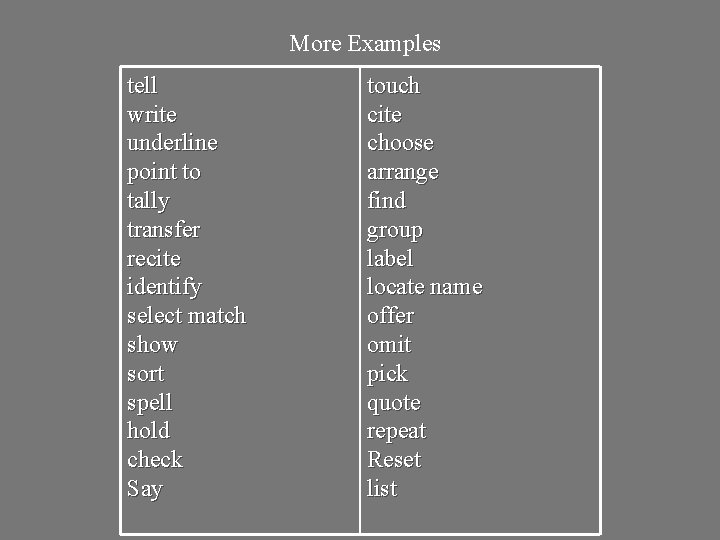
More Examples tell write underline point to tally transfer recite identify select match show sort spell hold check Say touch cite choose arrange find group label locate name offer omit pick quote repeat Reset list
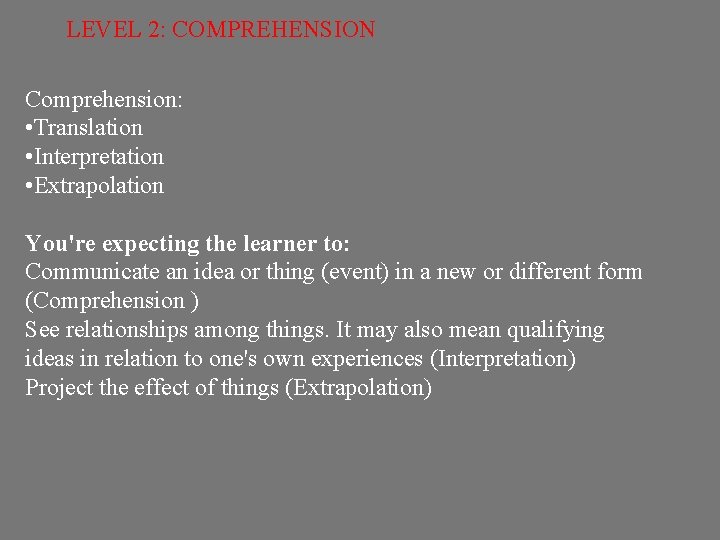
LEVEL 2: COMPREHENSION Comprehension: • Translation • Interpretation • Extrapolation You're expecting the learner to: Communicate an idea or thing (event) in a new or different form (Comprehension ) See relationships among things. It may also mean qualifying ideas in relation to one's own experiences (Interpretation) Project the effect of things (Extrapolation)
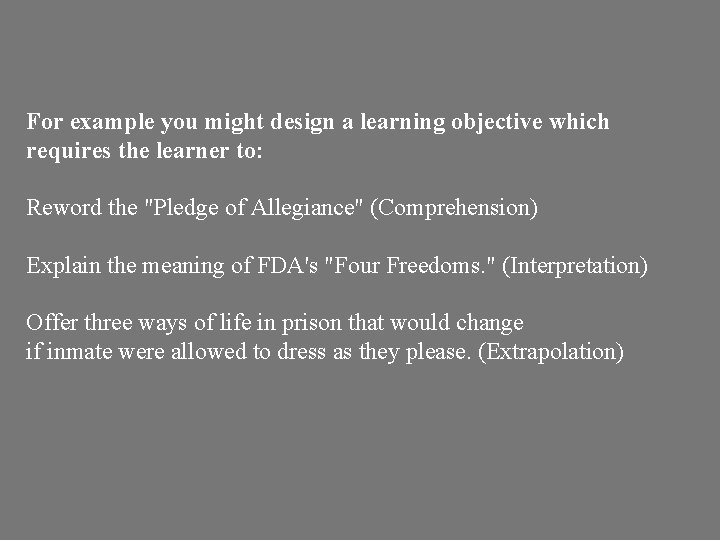
For example you might design a learning objective which requires the learner to: Reword the "Pledge of Allegiance" (Comprehension) Explain the meaning of FDA's "Four Freedoms. " (Interpretation) Offer three ways of life in prison that would change if inmate were allowed to dress as they please. (Extrapolation)
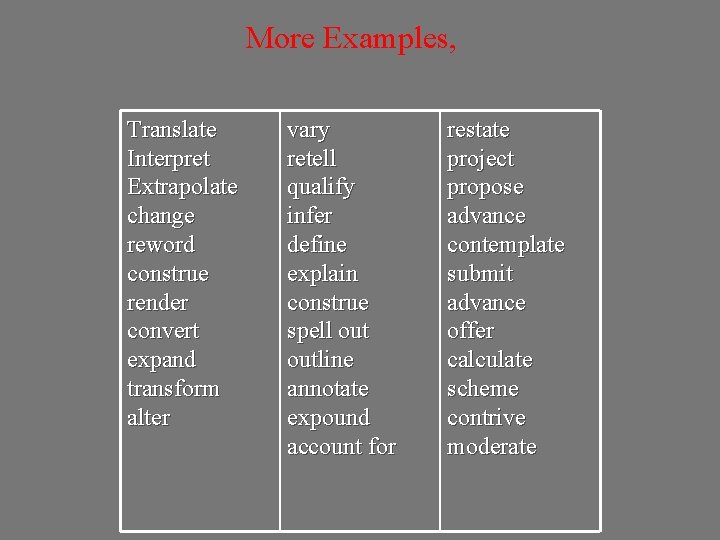
More Examples, Translate Interpret Extrapolate change reword construe render convert expand transform alter vary retell qualify infer define explain construe spell outline annotate expound account for restate project propose advance contemplate submit advance offer calculate scheme contrive moderate
LEVEL 3: APPLICATION Application is described by Bloom as "the use of abstract forms in particular and concrete situations. The abstractions may be in the form of general ideas, rules or procedures, generalized methods. " You're expecting the learner to: use what they know (data) from a variety of areas to find solutions to problems relate or apply ideas to new unusual, or noble situations
For example, you might design a learning objective which requires the learner to: • Make use of the clothes you are wearing to stay afloat for several hours • Utilize a pail and mop to remove the water from a plugged sink
More Examples, relate utilize solve adopt employ use avail capitalize on consume exploit profit by mobilize operate ply handle manipulate exert exercise try devote wield put in action put to use make use f take up develop
LEVEL 4: ANALYSIS Analysis of: • elements • relationships • organizational principles You're expecting the learner to: • break something down into its component arts • uncover the unique characteristics of a "thing"
For example you might design a learning objective which requires the learner to: Simplify "ballet" to its basic moves Take apart an alarm clock Inspect the house for poor workmanship Search the "Last Supper" to uncover as many principles of art as possible
More Examples break down uncover look into dissect examine take apart divide simplify reason include deduce syllogize check audit inspect section canvass scrutinize sift compare assay test for survey search study check screen
LEVEL 5: SYNTHESIS Synthesis • communicating in a unique way • developing a plan or proposing a set of operations • developing a set of abstract relations (to hypothesize) You're expecting the learner to: • think creatively (divergently) • to make or create new or original "things" • take "things" and pattern them in new ways
For example you might design a learning objective which requires the learner to: Develop a way to teach the concept of "adjective. " Create a new opening line for the song "Mary Had a little Lamb. " Combine elements of drama, music, and dance into a stage presentation.
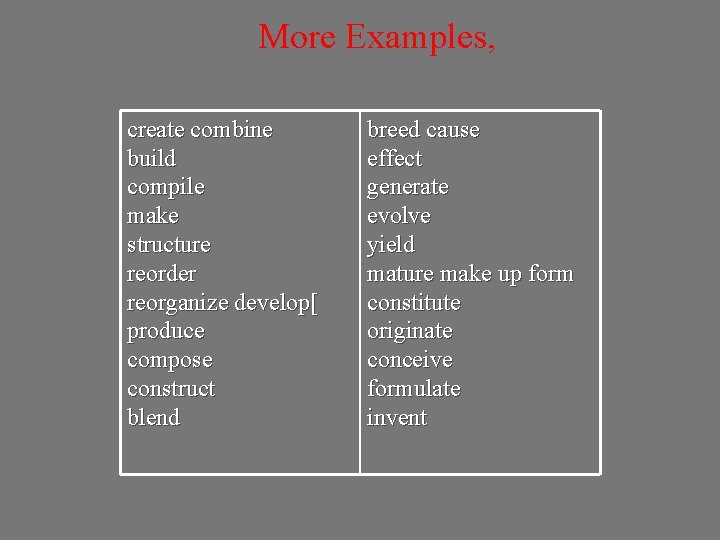
More Examples, create combine build compile make structure reorder reorganize develop[ produce compose construct blend breed cause effect generate evolve yield mature make up form constitute originate conceive formulate invent
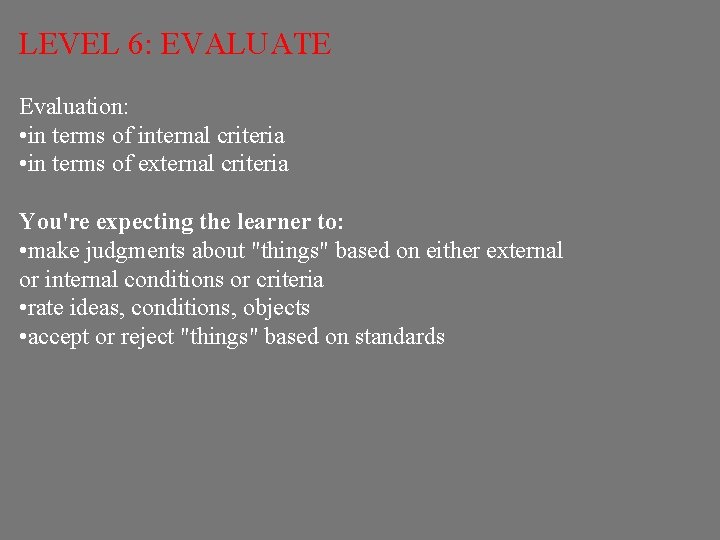
LEVEL 6: EVALUATE Evaluation: • in terms of internal criteria • in terms of external criteria You're expecting the learner to: • make judgments about "things" based on either external or internal conditions or criteria • rate ideas, conditions, objects • accept or reject "things" based on standards
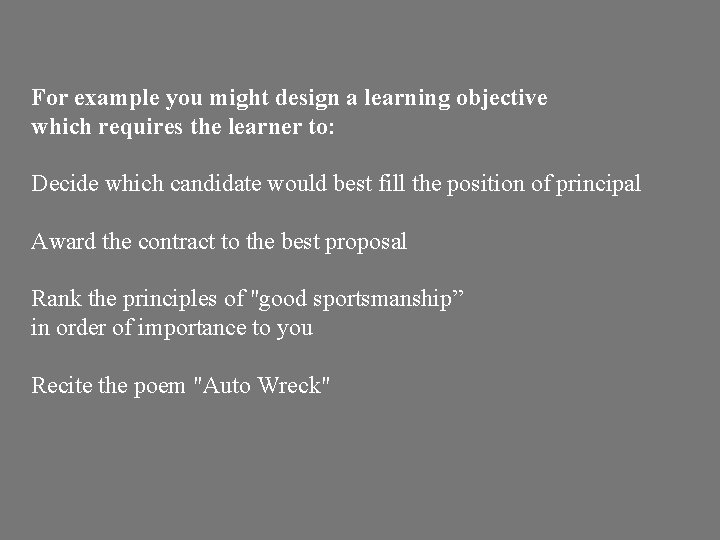
For example you might design a learning objective which requires the learner to: Decide which candidate would best fill the position of principal Award the contract to the best proposal Rank the principles of "good sportsmanship” in order of importance to you Recite the poem "Auto Wreck"
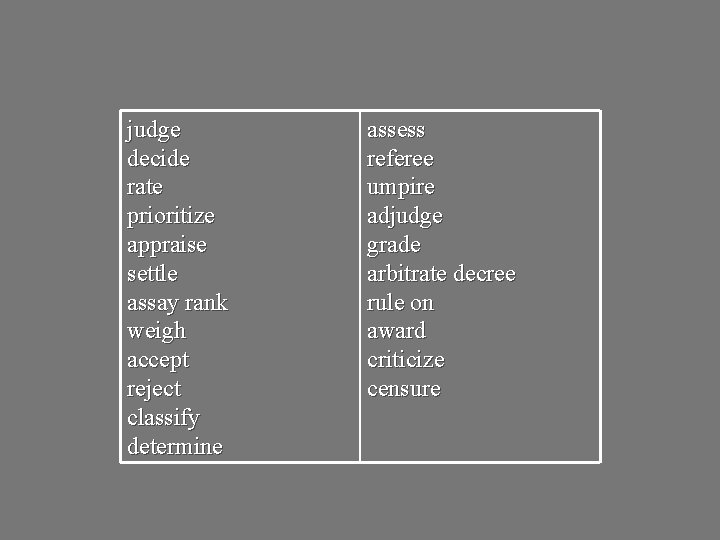
judge decide rate prioritize appraise settle assay rank weigh accept reject classify determine assess referee umpire adjudge grade arbitrate decree rule on award criticize censure

Affective Domain
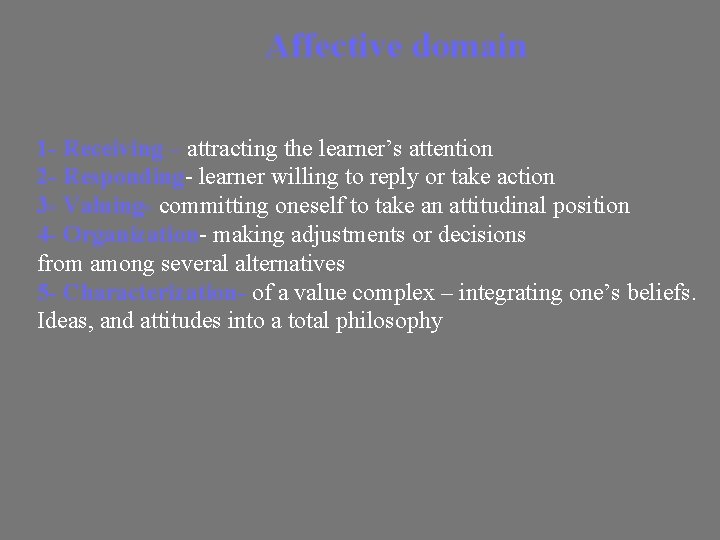
Affective domain 1 - Receiving – attracting the learner’s attention 2 - Responding- learner willing to reply or take action 3 - Valuing- committing oneself to take an attitudinal position 4 - Organization- making adjustments or decisions from among several alternatives 5 - Characterization- of a value complex – integrating one’s beliefs. Ideas, and attitudes into a total philosophy
1 - RECEIVING Student's willingness to attend to classroom activity Getting, holding, and directing students' attention Example Objectives The student will show awareness of class proceedings.
More Examples Listens attentively Shows awareness of the importance of learning Attends closely to the classroom activities Asks, chooses, describes, follows, holds, locates, selects, replies, uses
2 - RESPONDING Active participation on the part of the student Example, The student willingly answer questions
More Examples, Completes assigned homework Participates in class discussion Volunteers for tasks Shows interest in subject Enjoys helping others Answers, assists, conforms, greets, discusses, helps, performs, presents, reads, recites, tells, writes
3 - VALUING The worth or value a student attaches to a particular object or behavior Example, The student will express strong opinions on issues under discussion
More Examples, Demonstrates beliefs in the democratic process Shows concern for the welfare of others Demonstrates problem solving attitude Demonstrates commitment to social improvement Completes, describes, follows, forms, initiates, invites, joins, justifies, proposes, reads, reports, shares, studies, works
4 - ORGANIZATION Bringing together different values, resolving conflict between them and beginning the building of a consistent value system Example, The student will criticize arguments and positions presented in class.
More Examples, Recognizes the need for balance between freedom and responsibility in a democracy Accepts responsibility for his or her own behavior Understands and accepts own strengths and limitations Formulates a life plan in harmony with his abilities, interest, beliefs Adheres, alters, arranges, combines, compares, defines, explains, identifies, modifies, orders, prepares, relates, synthesizes
5 - VALUE OR VALUE COMPLEX The individual has a value system that has controlled his or her behavior for a sufficiently long time for him or her to have developed a "life style" Example, The student will demonstrate a philosophy of life by the consistency of his or her daily actions.
More Examples, Demonstrates self-reliance in working independently. Cooperation in group activities Punctuality and self discipline Acts, discriminates, displays, influences, listens, modifies, performs, practices, qualifies, questions, solves, uses, verifies.

Motor Skill Domain
Motor Skill domain 1 - Gross body movements- arms, shoulders, feet, and legs 2 - Finely coordinated movements – hand fingers, hand eye , hand ear, hand, eye, and foot 3 - Nonverbal communication – facial expression, gestures, bodily movements 4 - Speech behaviors- sound production and projection. Sound-gesture coordination
Reflex Movement To flex, to stretch, to straighten, to extend, to inhibit, to lengthen, to shorten, to tense, to stiffen, to relax Reflexes The child will turn his or head toward a loud sound.
Fundamental Movements To crawl, to creep, to slide, to walk, to run, to jump, to grasp, to reach, to tighten, to support, to handle, changes location, moves in space while remaining in one place, moves extremities in coordinated fashion The child will crawl on hands and knees.
Perceptual Abilities To catch, to bounce, to eat, to write, to balance, to bend, to draw from memory, to distinguish by touching, to explore, Discriminates visually, discriminates auditory, discriminates kinesthetically discriminates tactually, coordinates two or more perceptual abilities The child will walk a balance beam.
Physical Abilities To endure, to improve, to increase, to stop, to start, to move precisely, to touch, to bend Exerts tension, moves quickly, stops immediately, endures fatigue The learner will catch a volleyball that is thrown
Skilled Movements To waltz, to type, to play the piano, to plane, to file, to skate, to juggle, to paint, to dive, to fence, to golf, to change Changes or modifies basic body movement patterns, uses a tool or implement in adaptive or skilled manner The learner will dance a demonstrated routine.
Nondiscursive Communications To gesture, to stand, to sit, to express facially, to dance skillfully, to perform skillfully, to paint skillfully, to play skillfully Moves expressively, moves interpretatively, communicates emotions, communicates esthetically, expresses joy. The learner will pantomime a work given to him or her by the teacher.
- Slides: 65