
Lesson Overview Using Resources Wisely How do humans
- Slides: 20
Lesson Overview Using Resources Wisely How do humans affect the biosphere? Do now: What is one way we can conserve resources? HW: worksheet 91 -93 due Wednesday
Lesson Overview Using Resources Wisely The Effect of Human Activity How do our daily activities affect the environment? Humans affect regional and global environments through agriculture, development, and industry in ways that have an impact on the quality of Earth’s natural resources, including soil, water, and the atmosphere.
Lesson Overview Using Resources Wisely Agriculture Modern agricultural practices have enabled farmers to double world food production over the last 50 years. Monoculture- practice of clearing large areas of land to plant a single highly productive crop year after year. Monoculture enables efficient sowing, tending, and harvesting of crops using machines.
Lesson Overview Using Resources Wisely Sustainable Development What is the relationship between resource use and sustainable development? Sustainable development provides for human needs while preserving the ecosystems that produce natural resources.
Lesson Overview Using Resources Wisely Renewable and Nonrenewable Resources Ecosystem goods and services are classified as either renewable or nonrenewable. A renewable resource can be produced or replaced by a healthy ecosystem. Wind is a renewable resource. nonrenewable resources because natural processes cannot replenish them quickly Fossil fuels like coal, oil, and natural gas are nonrenewable resources formed from buried organic materials over millions of years.
Lesson Overview Using Resources Wisely Sustainable Resource Using natural resources in a way that does not cause long-term environmental harm is called sustainable development. Sustainable development should cause no long-term harm to the soil, water, and climate on which it depends. It should consume as little energy and material as possible.
Lesson Overview Using Resources Wisely Soil Resources Why is soil important, and how do we protect it? Healthy soil supports both agriculture and forestry. It is possible to minimize soil erosion through careful management of both agriculture and forestry.
Lesson Overview Using Resources Wisely Soil Erosion The dust bowl of the 1930 s was caused, in part, by conversion of prairie land to cropland in ways that left soil vulnerable to erosion. Soil erosion is the removal of soil by water or wind. Soil erosion is often worse when land is plowed and left barren between plantings. When no roots are left to hold soil in place, it is easily washed away.
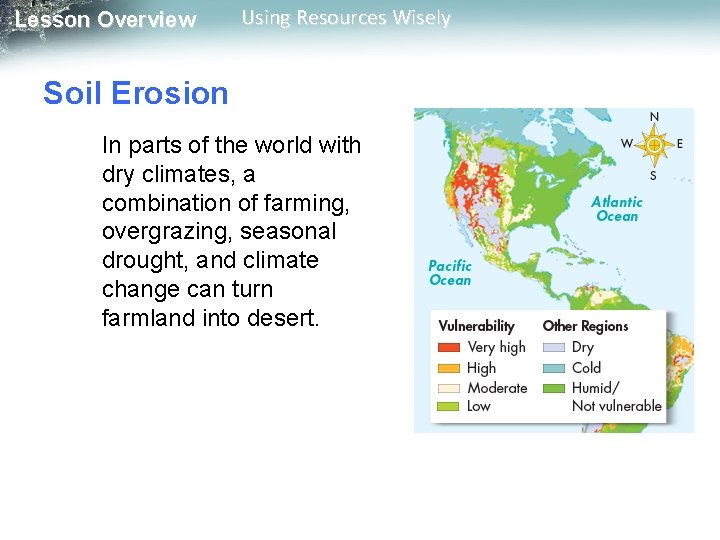
Lesson Overview Using Resources Wisely Soil Erosion In parts of the world with dry climates, a combination of farming, overgrazing, seasonal drought, and climate change can turn farmland into desert. This process is called desertification. .
Lesson Overview Using Resources Wisely Soil Erosion Deforestation, or the loss of forests, can have a negative effect on soil quality. More than half of the world’s old-growth forests (forests that had never been cut) have been lost to deforestation. Healthy forests hold soil in place, protect the quality of fresh water supplies, absorb carbon dioxide, and help moderate local climate.
Lesson Overview Using Resources Wisely Soil Use and Sustainability Leaving stems and roots of the previous year’s crop in the soil can help hold soil in place between plantings. Crop rotation—planting different crops at different seasons or in different years—can help prevent both erosion and nutrient loss. The practice of contour plowing involves planting fields of crops across, instead of down, the slope of the land. This can reduce water runoff and therefore erosion. Terracing—shaping the land to create level “steps”— also helps hold water and soil.
Lesson Overview Using Resources Wisely Freshwater Resources What are the primary sources of water pollution? The primary sources of water pollution are industrial and agricultural chemicals, residential sewage, and nonpoint sources.
Lesson Overview Using Resources Wisely Water Pollution Freshwater sources can be affected by different kinds of pollution. A pollutant is a harmful material that can enter the biosphere. Pollutants that enter water supplies from a single source —a factory or an oil spill, for example—are called point source pollution. Pollutants that enter water supplies from many smaller sources—the grease and oil washed off streets by rain or the chemicals released into the air by factories and automobiles, for example—are called nonpoint source pollution.
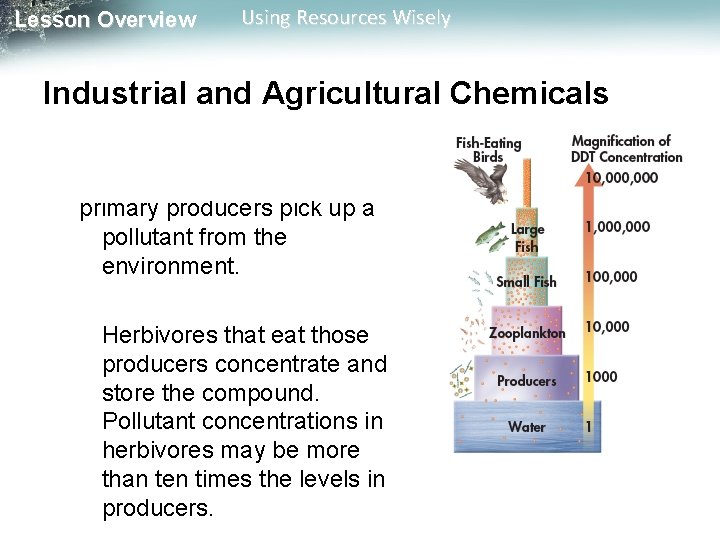
Lesson Overview Using Resources Wisely Industrial and Agricultural Chemicals In the process of biological magnification, primary producers pick up a pollutant from the environment. Herbivores that eat those producers concentrate and store the compound. Pollutant concentrations in herbivores may be more than ten times the levels in producers.
Lesson Overview Using Resources Wisely Water Quality and Sustainability One key to sustainable water use is to protect the natural systems involved in the water cycle. Protecting these ecosystems is a critical part of watershed conservation. A watershed includes all the land whose groundwater, streams, and rivers drain into the same place—such as a large lake or river. Pollution control can have direct and positive effects on the water quality in a watershed.
Lesson Overview Using Resources Wisely Atmospheric Resources What are the major forms of air pollution? Common forms of air pollution include smog, acid rain, greenhouse gases, and particulates.
Lesson Overview Using Resources Wisely Smog is a gray-brown haze formed by chemical reactions among pollutants released into the air by industry and cars. Ozone is one product of these reactions. At ground level, ozone and other pollutants threaten the health of people, especially those with respiratory conditions.
Lesson Overview Using Resources Wisely Acid Rain Burning fossil fuels releases nitrogen and sulfur compounds. When those compounds combine with water vapor in the air, they form nitric and sulfuric acids. These airborne acids can drift for many kilometers before they fall as acid rain. Acid precipitation can dissolve and release mercury and other toxic elements from soil, freeing those elements to enter other parts of the biosphere.
Lesson Overview Using Resources Wisely Greenhouse Gases Burning fossil fuels and forests releases stored carbon into the atmosphere as carbon dioxide, a greenhouse gas. Agricultural practices release methane, another greenhouse gas. Although some greenhouse gases are necessary, when excess greenhouse gases accumulate in the atmosphere, they contribute to global warming and climate change.
Lesson Overview Using Resources Wisely Particulates microscopic particles of ash and dust released by certain industrial processes and certain kinds of diesel engines. Very small particulates can pass through the nose and mouth and enter the lungs, where they can cause serious health problems.