
Lesson Overview Unit 8 DNA Structure and Replication
- Slides: 33
Lesson Overview Unit 8 – DNA Structure and Replication
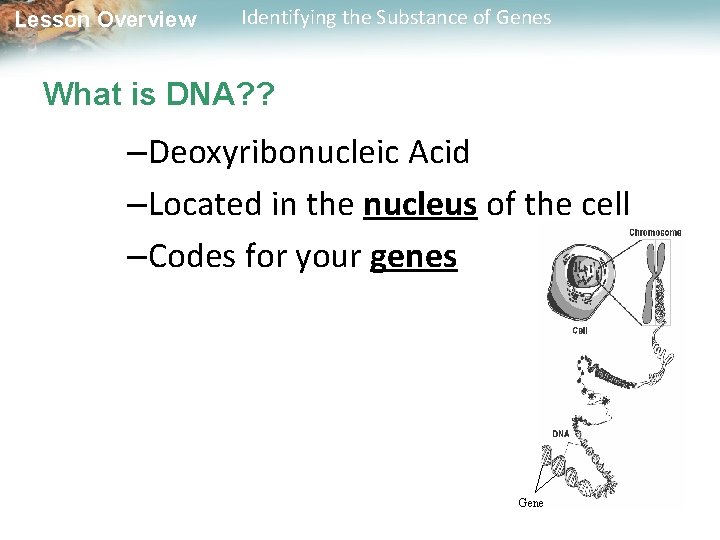
Lesson Overview Identifying the Substance of Genes What is DNA? ? –Deoxyribonucleic Acid –Located in the nucleus of the cell –Codes for your genes Gene
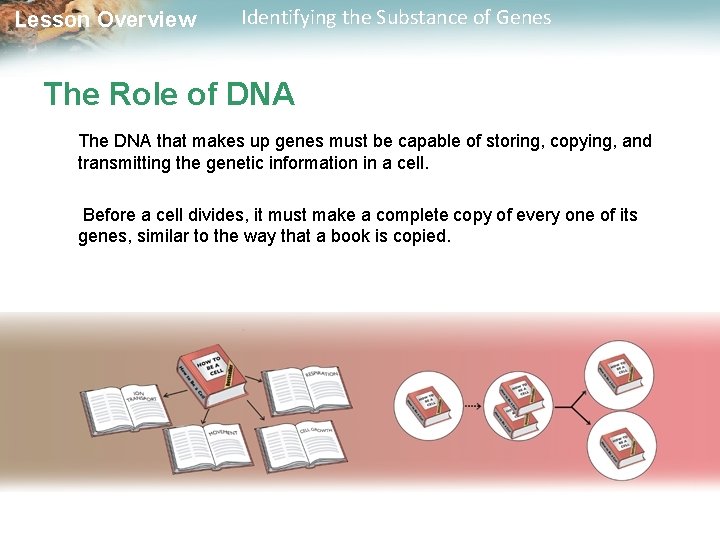
Lesson Overview Identifying the Substance of Genes The Role of DNA The DNA that makes up genes must be capable of storing, copying, and transmitting the genetic information in a cell. Before a cell divides, it must make a complete copy of every one of its genes, similar to the way that a book is copied.
Lesson Overview Identifying the Substance of Genes Transmitting Information When a cell divides, each daughter cell must receive a complete copy of the genetic information. Careful sorting is especially important during the formation of reproductive cells in meiosis. The loss of any DNA during meiosis might mean a loss of valuable genetic information from one generation to the next.
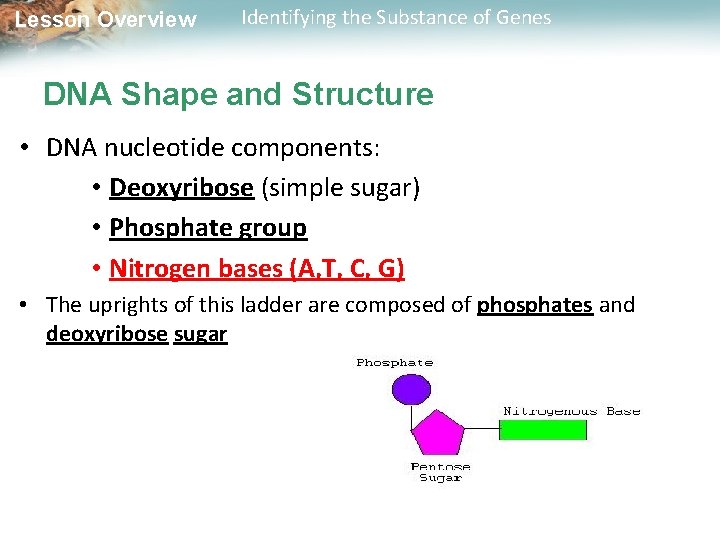
Lesson Overview Identifying the Substance of Genes DNA Shape and Structure • DNA nucleotide components: • Deoxyribose (simple sugar) • Phosphate group • Nitrogen bases (A, T, C, G) • The uprights of this ladder are composed of phosphates and deoxyribose sugar
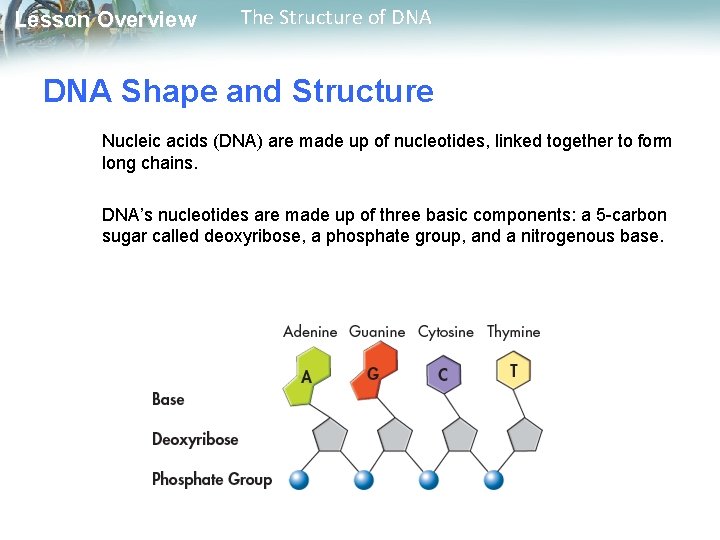
Lesson Overview The Structure of DNA Shape and Structure Nucleic acids (DNA) are made up of nucleotides, linked together to form long chains. DNA’s nucleotides are made up of three basic components: a 5 -carbon sugar called deoxyribose, a phosphate group, and a nitrogenous base.
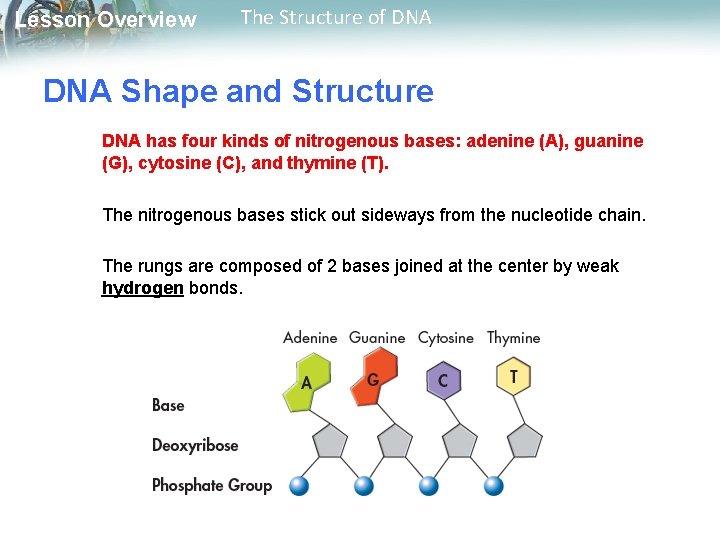
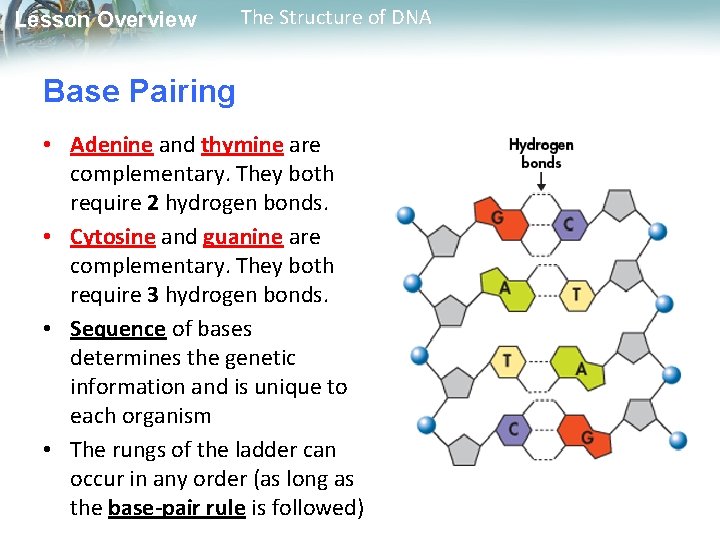
Lesson Overview The Structure of DNA Shape and Structure DNA has four kinds of nitrogenous bases: adenine (A), guanine (G), cytosine (C), and thymine (T). The nitrogenous bases stick out sideways from the nucleotide chain. The rungs are composed of 2 bases joined at the center by weak hydrogen bonds.
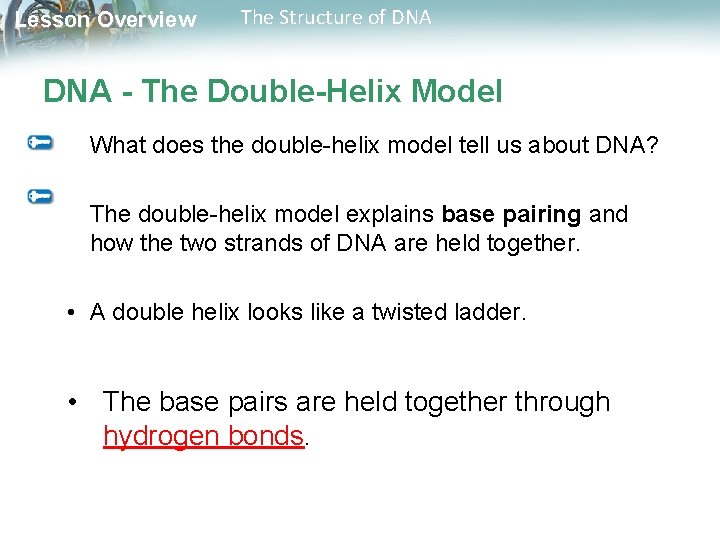
Lesson Overview The Structure of DNA - The Double-Helix Model What does the double-helix model tell us about DNA? The double-helix model explains base pairing and how the two strands of DNA are held together. • A double helix looks like a twisted ladder. • The base pairs are held together through hydrogen bonds.
Lesson Overview The Structure of DNA Base Pairing • Adenine and thymine are complementary. They both require 2 hydrogen bonds. • Cytosine and guanine are complementary. They both require 3 hydrogen bonds. • Sequence of bases determines the genetic information and is unique to each organism • The rungs of the ladder can occur in any order (as long as the base-pair rule is followed)
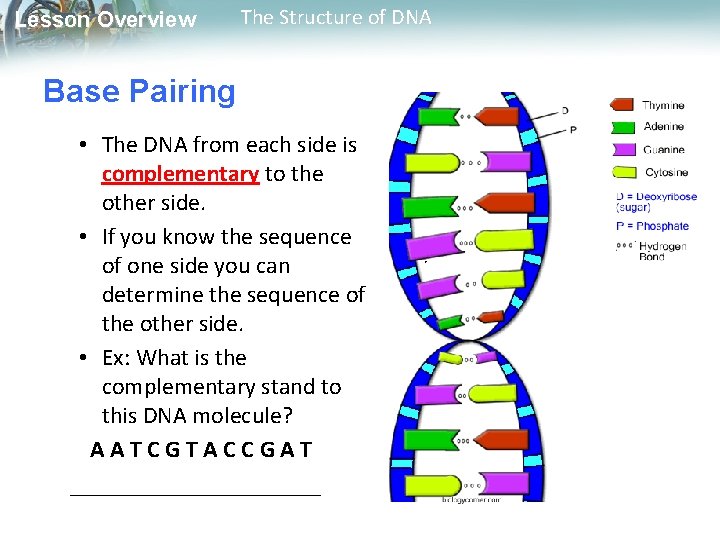
Lesson Overview The Structure of DNA Base Pairing • The DNA from each side is complementary to the other side. • If you know the sequence of one side you can determine the sequence of the other side. • Ex: What is the complementary stand to this DNA molecule? AATCGTACCGAT ___________
Lesson Overview The Structure of DNA The Replication Process Before a cell divides, it duplicates its DNA in a copying process called replication. This process ensures that each resulting cell has the same complete set of DNA molecules. • Why does DNA need to replicate? – Cells divide for an organism to grow or reproduce; every new cell needs a copy of the DNA or instructions to know how to be a cell.
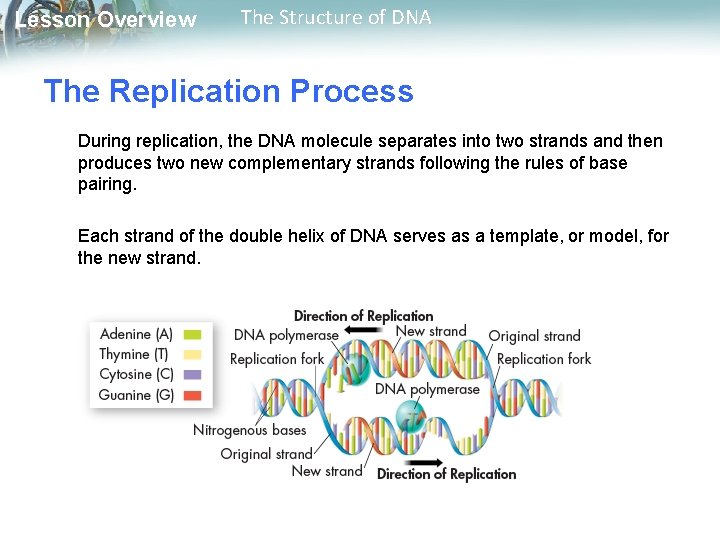
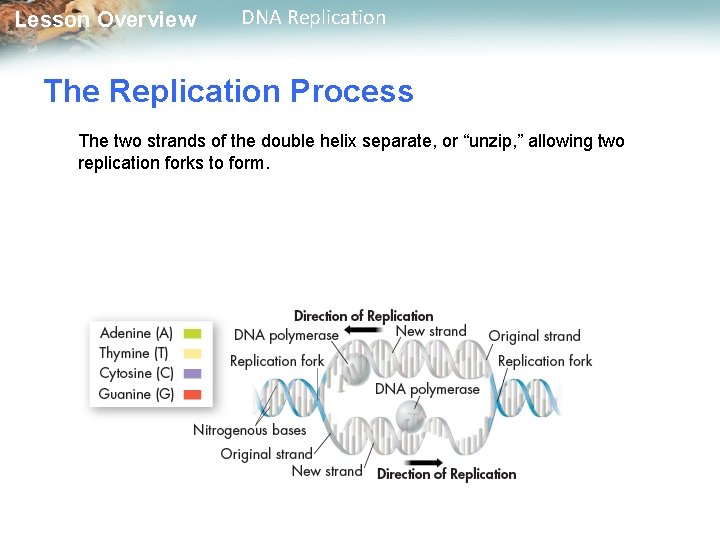
Lesson Overview The Structure of DNA The Replication Process During replication, the DNA molecule separates into two strands and then produces two new complementary strands following the rules of base pairing. Each strand of the double helix of DNA serves as a template, or model, for the new strand.
Lesson Overview DNA Replication The Replication Process The two strands of the double helix separate, or “unzip, ” allowing two replication forks to form.
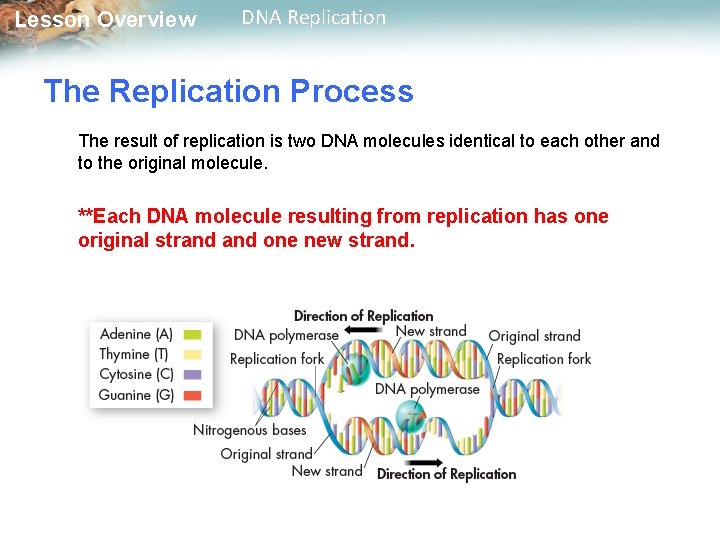
Lesson Overview DNA Replication The Replication Process The result of replication is two DNA molecules identical to each other and to the original molecule. **Each DNA molecule resulting from replication has one original strand one new strand.
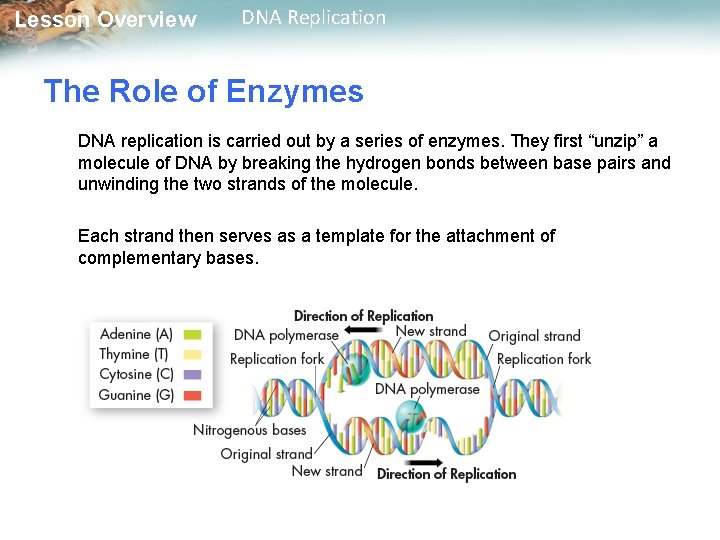
Lesson Overview DNA Replication The Role of Enzymes DNA replication is carried out by a series of enzymes. They first “unzip” a molecule of DNA by breaking the hydrogen bonds between base pairs and unwinding the two strands of the molecule. Each strand then serves as a template for the attachment of complementary bases.
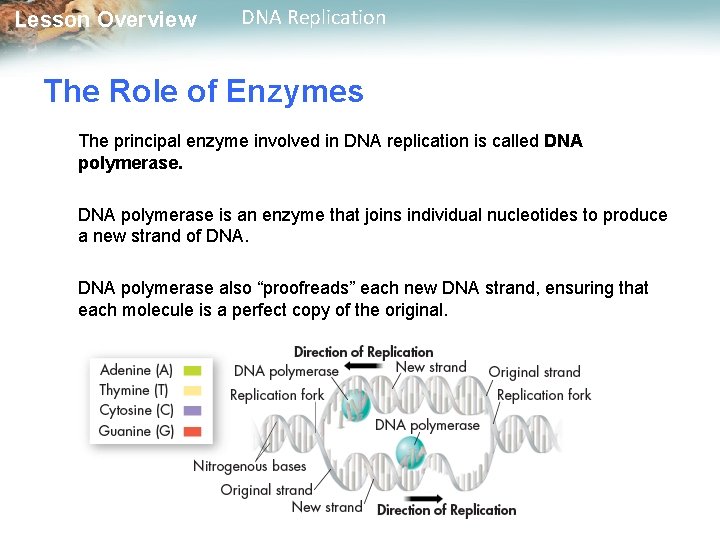
Lesson Overview DNA Replication The Role of Enzymes The principal enzyme involved in DNA replication is called DNA polymerase is an enzyme that joins individual nucleotides to produce a new strand of DNA polymerase also “proofreads” each new DNA strand, ensuring that each molecule is a perfect copy of the original.
Lesson Overview Fermentation Lesson Overview Unit 8 – RNA and Protein Synthesis
Lesson Overview Fermentation THINK ABOUT IT DNA is the genetic material of cells. The sequence of nucleotide bases in the strands of DNA carries some sort of code. In order for that code to work, the cell must be able to understand it. What, exactly, do those bases code for? Where is the cell’s decoding system?
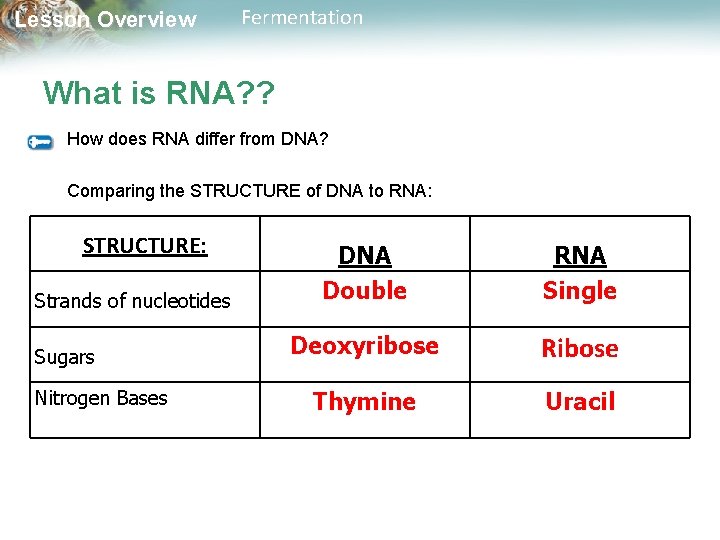
Lesson Overview Fermentation What is RNA? ? How does RNA differ from DNA? Comparing the STRUCTURE of DNA to RNA: STRUCTURE: Strands of nucleotides Sugars Nitrogen Bases DNA Double RNA Single Deoxyribose Ribose Thymine Uracil
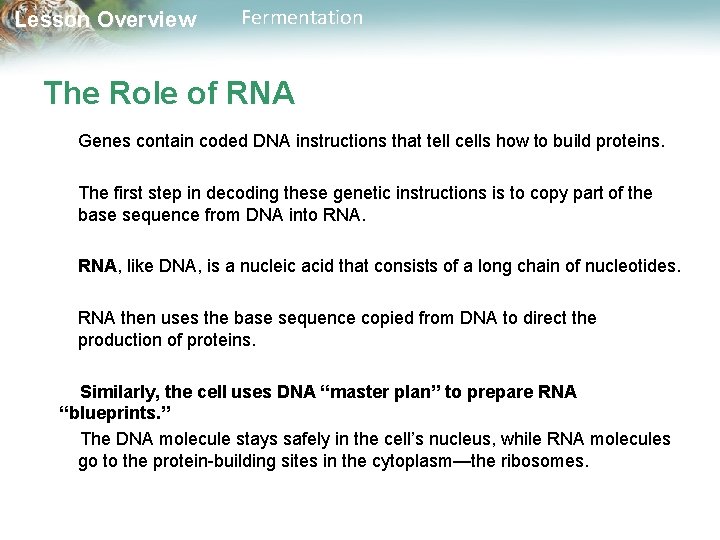
Lesson Overview Fermentation The Role of RNA Genes contain coded DNA instructions that tell cells how to build proteins. The first step in decoding these genetic instructions is to copy part of the base sequence from DNA into RNA, like DNA, is a nucleic acid that consists of a long chain of nucleotides. RNA then uses the base sequence copied from DNA to direct the production of proteins. Similarly, the cell uses DNA “master plan” to prepare RNA “blueprints. ” The DNA molecule stays safely in the cell’s nucleus, while RNA molecules go to the protein-building sites in the cytoplasm—the ribosomes.
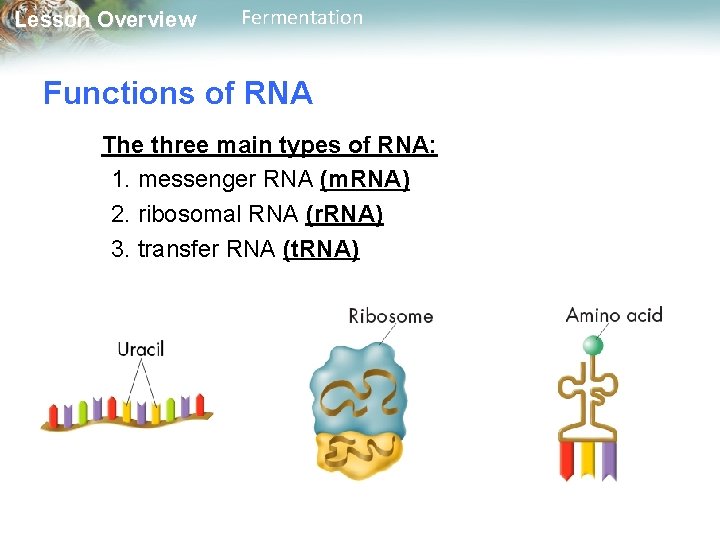
Lesson Overview Fermentation Functions of RNA The three main types of RNA: 1. messenger RNA (m. RNA) 2. ribosomal RNA (r. RNA) 3. transfer RNA (t. RNA)
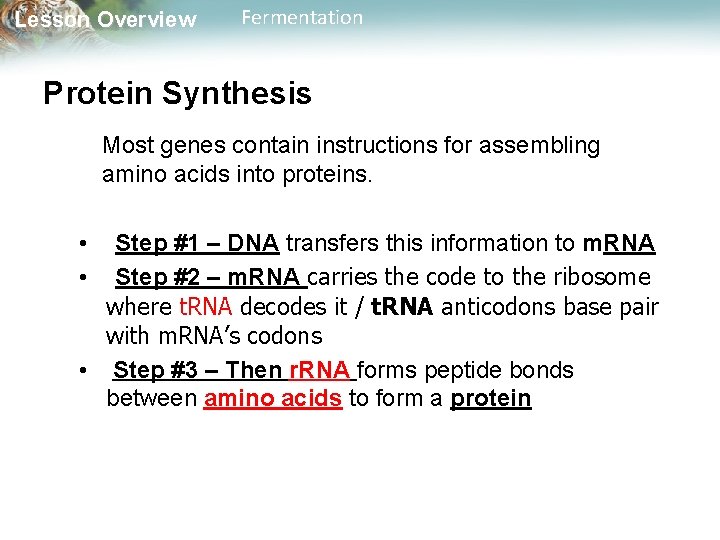
Lesson Overview Fermentation Protein Synthesis Most genes contain instructions for assembling amino acids into proteins. • • Step #1 – DNA transfers this information to m. RNA Step #2 – m. RNA carries the code to the ribosome where t. RNA decodes it / t. RNA anticodons base pair with m. RNA’s codons • Step #3 – Then r. RNA forms peptide bonds between amino acids to form a protein
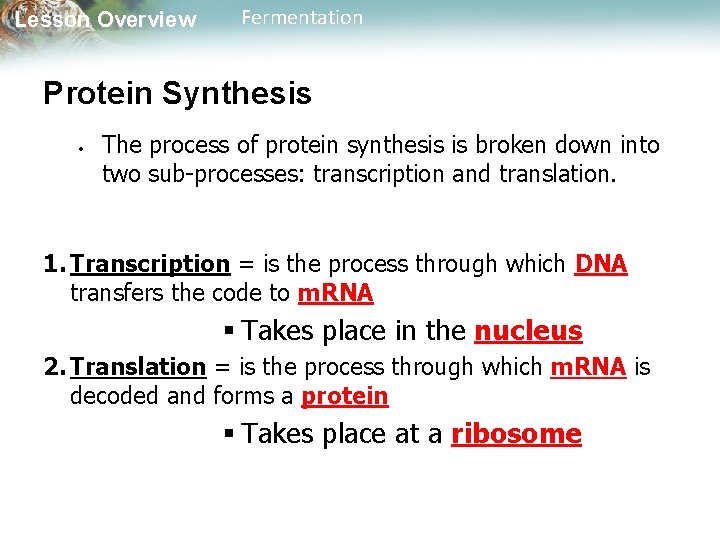
Lesson Overview Fermentation Protein Synthesis The process of protein synthesis is broken down into two sub-processes: transcription and translation. 1. Transcription = is the process through which DNA transfers the code to m. RNA Takes place in the nucleus 2. Translation = is the process through which m. RNA is decoded and forms a protein Takes place at a ribosome
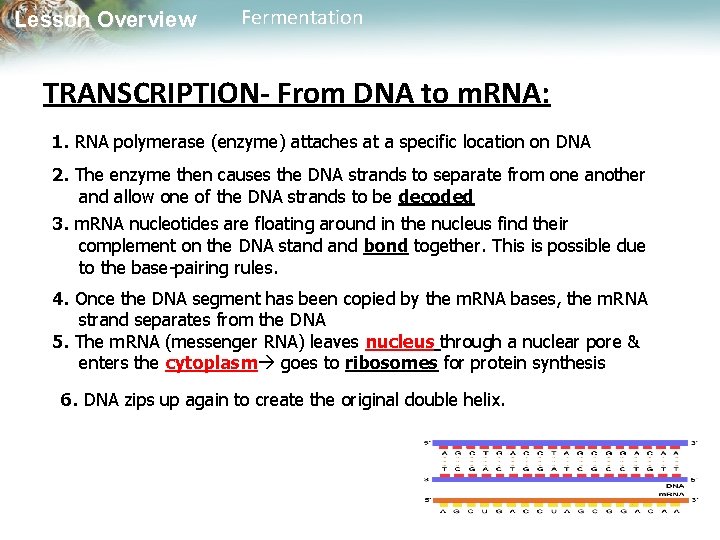
Lesson Overview Fermentation TRANSCRIPTION- From DNA to m. RNA: 1. RNA polymerase (enzyme) attaches at a specific location on DNA 2. The enzyme then causes the DNA strands to separate from one another and allow one of the DNA strands to be decoded 3. m. RNA nucleotides are floating around in the nucleus find their complement on the DNA stand bond together. This is possible due to the base-pairing rules. 4. Once the DNA segment has been copied by the m. RNA bases, the m. RNA strand separates from the DNA 5. The m. RNA (messenger RNA) leaves nucleus through a nuclear pore & enters the cytoplasm goes to ribosomes for protein synthesis 6. DNA zips up again to create the original double helix.
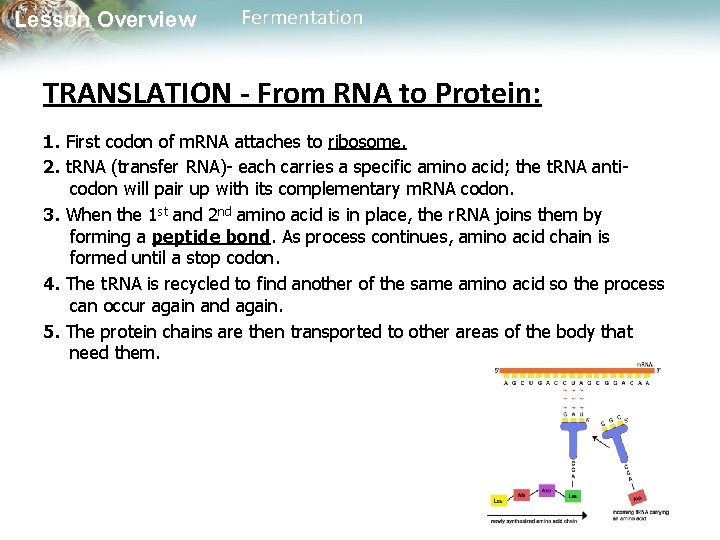
Lesson Overview Fermentation TRANSLATION - From RNA to Protein: 1. First codon of m. RNA attaches to ribosome. 2. t. RNA (transfer RNA)- each carries a specific amino acid; the t. RNA anticodon will pair up with its complementary m. RNA codon. 3. When the 1 st and 2 nd amino acid is in place, the r. RNA joins them by forming a peptide bond. As process continues, amino acid chain is formed until a stop codon. 4. The t. RNA is recycled to find another of the same amino acid so the process can occur again and again. 5. The protein chains are then transported to other areas of the body that need them.
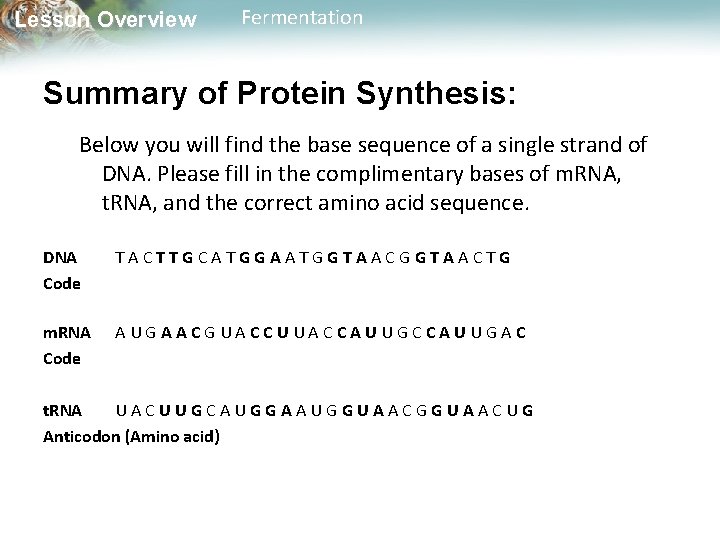
Lesson Overview Fermentation Summary of Protein Synthesis: Below you will find the base sequence of a single strand of DNA. Please fill in the complimentary bases of m. RNA, t. RNA, and the correct amino acid sequence. DNA Code TACTTGCATGGAATGGTAACTG m. RNA Code AUGAACGUACCUUACCAUUGAC t. RNA UACUUGCAUGGAAUGGUAACUG Anticodon (Amino acid)
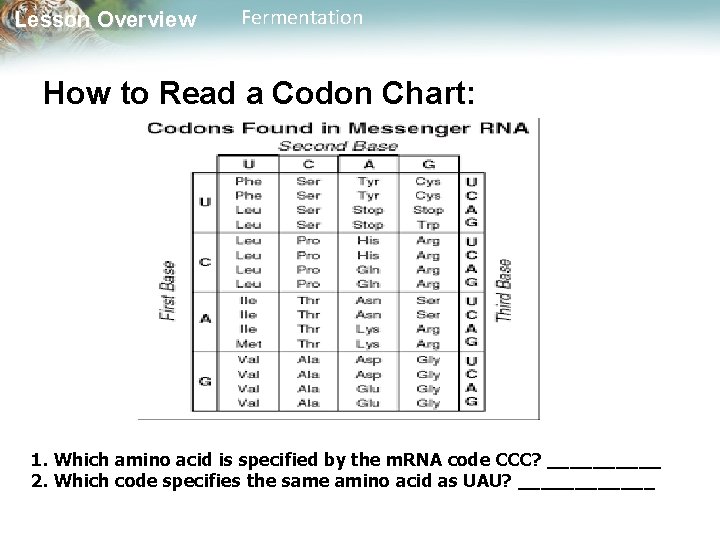
Lesson Overview Fermentation How to Read a Codon Chart: 1. Which amino acid is specified by the m. RNA code CCC? _____ 2. Which code specifies the same amino acid as UAU? ______
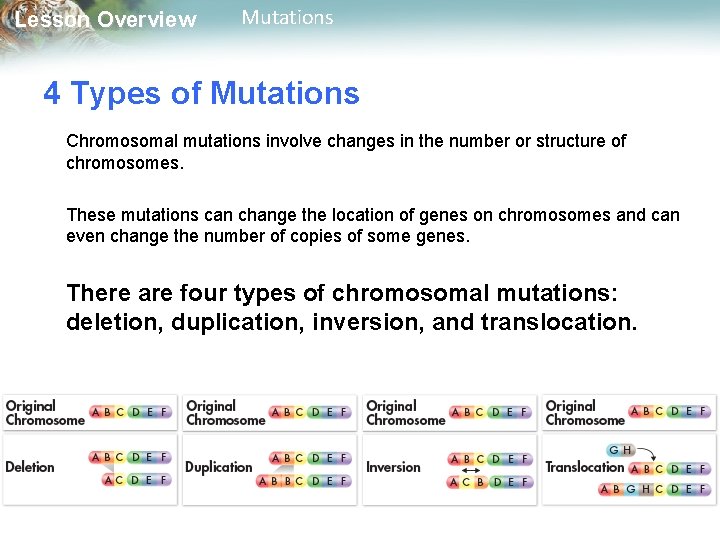
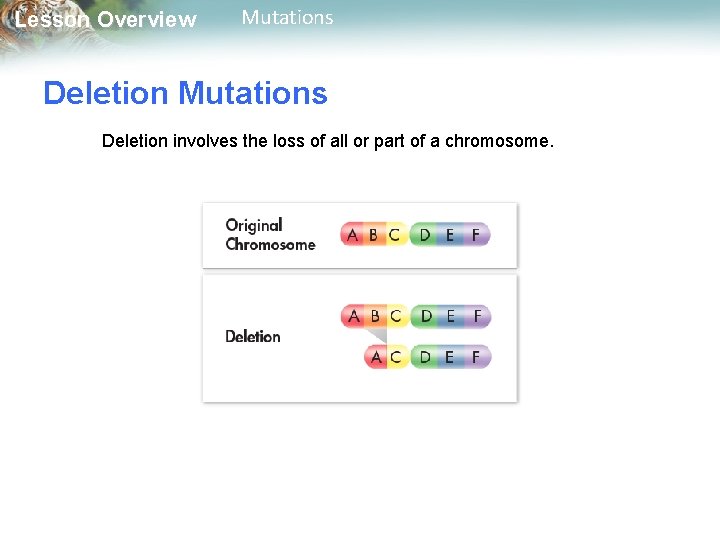
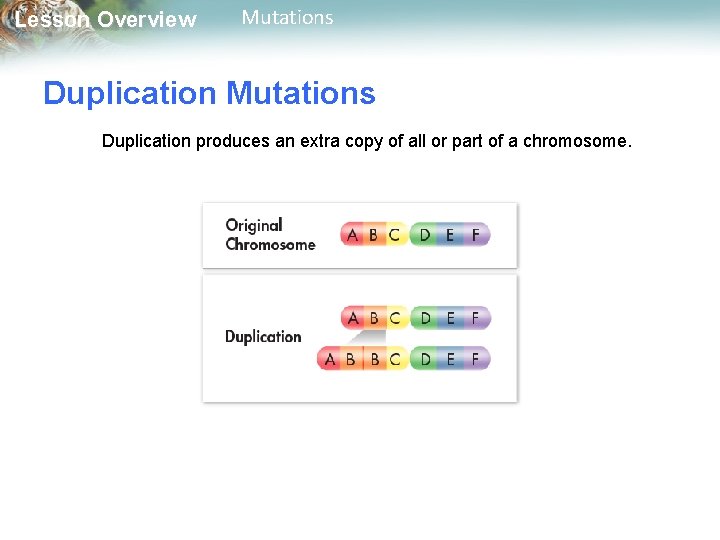
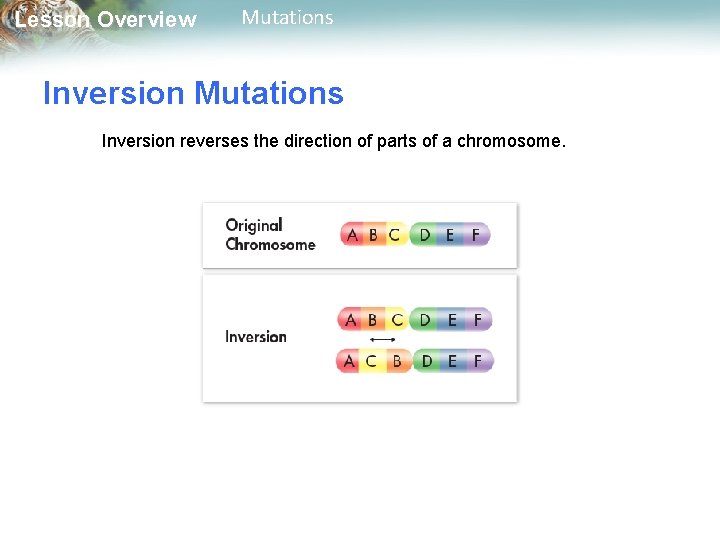
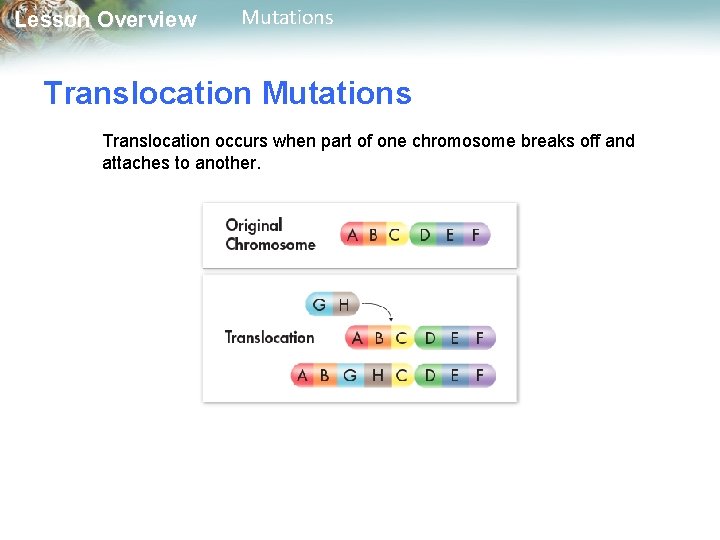
Lesson Overview Mutations 4 Types of Mutations Chromosomal mutations involve changes in the number or structure of chromosomes. These mutations can change the location of genes on chromosomes and can even change the number of copies of some genes. There are four types of chromosomal mutations: deletion, duplication, inversion, and translocation.
Lesson Overview Mutations Deletion involves the loss of all or part of a chromosome.
Lesson Overview Mutations Duplication produces an extra copy of all or part of a chromosome.
Lesson Overview Mutations Inversion reverses the direction of parts of a chromosome.
Lesson Overview Mutations Translocation occurs when part of one chromosome breaks off and attaches to another.
Lesson Overview Ribosomes and Protein Synthesis Genetic Code is UNIVERSAL!! One of the most interesting discoveries of molecular biology is the near- universal nature of the genetic code. Although some organisms show slight variations in the amino acids assigned to particular codons, the code is always read three bases at a time and in the same direction. Despite their enormous diversity in form and function, living organisms display remarkable unity at life’s most basic level, the molecular biology of the gene. **The same genetic code, meaning the letters (A, T, C, & G) are found in both bacteria and humans.