
Lesson Overview The Work of Gregor Mendel Lesson
- Slides: 12
Lesson Overview The Work of Gregor Mendel Lesson Overview 11. 1 The Work of Gregor Mendel
Lesson Overview The Work of Gregor Mendel The Experiments of Gregor Mendel Where does an organism get its unique characteristics? An individual’s characteristics are determined by factors that are passed from one parental generation to the next.
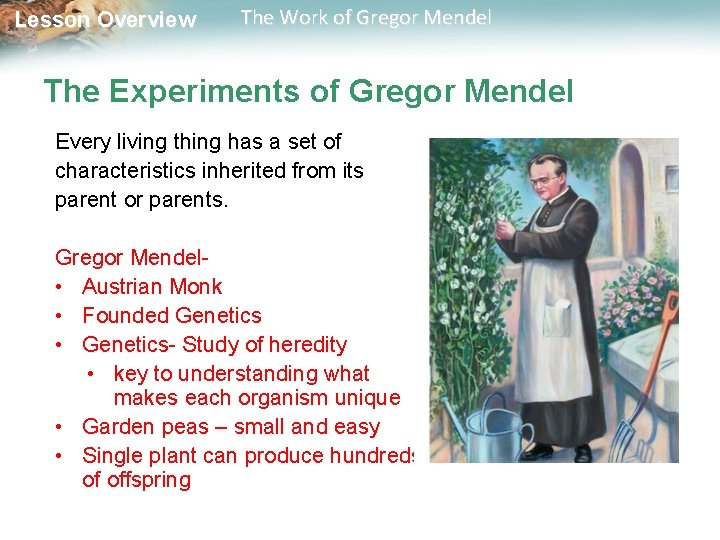
Lesson Overview The Work of Gregor Mendel The Experiments of Gregor Mendel Every living thing has a set of characteristics inherited from its parent or parents. Gregor Mendel • Austrian Monk • Founded Genetics • Genetics- Study of heredity • key to understanding what makes each organism unique • Garden peas – small and easy • Single plant can produce hundreds of offspring
Lesson Overview The Work of Gregor Mendel The Role of Fertilization During sexual reproduction, male and female reproductive cells join in a process known as fertilization to produce a new cell. In peas, this new cell develops into a tiny embryo encased within a seed. Pea flowers are normally self-pollinating, which means that sperm cells fertilize egg cells from within the same flower. (Asexual) A plant grown from a seed produced by self-pollination inherits all of its characteristics from the single plant that bore it. In effect, it has a single parent.
Lesson Overview The Work of Gregor Mendel The Role of Fertilization Mendel’s garden had several stocks of pea plants that were “truebreeding, ” meaning that they were self-pollinating, and would produce offspring with identical traits to themselves. In other words, the traits of each successive generation would be the same. A trait is a specific characteristic of an individual, such as seed color or plant height, and may vary from one individual to another. Mendel decided to “cross” his stocks of true-breeding plants—he caused one plant to reproduce with another plant.
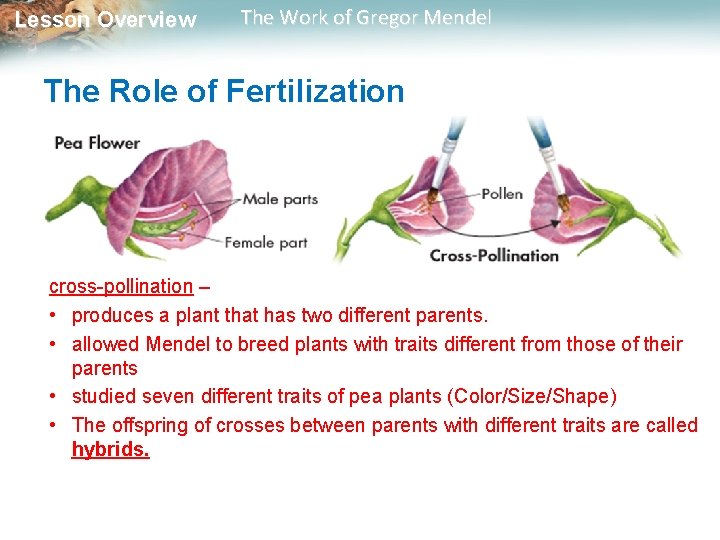
Lesson Overview The Work of Gregor Mendel The Role of Fertilization cross-pollination – • produces a plant that has two different parents. • allowed Mendel to breed plants with traits different from those of their parents • studied seven different traits of pea plants (Color/Size/Shape) • The offspring of crosses between parents with different traits are called hybrids.
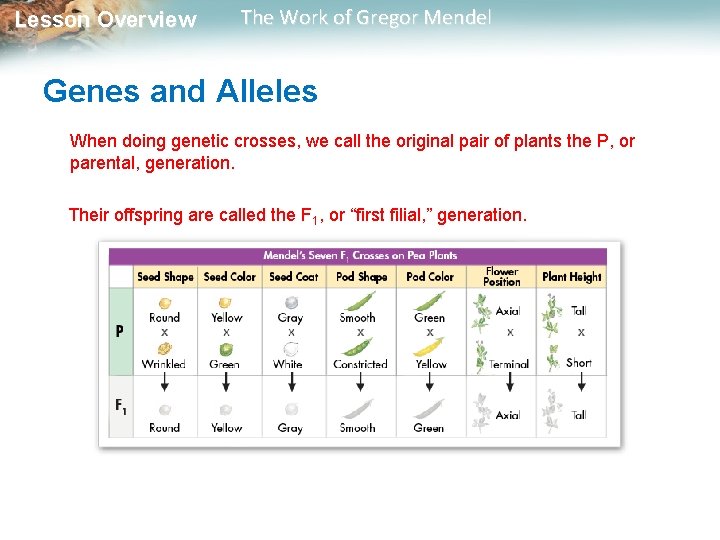
Lesson Overview The Work of Gregor Mendel Genes and Alleles When doing genetic crosses, we call the original pair of plants the P, or parental, generation. Their offspring are called the F 1, or “first filial, ” generation.
Lesson Overview The Work of Gregor Mendel Genes and Alleles Mendel’s Drew Two Conclusions. His first conclusion formed the basis of our current understanding of inheritance. 1. An individual’s characteristics are determined by factors that are passed from one parental generation to the next. Scientists call the factors that are passed from parent to offspring genes. Each of the traits Mendel studied was controlled by one gene that occurred in two contrasting varieties. These gene variations produced different expressions, or forms, of each trait. The different forms of a gene are called alleles.
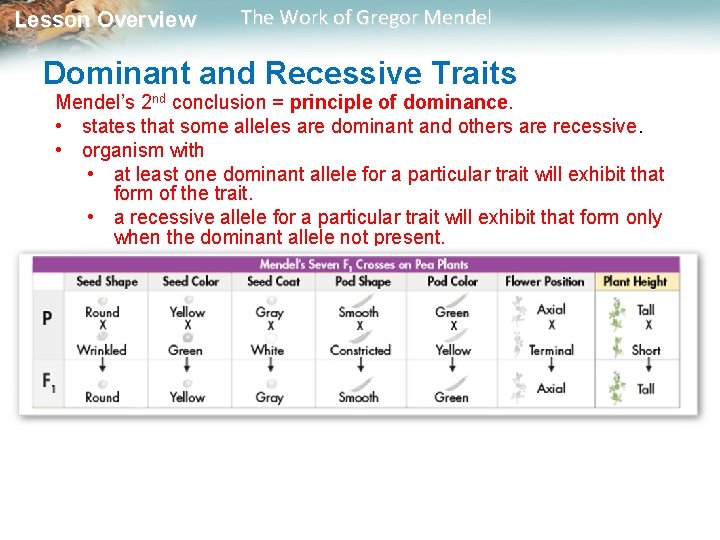
Lesson Overview The Work of Gregor Mendel Dominant and Recessive Traits Mendel’s 2 nd conclusion = principle of dominance. • states that some alleles are dominant and others are recessive. • organism with • at least one dominant allele for a particular trait will exhibit that form of the trait. • a recessive allele for a particular trait will exhibit that form only when the dominant allele not present.
Lesson Overview The Work of Gregor Mendel Segregation How are different forms of a gene distributed to offspring? During gamete formation, the alleles for each gene segregate from each other, so that each gamete carries only one allele for each gene.
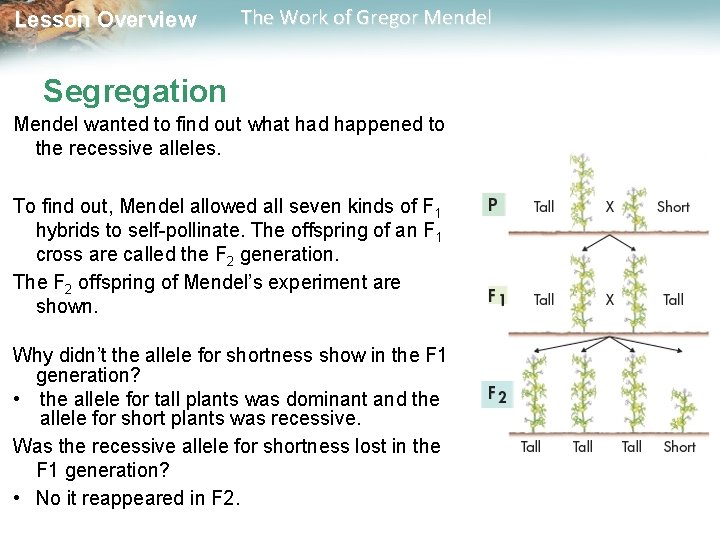
Lesson Overview The Work of Gregor Mendel Segregation Mendel wanted to find out what had happened to the recessive alleles. To find out, Mendel allowed all seven kinds of F 1 hybrids to self-pollinate. The offspring of an F 1 cross are called the F 2 generation. The F 2 offspring of Mendel’s experiment are shown. Why didn’t the allele for shortness show in the F 1 generation? • the allele for tall plants was dominant and the allele for short plants was recessive. Was the recessive allele for shortness lost in the F 1 generation? • No it reappeared in F 2.
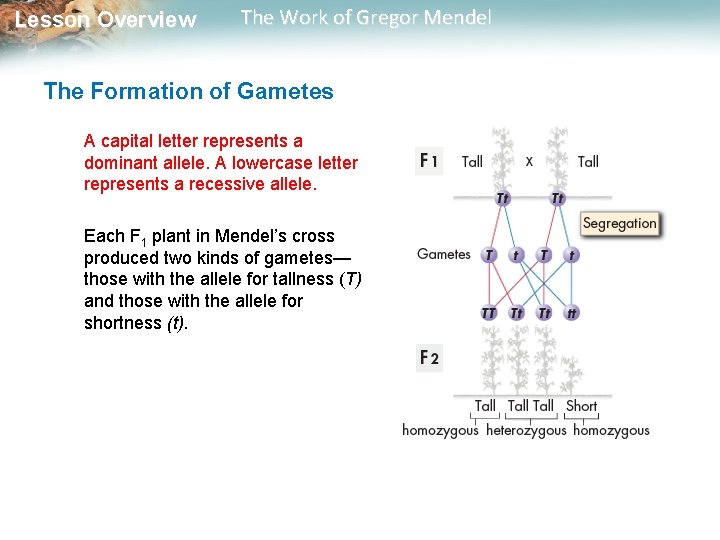
Lesson Overview The Work of Gregor Mendel The Formation of Gametes A capital letter represents a dominant allele. A lowercase letter represents a recessive allele. Each F 1 plant in Mendel’s cross produced two kinds of gametes— those with the allele for tallness (T) and those with the allele for shortness (t).