
Lesson Overview The Process of Photosynthesis Lesson Overview



- Slides: 29
Lesson Overview The Process of Photosynthesis Lesson Overview 8. 3 The Process of Photosynthesis
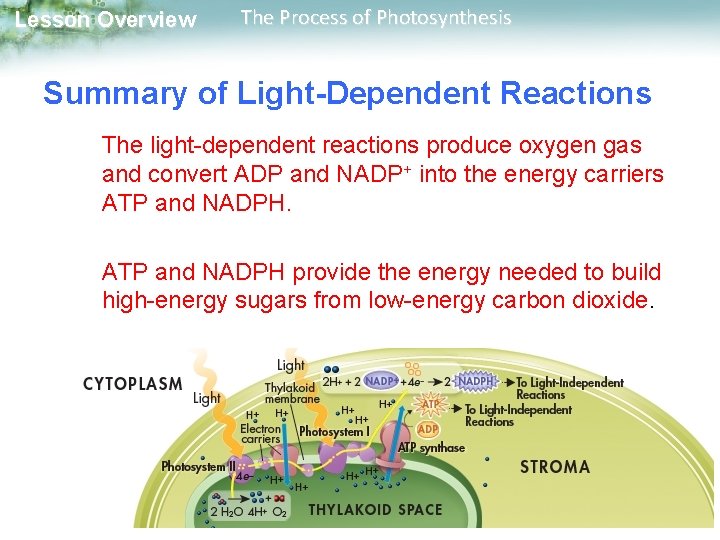
Lesson Overview The Process of Photosynthesis The Light-Dependent Reactions: Generating ATP and NADPH What happens during the light-dependent reactions? The light-dependent reactions use energy from sunlight to produce oxygen and convert ADP and NADP+ into the energy carriers ATP and NADPH.
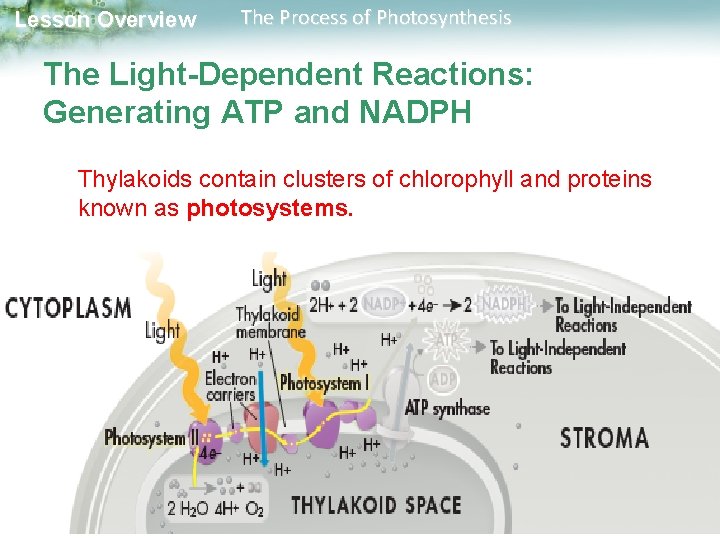
Lesson Overview The Process of Photosynthesis The Light-Dependent Reactions: Generating ATP and NADPH The light-dependent reactions encompass the steps of photosynthesis that directly involve sunlight. The light-dependent reactions occur in the thylakoids of chloroplasts.
Lesson Overview The Process of Photosynthesis The Light-Dependent Reactions: Generating ATP and NADPH Thylakoids contain clusters of chlorophyll and proteins known as photosystems.
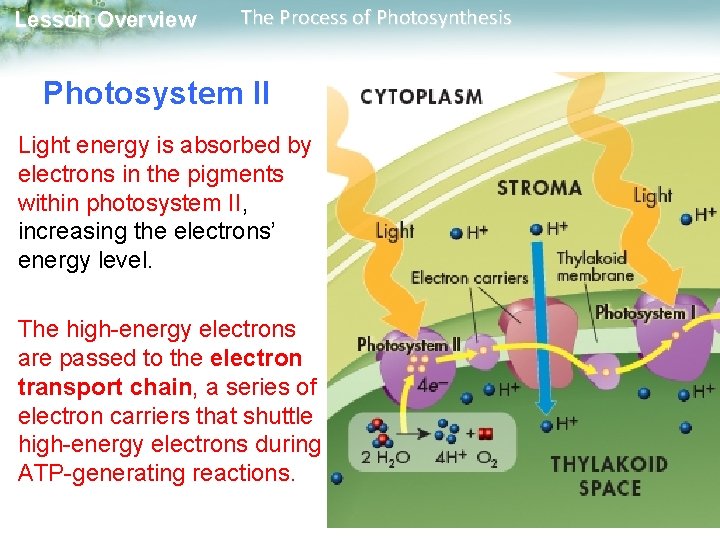
Lesson Overview The Process of Photosynthesis Photosystem II Light energy is absorbed by electrons in the pigments within photosystem II, increasing the electrons’ energy level. The high-energy electrons are passed to the electron transport chain, a series of electron carriers that shuttle high-energy electrons during ATP-generating reactions.
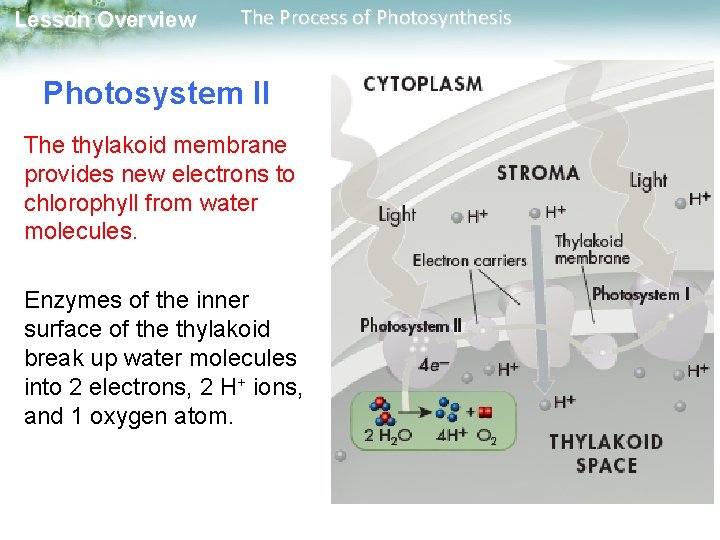
Lesson Overview The Process of Photosynthesis Photosystem II The thylakoid membrane provides new electrons to chlorophyll from water molecules. Enzymes of the inner surface of the thylakoid break up water molecules into 2 electrons, 2 H+ ions, and 1 oxygen atom.
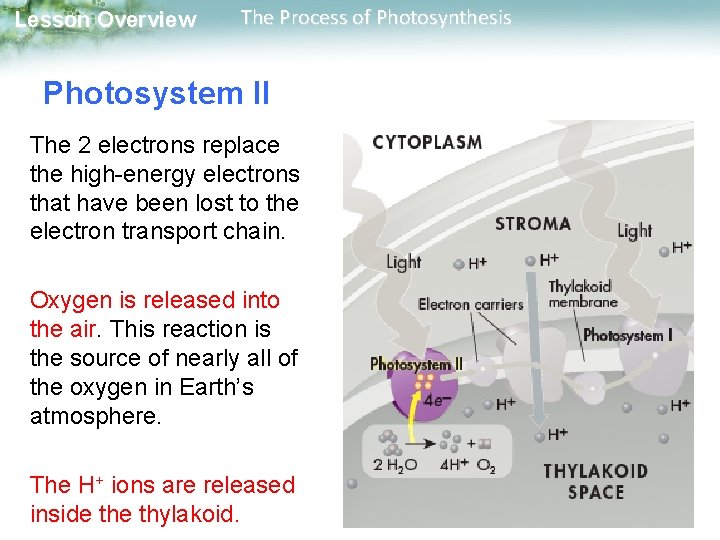
Lesson Overview The Process of Photosynthesis Photosystem II The 2 electrons replace the high-energy electrons that have been lost to the electron transport chain. Oxygen is released into the air. This reaction is the source of nearly all of the oxygen in Earth’s atmosphere. The H+ ions are released inside thylakoid.
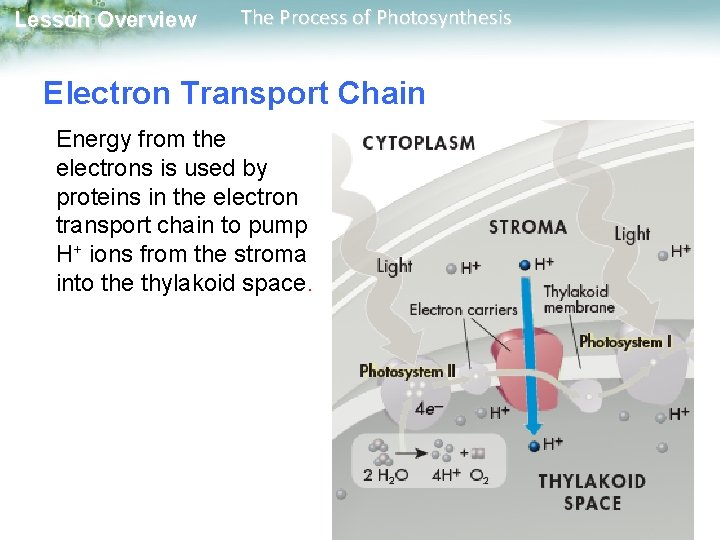
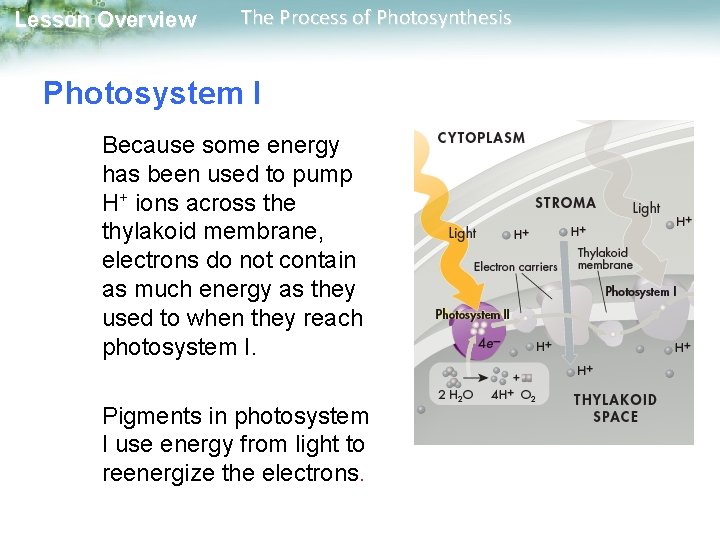
Lesson Overview The Process of Photosynthesis Electron Transport Chain Energy from the electrons is used by proteins in the electron transport chain to pump H+ ions from the stroma into the thylakoid space.
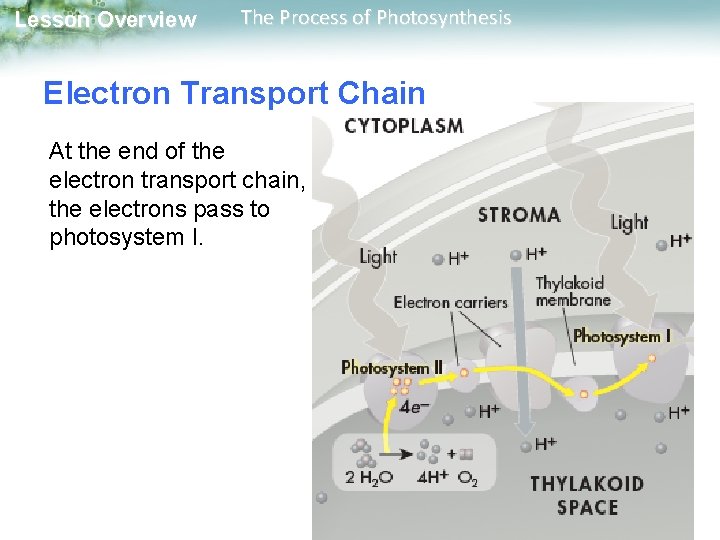
Lesson Overview The Process of Photosynthesis Electron Transport Chain At the end of the electron transport chain, the electrons pass to photosystem I.
Lesson Overview The Process of Photosynthesis Photosystem I Because some energy has been used to pump H+ ions across the thylakoid membrane, electrons do not contain as much energy as they used to when they reach photosystem I. Pigments in photosystem I use energy from light to reenergize the electrons.
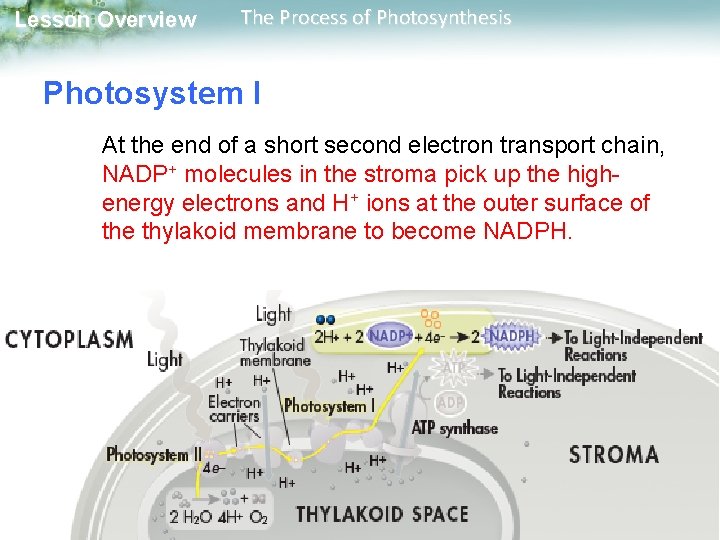
Lesson Overview The Process of Photosynthesis Photosystem I At the end of a short second electron transport chain, NADP+ molecules in the stroma pick up the highenergy electrons and H+ ions at the outer surface of the thylakoid membrane to become NADPH.
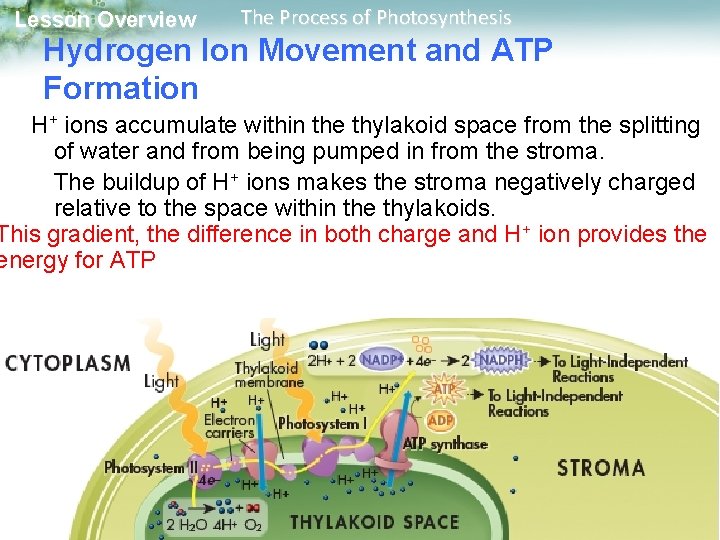
Lesson Overview The Process of Photosynthesis Hydrogen Ion Movement and ATP Formation H+ ions accumulate within the thylakoid space from the splitting of water and from being pumped in from the stroma. The buildup of H+ ions makes the stroma negatively charged relative to the space within the thylakoids. This gradient, the difference in both charge and H+ ion provides the energy for ATP
Lesson Overview The Process of Photosynthesis Hydrogen Ion Movement and ATP Formation H+ ions cannot directly cross the thylakoid membane. ATP synthase (protein) that spans the membrane and allows H+ ions to pass through it. ATP synthase binds ADP and a phosphate group together to produce ATP.
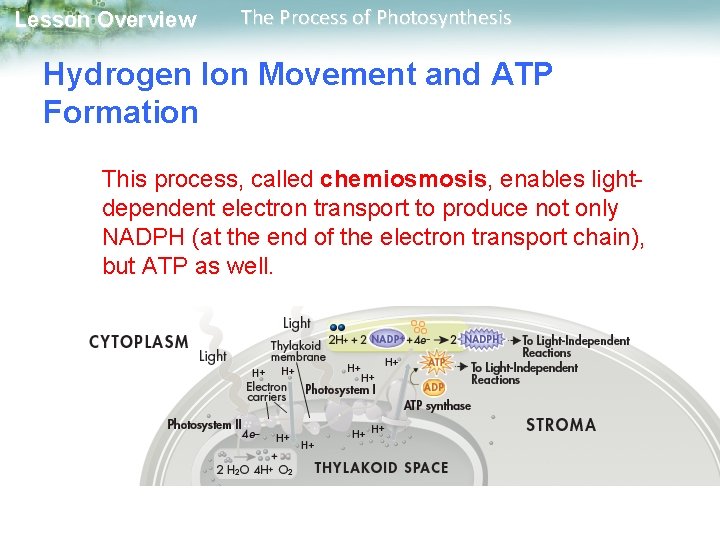
Lesson Overview The Process of Photosynthesis Hydrogen Ion Movement and ATP Formation This process, called chemiosmosis, enables lightdependent electron transport to produce not only NADPH (at the end of the electron transport chain), but ATP as well.
Lesson Overview The Process of Photosynthesis Summary of Light-Dependent Reactions The light-dependent reactions produce oxygen gas and convert ADP and NADP+ into the energy carriers ATP and NADPH provide the energy needed to build high-energy sugars from low-energy carbon dioxide.
Lesson Overview The Process of Photosynthesis The Light-Independent Reactions: Producing Sugars What happens during the light-independent reactions? During the light-independent reactions, ATP and NADPH from the light dependent reactions are used to produce high-energy sugars.
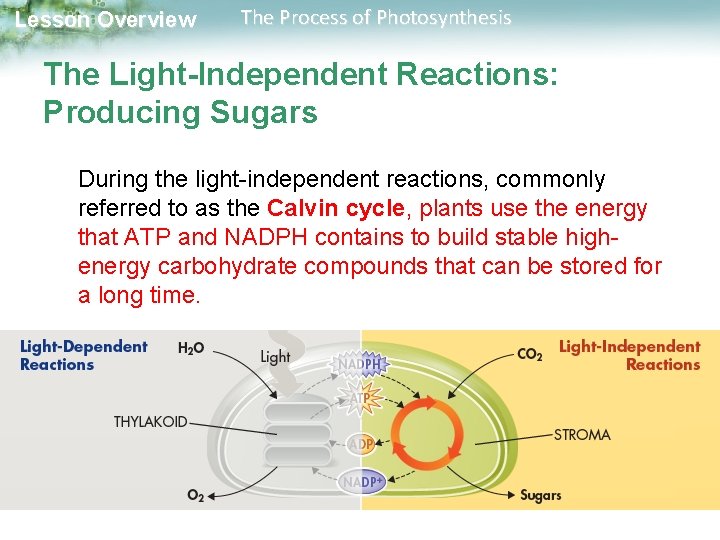
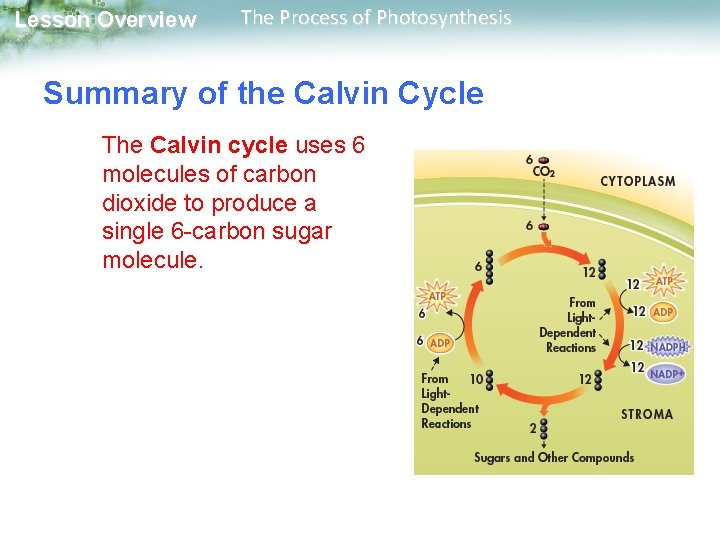
Lesson Overview The Process of Photosynthesis The Light-Independent Reactions: Producing Sugars During the light-independent reactions, commonly referred to as the Calvin cycle, plants use the energy that ATP and NADPH contains to build stable highenergy carbohydrate compounds that can be stored for a long time.
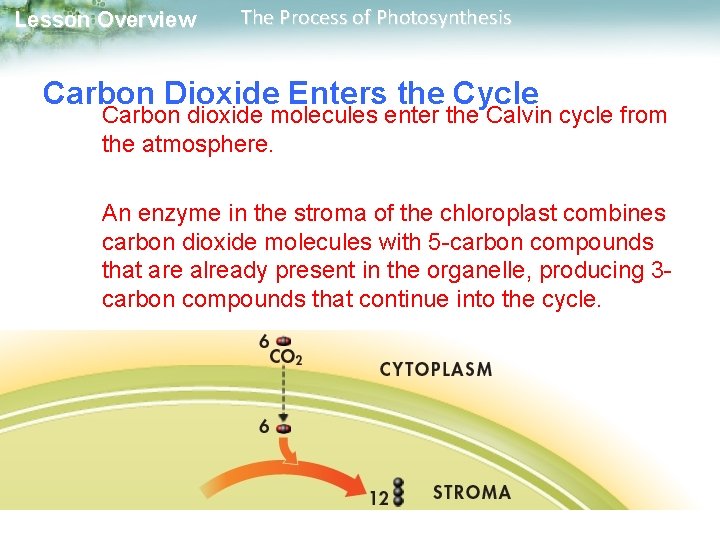
Lesson Overview The Process of Photosynthesis Carbon Dioxide Enters the Cycle Carbon dioxide molecules enter the Calvin cycle from the atmosphere. An enzyme in the stroma of the chloroplast combines carbon dioxide molecules with 5 -carbon compounds that are already present in the organelle, producing 3 carbon compounds that continue into the cycle.
Lesson Overview The Process of Photosynthesis Summary of the Calvin Cycle The Calvin cycle uses 6 molecules of carbon dioxide to produce a single 6 -carbon sugar molecule.
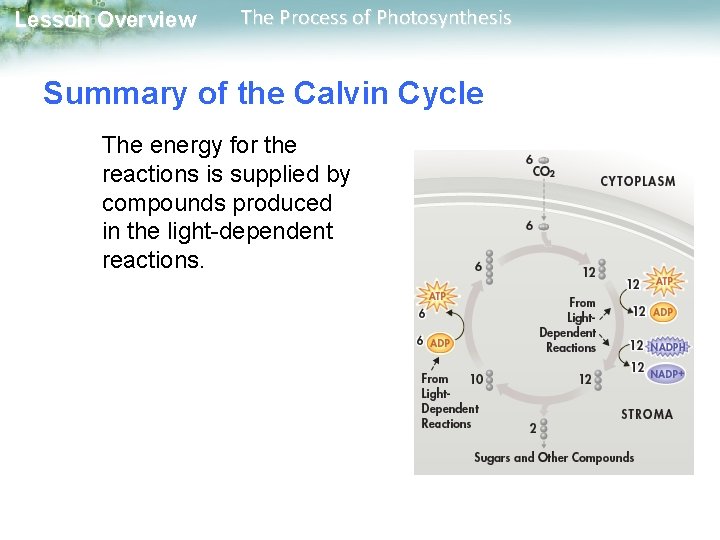
Lesson Overview The Process of Photosynthesis Summary of the Calvin Cycle The energy for the reactions is supplied by compounds produced in the light-dependent reactions.
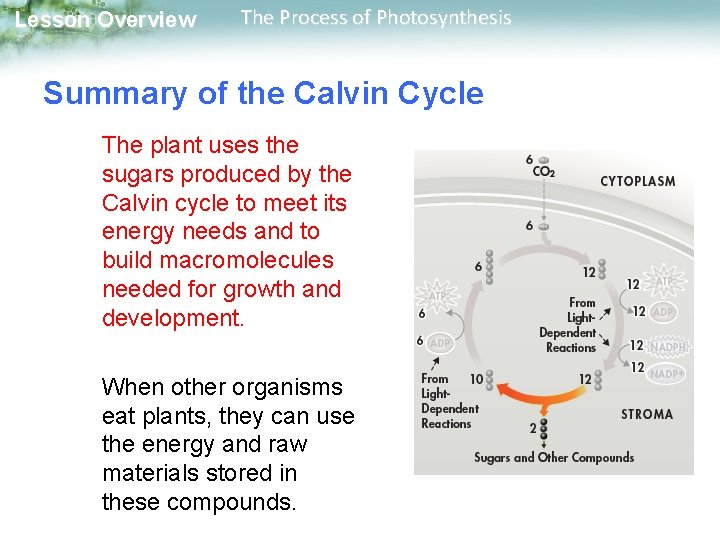
Lesson Overview The Process of Photosynthesis Summary of the Calvin Cycle The plant uses the sugars produced by the Calvin cycle to meet its energy needs and to build macromolecules needed for growth and development. When other organisms eat plants, they can use the energy and raw materials stored in these compounds.
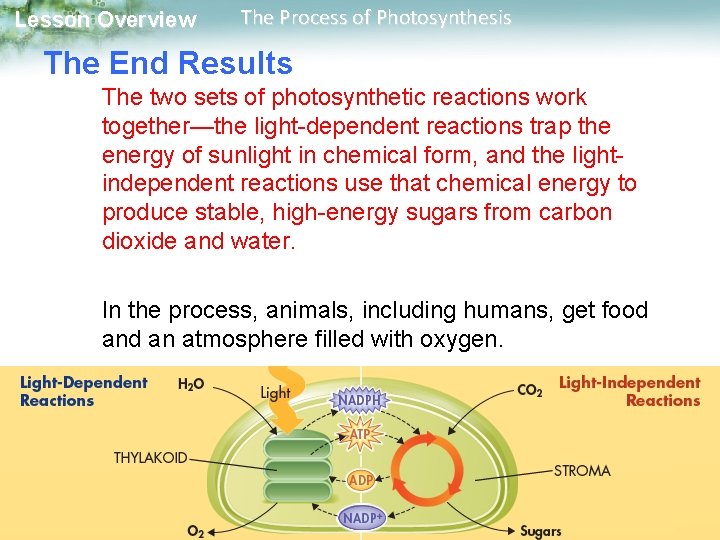
Lesson Overview The Process of Photosynthesis The End Results The two sets of photosynthetic reactions work together—the light-dependent reactions trap the energy of sunlight in chemical form, and the lightindependent reactions use that chemical energy to produce stable, high-energy sugars from carbon dioxide and water. In the process, animals, including humans, get food an atmosphere filled with oxygen.
Lesson Overview The Process of Photosynthesis Factors Affecting Photosynthesis What factors affect photosynthesis? Among the most important factors that affect photosynthesis are: temperature, light intensity, and the availability of water.
Lesson Overview The Process of Photosynthesis Temperature, Light, and Water The reactions of photosynthesis are made possible by enzymes that function best between 0°C and 35°C. Temperatures above or below this range may affect those enzymes, slowing down the rate of photosynthesis or stopping it entirely.
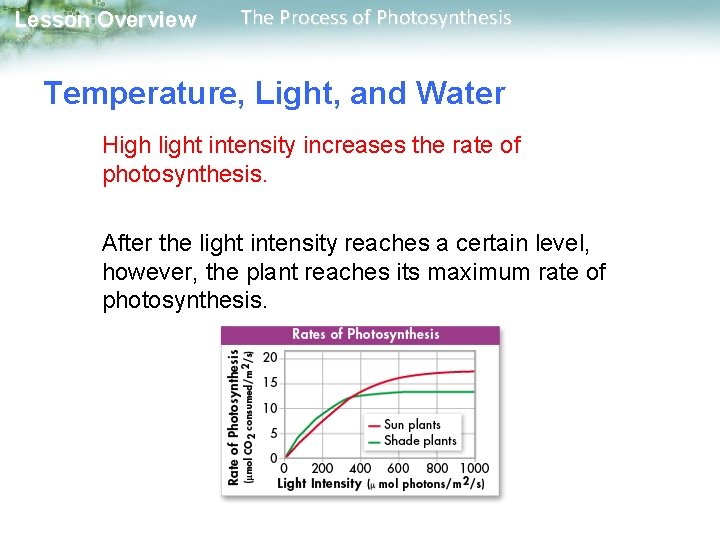
Lesson Overview The Process of Photosynthesis Temperature, Light, and Water High light intensity increases the rate of photosynthesis. After the light intensity reaches a certain level, however, the plant reaches its maximum rate of photosynthesis.
Lesson Overview The Process of Photosynthesis Temperature, Light, and Water Because water is one of the raw materials in photosynthesis, a shortage of water can slow or even stop photosynthesis. Water loss can also damage plant tissues. Plants that live in dry conditions often have waxy coatings on their leaves to reduce water loss. They may also have biochemical adaptations that make photosynthesis more efficient under dry conditions.
Lesson Overview The Process of Photosynthesis Under Extreme Conditions In order to conserve water, most plants under bright, hot conditions close the small openings in their leaves that normally admit carbon dioxide. This causes carbon dioxide within the leaves to fall to very low levels, slowing down or even stopping photosynthesis. C 4 and CAM plants have biochemical adaptations that minimize water loss while still allowing photosynthesis to take place in intense sunlight.
Lesson Overview The Process of Photosynthesis C 4 plants have a specialized chemical pathway that allows them to capture even very low levels of carbon dioxide and pass it to the Calvin cycle. The name “C 4 plant” comes from the fact that the first compound formed in this pathway contains 4 carbon atoms. The C 4 pathway requires extra energy in the form of ATP to function. C 4 organisms include crop plants like corn, sugar cane, and sorghum.
Lesson Overview The Process of Photosynthesis CAM Plants Members of the Crassulacae family, such as cacti and succulents, use a process called Crassulacean Acid Metabolism (CAM). CAM plants admit air into their leaves only at night, where carbon dioxide is combined with existing molecules to produce organic acids, “trapping” the carbon within the leaves. During the daytime, when leaves are tightly sealed to prevent water loss, these compounds release carbon dioxide, enabling carbohydrate production. CAM plants include pineapple trees, many desert cacti, and “ice plants”.