
Lesson Overview SEC 32 2 The Muscular System








- Slides: 24
Lesson Overview SEC 32. 2 The Muscular System
Lesson Overview The Muscular System THINK ABOUT IT How much of your body do you think is muscle? As surprising at it might seem, about one third of the mass of an average person’s body is muscle.
Lesson Overview The Muscular System Muscle Tissue Muscle tissue is found everywhere in the body. There are three different types of muscle tissue, each specialized for a specific function in the body: skeletal, smooth, and cardiac.
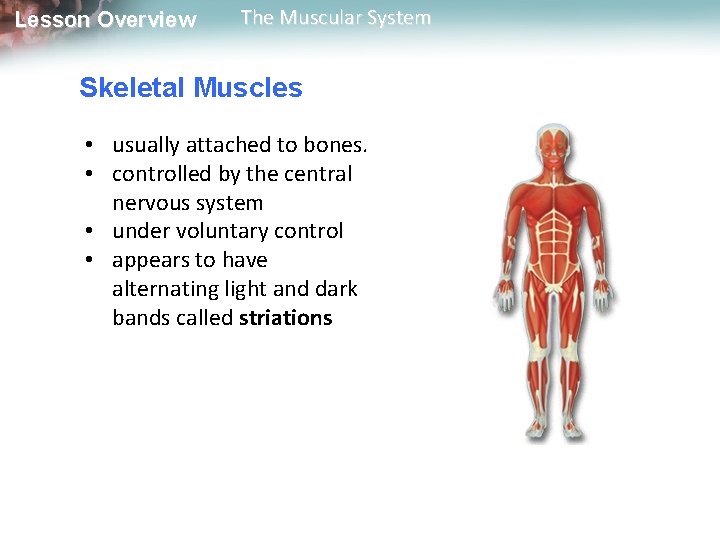
Lesson Overview The Muscular System Skeletal Muscles • usually attached to bones. • controlled by the central nervous system • under voluntary control • appears to have alternating light and dark bands called striations
Lesson Overview The Muscular System Skeletal Muscles cells are large have many nuclei vary in length smallest skeletal muscle (1 millimeter long) is found in the middle ear • longest skeletal muscle (up to 30 centimeters) runs from the hip to the knee. Because skeletal muscle cells are long and slender, they are often called muscle fibers. • •
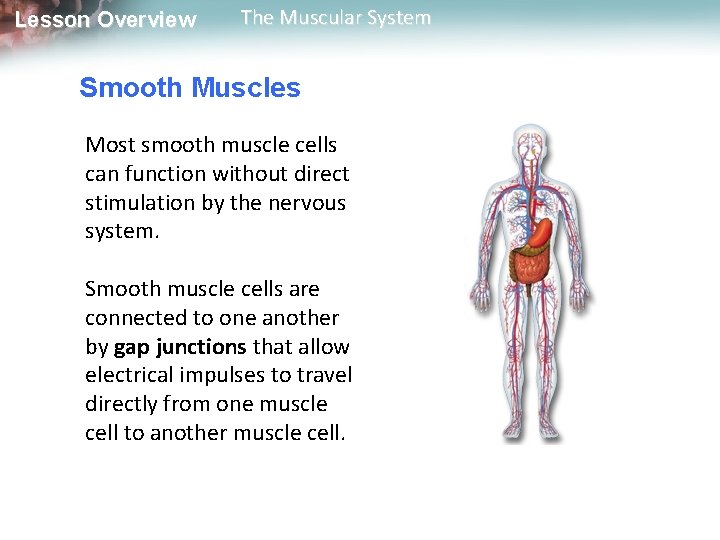
Lesson Overview The Muscular System Smooth Muscles • do not have striations - look “smooth” under the microscope • spindle-shaped • usually have a single nucleus • found throughout body especially hollow structures like stomach, blood vessels and intestines • usually under involuntary control
Lesson Overview The Muscular System Smooth Muscles Smooth muscle movements are usually involuntary • moving food through the digestive system • control blood flow through the circulatory system • decrease pupil size in bright light
Lesson Overview The Muscular System Smooth Muscles Most smooth muscle cells can function without direct stimulation by the nervous system. Smooth muscle cells are connected to one another by gap junctions that allow electrical impulses to travel directly from one muscle cell to another muscle cell.
Lesson Overview The Muscular System Cardiac Muscle • • found in the heart striated like skeletal muscle smaller than skeletal muscle usually have just one or two nuclei
Lesson Overview The Muscular System Cardiac Muscle • not usually under the direct control of the central nervous system • can contract on their own • connected to their neighbors by gap junctions
Lesson Overview The Muscular System Muscle Contraction How do muscles contract? “Sliding Filament Model”
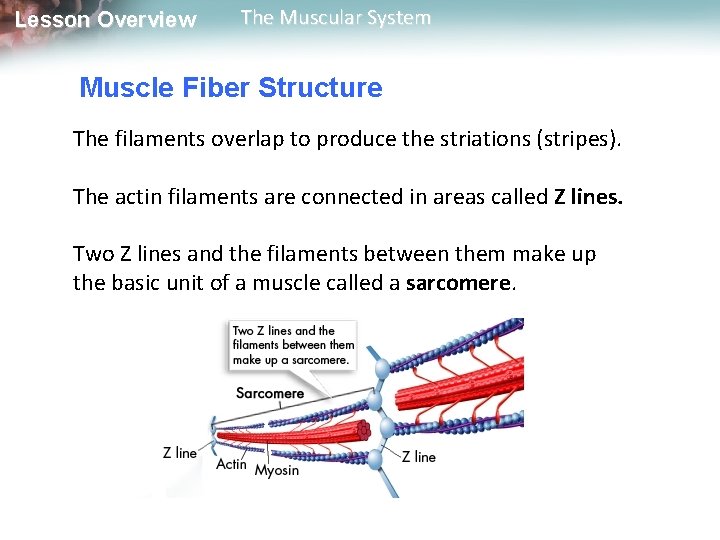
Lesson Overview The Muscular System Muscle Fiber Structure Skeletal muscle cells, or fibers, are arranged in bundles called myofibrils. Each myofibril contains thick protein filaments called myosin and thin protein filaments called actin.
Lesson Overview The Muscular System Muscle Fiber Structure The filaments overlap to produce the striations (stripes). The actin filaments are connected in areas called Z lines. Two Z lines and the filaments between them make up the basic unit of a muscle called a sarcomere.
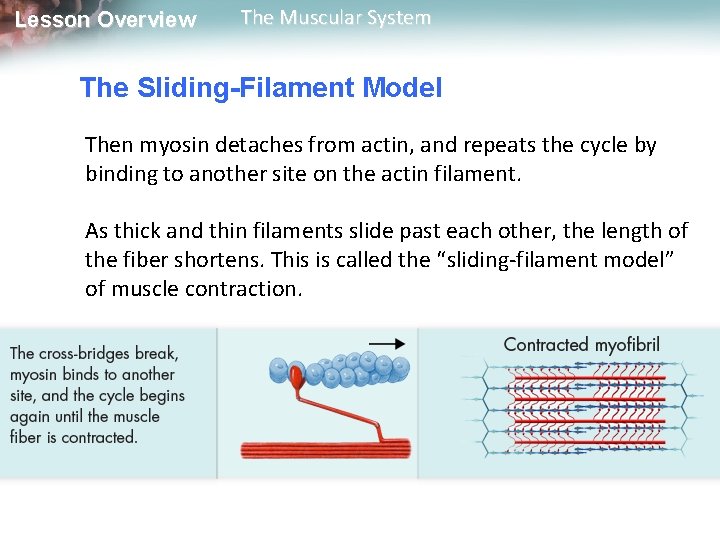
Lesson Overview The Muscular System The Sliding-Filament Model During a muscle contraction, myosin filaments attach to the actin filaments. The myosin pulls the actin filaments toward the center of the sarcomere. This decreases the distance between the Z lines, and the muscle fiber contracts (shortens).
Lesson Overview The Muscular System The Sliding-Filament Model Then myosin detaches from actin, and repeats the cycle by binding to another site on the actin filament. As thick and thin filaments slide past each other, the length of the fiber shortens. This is called the “sliding-filament model” of muscle contraction.
Lesson Overview The Muscular System Control of Muscle Contraction Skeletal muscles are useful only if they contract in a controlled fashion. Impulses from nerve cells (neuron)control the contraction of muscle fibers. Nerve cells release a chemical that causes a reaction between myosin and actin. The point of contact between a neuron and a skeletal muscle cell is called a neuromuscular junction.
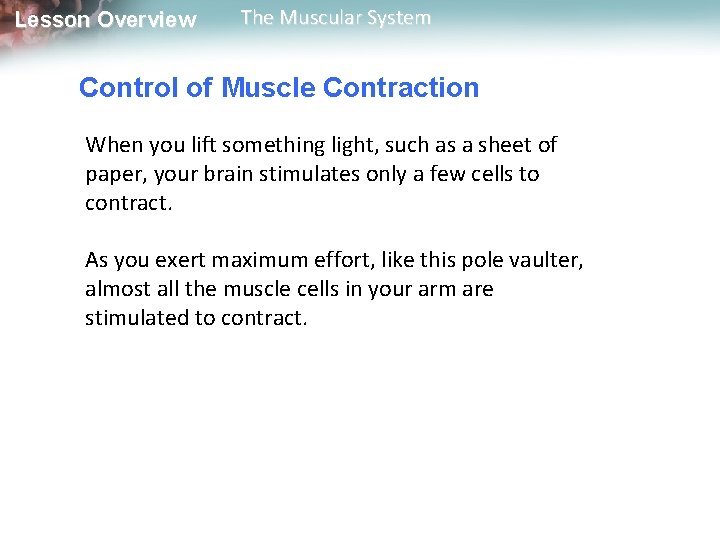
Lesson Overview The Muscular System Control of Muscle Contraction When you lift something light, such as a sheet of paper, your brain stimulates only a few cells to contract. As you exert maximum effort, like this pole vaulter, almost all the muscle cells in your arm are stimulated to contract.
Lesson Overview The Muscular System Muscles and Movement How do muscle contractions produce movement? Skeletal muscles generate force and produce movement by pulling on body parts as they contract.
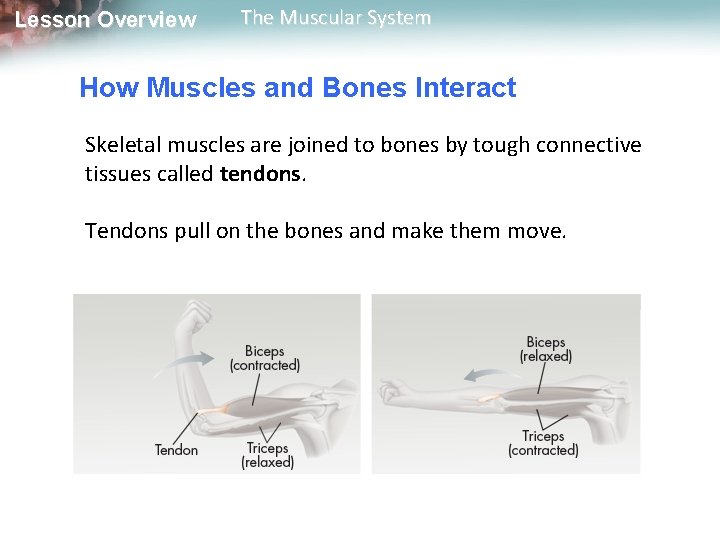
Lesson Overview The Muscular System How Muscles and Bones Interact Skeletal muscles are joined to bones by tough connective tissues called tendons. Tendons pull on the bones and make them move.
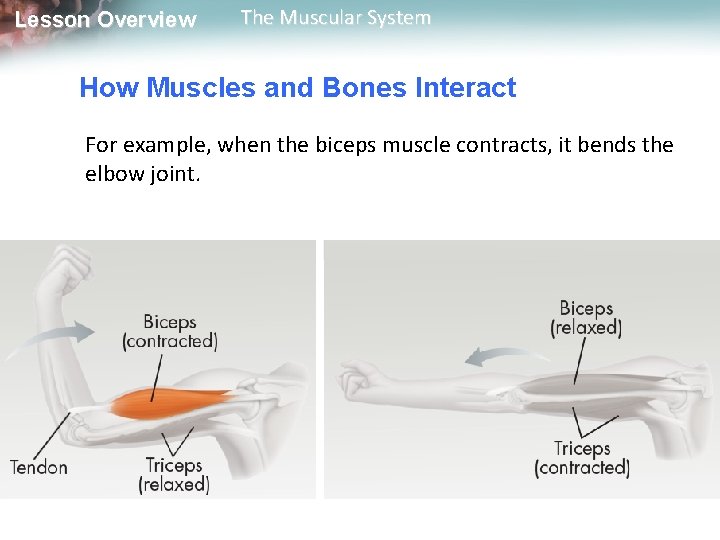
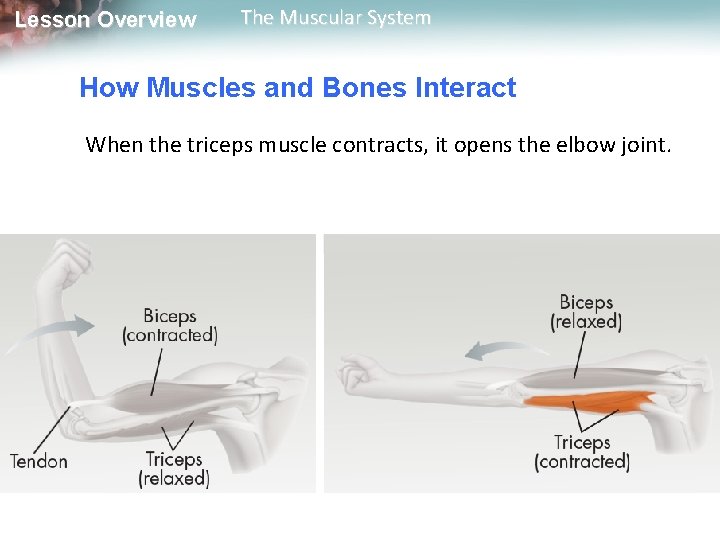
Lesson Overview The Muscular System How Muscles and Bones Interact Most skeletal muscles work in opposing pairs—when one muscle contracts, the other relaxes.
Lesson Overview The Muscular System How Muscles and Bones Interact For example, when the biceps muscle contracts, it bends the elbow joint.
Lesson Overview The Muscular System How Muscles and Bones Interact When the triceps muscle contracts, it opens the elbow joint.
Lesson Overview The Muscular System Types of Muscle Fibers Two principal types of skeletal muscle fibers—red and white. Red muscle • slow twitch muscle • contains many mitochondria • dark red color due to small blood vessels • contains oxygen- storing protein called myoglobin • derive their energy through aerobic respiration • able to work for long periods of time
Lesson Overview The Muscular System Types of Muscle Fibers White muscle • • • fast-twitch muscle that contracts rapidly generates more force than red muscle cells contain few mitochondria tire quickly. useful for activities that require great strength or quick bursts of energy