
Lesson Overview Meeting Ecological Challenges Lesson Overview 6




- Slides: 26
Lesson Overview Meeting Ecological Challenges Lesson Overview 6. 4 Meeting Ecological Challenges
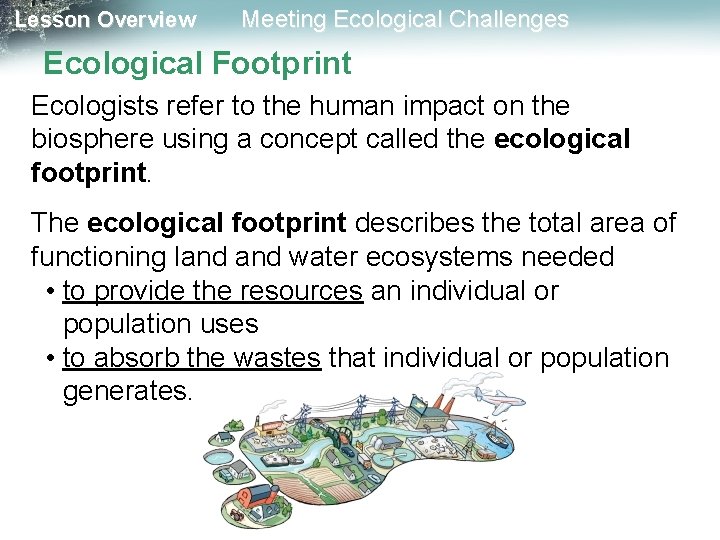
Lesson Overview Meeting Ecological Challenges Ecological Footprint Ecologists refer to the human impact on the biosphere using a concept called the ecological footprint. The ecological footprint describes the total area of functioning land water ecosystems needed • to provide the resources an individual or population uses • to absorb the wastes that individual or population generates.
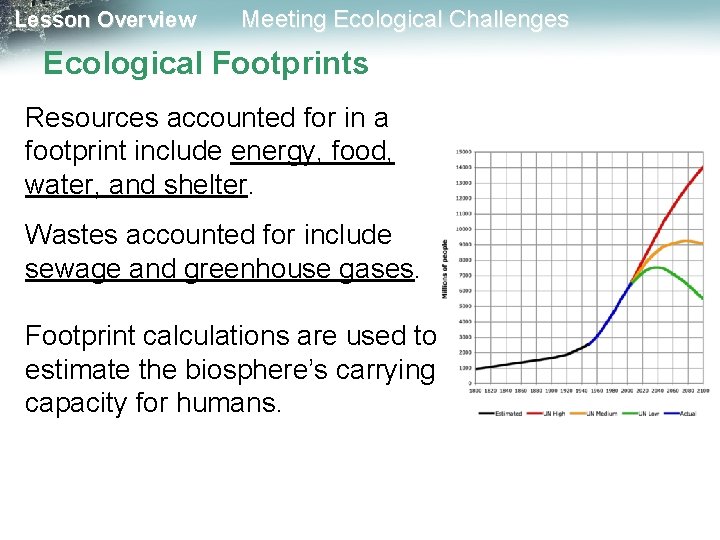
Lesson Overview Meeting Ecological Challenges Ecological Footprints Resources accounted for in a footprint include energy, food, water, and shelter. Wastes accounted for include sewage and greenhouse gases. Footprint calculations are used to estimate the biosphere’s carrying capacity for humans.
Lesson Overview Meeting Ecological Challenges Footprint Limitations 1. Calculating actual numbers for ecological footprints is complicated. 1. The concept is so new that there is no universally accepted way to calculate footprint size. 1. In addition, footprints give only a “snapshot” of the situation at a particular point in time.
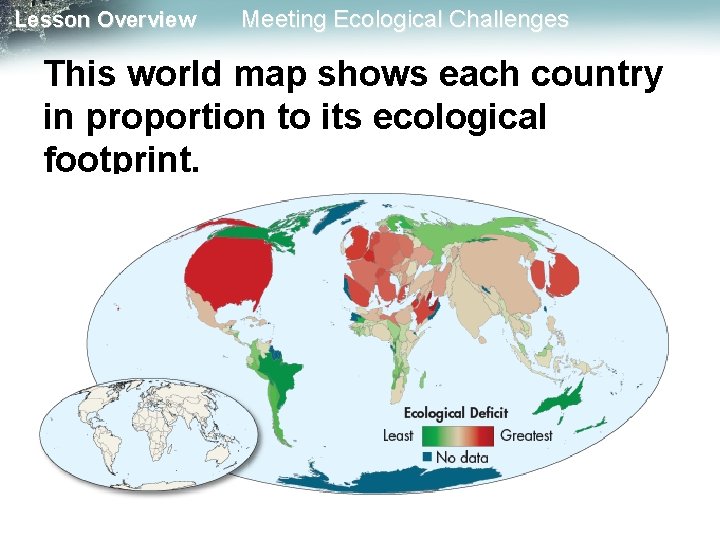
Lesson Overview Meeting Ecological Challenges Comparing Footprints Ecological footprints can be useful for making comparisons among different populations. According to one data set, the average American has an ecological footprint over four times larger than the global average. The person use of resources in America is almost twice that in England, more than twice that in Japan, and almost six times that in China, as shown on the map on the following slide.
Lesson Overview Meeting Ecological Challenges This world map shows each country in proportion to its ecological footprint.
Lesson Overview Meeting Ecological Challenges Ecology in Action The future of the biosphere depends on our ecological footprints, global population growth, and technological development. Ecological research, properly collected, analyzed, and applied, can help us make decisions that will produce profoundly positive effects on the human condition.
Lesson Overview Meeting Ecological Challenges Ecology in Action We can have a positive impact on the global environment by (1) recognizing problems in the environment (2) researching the problems to determine their cause (3) using scientific understanding to change our behavior
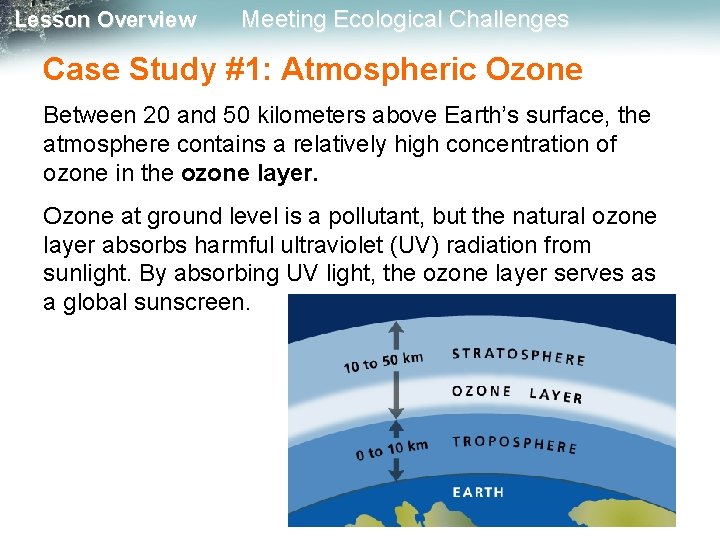
Lesson Overview Meeting Ecological Challenges Case Study #1: Atmospheric Ozone Between 20 and 50 kilometers above Earth’s surface, the atmosphere contains a relatively high concentration of ozone in the ozone layer. Ozone at ground level is a pollutant, but the natural ozone layer absorbs harmful ultraviolet (UV) radiation from sunlight. By absorbing UV light, the ozone layer serves as a global sunscreen.
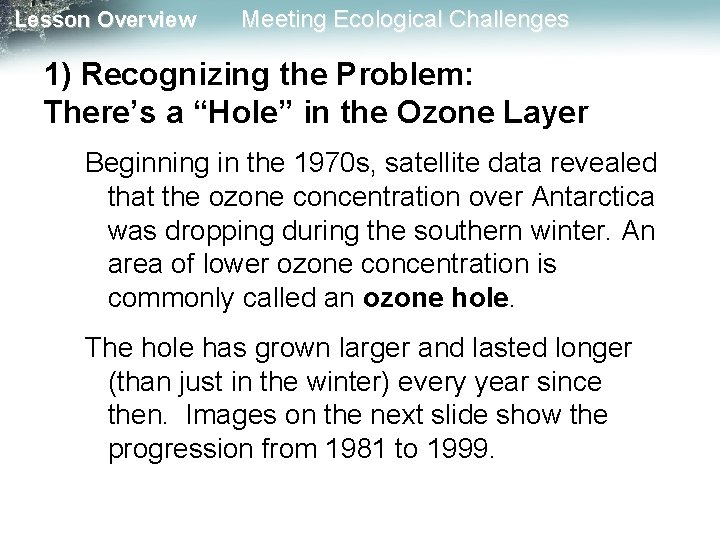
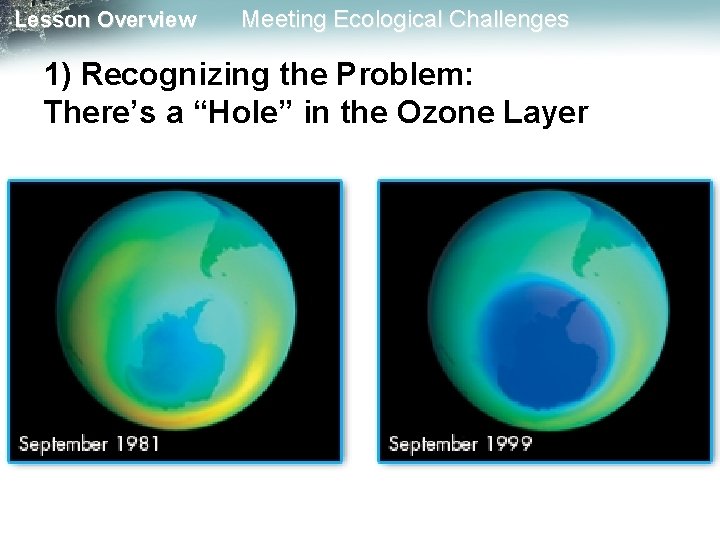
Lesson Overview Meeting Ecological Challenges 1) Recognizing the Problem: There’s a “Hole” in the Ozone Layer Beginning in the 1970 s, satellite data revealed that the ozone concentration over Antarctica was dropping during the southern winter. An area of lower ozone concentration is commonly called an ozone hole. The hole has grown larger and lasted longer (than just in the winter) every year since then. Images on the next slide show the progression from 1981 to 1999.
Lesson Overview Meeting Ecological Challenges 1) Recognizing the Problem: There’s a “Hole” in the Ozone Layer
Lesson Overview Meeting Ecological Challenges 2) Researching the Cause: CFCs In 1974 a research team demonstrated that gases called chlorofluorocarbons (CFCs) were damaging the ozone layer. CFCs were once widely used as propellants in aerosol cans; as coolant in refrigerators, freezers, and air conditioners; and in the production of plastic foams.
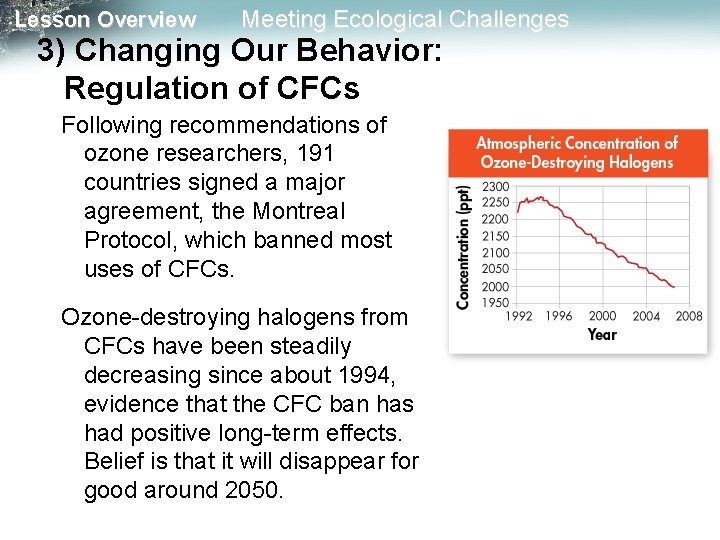
Lesson Overview Meeting Ecological Challenges 3) Changing Our Behavior: Regulation of CFCs Following recommendations of ozone researchers, 191 countries signed a major agreement, the Montreal Protocol, which banned most uses of CFCs. Ozone-destroying halogens from CFCs have been steadily decreasing since about 1994, evidence that the CFC ban has had positive long-term effects. Belief is that it will disappear for good around 2050.
Lesson Overview Meeting Ecological Challenges Case Study #2: North Atlantic Fisheries From 1950 to 1997, the annual world seafood catch grew from 19 million tons to more than 90 million tons. Recent dramatic declines in commercial fish populations have proved that the fish supply is not an endless, renewable resource.
Lesson Overview Meeting Ecological Challenges 1) Recognizing the Problem: More Work, Fewer Fish Larger boats and high-tech fish-finding equipment have made the fishing effort both more intense and more efficient in recent times. Catches rose but then began falling in the ‘ 80’s and continued to fall despite the most intense fishing effort in history. 2) Researching the Cause: Overfishing Fishery ecologists gathered data (including age structure and growth rates) that showed fish populations were shrinking. Ecologists determined that this was the result of overfishing. Fish were being caught faster than they could be replaced by reproduction.
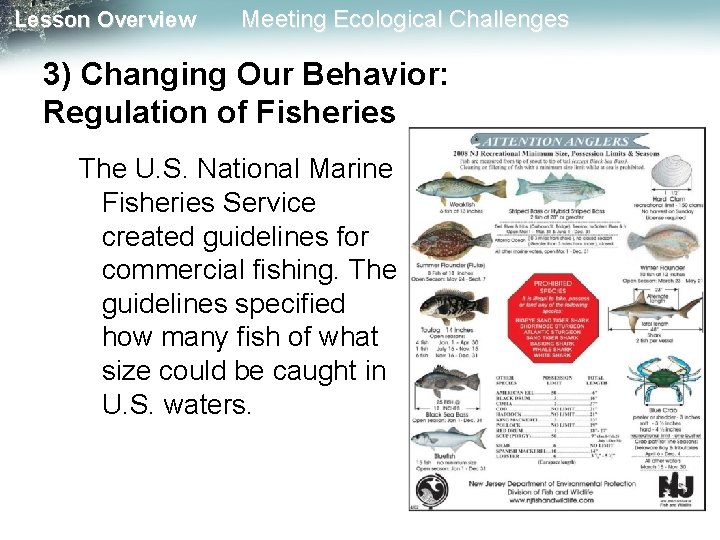
Lesson Overview Meeting Ecological Challenges 3) Changing Our Behavior: Regulation of Fisheries The U. S. National Marine Fisheries Service created guidelines for commercial fishing. The guidelines specified how many fish of what size could be caught in U. S. waters.
Lesson Overview Meeting Ecological Challenges Changing Our Behavior: Regulation of Fisheries In 1996, the Sustainable Fisheries Act closed certain areas to fishing until stocks recover. Other areas are closed seasonally to allow fish to breed and spawn. Aquaculture—the farming of aquatic animals—offers a good alternative to commercial fishing with limited environmental damage if properly managed.
Lesson Overview Meeting Ecological Challenges Changing Behavior: Regulation of Fisheries Progress in restoring fish populations has been slow. Huge fleets from other countries continue to fish the ocean waters and are reluctant to accept conservation efforts. To them, regulations that protect fish populations for the future cause job and income losses today. The challenge is to come up with sustainable practices that ensure the long-term health of fisheries AND minimal short-term impact on the fishing industry.
Lesson Overview Meeting Ecological Challenges Case Study #3: Climate Change 1) Recognizing the Problem: Global Warming A 2007 report of the Intergovernmental Panel On Climate Change (IPCC) has been agreed upon and accepted by 2500 climate scientists and governments from around the world. It confirms earlier observations that global temperatures are rising. This increase in average temperature is called global warming. The report amassed much physical and biological evidence which has contributed to our current understanding of the climate change issue.
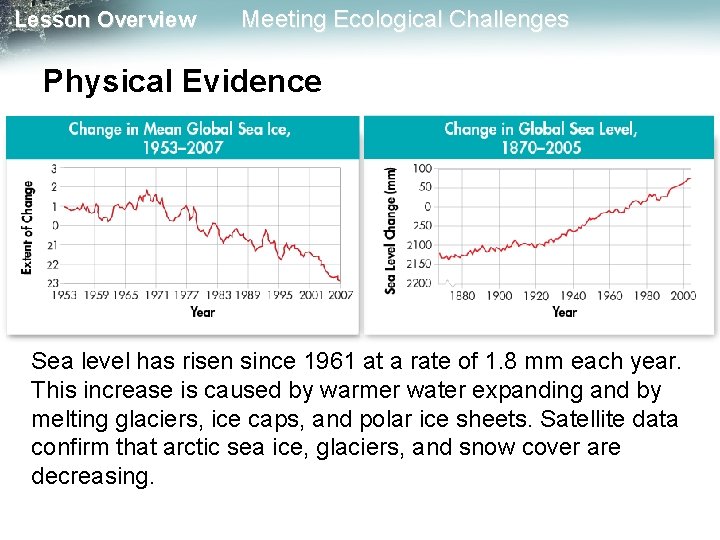
Lesson Overview Meeting Ecological Challenges Physical Evidence Data has shown that eleven of the twelve years between 1995 and 2006 were among the warmest years since temperature recording began in 1850. Between 1906 and 2005, Earth’s average global temperature rose 0. 74°C. The largest changes are occurring in and near the Arctic Circle.
Lesson Overview Meeting Ecological Challenges Physical Evidence Sea level has risen since 1961 at a rate of 1. 8 mm each year. This increase is caused by warmer water expanding and by melting glaciers, ice caps, and polar ice sheets. Satellite data confirm that arctic sea ice, glaciers, and snow cover are decreasing.
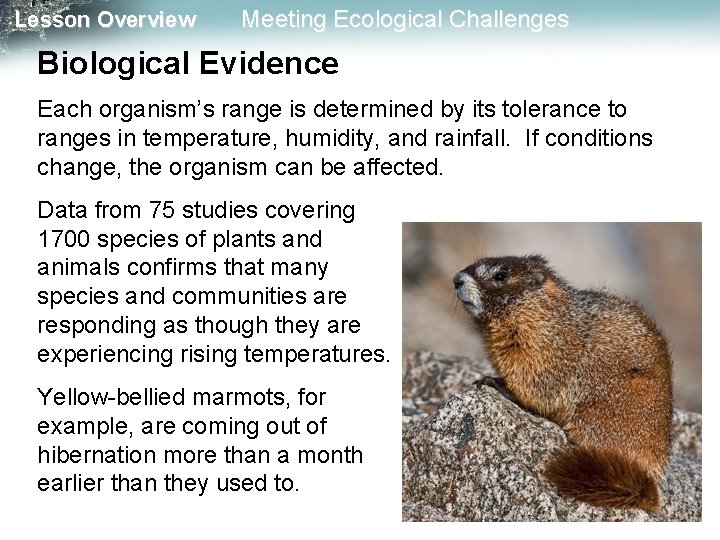
Lesson Overview Meeting Ecological Challenges Biological Evidence Each organism’s range is determined by its tolerance to ranges in temperature, humidity, and rainfall. If conditions change, the organism can be affected. Data from 75 studies covering 1700 species of plants and animals confirms that many species and communities are responding as though they are experiencing rising temperatures. Yellow-bellied marmots, for example, are coming out of hibernation more than a month earlier than they used to.
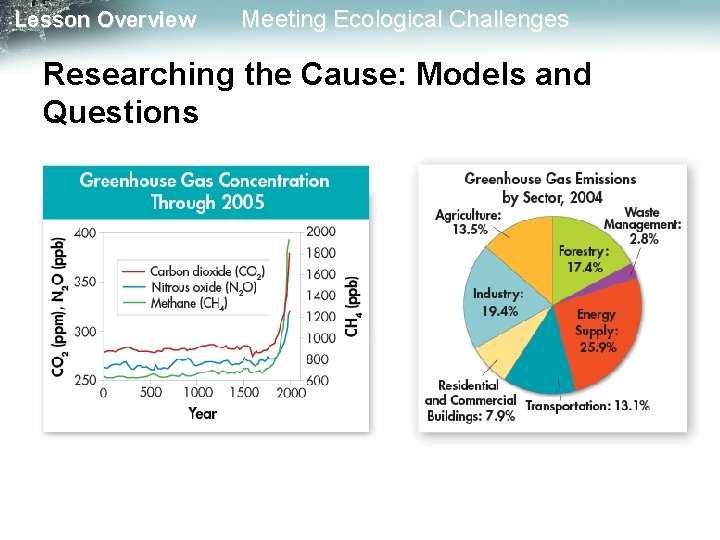
Lesson Overview Meeting Ecological Challenges 2) Researching the Cause: Models and Questions The IPCC report documents that concentrations of carbon dioxide and several other greenhouse gases have increased significantly over the last 200 years. Several kinds of data suggest this increase is due to the burning of fossil fuels, combined with the cutting and burning of forests worldwide. These activities add carbon dioxide to the atmosphere faster than the carbon cycle removes it. Most climate scientists worldwide agree that this added carbon dioxide is strengthening the natural greenhouse effect, causing the biosphere to retain more heat.
Lesson Overview Meeting Ecological Challenges Researching the Cause: Models and Questions
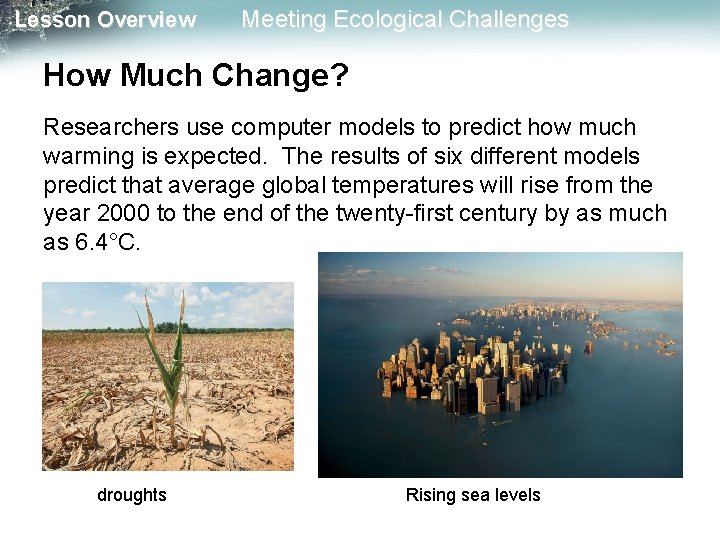
Lesson Overview Meeting Ecological Challenges How Much Change? Researchers use computer models to predict how much warming is expected. The results of six different models predict that average global temperatures will rise from the year 2000 to the end of the twenty-first century by as much as 6. 4°C. droughts Rising sea levels
Lesson Overview Meeting Ecological Challenges 3) Changing Our Behavior: The Challenges Ahead The changes in behavior that needed to cut back significantly on greenhouse gas emissions will be major and will require input from economists and many other individuals from fields beyond biology. Some changes will rely on new technology for renewable energy and more efficient energy use. We have begun to see the emergence of electric cars, recycled products, and green buildings. Nations of the world have begun holding international climate summits, at which they attempt to work out agreements to protect the atmosphere and climate.