
Lesson Overview Cellular Respiration An Overview Lesson Overview
- Slides: 23
Lesson Overview Cellular Respiration: An Overview Lesson Overview 9. 2 The Process of Cellular Respiration
Lesson Overview Cellular Respiration: An Overview THINK ABOUT IT • Food burns! How does a living cell extract the energy stored in food without setting a fire or blowing things up?
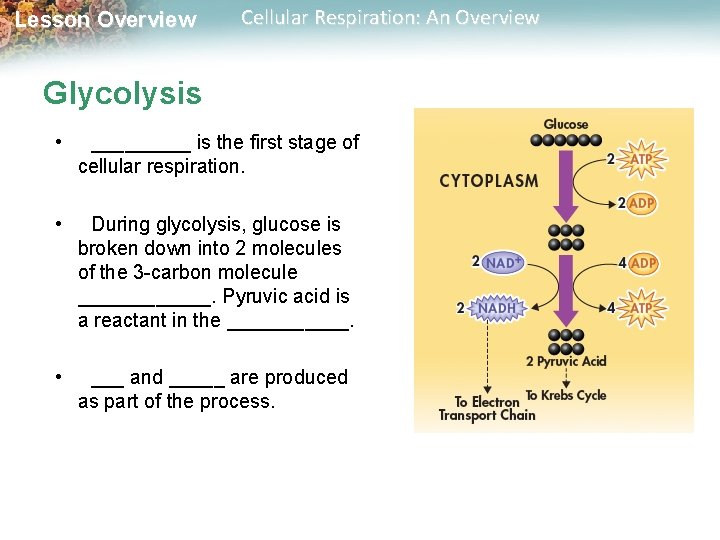
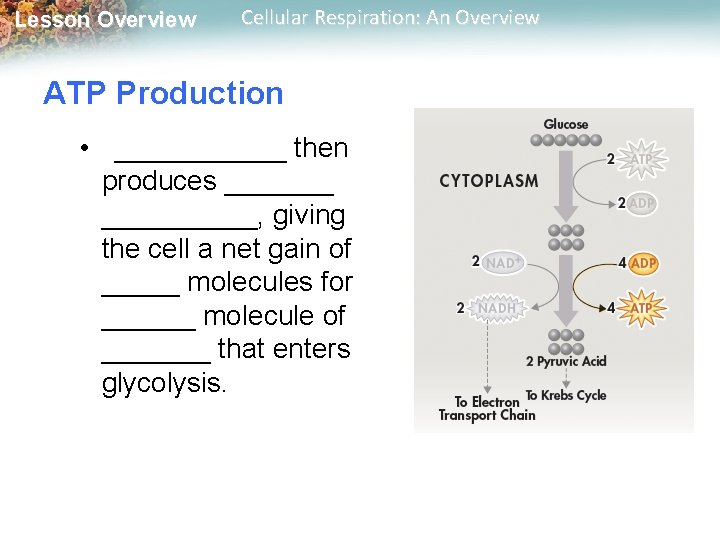
Lesson Overview Cellular Respiration: An Overview Glycolysis • _____ is the first stage of cellular respiration. • During glycolysis, glucose is broken down into 2 molecules of the 3 -carbon molecule ______. Pyruvic acid is a reactant in the ______. • ___ and _____ are produced as part of the process.
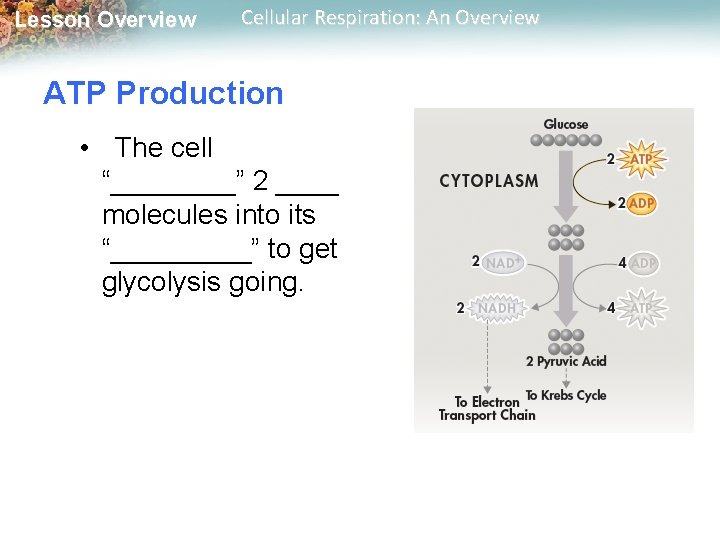
Lesson Overview Cellular Respiration: An Overview ATP Production • The cell “____” 2 ____ molecules into its “_____” to get glycolysis going.
Lesson Overview Cellular Respiration: An Overview ATP Production • ______ then produces __________, giving the cell a net gain of _____ molecules for ______ molecule of _______ that enters glycolysis.
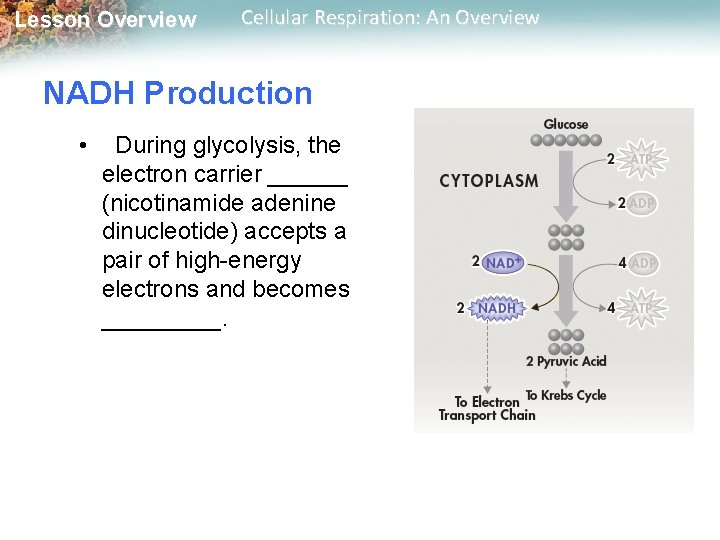
Lesson Overview Cellular Respiration: An Overview NADH Production • During glycolysis, the electron carrier ______ (nicotinamide adenine dinucleotide) accepts a pair of high-energy electrons and becomes _____.
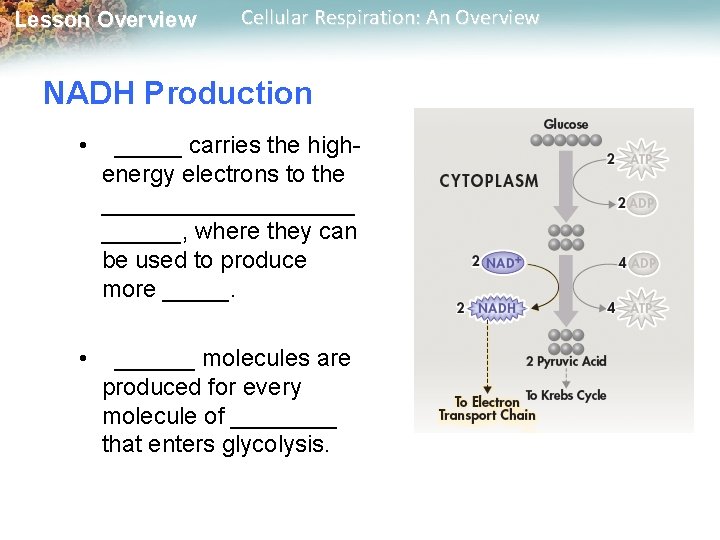
Lesson Overview Cellular Respiration: An Overview NADH Production • _____ carries the highenergy electrons to the __________, where they can be used to produce more _____. • ______ molecules are produced for every molecule of ____ that enters glycolysis.
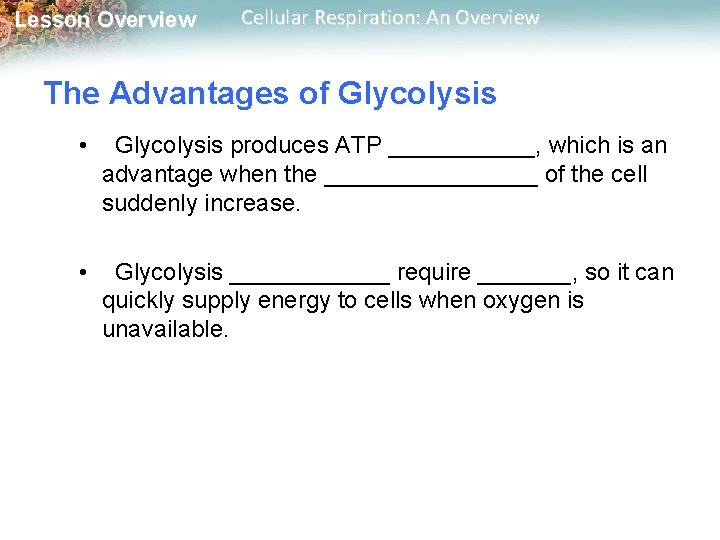
Lesson Overview Cellular Respiration: An Overview The Advantages of Glycolysis • Glycolysis produces ATP ______, which is an advantage when the ________ of the cell suddenly increase. • Glycolysis ______ require _______, so it can quickly supply energy to cells when oxygen is unavailable.
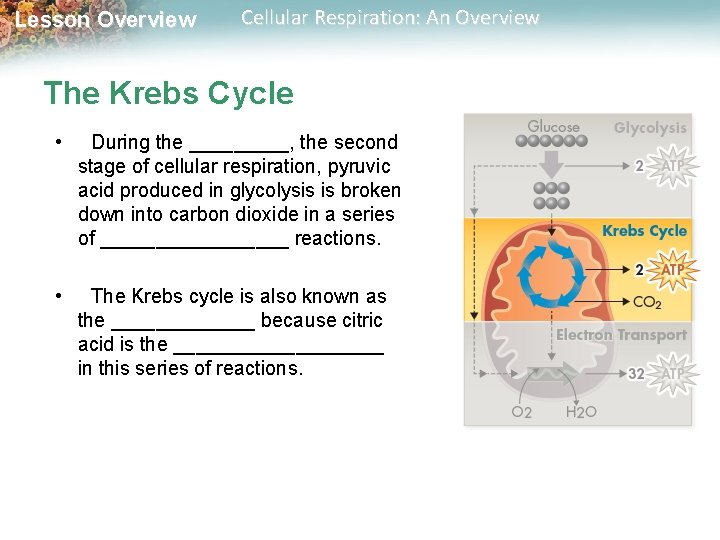
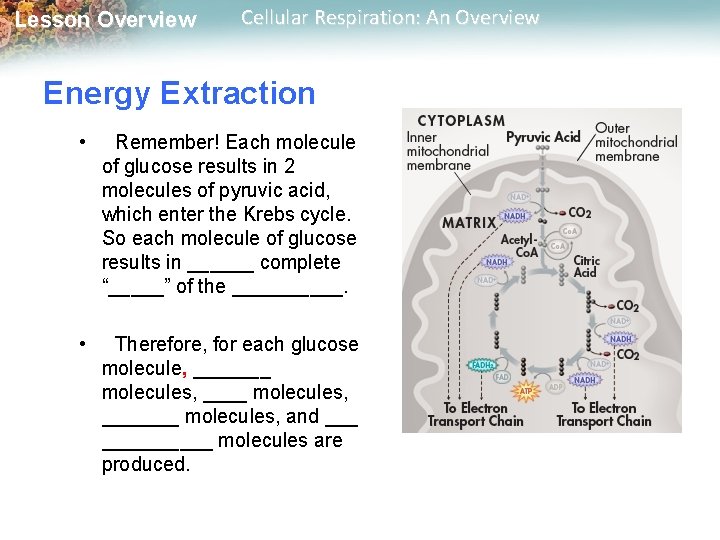
Lesson Overview Cellular Respiration: An Overview The Krebs Cycle • During the _____, the second stage of cellular respiration, pyruvic acid produced in glycolysis is broken down into carbon dioxide in a series of _________ reactions. • The Krebs cycle is also known as the _______ because citric acid is the __________ in this series of reactions.
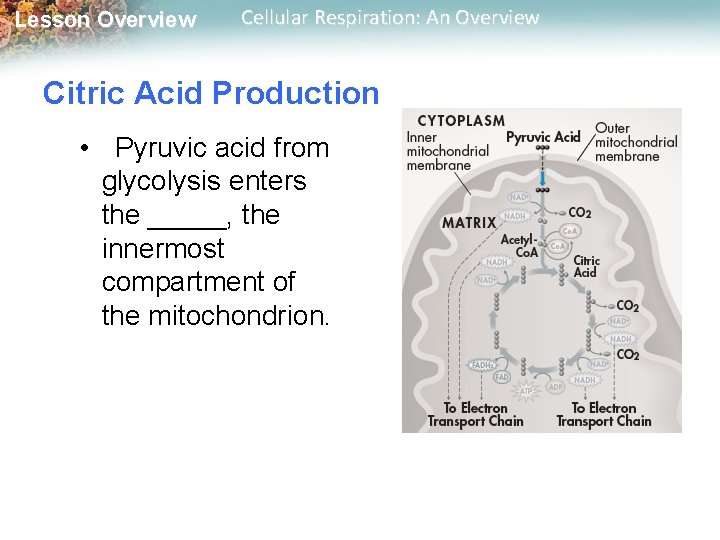
Lesson Overview Cellular Respiration: An Overview Citric Acid Production • Pyruvic acid from glycolysis enters the _____, the innermost compartment of the mitochondrion.
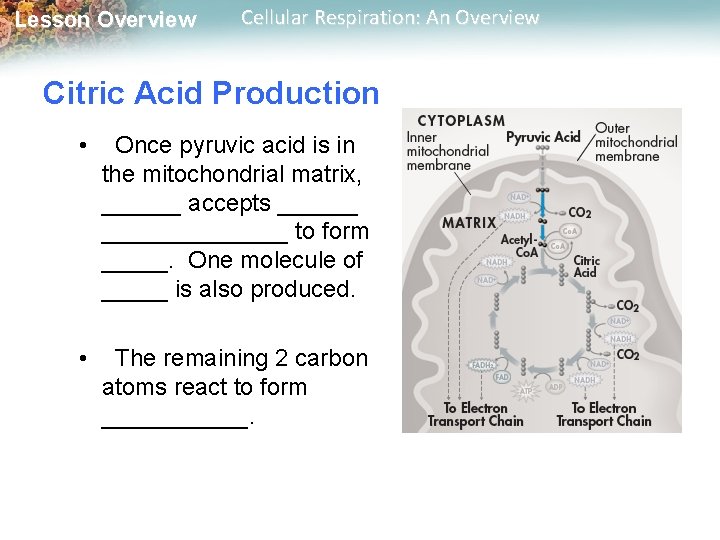
Lesson Overview Cellular Respiration: An Overview Citric Acid Production • Once pyruvic acid is in the mitochondrial matrix, ______ accepts __________ to form _____. One molecule of _____ is also produced. • The remaining 2 carbon atoms react to form ______.
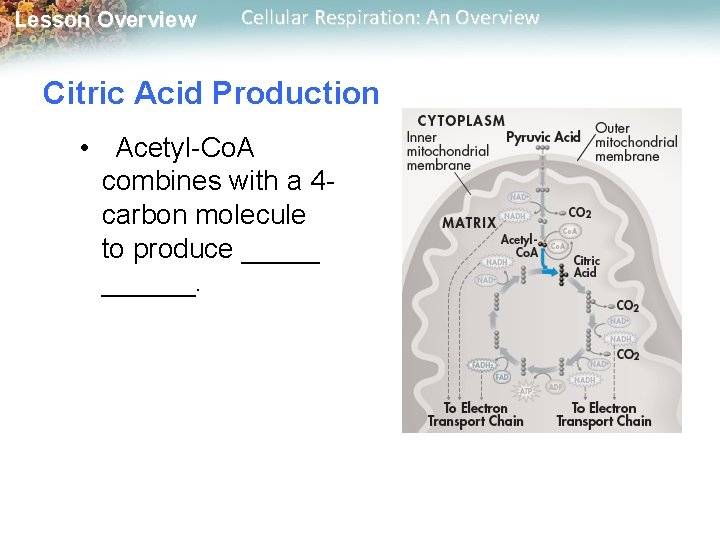
Lesson Overview Cellular Respiration: An Overview Citric Acid Production • Acetyl-Co. A combines with a 4 carbon molecule to produce ______.
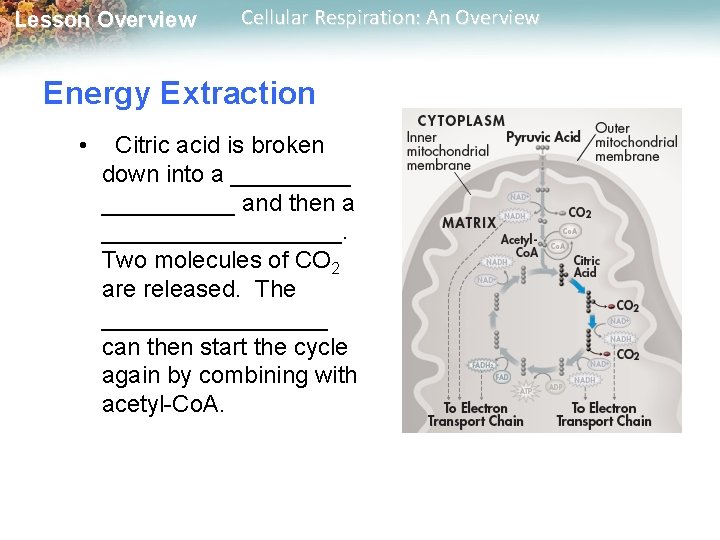
Lesson Overview Cellular Respiration: An Overview Energy Extraction • Citric acid is broken down into a __________ and then a _________. Two molecules of CO 2 are released. The _________ can then start the cycle again by combining with acetyl-Co. A.
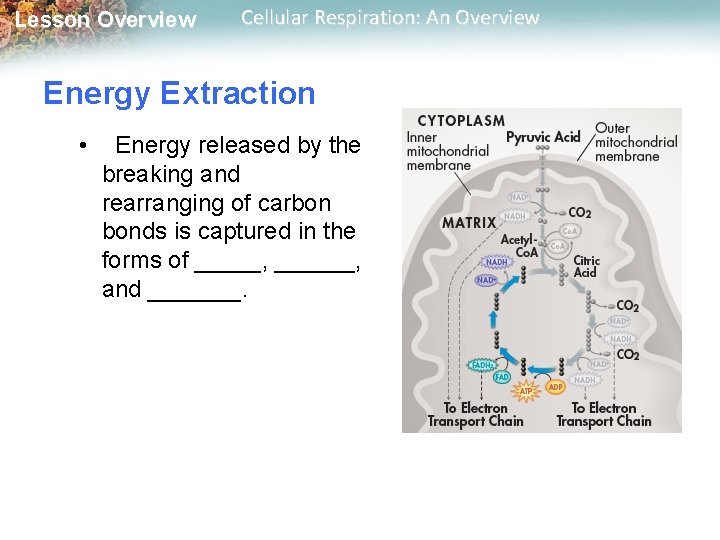
Lesson Overview Cellular Respiration: An Overview Energy Extraction • Energy released by the breaking and rearranging of carbon bonds is captured in the forms of _____, ______, and _______.
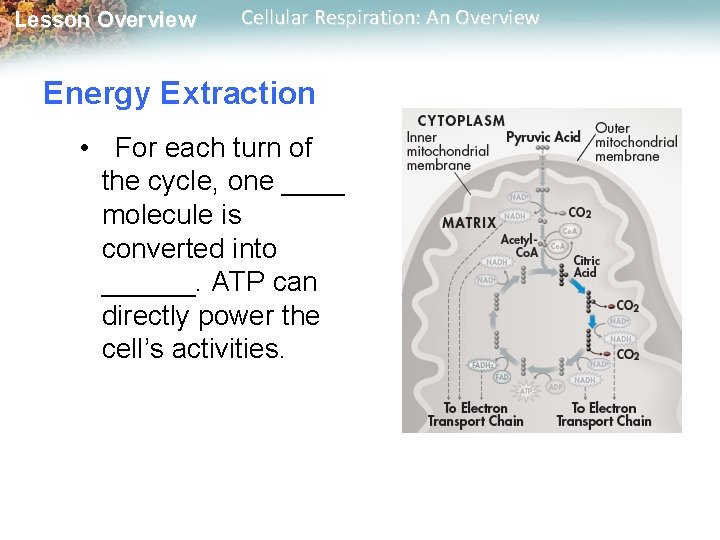
Lesson Overview Cellular Respiration: An Overview Energy Extraction • For each turn of the cycle, one ____ molecule is converted into ______. ATP can directly power the cell’s activities.
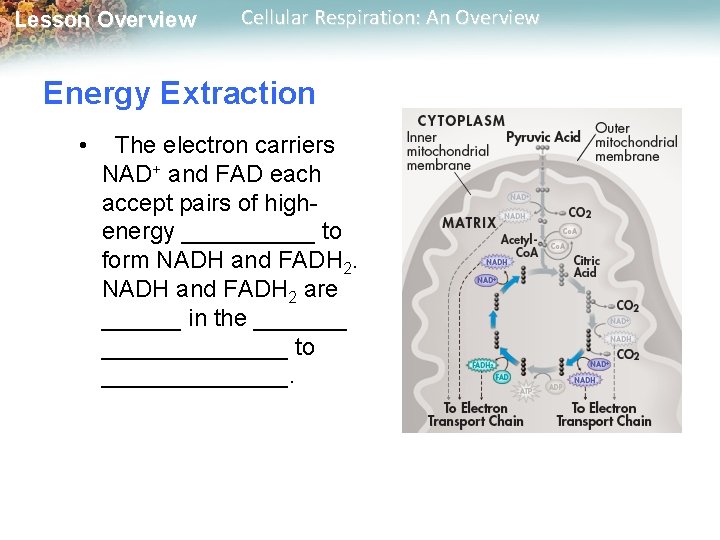
Lesson Overview Cellular Respiration: An Overview Energy Extraction • The electron carriers NAD+ and FAD each accept pairs of highenergy _____ to form NADH and FADH 2 are ______ in the ______________ to _______.
Lesson Overview Cellular Respiration: An Overview Energy Extraction • Remember! Each molecule of glucose results in 2 molecules of pyruvic acid, which enter the Krebs cycle. So each molecule of glucose results in ______ complete “_____” of the _____. • Therefore, for each glucose molecule, _______ molecules, and __________ molecules are produced.
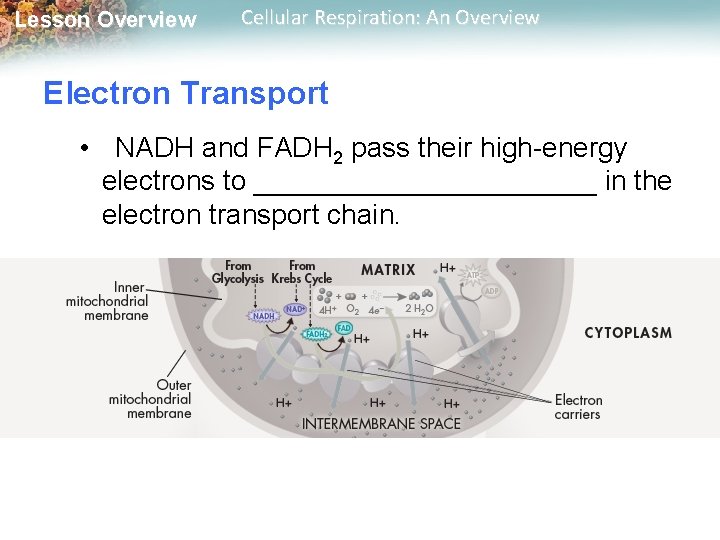
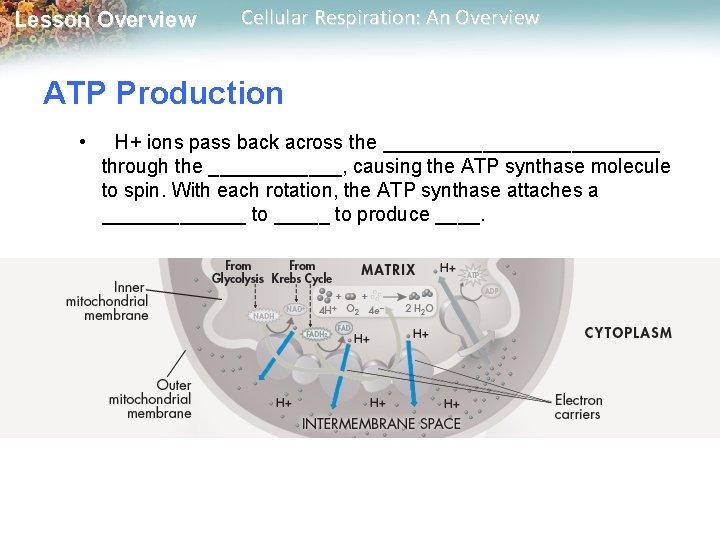
Lesson Overview Cellular Respiration: An Overview Electron Transport • NADH and FADH 2 pass their high-energy electrons to ___________ in the electron transport chain.
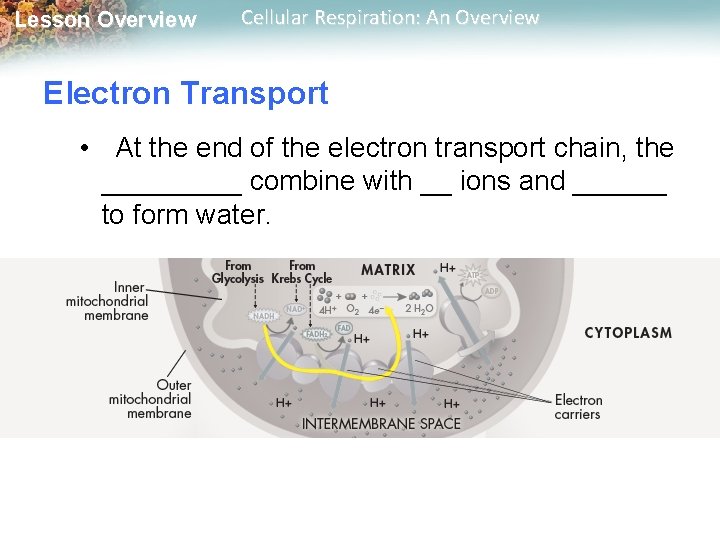
Lesson Overview Cellular Respiration: An Overview Electron Transport • At the end of the electron transport chain, the _____ combine with __ ions and ______ to form water.
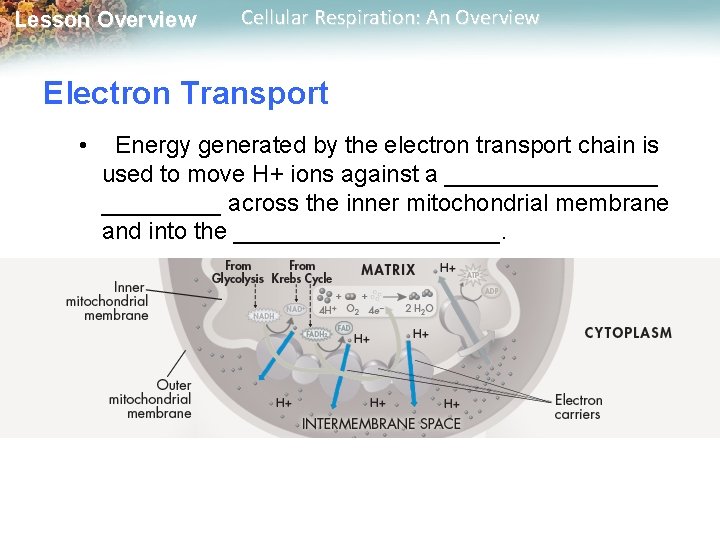
Lesson Overview Cellular Respiration: An Overview Electron Transport • Energy generated by the electron transport chain is used to move H+ ions against a ________ across the inner mitochondrial membrane and into the __________.
Lesson Overview Cellular Respiration: An Overview ATP Production • H+ ions pass back across the _____________ through the ______, causing the ATP synthase molecule to spin. With each rotation, the ATP synthase attaches a _______ to produce ____.
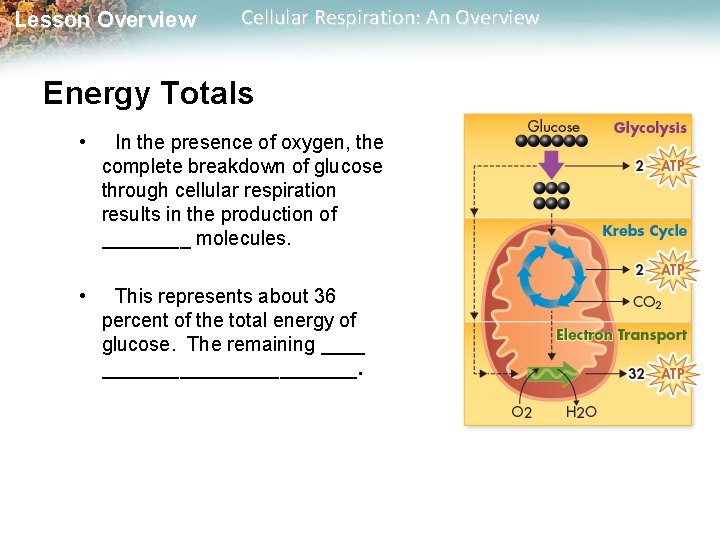
Lesson Overview Cellular Respiration: An Overview Energy Totals • In the presence of oxygen, the complete breakdown of glucose through cellular respiration results in the production of ____ molecules. • This represents about 36 percent of the total energy of glucose. The remaining ______________.
Lesson Overview Cellular Respiration: An Overview Energy Totals • The cell can generate ATP from just about any source, even though we’ve modeled it using only glucose. Complex carbohydrates are broken down into simple sugars like glucose. Lipids and proteins can be broken down into molecules that enter the Krebs cycle or glycolysis at one of several places.