
Lesson Overview Carbon Compounds Lesson Overview 2 3
Lesson Overview Carbon Compounds Lesson Overview 2. 3 Carbon Compounds

Lesson Overview Carbon Compounds THINK ABOUT IT What is Organic chemistry? Why is it not Life chemistry or biology chemistry? In the early 1800 s, many chemists called the compounds created by organisms “organic, ” believing they were fundamentally different from compounds in nonliving things. We now understand that the principles governing the chemistry of living and nonliving things are the same, but the term “organic chemistry” is still around. Today, organic chemistry means the study of compounds that contain bonds between carbon atoms, while inorganic chemistry is the study of all other compounds.
Lesson Overview Carbon Compounds The Chemistry of Carbon What elements does carbon bond with to make up life’s molecules? Carbon can bond with many elements, including hydrogen, oxygen, phosphorus, sulfur, and nitrogen to form the molecules of life.
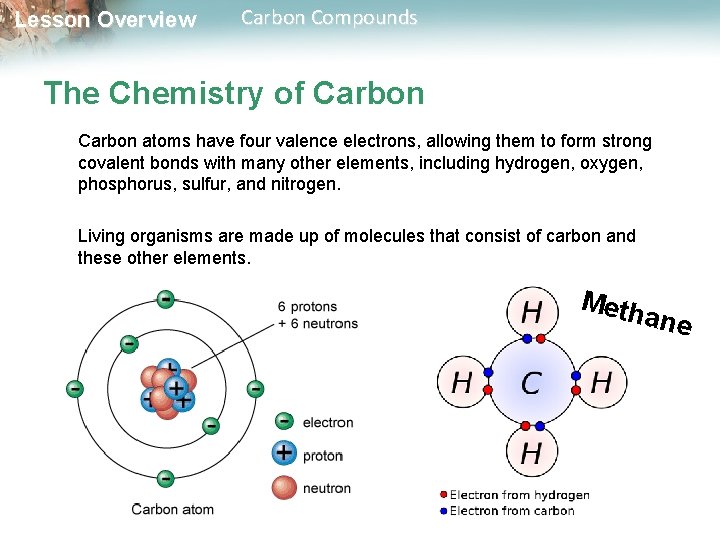
Lesson Overview Carbon Compounds The Chemistry of Carbon atoms have four valence electrons, allowing them to form strong covalent bonds with many other elements, including hydrogen, oxygen, phosphorus, sulfur, and nitrogen. Living organisms are made up of molecules that consist of carbon and these other elements. Meth ane
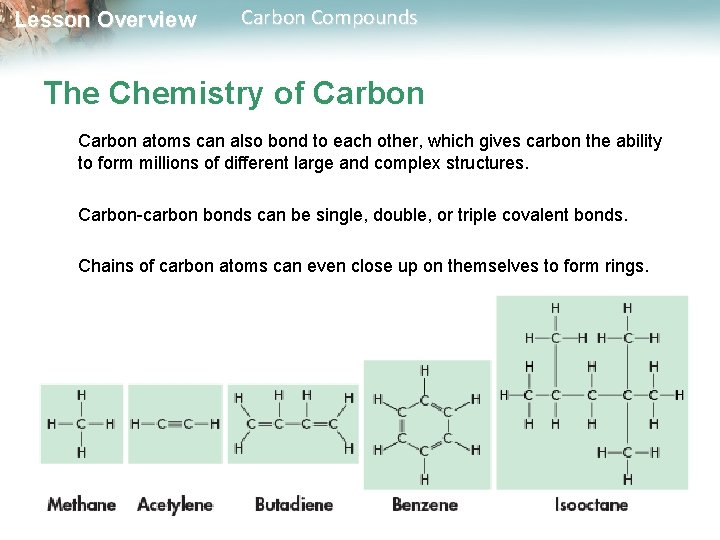
Lesson Overview Carbon Compounds The Chemistry of Carbon atoms can also bond to each other, which gives carbon the ability to form millions of different large and complex structures. Carbon-carbon bonds can be single, double, or triple covalent bonds. Chains of carbon atoms can even close up on themselves to form rings.
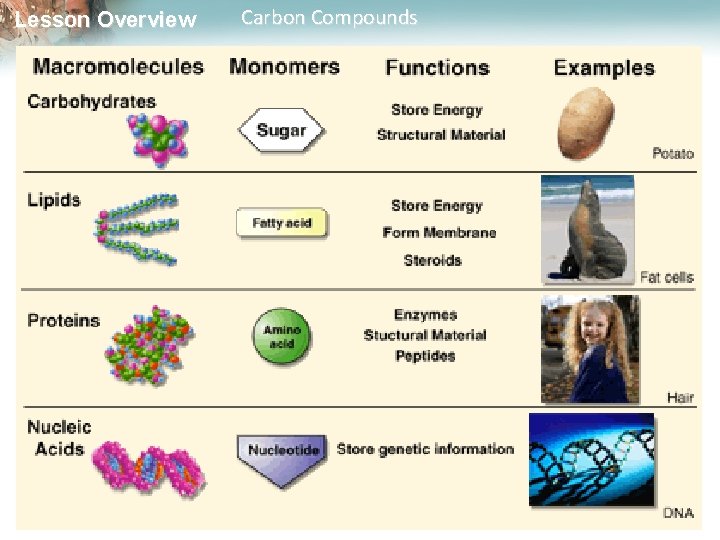
Lesson Overview Carbon Compounds Macromolecules What are the functions of each of the four groups of macromolecules? Living things use carbohydrates as their main source of energy. Plants, some animals, and other organisms also use carbohydrates for structural purposes. Lipids can be used to store energy. Some lipids are important parts of biological membranes and waterproof coverings. Nucleic acids store and transmit hereditary, or genetic, information. Some proteins control the rate of reactions and regulate cell processes. Others form important cellular structures, while still others transport substances into or out of cells or help to fight disease.
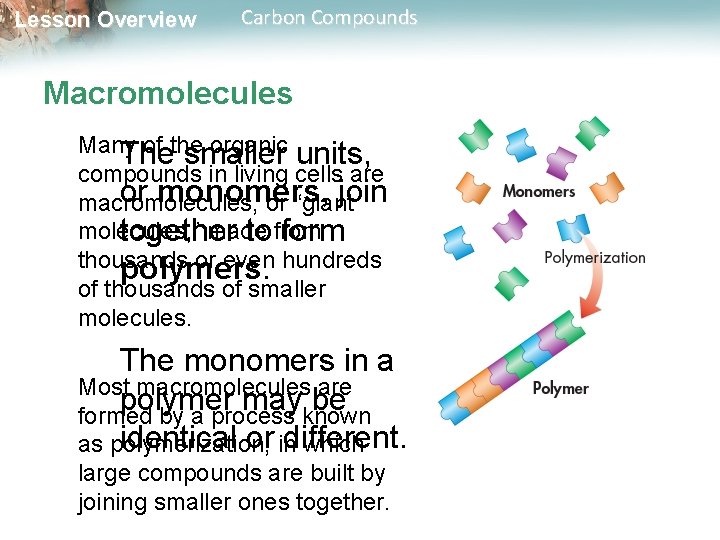
Lesson Overview Carbon Compounds Macromolecules Many of the organic units, The smaller compounds in living cells are or monomers, join macromolecules, or “giant molecules, ” made together to from form thousands or even hundreds polymers. of thousands of smaller molecules. The monomers in a Most macromolecules are polymer may be formed by a process known identical or indifferent. as polymerization, which large compounds are built by joining smaller ones together.
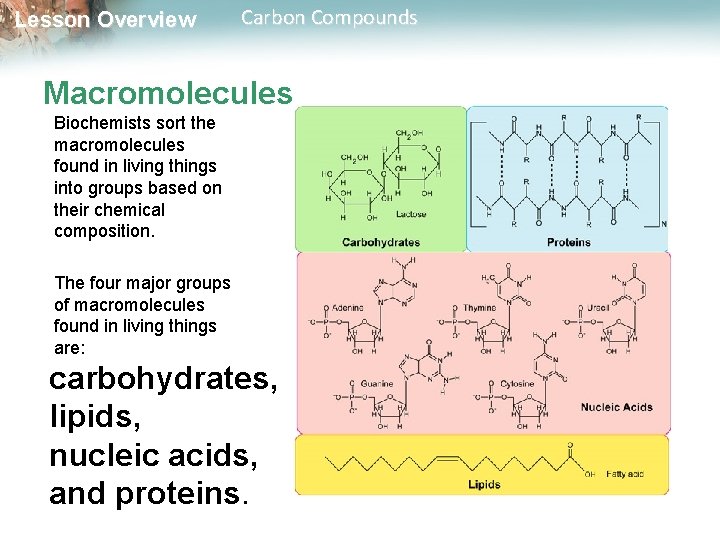
Lesson Overview Carbon Compounds Macromolecules Biochemists sort the macromolecules found in living things into groups based on their chemical composition. The four major groups of macromolecules found in living things are: carbohydrates, lipids, nucleic acids, and proteins.
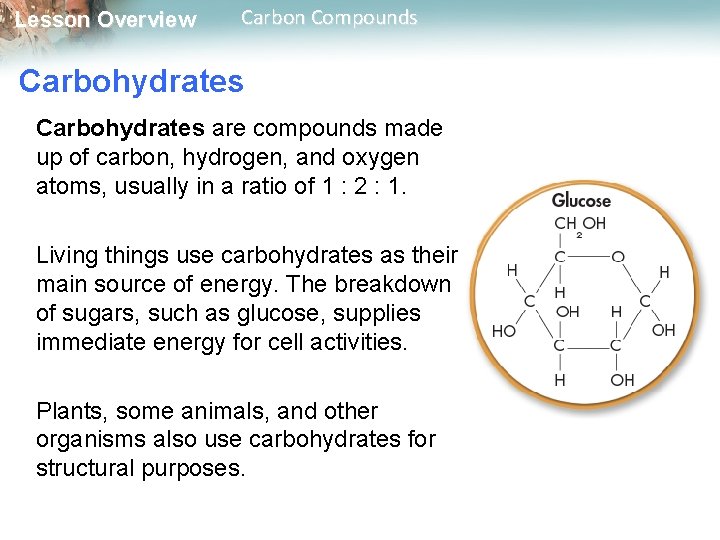
Lesson Overview Carbon Compounds Carbohydrates are compounds made up of carbon, hydrogen, and oxygen atoms, usually in a ratio of 1 : 2 : 1. Living things use carbohydrates as their main source of energy. The breakdown of sugars, such as glucose, supplies immediate energy for cell activities. Plants, some animals, and other organisms also use carbohydrates for structural purposes.
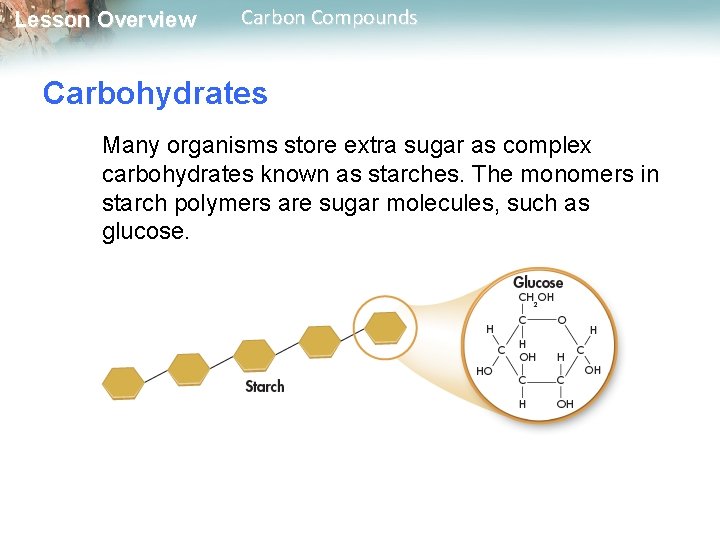
Lesson Overview Carbon Compounds Carbohydrates Many organisms store extra sugar as complex carbohydrates known as starches. The monomers in starch polymers are sugar molecules, such as glucose.
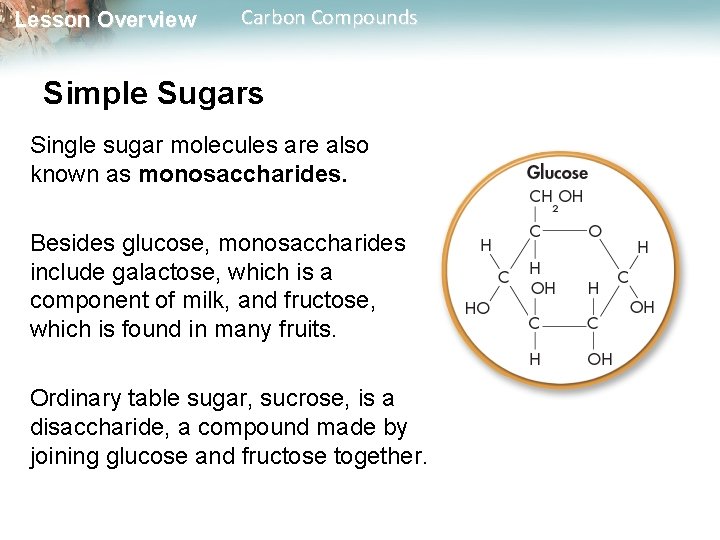
Lesson Overview Carbon Compounds Simple Sugars Single sugar molecules are also known as monosaccharides. Besides glucose, monosaccharides include galactose, which is a component of milk, and fructose, which is found in many fruits. Ordinary table sugar, sucrose, is a disaccharide, a compound made by joining glucose and fructose together.
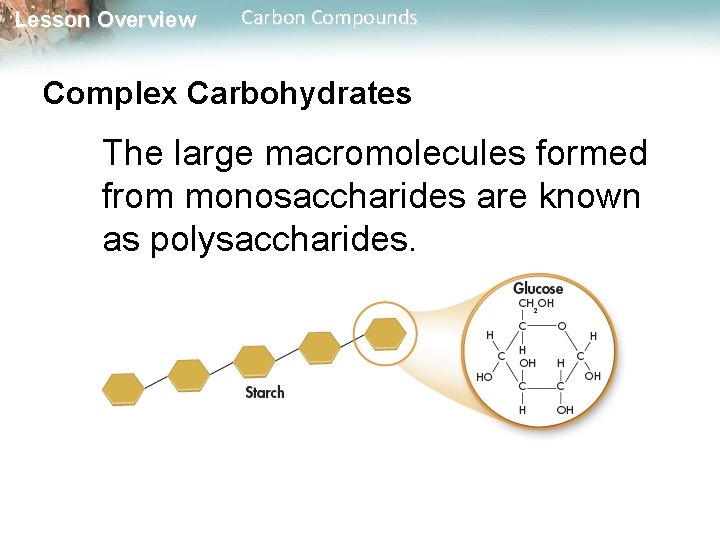
Lesson Overview Carbon Compounds Complex Carbohydrates The large macromolecules formed from monosaccharides are known as polysaccharides.
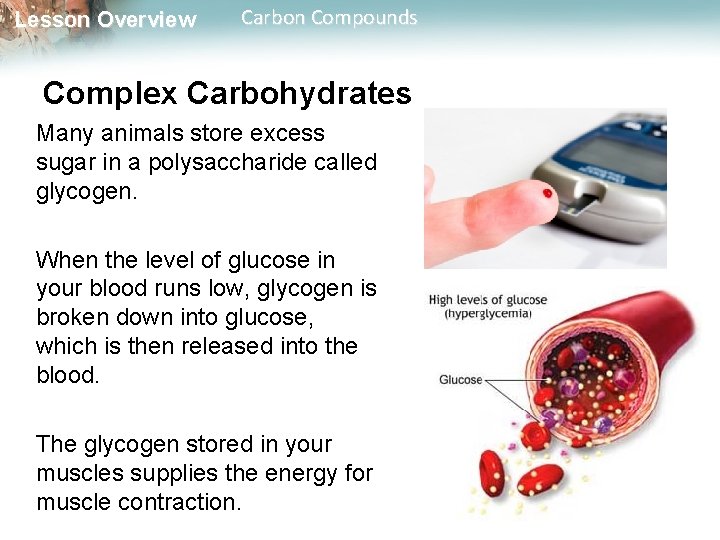
Lesson Overview Carbon Compounds Complex Carbohydrates Many animals store excess sugar in a polysaccharide called glycogen. When the level of glucose in your blood runs low, glycogen is broken down into glucose, which is then released into the blood. The glycogen stored in your muscles supplies the energy for muscle contraction.
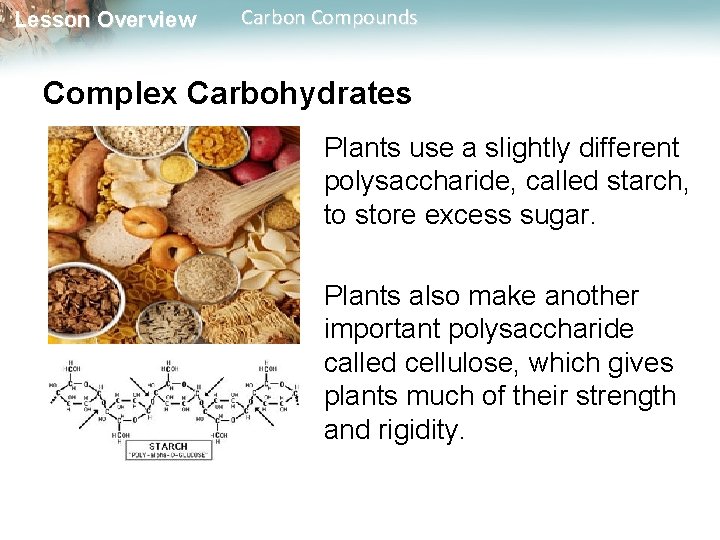
Lesson Overview Carbon Compounds Complex Carbohydrates Plants use a slightly different polysaccharide, called starch, to store excess sugar. Plants also make another important polysaccharide called cellulose, which gives plants much of their strength and rigidity.
Lesson Overview Carbon Compounds Lipids are a large and varied group of biological molecules. Lipids are made mostly from carbon and hydrogen atoms and are generally not soluble in water. The common categories of lipids are fats, oils, and waxes. Lipids can be used to store energy. Some lipids are important parts of biological membranes and waterproof coverings. Steroids synthesized by the body are lipids as well. Many steroids, such as hormones, serve as chemical messengers.
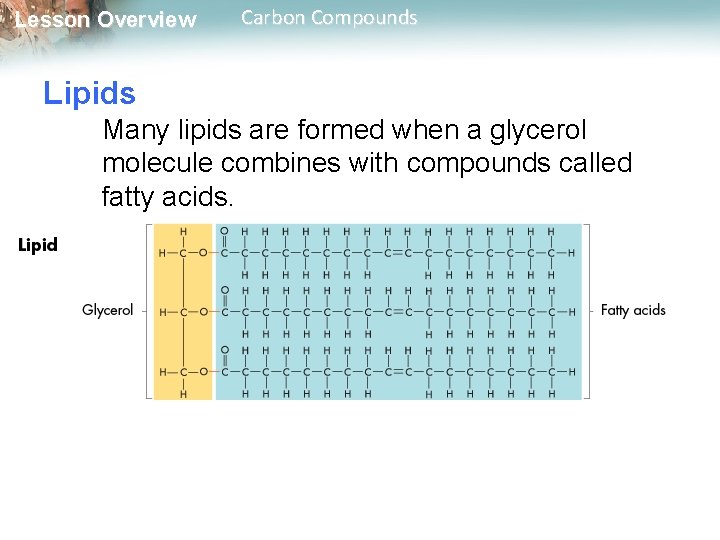
Lesson Overview Carbon Compounds Lipids Many lipids are formed when a glycerol molecule combines with compounds called fatty acids.
Lesson Overview Carbon Compounds Lipids If each carbon atom in a lipid’s fatty acid chains is joined to another carbon atom by a single bond, the lipid is said to be saturated. If there is at least one carbon-carbon double bond in a fatty acid, the fatty acid is said to be unsaturated. Lipids whose fatty acids contain more than one double bond are said to be polyunsaturated.
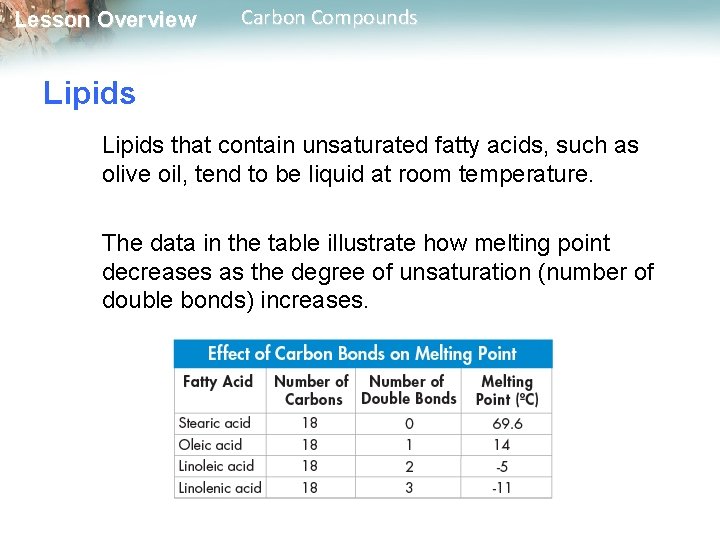
Lesson Overview Carbon Compounds Lipids that contain unsaturated fatty acids, such as olive oil, tend to be liquid at room temperature. The data in the table illustrate how melting point decreases as the degree of unsaturation (number of double bonds) increases.
Lesson Overview Carbon Compounds Nucleic Acids Nucleic acids store and transmit hereditary, or genetic, information. Nucleic acids are macromolecules containing hydrogen, oxygen, nitrogen, carbon, and phosphorus. Nucleic acids are polymers assembled from individual monomers known as nucleotides.
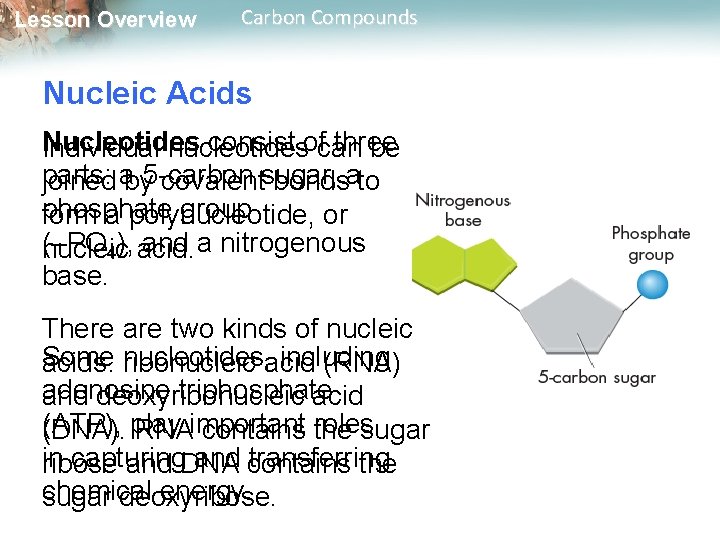
Lesson Overview Carbon Compounds Nucleic Acids Nucleotides consist ofcan three Individual nucleotides be parts: joined aby 5 -carbon covalentsugar, bondsato phosphate group form a polynucleotide, or (–PO and a nitrogenous nucleic 4), acid. base. There are two kinds of nucleic Some including acids: nucleotides, ribonucleic acid (RNA) adenosine triphosphate and deoxyribonucleic acid (ATP), (DNA). play RNAimportant contains roles the sugar in capturing and contains transferring ribose and DNA the chemical energy. sugar deoxyribose.
Lesson Overview Carbon Compounds Proteins are macromolecules that contain nitrogen as well as carbon, hydrogen, and oxygen. Proteins are polymers of molecules called amino acids. Proteins perform many varied functions, such as controlling the rate of reactions and regulating cell processes, forming cellular structures, transporting substances into or out of cells, and helping to fight disease.
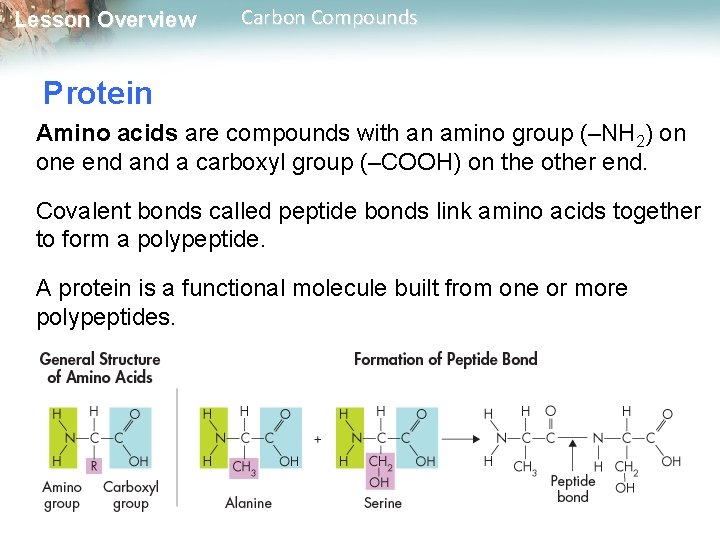
Lesson Overview Carbon Compounds Protein Amino acids are compounds with an amino group (–NH 2) on one end a carboxyl group (–COOH) on the other end. Covalent bonds called peptide bonds link amino acids together to form a polypeptide. A protein is a functional molecule built from one or more polypeptides.
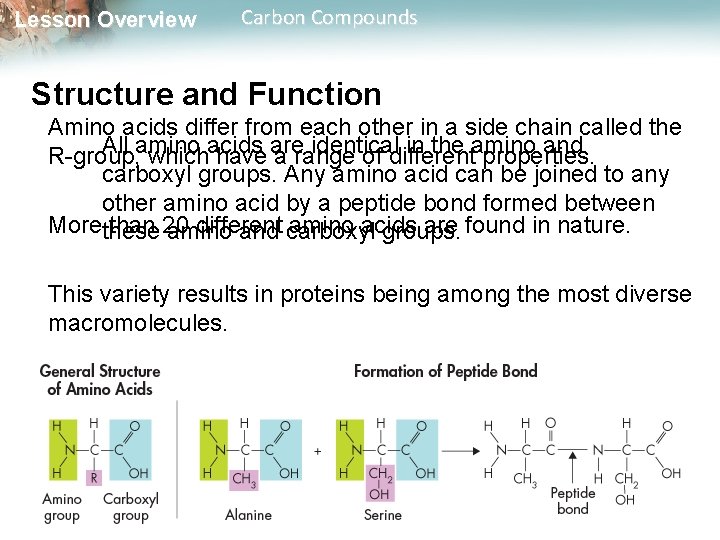
Lesson Overview Carbon Compounds Structure and Function Amino acids differ from each other in a side chain called the All amino identical in the amino and R-group, whichacids have are a range of different properties. carboxyl groups. Any amino acid can be joined to any other amino acid by a peptide bond formed between Morethese than 20 different amino acids are found in nature. amino and carboxyl groups. This variety results in proteins being among the most diverse macromolecules.
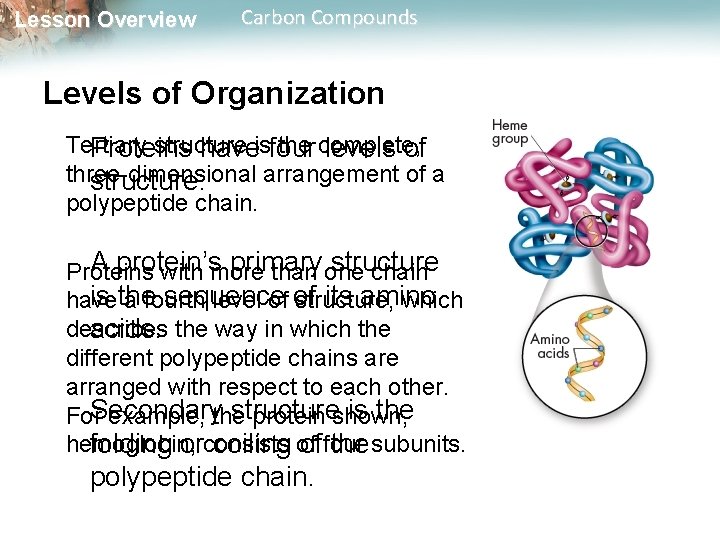
Lesson Overview Carbon Compounds Levels of Organization Tertiary structure the complete, Proteins haveisfour levels of three-dimensional arrangement of a structure. polypeptide chain. A protein’s primary structure Proteins with more than one chain is the sequence its amino have a fourth level of of structure, which describes acids. the way in which the different polypeptide chains are arranged with respect to each other. structure is the For. Secondary example, the protein shown, hemoglobin, folding orconsists coiling of offour the subunits. polypeptide chain.
Lesson Overview Carbon Compounds
- Slides: 25