
Lesson One Native American Agriculture in the Americas

- Slides: 15
Lesson One: Native American Agriculture in the America's Before 1492 (Columbus) by Ms. Leslie Rae Henry Oglala Lakota College Ag & Natural Resource Department Kyle, South Dakota 57752 Dec. 1, 2003 For Dr. Diane Rickerl South Dakota State University Agro-ecology Curriculum
Educational Outcomes for Lesson One n n 1. Explore Native American agriculture in North, Central, & South America. 2. Examine the movement of maize across the Americas. 3. Compare the agrarian cultures with hunting/gathering cultures. 4. Examine how hunting/gathering culture and agrarian cultures depended on each other for survival.
Where did agriculture begin in the America's? n The beginning of American agriculture n n overlooked in many history classes around the world Traditional education's systems often state that n agrarian culture's began in the Near East area of Mesopotamia n n n (parts of Iran, Iraq, Turkey, Syria, Lebannon, & Israel) ~ 9, 000 to 14, 000 years ago. Early Mesopotamian's domesticated wheat, barley, pea, lentil, vetch, dogs, goats, and sheep. Egypt had a similar development n credited with the first ornamental gardens.
Tehuacan Valley in Central America (Mesoamerica) n n Credited with the site of the beginning of agriculture around 3500 BC (potentially much earlier as wild avocado have been dated ~7, 000 -6, 500 BC). earliest cultigens were several species of the squash family n n n (Cucurbitaceae; genus Cucurbita) with the pumpkin squash (Cucurbits pepo) from Guila Naquitz (dated 8, 000 -7, 000 BC) and at Ocampo Cave in Tamaulipas (dated 7, 000 -6, 500 BC).
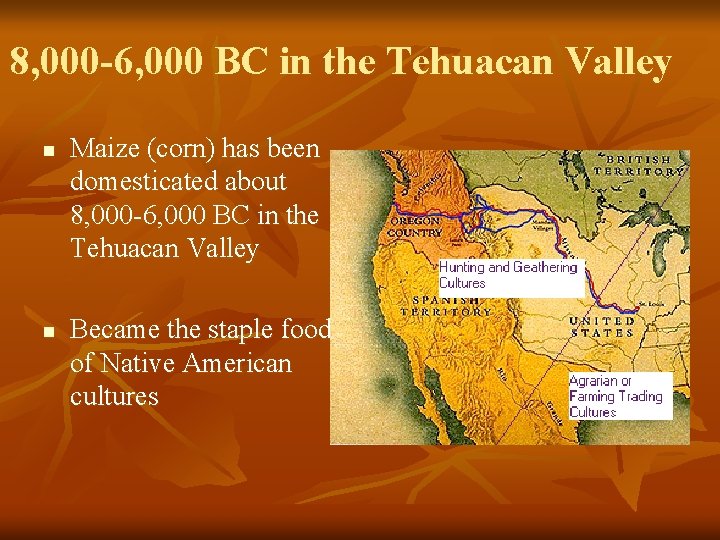
8, 000 -6, 000 BC in the Tehuacan Valley n n Maize (corn) has been domesticated about 8, 000 -6, 000 BC in the Tehuacan Valley Became the staple food of Native American cultures
What types of plants were cultivated by Native Americans? n Mesoamerican crops: n Maize (Corn) n Squash n Beans The Three Sisters n Other Crops: n n n Tomatoes, avocados, guavas, chile peppers, manionc, agave, and prickly pear cacti n n Some other crops were cultivated for uses other than food as: rubber trees and cotton plants for latex balls and clothing. Also, cacao beans were used for money and latter for making chocolate and the leaves used as a mild narcotic to stop hunger and to handle high altitudes.
What Cultures cultivated plants? n n n Central American Agrarian Cultures: Olmecs (1200 -1000 BC to 300 BC) Teotihuacán (2 BC 700 AD) Toltec's (950 -1200 AD) Mayan (300 -900 AD) Aztec (1168 -1524)- n n South American Cultures: Chauvin - (1000 BC to 600 AD) Tiahuanaco - (6001400 AD) Inca (ancient people, expand empire 12 th century -1532)
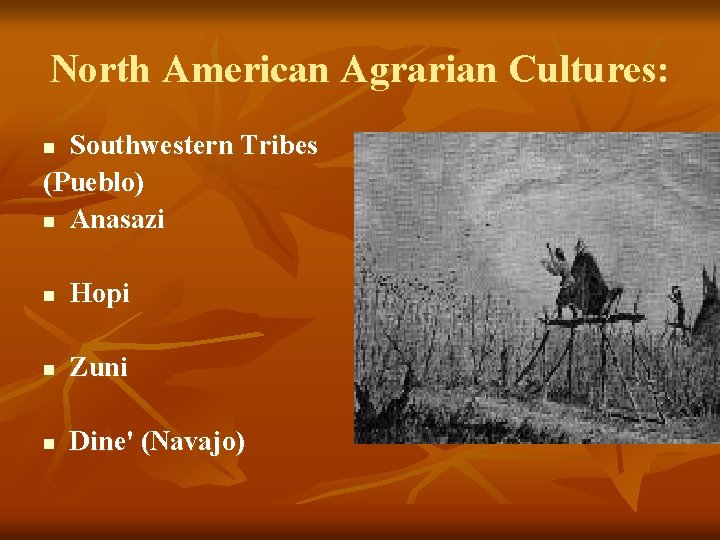
North American Agrarian Cultures: Southwestern Tribes (Pueblo) n Anasazi n n Hopi n Zuni n Dine' (Navajo)
Eastern Woodland & Southeast: n n Mississippian (Mound builders) Iroquois "People of the Longhouse" (Haudenosaunee)
Great Plains Agricultural Tribes: n Arikara - Story of Corn n Mandan – n Hidatsa – Story n Pawnee – n Omaha -
Corn n n "Corn-America's most important native food-plays a recurring role in history. First cultivated by the Indians, it sustained waves of colonists, pioneers, and nation builders. Now it feeds the world. “ according to the Editors of the Better Homes and Gardens Heritage Cook Book.
Research Questions: n n n n 1. Did Native Americans have an agriculture economy before 1492? 2. What crops were domesticated by Native American agriculturist? 3. What were the geographic areas of Native American agriculture before Columbus? 4. How were the crops grown by Native American producers before Columbus? 5. How were the crops processed for human use? 6. Were Native Americans agriculturalists researchers before Columbus? 7. Has Native American Agricultural history been lost or not emphasized in current scientific education?
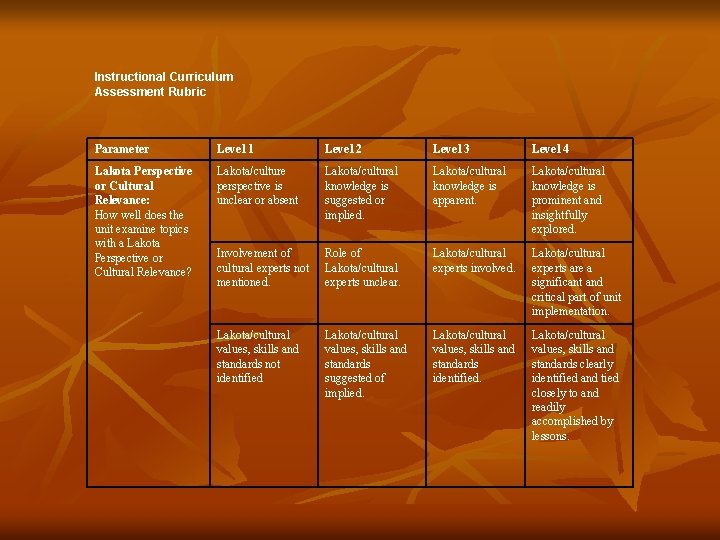
Instructional Curriculum Assessment Rubric Parameter Level 1 Level 2 Level 3 Level 4 Lakota Perspective or Cultural Relevance: How well does the unit examine topics with a Lakota Perspective or Cultural Relevance? Lakota/culture perspective is unclear or absent Lakota/cultural knowledge is suggested or implied. Lakota/cultural knowledge is apparent. Lakota/cultural knowledge is prominent and insightfully explored. Involvement of cultural experts not mentioned. Role of Lakota/cultural experts unclear. Lakota/cultural experts involved. Lakota/cultural experts are a significant and critical part of unit implementation. Lakota/cultural values, skills and standards not identified Lakota/cultural values, skills and standards suggested of implied. Lakota/cultural values, skills and standards identified. Lakota/cultural values, skills and standards clearly identified and tied closely to and readily accomplished by lessons.
Core Competencies: In the section below, please indicate to what level you address each core competency in the above listed courses by filling in the appropriate circle. = Competency not addressed but assumed = Competency minimally addressed = Competency addressed as a secondary goal = Competency addressed as a major goal Reading: To read and comprehend at the college level, including word meanings, contextual meanings, main and supporting idea’s, and drawing correct inferences. If you rated this competency a 3, 4, or 5 explain which goals in your syllabus support your rating. Please write the goals or list some student/faculty activities that demonstrate how you accomplish this. Explore Native American agriculture in North, Central, & South America. Each student will have to do research on an American countries native agricultural. See attached assignment.
For More Information n n Contact the Agriculture and Natural Resource Department at Oglala Lakota College http: //www. olc. edu Or Plant Science Department at South Dakota State University http: //www. sdstate. edu