
Lesson ObjectiveAmcanion y wers WALT WE ARE LEARNING
Lesson Objective/Amcanion y wers WALT - WE ARE LEARNING TO…… Date: __________ THEME 6: Development and Resource Issues LO: What are the causes and consequences of regional patterns of economic development in India and the UK?
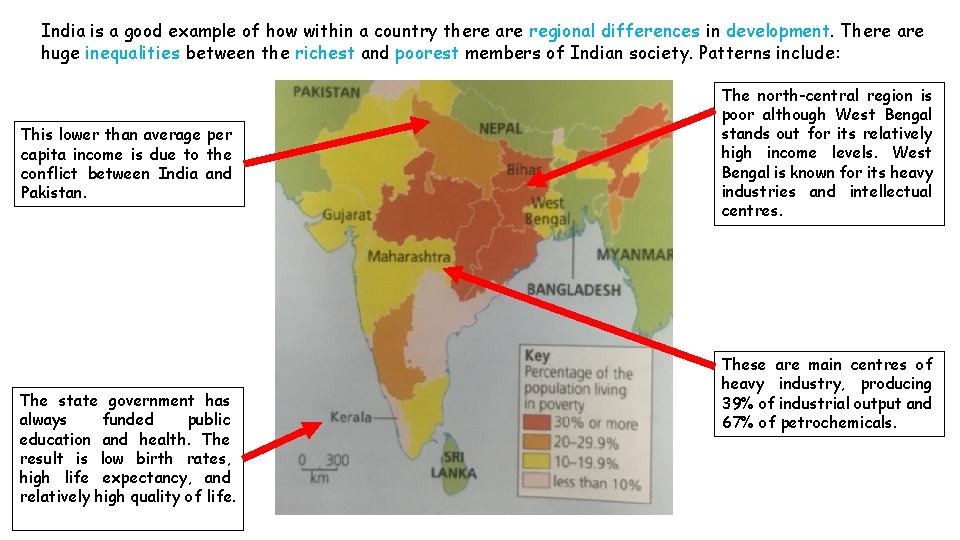
India is a good example of how within a country there are regional differences in development. There are huge inequalities between the richest and poorest members of Indian society. Patterns include: This lower than average per capita income is due to the conflict between India and Pakistan. The state government has always funded public education and health. The result is low birth rates, high life expectancy, and relatively high quality of life. The north-central region is poor although West Bengal stands out for its relatively high income levels. West Bengal is known for its heavy industries and intellectual centres. These are main centres of heavy industry, producing 39% of industrial output and 67% of petrochemicals.
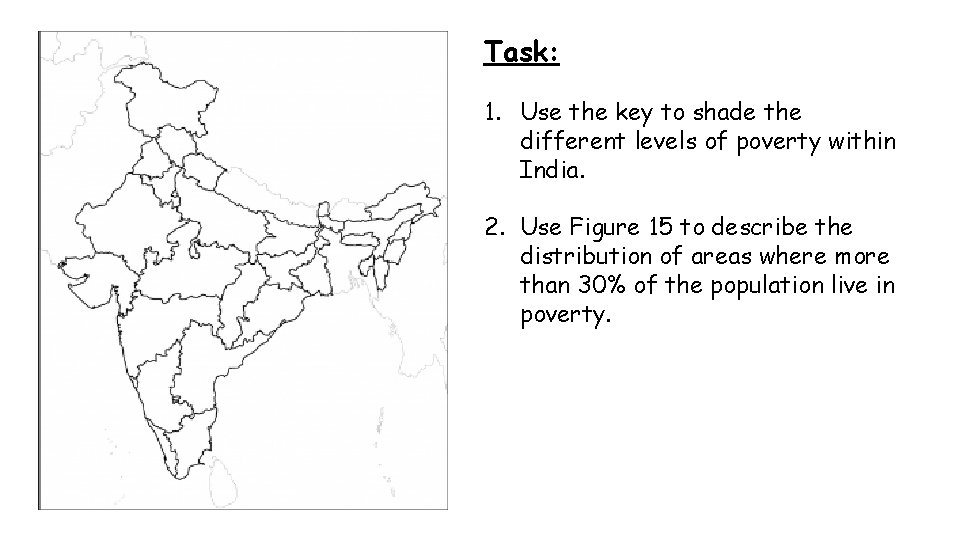
Task: 1. Use the key to shade the different levels of poverty within India. 2. Use Figure 15 to describe the distribution of areas where more than 30% of the population live in poverty.
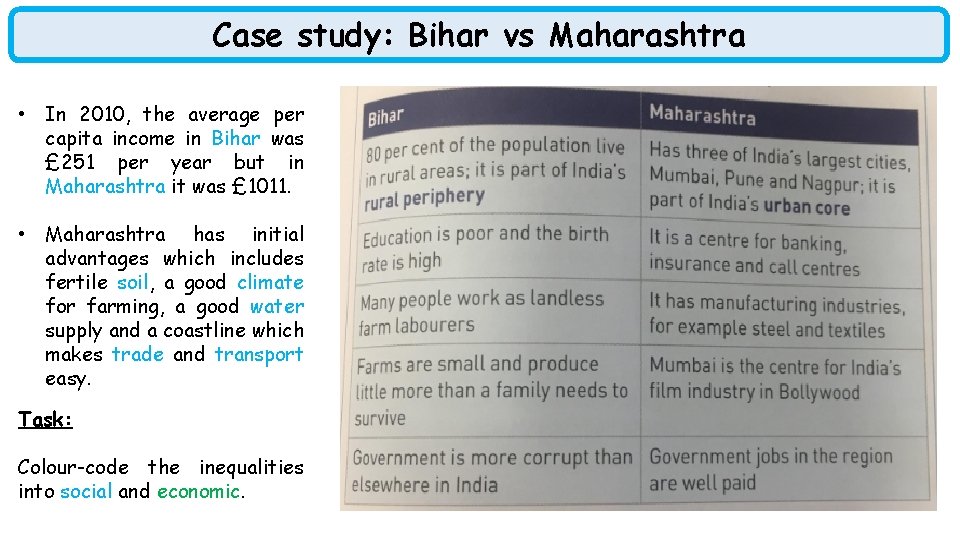
Case study: Bihar vs Maharashtra • In 2010, the average per capita income in Bihar was £ 251 per year but in Maharashtra it was £ 1011. • Maharashtra has initial advantages which includes fertile soil, a good climate for farming, a good water supply and a coastline which makes trade and transport easy. Task: Colour-code the inequalities into social and economic.

Lesson Objective/Amcanion y wers WALT - WE ARE LEARNING TO…… Date: __________ THEME 6: Development and Resource Issues LO: To identify and explain regional inequalities in the UK
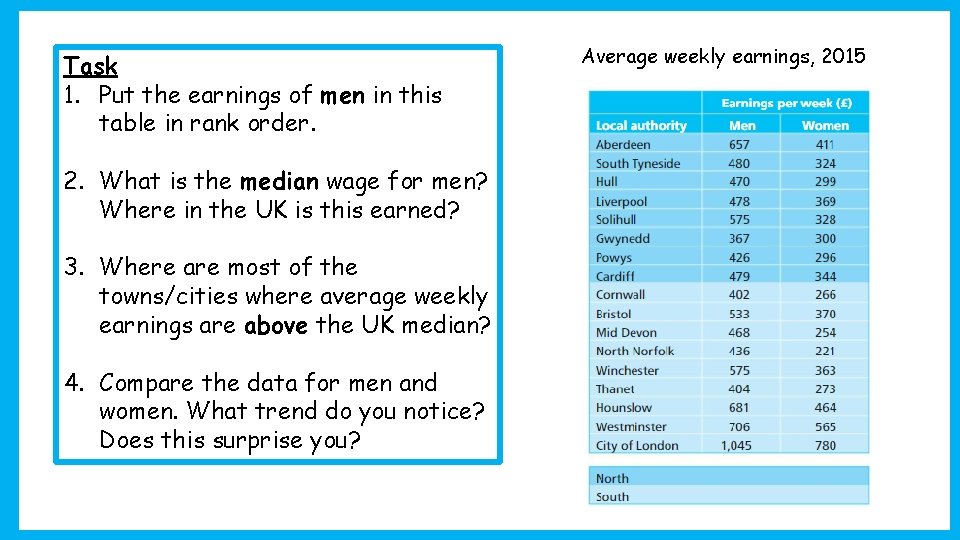
Task 1. Put the earnings of men in this table in rank order. 2. What is the median wage for men? Where in the UK is this earned? 3. Where are most of the towns/cities where average weekly earnings are above the UK median? 4. Compare the data for men and women. What trend do you notice? Does this surprise you? Average weekly earnings, 2015

The north-south divide In the UK, it has long been recognised that there is a north-south divide. This refers to the social and economic differences between southern England the rest of the UK. Reasons for these differences include: • The zone stretching along the M 4 motorway corridor between Bristol and London has attracted modern high-tech manufacturing industries. • Research and development spending in the south-east in 2010 was £ 3. 6 billion compared to £ 0. 3 billion in the north-east. • The south has a more educated workforce with higher paid jobs in science, technology and finance. • London is a global centre for banking and finance. • The south is also home to the UK’s major airports: Heathrow, Gatwick, Stansted and Bristol. • The north was once heavily industrialised but these areas have declined due to deindustrialisation. For example, the steel industry has lost over 200, 000 jobs since 1967.
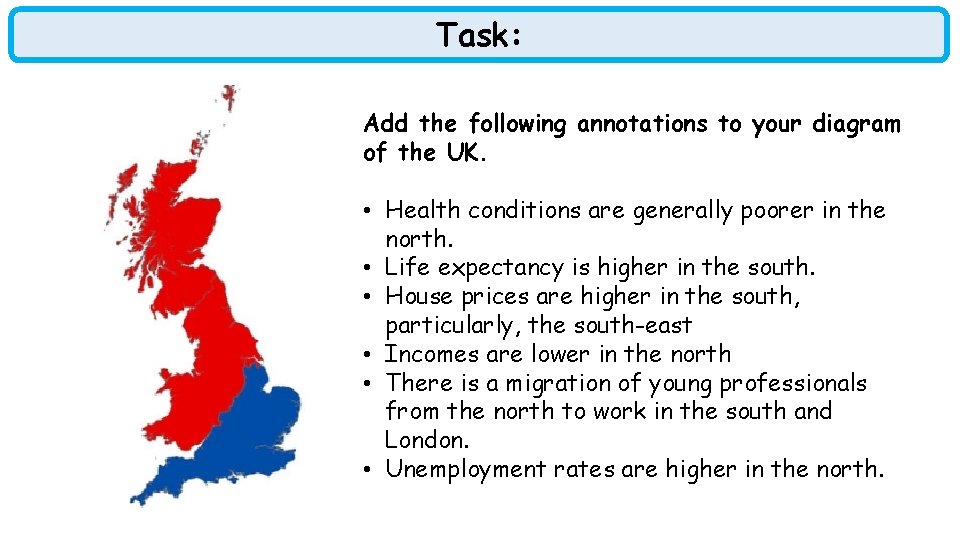
Task: Add the following annotations to your diagram of the UK. • Health conditions are generally poorer in the north. • Life expectancy is higher in the south. • House prices are higher in the south, particularly, the south-east • Incomes are lower in the north • There is a migration of young professionals from the north to work in the south and London. • Unemployment rates are higher in the north.
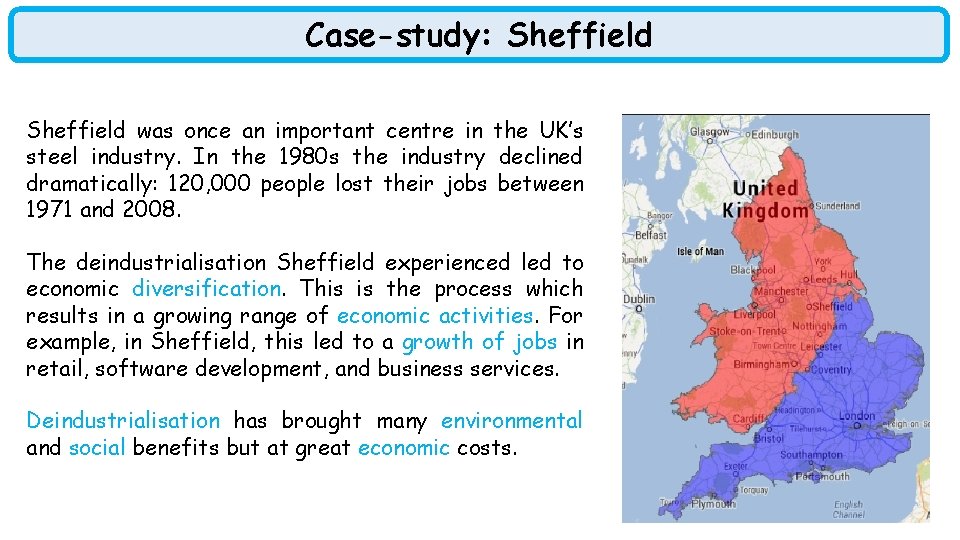
Case-study: Sheffield was once an important centre in the UK’s steel industry. In the 1980 s the industry declined dramatically: 120, 000 people lost their jobs between 1971 and 2008. The deindustrialisation Sheffield experienced led to economic diversification. This is the process which results in a growing range of economic activities. For example, in Sheffield, this led to a growth of jobs in retail, software development, and business services. Deindustrialisation has brought many environmental and social benefits but at great economic costs.
Case-study: Sheffield Positive impacts Negative impacts
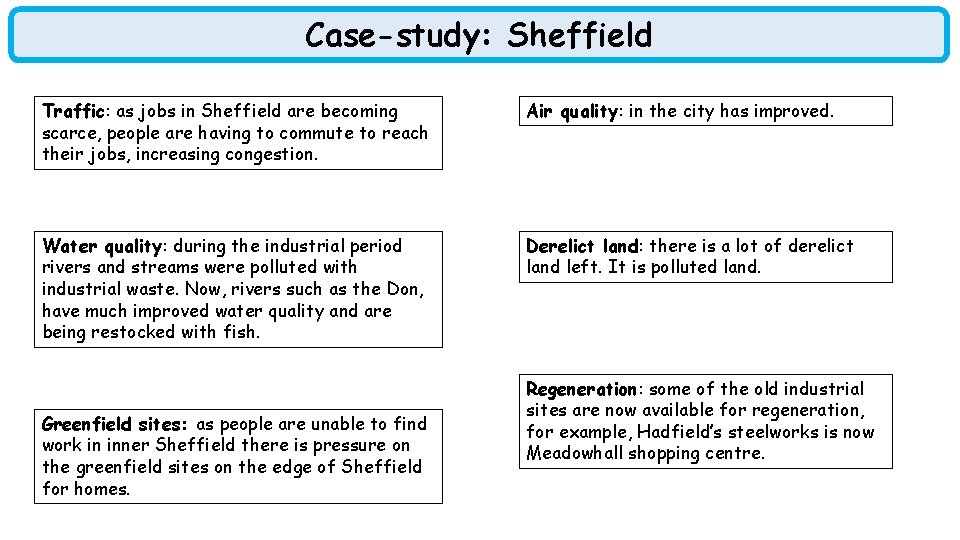
Case-study: Sheffield Traffic: as jobs in Sheffield are becoming scarce, people are having to commute to reach their jobs, increasing congestion. Air quality: in the city has improved. Water quality: during the industrial period rivers and streams were polluted with industrial waste. Now, rivers such as the Don, have much improved water quality and are being restocked with fish. Derelict land: there is a lot of derelict land left. It is polluted land. Greenfield sites: as people are unable to find work in inner Sheffield there is pressure on the greenfield sites on the edge of Sheffield for homes. Regeneration: some of the old industrial sites are now available for regeneration, for example, Hadfield’s steelworks is now Meadowhall shopping centre.
- Slides: 11