
LESSON OBJECTIVE To understand the different types of
LESSON OBJECTIVE • To understand the different types of feedback, learning plateaus and the transfer of learning. LESSSON OUTCOME • To be able to explain the nine different types of feedback and give examples. • Be able to explain the reasons for a learning plateau and who it can be prevented and the different forms of guidance. 1
TYPES OF FEEBACK RECAP TASK • Match the different characteristics to the correct type of feedback. 2

TYPES OF FEEDBACK • As our skill level improves, the type of feedback that we use changes. Cognitive performer • Relies on extrinsic feedback • Must be immediate • Knowledge of results • Terminal Autonomous performer • Can understand intrinsic feedback • Concurrent • Knowledge of performance • Can be delayed
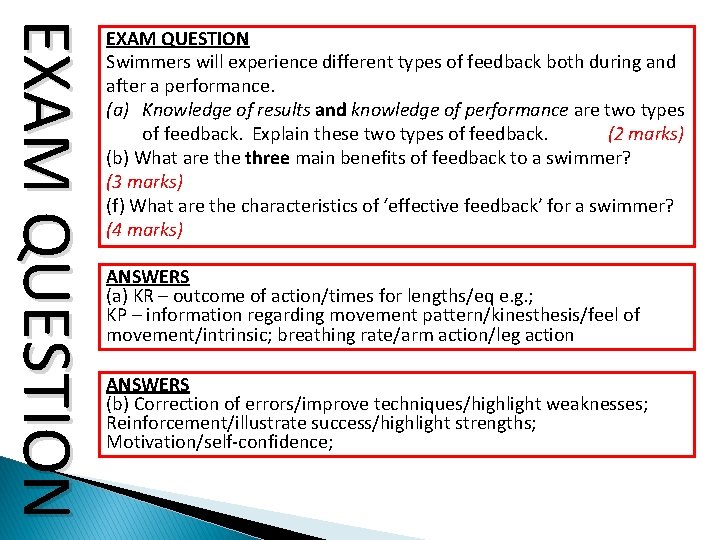
EXAM QUESTION Swimmers will experience different types of feedback both during and after a performance. (a) Knowledge of results and knowledge of performance are two types of feedback. Explain these two types of feedback. (2 marks) (b) What are three main benefits of feedback to a swimmer? (3 marks) (f) What are the characteristics of ‘effective feedback’ for a swimmer? (4 marks) ANSWERS (a) KR – outcome of action/times for lengths/eq e. g. ; KP – information regarding movement pattern/kinesthesis/feel of movement/intrinsic; breathing rate/arm action/leg action ANSWERS (b) Correction of errors/improve techniques/highlight weaknesses; Reinforcement/illustrate success/highlight strengths; Motivation/self-confidence;
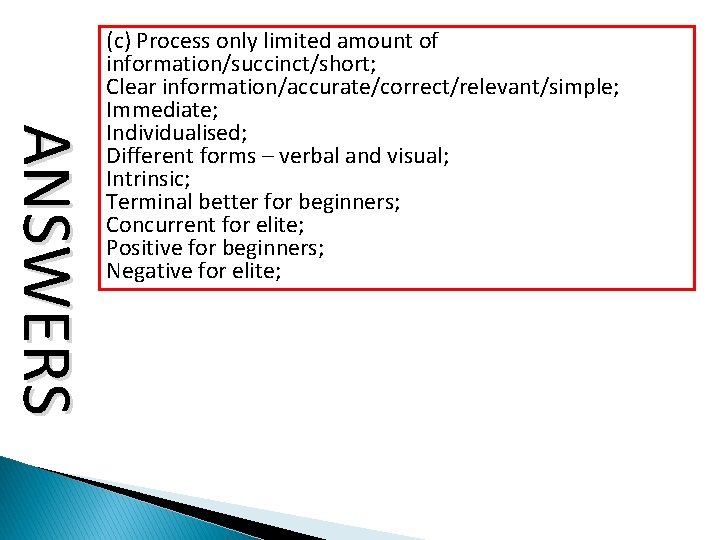
ANSWERS (c) Process only limited amount of information/succinct/short; Clear information/accurate/correct/relevant/simple; Immediate; Individualised; Different forms – verbal and visual; Intrinsic; Terminal better for beginners; Concurrent for elite; Positive for beginners; Negative for elite;

LEARNING OR PERFORMANCE CURVES Improvement in performance are seen as a learning curve. Quality of performance No improvement Learning plateau Period of rapid improvement little early improvement Length of time or number of trials Performance deteriorates

CAUSES PREVENTION Fatigue Rest/ recovery periods Loss of motivation/ boredom Rewards/ goals Technical deficiencies/ lack of understanding Isolate and correct fault Change style/ method of practice Poor coaching

TRANSFER OF LEARNING…. POSITIVE NEGATIVE ZERO BILATERAL PROACTIVE RETROACTIVE When earlier learning had a beneficial effect on new learning. When earlier learning has a detrimental effect on new learning. When earlier learning has no effect on new learning. Learning a skill using one limb has positive effects on performance of the same skill using the other limb. Learning of a new skill has benefits for the future learning of a skill. Learning of a new skill has benefits for a skill that was learned previously.
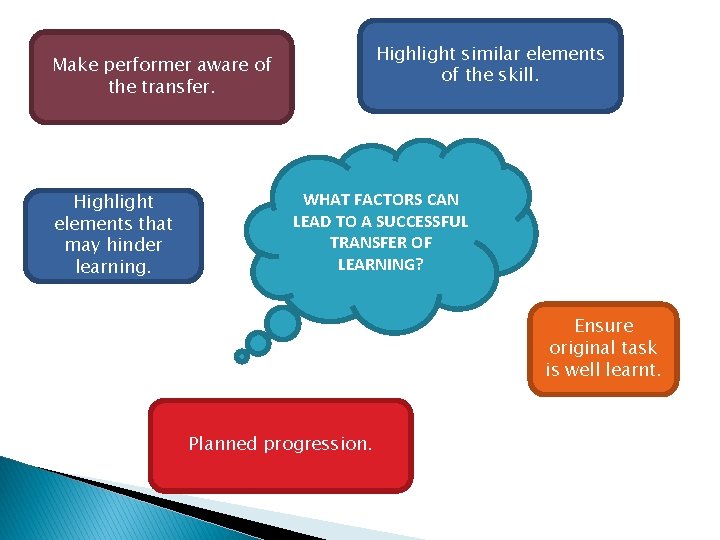
Highlight similar elements of the skill. Make performer aware of the transfer. Highlight elements that may hinder learning. WHAT FACTORS CAN LEAD TO A SUCCESSFUL TRANSFER OF LEARNING? Ensure original task is well learnt. Planned progression.
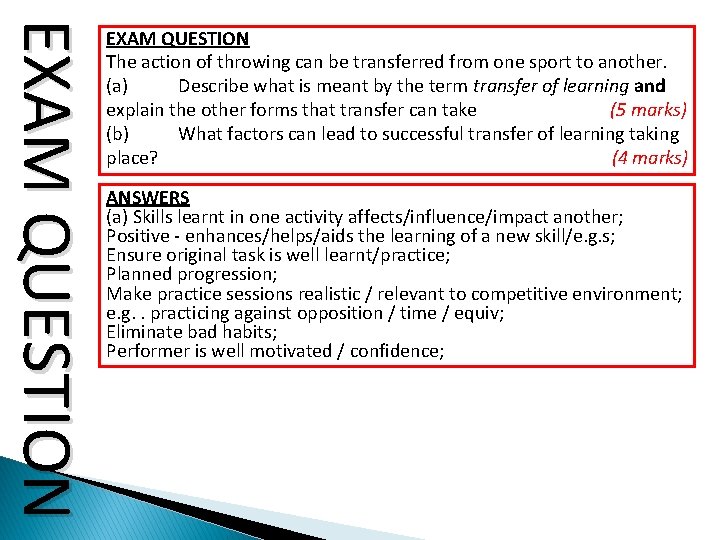
EXAM QUESTION The action of throwing can be transferred from one sport to another. (a) Describe what is meant by the term transfer of learning and explain the other forms that transfer can take (5 marks) (b) What factors can lead to successful transfer of learning taking place? (4 marks) ANSWERS (a) Skills learnt in one activity affects/influence/impact another; Positive - enhances/helps/aids the learning of a new skill/e. g. s; Ensure original task is well learnt/practice; Planned progression; Make practice sessions realistic / relevant to competitive environment; e. g. . practicing against opposition / time / equiv; Eliminate bad habits; Performer is well motivated / confidence;
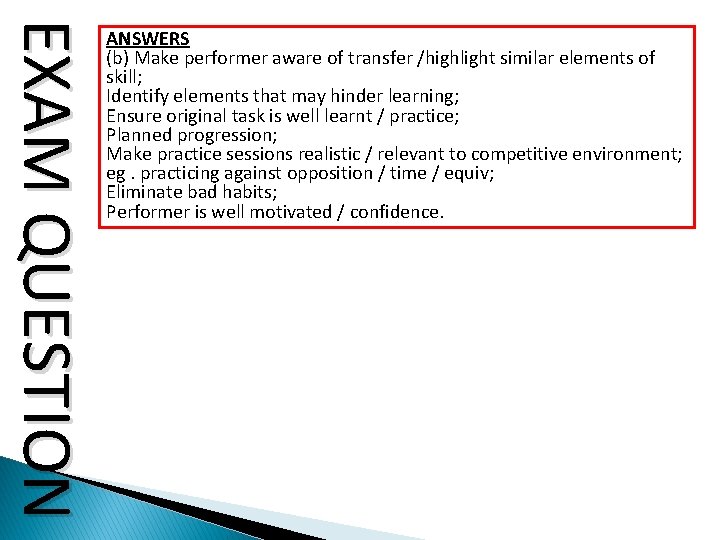
EXAM QUESTION ANSWERS (b) Make performer aware of transfer /highlight similar elements of skill; Identify elements that may hinder learning; Ensure original task is well learnt / practice; Planned progression; Make practice sessions realistic / relevant to competitive environment; eg. practicing against opposition / time / equiv; Eliminate bad habits; Performer is well motivated / confidence.
EXAM: MONDAY 1 ST OCTOBER 2012 REVISE: v Learning theories v Learning plateau v Transfer of learning v Motivation v Schema theory 12
WHAT HAVE YOU LEARNT IN TODAY’S LESSON? LESSON OUTCOME • To be able to explain Adam’s closed loop theory, schema theory and observation of learning and provide relevant examples of each. 13
- Slides: 13