
Lesson objective To develop our poetry analysis skills
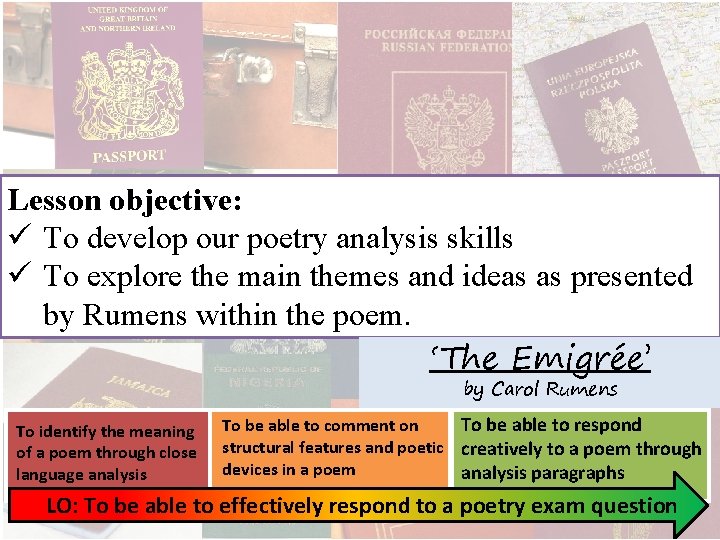
Lesson objective: ü To develop our poetry analysis skills ü To explore the main themes and ideas as presented by Rumens within the poem. ‘The Emigrée’ by Carol Rumens To identify the meaning of a poem through close language analysis To be able to respond To be able to comment on structural features and poetic creatively to a poem through devices in a poem analysis paragraphs LO: To be able to effectively respond to a poetry exam question
Getting started. . . 1. Note down any words or phrases that are repeated within the poem. Do you notice anything interesting about these words/phrases? An émigré is a person who has "migrated out", often with a connotation of political or social self-exile. The word is the past participle of the French émigrer 'to emigrate'. 2. What is an ‘emigrée’? 3. Highlight any words or phrases that are connected to the idea of being forced to leave somewhere. 4. What do the opening words ‘there once was a country’ suggest about what to expect from the poem? To identify the meaning of a poem through close language analysis To be able to respond To be able to comment on structural features and poetic creatively to a poem through devices in a poem analysis paragraphs LO: To be able to effectively respond to a poetry exam question
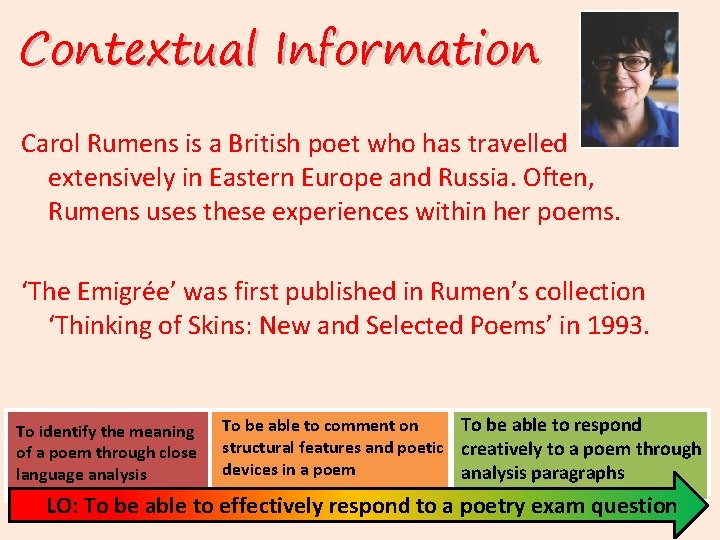
Contextual Information Carol Rumens is a British poet who has travelled extensively in Eastern Europe and Russia. Often, Rumens uses these experiences within her poems. ‘The Emigrée’ was first published in Rumen’s collection ‘Thinking of Skins: New and Selected Poems’ in 1993. To identify the meaning of a poem through close language analysis To be able to respond To be able to comment on structural features and poetic creatively to a poem through devices in a poem analysis paragraphs LO: To be able to effectively respond to a poetry exam question
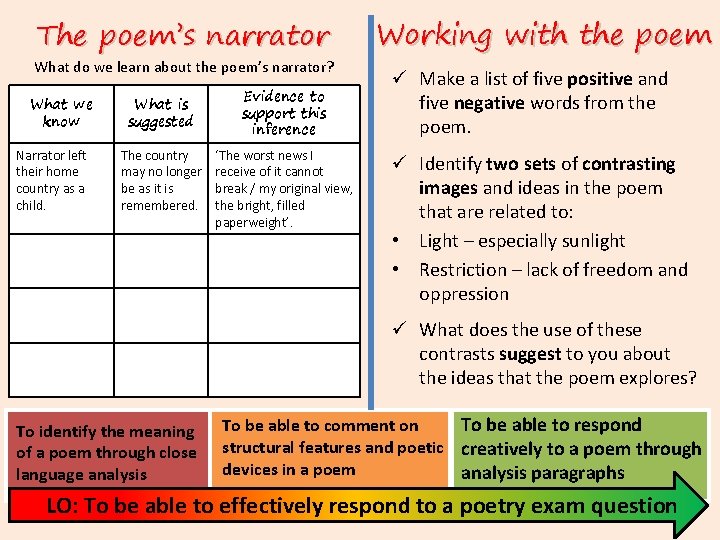
The poem’s narrator What do we learn about the poem’s narrator? What we know Narrator left their home country as a child. What is suggested The country may no longer be as it is remembered. Evidence to support this inference ‘The worst news I receive of it cannot break / my original view, the bright, filled paperweight’. Working with the poem ü Make a list of five positive and five negative words from the poem. ü Identify two sets of contrasting images and ideas in the poem that are related to: • Light – especially sunlight • Restriction – lack of freedom and oppression ü What does the use of these contrasts suggest to you about the ideas that the poem explores? To identify the meaning of a poem through close language analysis To be able to respond To be able to comment on structural features and poetic creatively to a poem through devices in a poem analysis paragraphs LO: To be able to effectively respond to a poetry exam question
The detail • The ‘exploring the detail’ sheet should help you form a close understanding of the main ideas within the poem. • The poem takes the literal meaning of ‘emigrée’ and explores how it can also be used to represent other kinds of isolation or forced absence. This is called an extended metaphor. • Do you think any other kinds of absence may be implied within the poem? Explain your reasons using textual references. To identify the meaning of a poem through close language analysis To be able to respond To be able to comment on structural features and poetic creatively to a poem through devices in a poem analysis paragraphs LO: To be able to effectively respond to a poetry exam question
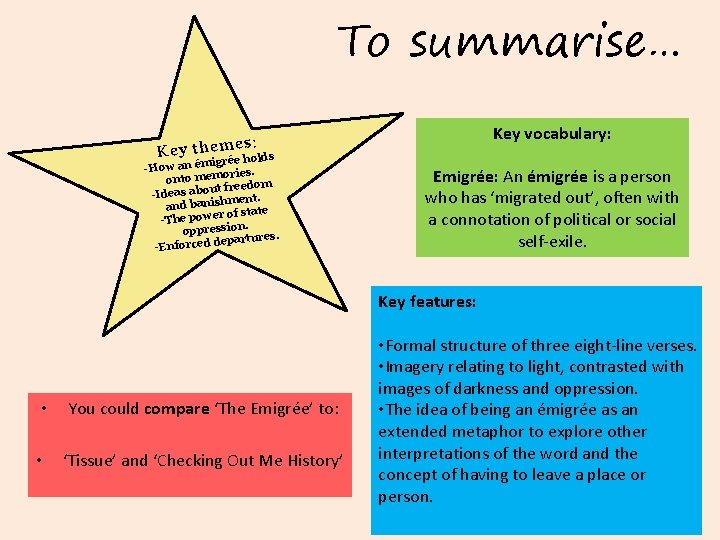
To summarise… Key vocabulary: s: Key theme s igrée hold -How an ém ories. onto mem ut freedom -Ideas abo hment. and banis r of state -The powe n. oppressio s. a dep rture -Enforced Emigrée: An émigrée is a person who has ‘migrated out’, often with a connotation of political or social self-exile. Key features: • You could compare ‘The Emigrée’ to: • ‘Tissue’ and ‘Checking Out Me History’ • Formal structure of three eight-line verses. • Imagery relating to light, contrasted with images of darkness and oppression. • The idea of being an émigrée as an extended metaphor to explore other interpretations of the word and the concept of having to leave a place or person.
Homework Complete the worksheet. Annotate the poem in the anthology, with reference to the poetry tree.
Assessment points Ø Explain how the poem, ‘The Emigrée’ uses specific language and imagery to explore different ideas about oppression and banishment. Ø Compare the ways in which ‘The Emigrée’ and ‘Checking Out Me History’ present ideas about the conflict between the past and the present. ü To develop our poetry analysis skills
- Slides: 8