
LESSON Learning Objectives 4 1 Preparing Financial Information
LESSON Learning Objectives 4 -1 Preparing Financial Information for a Departmentalized Business LO 1 Identify the steps necessary to prepare for end-of-period financial reporting. LO 2 Prepare an unadjusted trial balance. LO 3 Journalize adjusting entries. LO 4 Prepare an adjusted trial balance. © 2014 Cengage Learning. All Rights Reserved.
Lesson 4 -1 Preparing for End-of-Period Financial Reporting LO 1 ● The length of time for which a business summarizes its financial information and reports its financial performance is called a fiscal period. ● A fiscal period consisting of 12 consecutive months is called a fiscal year. © 2014 Cengage Learning. All Rights Reserved. SLIDE 2
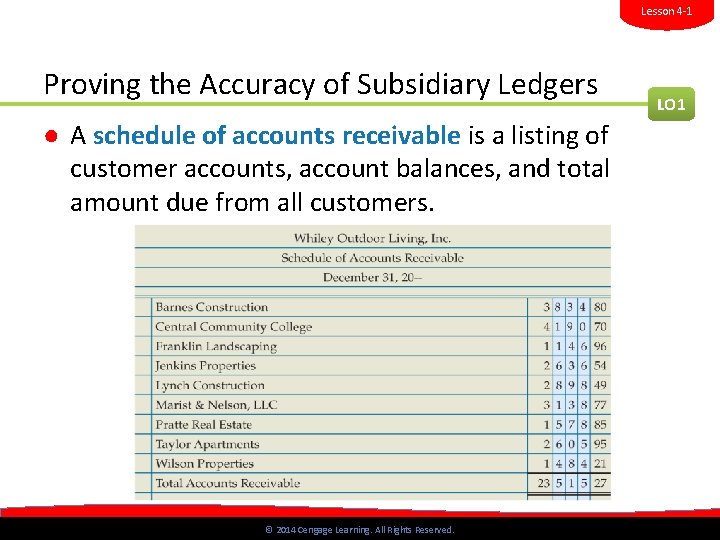
Lesson 4 -1 Proving the Accuracy of Subsidiary Ledgers LO 1 ● A schedule of accounts receivable is a listing of customer accounts, account balances, and total amount due from all customers. © 2014 Cengage Learning. All Rights Reserved. SLIDE 3
Lesson 4 -1 Proving the Accuracy of Subsidiary Ledgers LO 1 ● A listing of vendor accounts, account balances, and the total amount due all vendors is called a schedule of accounts payable. ● Some businesses call this listing an accounts payable trial balance. © 2014 Cengage Learning. All Rights Reserved. SLIDE 4
Lesson 4 -1 Preparing an Unadjusted Trial Balance LO 2 ● Journal entries recorded to update general ledger accounts at the end of a fiscal period are called adjusting entries. ● A trial balance prepared before adjusting entries are posted is called an unadjusted trial balance. © 2014 Cengage Learning. All Rights Reserved. SLIDE 5
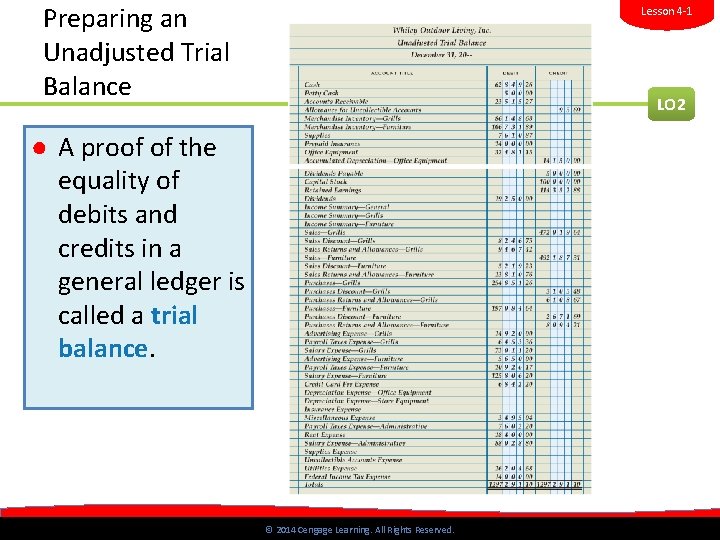
Preparing an Unadjusted Trial Balance Lesson 4 -1 LO 2 ● A proof of the equality of debits and credits in a general ledger is called a trial balance. © 2014 Cengage Learning. All Rights Reserved. SLIDE 6
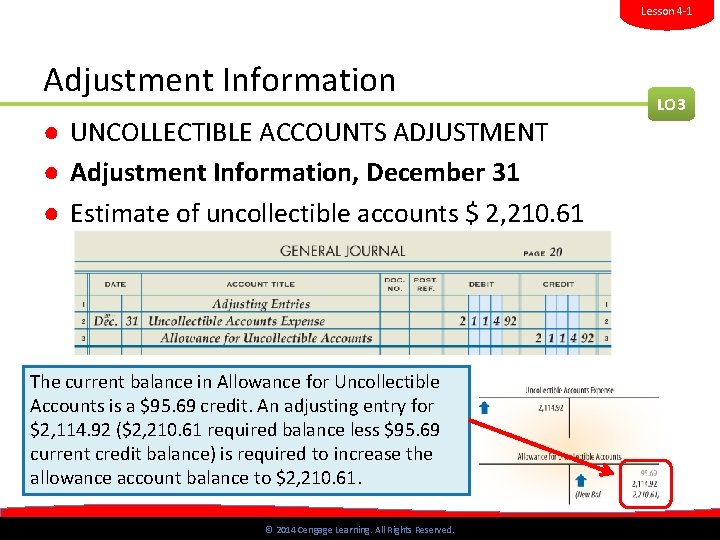
Lesson 4 -1 Adjustment Information ● UNCOLLECTIBLE ACCOUNTS ADJUSTMENT ● Adjustment Information, December 31 ● Estimate of uncollectible accounts $ 2, 210. 61 LO 3 The current balance in Allowance for Uncollectible Accounts is a $95. 69 credit. An adjusting entry for $2, 114. 92 ($2, 210. 61 required balance less $95. 69 current credit balance) is required to increase the allowance account balance to $2, 210. 61. © 2014 Cengage Learning. All Rights Reserved. SLIDE 7
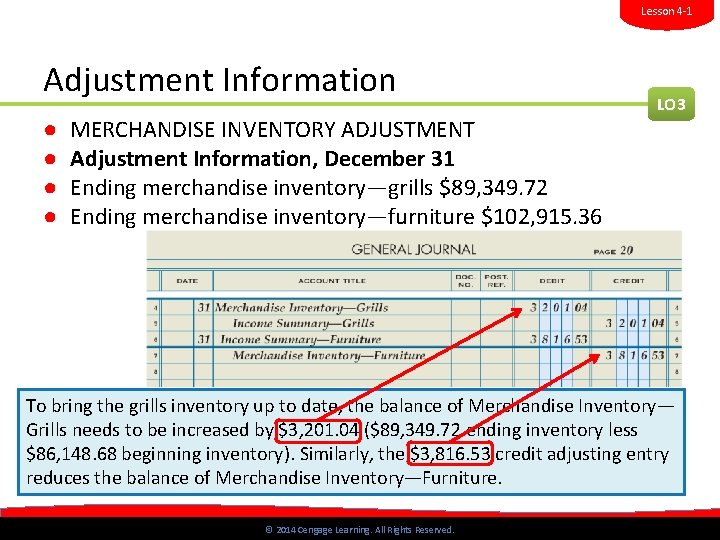
Lesson 4 -1 Adjustment Information ● ● MERCHANDISE INVENTORY ADJUSTMENT Adjustment Information, December 31 Ending merchandise inventory—grills $89, 349. 72 Ending merchandise inventory—furniture $102, 915. 36 LO 3 To bring the grills inventory up to date, the balance of Merchandise Inventory— Grills needs to be increased by $3, 201. 04 ($89, 349. 72 ending inventory less $86, 148. 68 beginning inventory). Similarly, the $3, 816. 53 credit adjusting entry reduces the balance of Merchandise Inventory—Furniture. © 2014 Cengage Learning. All Rights Reserved. SLIDE 8
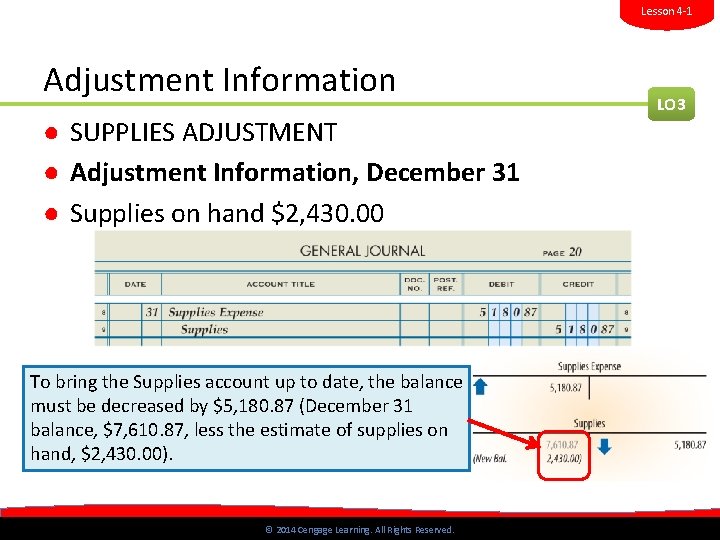
Lesson 4 -1 Adjustment Information ● SUPPLIES ADJUSTMENT ● Adjustment Information, December 31 ● Supplies on hand $2, 430. 00 LO 3 To bring the Supplies account up to date, the balance must be decreased by $5, 180. 87 (December 31 balance, $7, 610. 87, less the estimate of supplies on hand, $2, 430. 00). © 2014 Cengage Learning. All Rights Reserved. SLIDE 9

Lesson 4 -1 Adjustment Information ● PREPAID INSURANCE ADJUSTMENT ● Adjustment Information, December 31 ● Value of prepaid insurance $2, 000. 00 LO 3 To bring the prepaid account up to date, the balance of Prepaid Insurance must be decreased by $12, 000. 00 (December 31 balance, $14, 000. 00, less unexpired insurance, $2, 000. 00). © 2014 Cengage Learning. All Rights Reserved. SLIDE 10
Lesson 4 -1 Adjustment Information LO 3 ● Physical assets that will be used for a number of years in the operation of a business are called plant assets. ● The portion of a plant asset’s cost that is transferred to an expense account in each fiscal period during that asset’s useful life is called depreciation expense. ● The amount of depreciation is an estimate. © 2014 Cengage Learning. All Rights Reserved. SLIDE 11
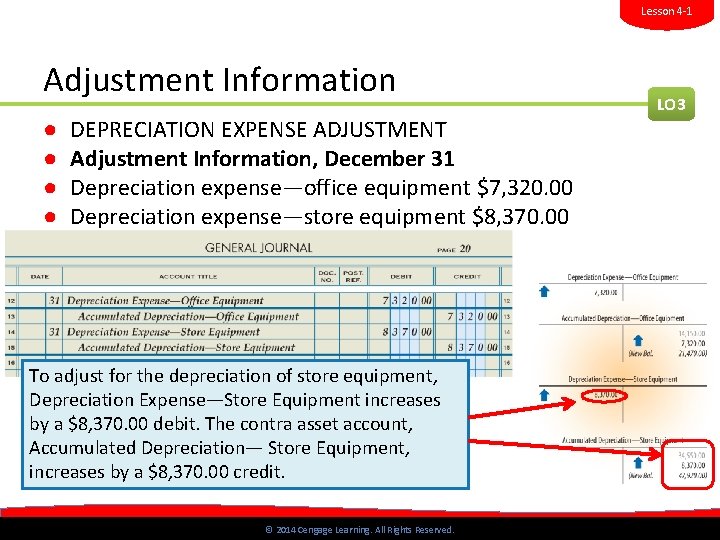
Lesson 4 -1 Adjustment Information ● ● DEPRECIATION EXPENSE ADJUSTMENT Adjustment Information, December 31 Depreciation expense—office equipment $7, 320. 00 Depreciation expense—store equipment $8, 370. 00 LO 3 To adjust for the depreciation of store equipment, Depreciation Expense—Store Equipment increases by a $8, 370. 00 debit. The contra asset account, Accumulated Depreciation— Store Equipment, increases by a $8, 370. 00 credit. © 2014 Cengage Learning. All Rights Reserved. SLIDE 12
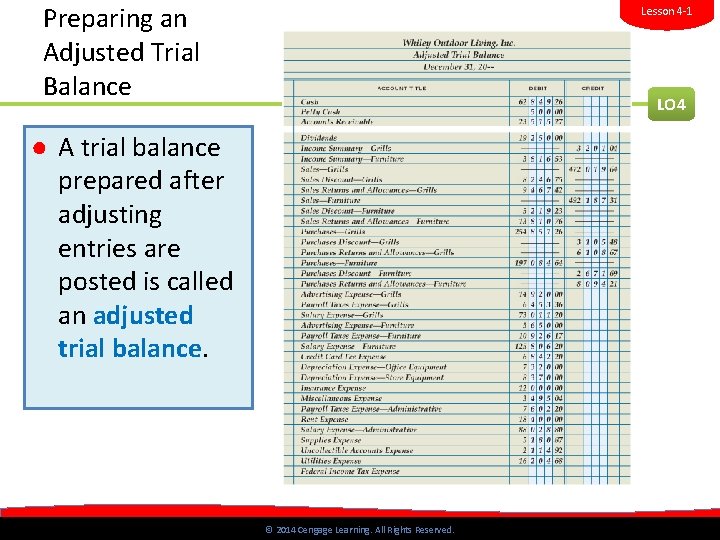
Preparing an Adjusted Trial Balance Lesson 4 -1 LO 4 ● A trial balance prepared after adjusting entries are posted is called an adjusted trial balance. © 2014 Cengage Learning. All Rights Reserved. SLIDE 13
Calculating the Federal Income Tax Adjustment Lesson 4 -1 LO 4 ● Different tax rates are applied to different levels of net income. ● Each tax rate and taxable income amount on one line of a tax table is called a tax bracket. ● The tax rate associated with a tax bracket is called a marginal tax rate. © 2014 Cengage Learning. All Rights Reserved. SLIDE 14
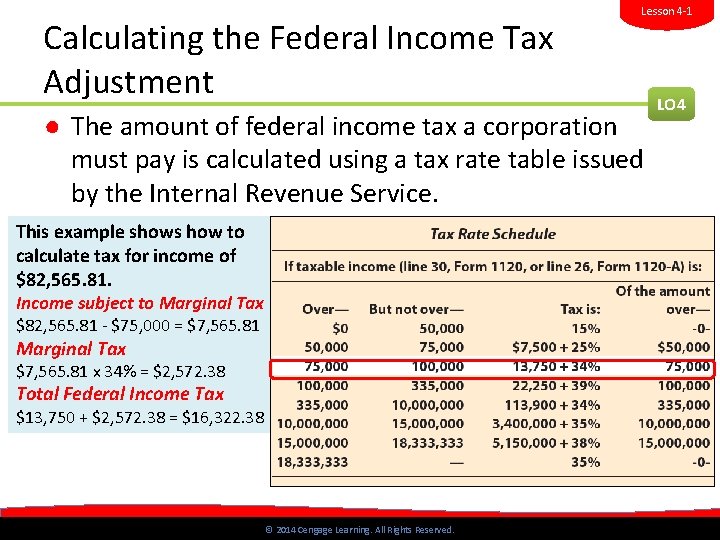
Calculating the Federal Income Tax Adjustment Lesson 4 -1 ● The amount of federal income tax a corporation must pay is calculated using a tax rate table issued by the Internal Revenue Service. LO 4 This example shows how to calculate tax for income of $82, 565. 81. Income subject to Marginal Tax $82, 565. 81 - $75, 000 = $7, 565. 81 Marginal Tax $7, 565. 81 x 34% = $2, 572. 38 Total Federal Income Tax $13, 750 + $2, 572. 38 = $16, 322. 38 © 2014 Cengage Learning. All Rights Reserved. SLIDE 15
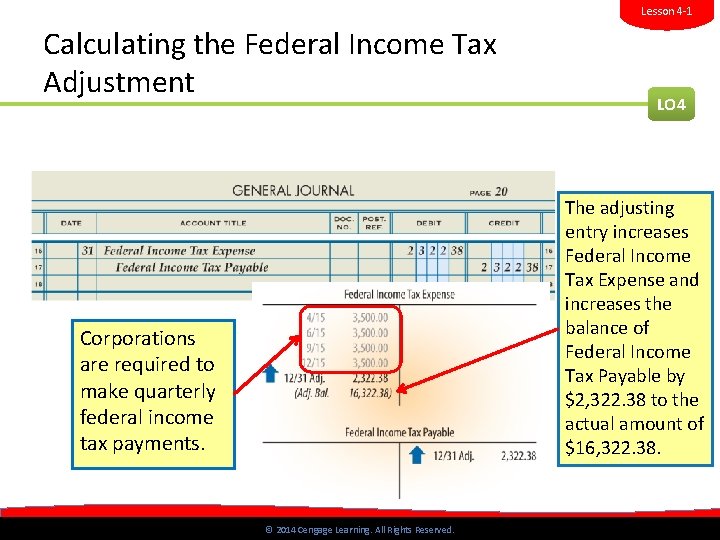
Lesson 4 -1 Calculating the Federal Income Tax Adjustment LO 4 The adjusting entry increases Federal Income Tax Expense and increases the balance of Federal Income Tax Payable by $2, 322. 38 to the actual amount of $16, 322. 38. Corporations are required to make quarterly federal income tax payments. © 2014 Cengage Learning. All Rights Reserved. SLIDE 16
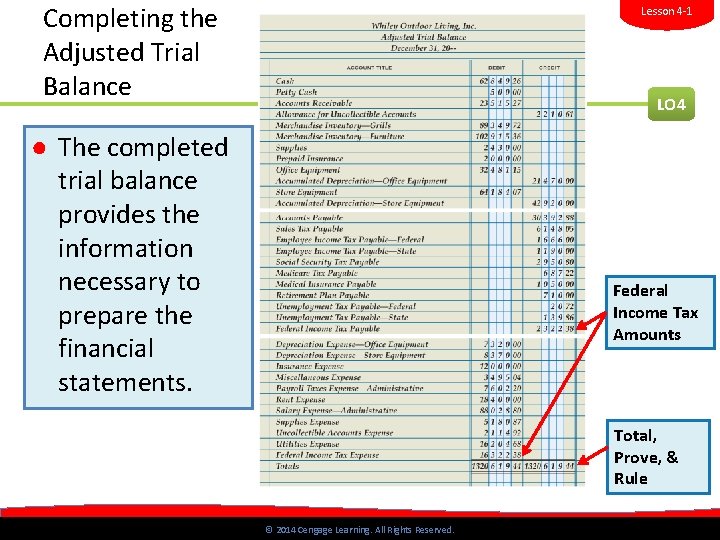
Completing the Adjusted Trial Balance Lesson 4 -1 LO 4 ● The completed trial balance provides the information necessary to prepare the financial statements. Federal Income Tax Amounts Total, Prove, & Rule © 2014 Cengage Learning. All Rights Reserved. SLIDE 17
Lesson 4 -1 Using a Work Sheet to Prepare Financial Statements LO 4 ● A work sheet is a columnar accounting form used to summarize the general ledger information needed to prepare financial statements. ● Prior to computerized accounting systems, the work sheet was the most effective tool for collecting the information needed to prepare the financial statements. © 2014 Cengage Learning. All Rights Reserved. SLIDE 18
Lesson 4 -1 Audit Your Understanding 1. What two reports are prepared to prove the accuracy of posting to subsidiary ledgers? ANSWER Schedule of accounts receivable and schedule of accounts payable. © 2014 Cengage Learning. All Rights Reserved. SLIDE 19
Lesson 4 -1 Audit Your Understanding 2. Why are adjustments made to certain accounts at the end of the fiscal period? ANSWER To bring certain general ledger accounts up to date. © 2014 Cengage Learning. All Rights Reserved. SLIDE 20
Lesson 4 -1 Audit Your Understanding 3. Explain how income before income taxes is calculated using an adjusted trial balance. ANSWER Subtract the total of the income statement accounts having a debit balance, except for Federal Income Tax Expense, from the total of the income statement accounts having a credit balance. Include any debit or credit balances of income summary accounts. © 2014 Cengage Learning. All Rights Reserved. SLIDE 21
- Slides: 21