
LESSON Learning Objectives 2 1 Using T Accounts

LESSON Learning Objectives 2 -1 Using T Accounts LO 1 Show the relationship between the accounting equation and a T account. LO 2 Identify the debit and credit side, the increase and decrease side, and the balance side of various accounts. LO 3 Restate and apply the two rules that are associated with the increase side of an account. Gilbertson, Century 21 Accounting General Journal, 11 Edition. © 2019 Cengage. All Rights Reserved. May not be scanned, copied or duplicated, or posted to a publicly accessible website, in whole or in part.
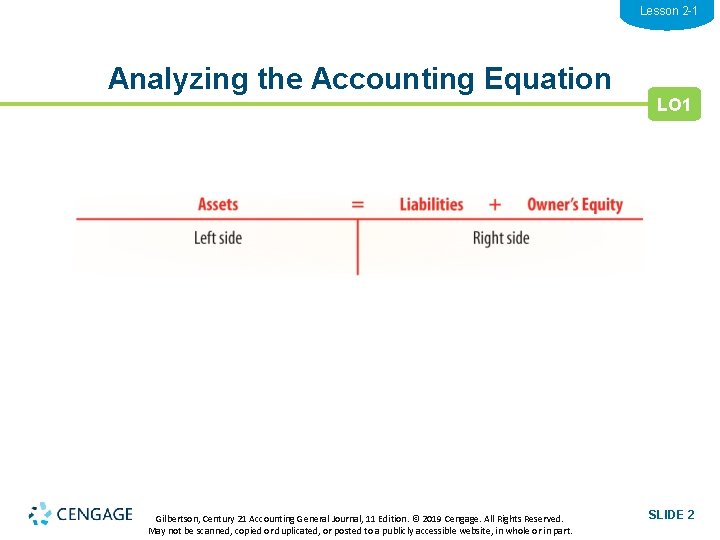
Lesson 2 -1 Analyzing the Accounting Equation Gilbertson, Century 21 Accounting General Journal, 11 Edition. © 2019 Cengage. All Rights Reserved. May not be scanned, copied or duplicated, or posted to a publicly accessible website, in whole or in part. LO 1 SLIDE 2

Lesson 2 -1 Accounts LO 2 • A record summarizing all the information affecting a single • • • item in the accounting equation is known as an account. An accounting device used to analyze transactions is called a T account. Debit means an amount recorded on the left side of an account. Credit means an amount recorded on the right side of an account. Gilbertson, Century 21 Accounting General Journal, 11 Edition. © 2019 Cengage. All Rights Reserved. May not be scanned, copied or duplicated, or posted to a publicly accessible website, in whole or in part. SLIDE 3

Lesson 2 -1 Accounts Gilbertson, Century 21 Accounting General Journal, 11 Edition. © 2019 Cengage. All Rights Reserved. May not be scanned, copied or duplicated, or posted to a publicly accessible website, in whole or in part. LO 2 SLIDE 4

Lesson 2 -1 Increases, Decreases, and Balances in Accounts LO 3 • Assets • On the left side of the accounting equation • Increase on the left, or debit, side of the account • Liabilities and the owner’s capital account • On the right side of the accounting equation • Increase on the right, or credit, side of the account • Normal balance • The side of the account that is increased is called the • • normal balance of the account Assets have normal debit balances Liabilities and the owner’s capital account have normal credit balances Gilbertson, Century 21 Accounting General Journal, 11 Edition. © 2019 Cengage. All Rights Reserved. May not be scanned, copied or duplicated, or posted to a publicly accessible website, in whole or in part. SLIDE 5

Lesson 2 -1 Increases, Decreases, and Balances in Accounts Gilbertson, Century 21 Accounting General Journal, 11 Edition. © 2019 Cengage. All Rights Reserved. May not be scanned, copied or duplicated, or posted to a publicly accessible website, in whole or in part. LO 3 SLIDE 6

Lesson 2 -1 Audit Your Understanding 1. Draw the accounting equation on a T account. ANSWER Gilbertson, Century 21 Accounting General Journal, 11 Edition. © 2019 Cengage. All Rights Reserved. May not be scanned, copied or duplicated, or posted to a publicly accessible website, in whole or in part. SLIDE 7
Lesson 2 -1 Audit Your Understanding 2. What are the two accounting rules that explain increases of account balances? ANSWER (1) Assets are on the left side of the accounting equation. Therefore, assets increase on the left, or debit, side of the account. (2) Liabilities and the owner’s capital account are on the right side of the accounting equation. Therefore, liabilities and the owner’s capital account increase on the right, or credit, side of the account. Gilbertson, Century 21 Accounting General Journal, 11 Edition. © 2019 Cengage. All Rights Reserved. May not be scanned, copied or duplicated, or posted to a publicly accessible website, in whole or in part. SLIDE 8
- Slides: 8