
LESSON Learning Objectives 193 Product Pricing LO 8
LESSON Learning Objectives 193 Product Pricing LO 8 Use cost-based pricing to calculate the price of a product. LO 9 Calculate the target cost of a product. © 2015 Cengage Learning. All Rights Reserved.
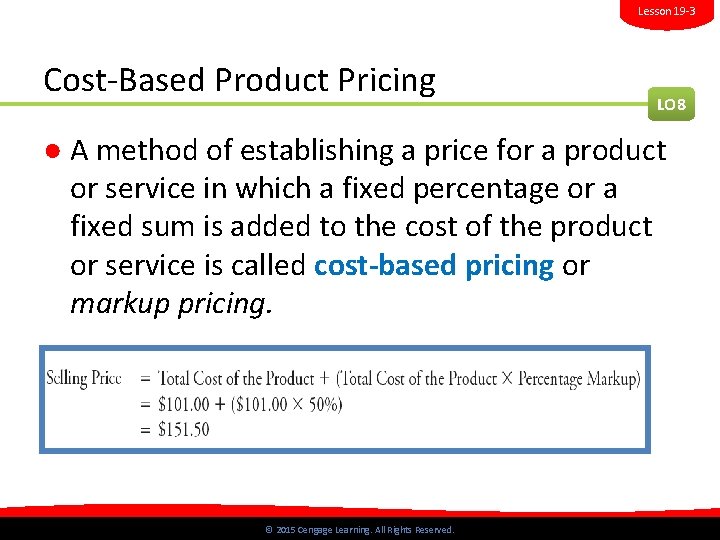
Lesson 19 -3 Cost-Based Product Pricing LO 8 ● A method of establishing a price for a product or service in which a fixed percentage or a fixed sum is added to the cost of the product or service is called cost-based pricing or markup pricing. © 2015 Cengage Learning. All Rights Reserved. SLIDE 2
Lesson 19 -3 Advantages and Disadvantages of Cost-Based Product Pricing LO 8 Advantages Disadvantages ● Easy to calculate. ● Easy to use. ● Software can calculate the selling price for each product. ● It focuses on the company and company costs, instead of the customer. ● It may lead to prices that are too high or too low. ● There is no incentive to keep costs under control. ● Management must take measures to monitor costs and selling prices periodically because when the product changes, the costs change. © 2015 Cengage Learning. All Rights Reserved.
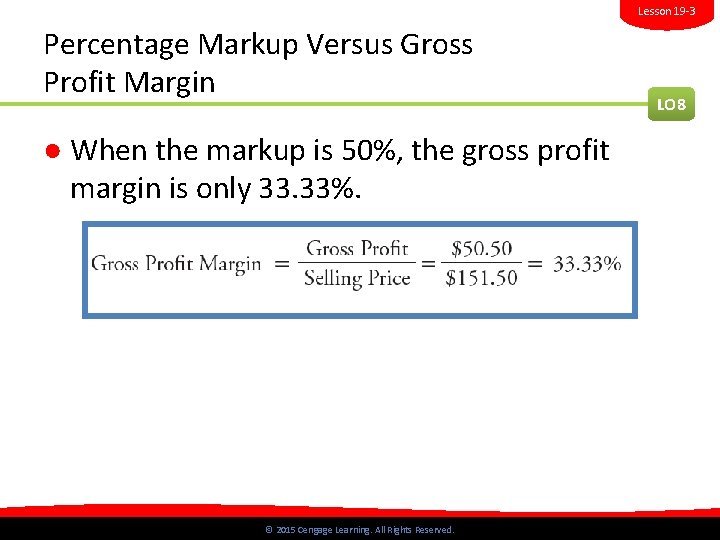
Lesson 19 -3 Percentage Markup Versus Gross Profit Margin LO 8 ● When the markup is 50%, the gross profit margin is only 33. 33%. © 2015 Cengage Learning. All Rights Reserved. SLIDE 4
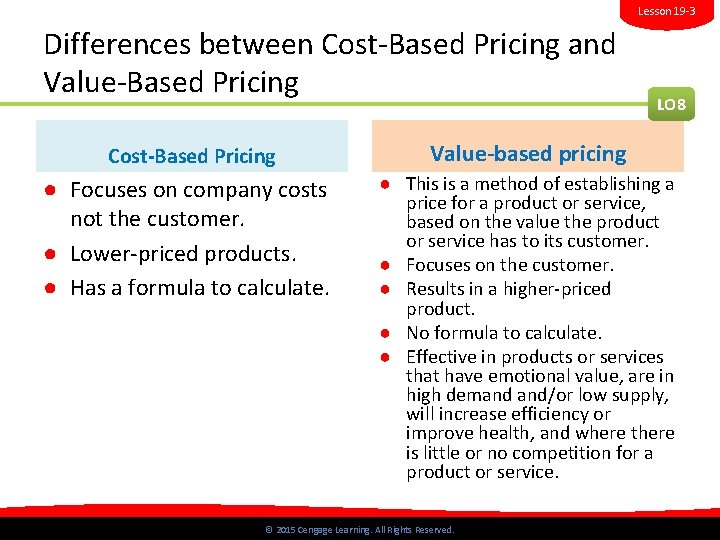
Lesson 19 -3 Differences between Cost-Based Pricing and Value-Based Pricing LO 8 Cost-Based Pricing Value-based pricing ● Focuses on company costs not the customer. ● Lower-priced products. ● Has a formula to calculate. ● This is a method of establishing a price for a product or service, based on the value the product or service has to its customer. ● Focuses on the customer. ● Results in a higher-priced product. ● No formula to calculate. ● Effective in products or services that have emotional value, are in high demand and/or low supply, will increase efficiency or improve health, and where there is little or no competition for a product or service. © 2015 Cengage Learning. All Rights Reserved.
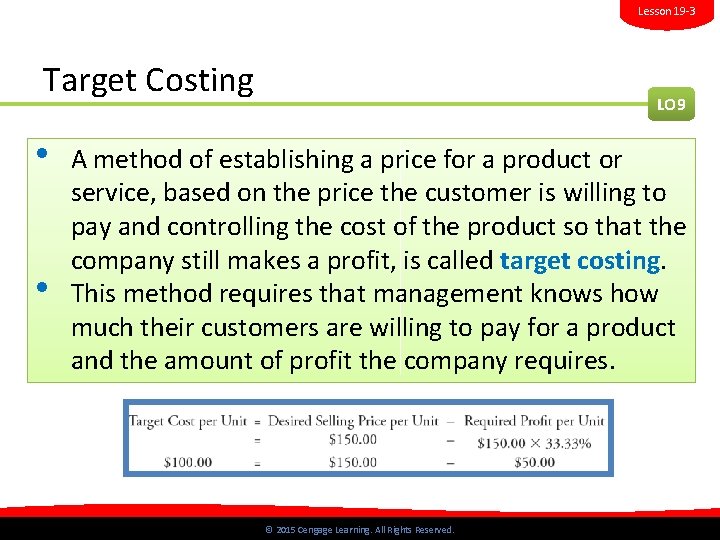
Lesson 19 -3 Target Costing • • LO 9 A method of establishing a price for a product or service, based on the price the customer is willing to pay and controlling the cost of the product so that the company still makes a profit, is called target costing. This method requires that management knows how much their customers are willing to pay for a product and the amount of profit the company requires. © 2015 Cengage Learning. All Rights Reserved. SLIDE 6
Lesson 19 -3 Audit Your Understanding 1. List four disadvantages of cost-based pricing. ANSWER Cost-based pricing focuses on company costs instead of the customer; it may lead to prices that are too high or too low; it provides no incentive to contain costs; and if the cost of the product changes and the price is not changed, the profit margin will change. © 2015 Cengage Learning. All Rights Reserved. SLIDE 7
Lesson 19 -3 Audit Your Understanding 2. Name four cases where value-based pricing is effective. ANSWER When products or services have emotional value, are in high demand/low supply, will increase efficiency or improve health, or there is little or no competition for a product or service that is necessary. © 2015 Cengage Learning. All Rights Reserved. SLIDE 8
Lesson 19 -3 Audit Your Understanding 3. What is the formula for calculating target cost? ANSWER Target cost equals desired selling price per unit minus required profit per unit. © 2015 Cengage Learning. All Rights Reserved. SLIDE 9
- Slides: 9