
LESSON Learning Objectives 181 ShortTerm Management Decisions Using
LESSON Learning Objectives 181 Short-Term Management Decisions Using Differential Analysis LO 1 Use differential analysis for make or buy decisions. LO 2 Use differential analysis for special order decisions. LO 3 Use differential analysis for discontinuing a segment decisions. LO 4 Use differential analysis for sell or process further decisions. © 2015 Cengage Learning. All Rights Reserved.
Lesson 18 -1 Differential Analysis LO 1 ● Analyzing only the differences between the revenues and expenses resulting from each of two options is called differential analysis. ● Revenues that are different between two options are called relevant revenues. ● Relevant costs must be both future costs and costs that differ between alternatives. Costs that are different between two options are called relevant costs. ● A cost that occurred in the past and cannot be recovered by a future decision is called a sunk cost. This cost can never be a relevant cost. © 2015 Cengage Learning. All Rights Reserved. SLIDE 2
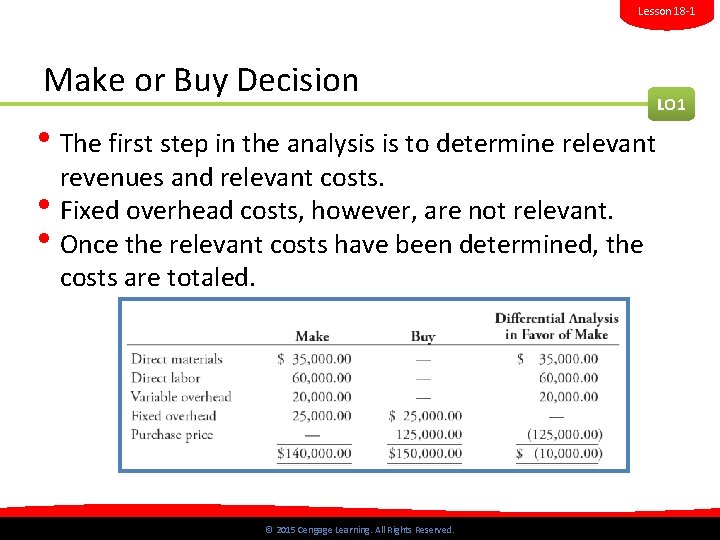
Lesson 18 -1 Make or Buy Decision • The first step in the analysis is to determine relevant LO 1 revenues and relevant costs. • Fixed overhead costs, however, are not relevant. • Once the relevant costs have been determined, the costs are totaled. © 2015 Cengage Learning. All Rights Reserved. SLIDE 3
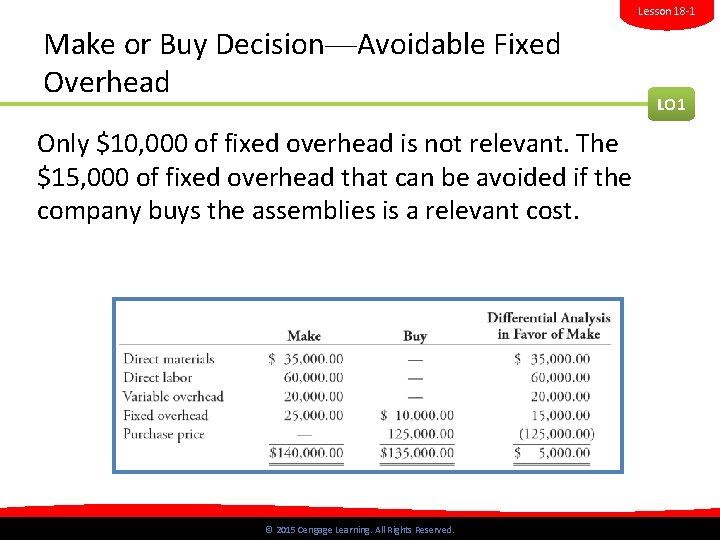
Lesson 18 -1 Make or Buy Decision—Avoidable Fixed Overhead LO 1 Only $10, 000 of fixed overhead is not relevant. The $15, 000 of fixed overhead that can be avoided if the company buys the assemblies is a relevant cost. © 2015 Cengage Learning. All Rights Reserved. SLIDE 4
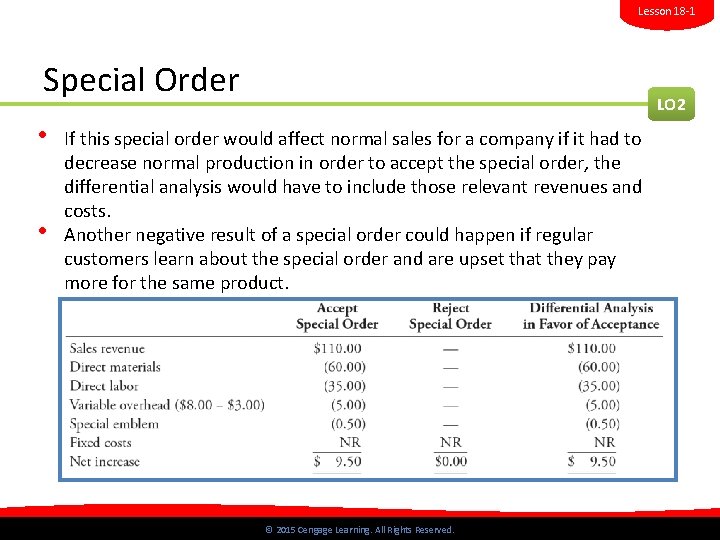
Lesson 18 -1 Special Order • • LO 2 If this special order would affect normal sales for a company if it had to decrease normal production in order to accept the special order, the differential analysis would have to include those relevant revenues and costs. Another negative result of a special order could happen if regular customers learn about the special order and are upset that they pay more for the same product. © 2015 Cengage Learning. All Rights Reserved. SLIDE 5
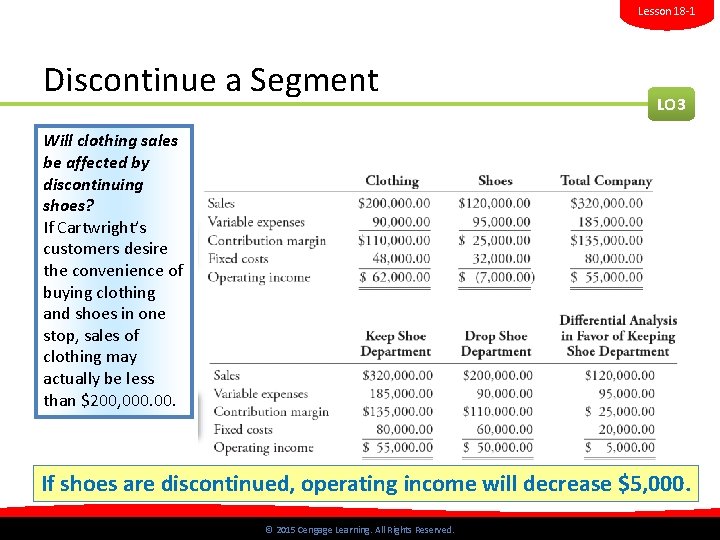
Lesson 18 -1 Discontinue a Segment LO 3 Will clothing sales be affected by discontinuing shoes? If Cartwright’s customers desire the convenience of buying clothing and shoes in one stop, sales of clothing may actually be less than $200, 000. If shoes are discontinued, operating income will decrease $5, 000. © 2015 Cengage Learning. All Rights Reserved. SLIDE 6
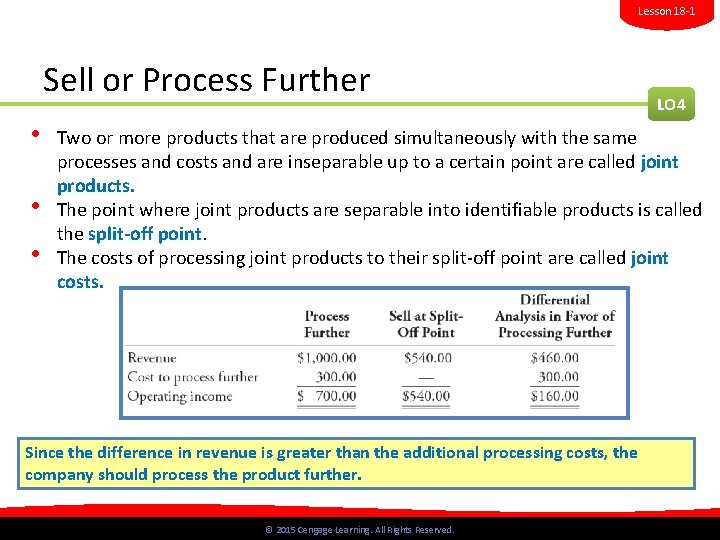
Lesson 18 -1 Sell or Process Further • • • LO 4 Two or more products that are produced simultaneously with the same processes and costs and are inseparable up to a certain point are called joint products. The point where joint products are separable into identifiable products is called the split-off point. The costs of processing joint products to their split-off point are called joint costs. Since the difference in revenue is greater than the additional processing costs, the company should process the product further. © 2015 Cengage Learning. All Rights Reserved. SLIDE 7
Lesson 18 -1 Audit Your Understanding 1. What two features are necessary for a cost to be a relevant cost? ANSWER A relevant cost must be a future cost, and it must differ between alternatives. © 2015 Cengage Learning. All Rights Reserved. SLIDE 8
Lesson 18 -1 Audit Your Understanding 2. In a make or buy decision, how is an avoidable fixed cost treated? ANSWER As a relevant cost. © 2015 Cengage Learning. All Rights Reserved. SLIDE 9
Lesson 18 -1 Audit Your Understanding 3. Besides differential analysis, what other factors should a company consider when deciding whether to accept or reject a special order? ANSWER If the special order will affect sales for the product and if normal customers will be upset by the discounted price of the special order. © 2015 Cengage Learning. All Rights Reserved. SLIDE 10
Lesson 18 -1 Audit Your Understanding 4. In a sell or process further decision, if the difference in revenue is less than the additional processing costs, what should the company do? ANSWER Sell the product at the split-off point. © 2015 Cengage Learning. All Rights Reserved. SLIDE 11
- Slides: 11