
LESSON Learning Objectives 133 Calculating and Analyzing Efficiency
LESSON Learning Objectives 133 Calculating and Analyzing Efficiency Measures and Market Ratio LO 3 Perform efficiency analysis of a business. LO 4 Calculate the market ratios of a business. © 2015 Cengage Learning. All Rights Reserved.
Lesson 13 -3 Analyzing Efficiency • • • LO 3 The profitability and continued growth of a business are influenced by how efficiently the business utilizes its assets. The operating cycle of a merchandising business consists of three phases: (1) purchasing merchandise, (2) selling merchandise (frequently on account), and (3) collecting the accounts receivable. The faster a business can convert these receivables and inventory into cash and begin another operating cycle, the more efficient and profitable the business will be. © 2015 Cengage Learning. All Rights Reserved. SLIDE 2
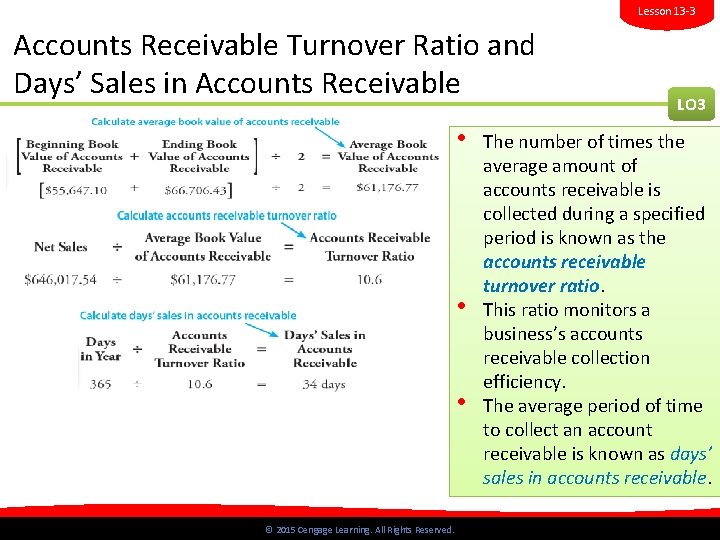
Lesson 13 -3 Accounts Receivable Turnover Ratio and Days’ Sales in Accounts Receivable • • • © 2015 Cengage Learning. All Rights Reserved. LO 3 The number of times the average amount of accounts receivable is collected during a specified period is known as the accounts receivable turnover ratio. This ratio monitors a business’s accounts receivable collection efficiency. The average period of time to collect an account receivable is known as days’ sales in accounts receivable. SLIDE 3
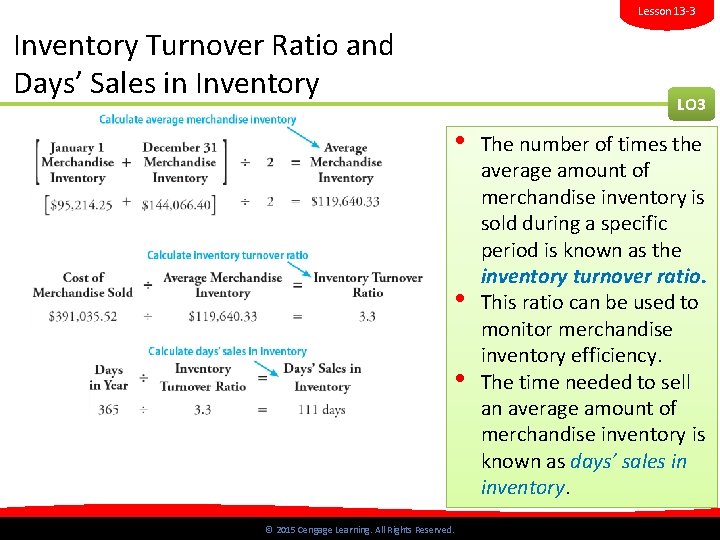
Lesson 13 -3 Inventory Turnover Ratio and Days’ Sales in Inventory LO 3 • • • © 2015 Cengage Learning. All Rights Reserved. The number of times the average amount of merchandise inventory is sold during a specific period is known as the inventory turnover ratio. This ratio can be used to monitor merchandise inventory efficiency. The time needed to sell an average amount of merchandise inventory is known as days’ sales in inventory. SLIDE 4

Lesson 13 -3 Market Ratios LO 4 • A ratio that measures a corporation’s financial performance in relation to the market value of its stock is called a market ratio. • Market ratios are somewhat objective because the market price of a stock is determined by the marketplace, rather than the financial statements issued by management. • Market ratios include: (1) earnings per share (EPS), (2) price-earnings ratio (P/E ratio), and (3) dividend yield. © 2015 Cengage Learning. All Rights Reserved. SLIDE 5

Lesson 13 -3 Earnings per Share LO 4 ● Net income after federal income tax divided by the number of outstanding shares of stock is called earnings per share, often abbreviated as EPS. [Net income Year $88, 469. 56 20 X 3 20 X 2 $90, 664. 44 20 X 1 $89, 235. 15 - Preferred Dividends] - $7, 650 $3, 000 Shares Common Earnings ÷ = Stock per Share Outstand. ÷ ÷ ÷ 65, 000 © 2015 Cengage Learning. All Rights Reserved. = = = $1. 24 $1. 28 $1. 33
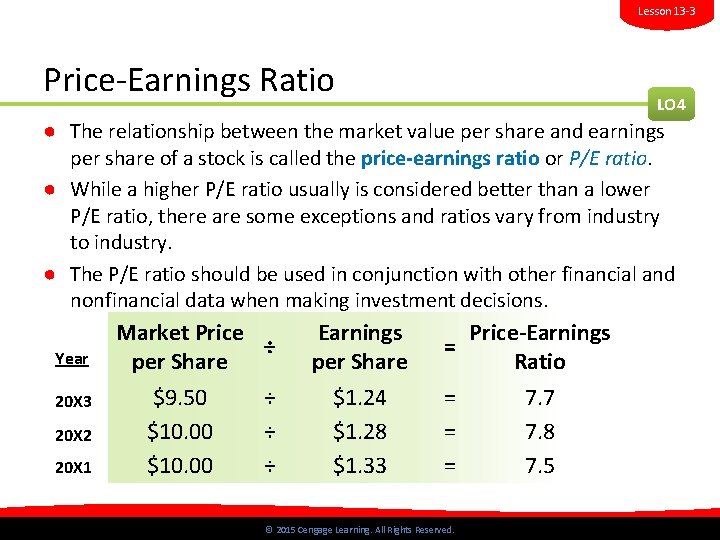
Lesson 13 -3 Price-Earnings Ratio LO 4 ● The relationship between the market value per share and earnings per share of a stock is called the price-earnings ratio or P/E ratio. ● While a higher P/E ratio usually is considered better than a lower P/E ratio, there are some exceptions and ratios vary from industry to industry. ● The P/E ratio should be used in conjunction with other financial and nonfinancial data when making investment decisions. Year 20 X 3 20 X 2 20 X 1 Market Price ÷ per Share $9. 50 $10. 00 ÷ ÷ ÷ Earnings per Share $1. 24 $1. 28 $1. 33 Price-Earnings = Ratio = = = © 2015 Cengage Learning. All Rights Reserved. 7. 7 7. 8 7. 5
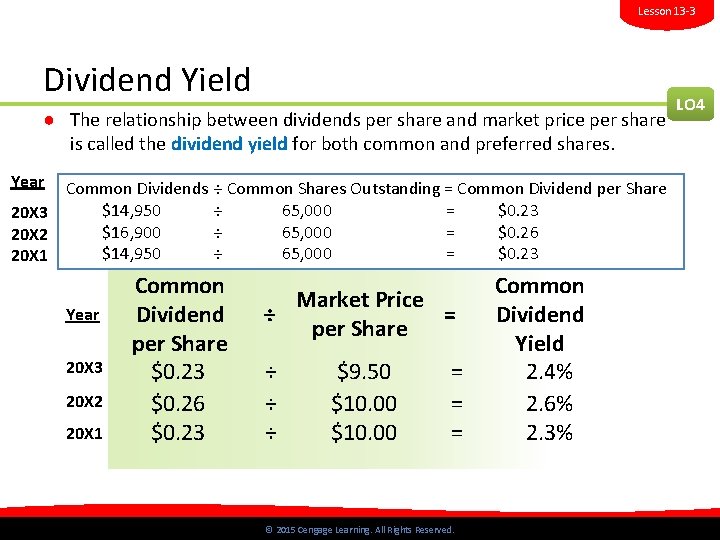
Lesson 13 -3 Dividend Yield ● The relationship between dividends per share and market price per share is called the dividend yield for both common and preferred shares. Year Common Dividends $14, 950 20 X 3 $16, 900 20 X 2 $14, 950 20 X 1 Year 20 X 3 20 X 2 20 X 1 ÷ Common Shares Outstanding = Common Dividend per Share ÷ 65, 000 = $0. 23 ÷ 65, 000 = $0. 26 ÷ 65, 000 = $0. 23 Common Dividend per Share $0. 23 $0. 26 $0. 23 Market Price ÷ = per Share ÷ ÷ ÷ $9. 50 $10. 00 = = = © 2015 Cengage Learning. All Rights Reserved. Common Dividend Yield 2. 4% 2. 6% 2. 3% LO 4
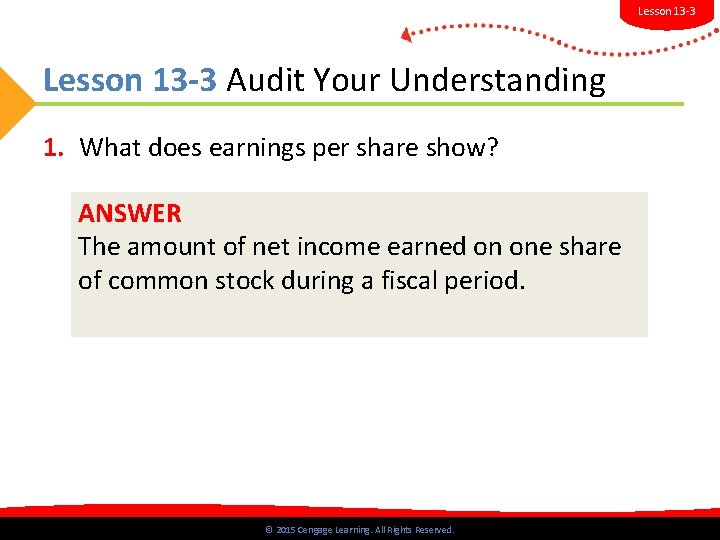
Lesson 13 -3 Audit Your Understanding 1. What does earnings per share show? ANSWER The amount of net income earned on one share of common stock during a fiscal period. © 2015 Cengage Learning. All Rights Reserved. SLIDE 9
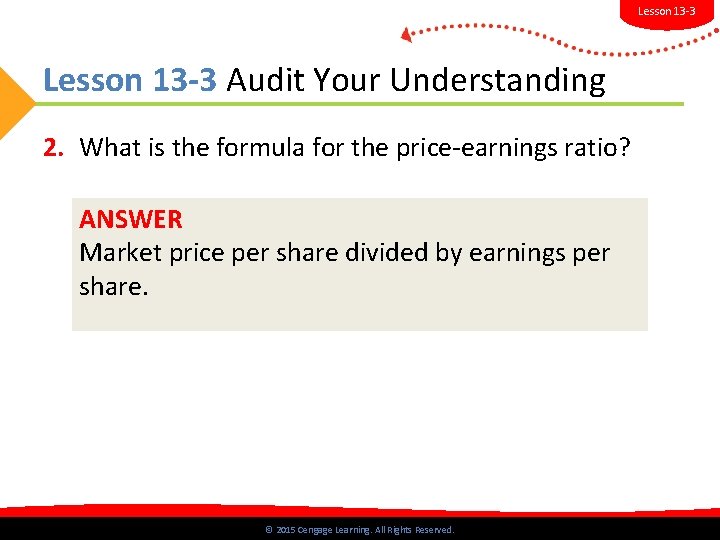
Lesson 13 -3 Audit Your Understanding 2. What is the formula for the price-earnings ratio? ANSWER Market price per share divided by earnings per share. © 2015 Cengage Learning. All Rights Reserved. SLIDE 10
Lesson 13 -3 Audit Your Understanding 3. If the dividend paid remains the same from Year 1 to Year 2, but the market value of the stock decreases, how will the dividend yield be affected? ANSWER Dividend yield will increase. © 2015 Cengage Learning. All Rights Reserved. SLIDE 11
- Slides: 11