
LESSON Learning Objectives 1 1 Using Accounting Principles
LESSON Learning Objectives 1 -1 Using Accounting Principles and Records LO 1 LO 2 Explain the relationship between the accounting equation and accounting records. Explain the relationship between a subsidiary ledger and a controlling account. © 2015 Cengage Learning. All Rights Reserved.
Lesson 1 -1 Financial Reporting for Departments LO 1 ● Financial information for a business can be recorded, summarized, and reported in a variety of ways. ● If managers of individual departments want to use financial statements to assist in making decisions, information for each department must be recorded separately. © 2015 Cengage Learning. All Rights Reserved. SLIDE 2

Lesson 1 -1 Accounting Equation LO 1 Financial rights to the assets of a business are called equities. Anything of value that is owned is called an asset. An amount owed by a business is called a liability. • The owners’ equity in a corporation is called stockholders’ equity. © 2015 Cengage Learning. All Rights Reserved. SLIDE 3
Lesson 1 -1 Accounting Records LO 1 ● Accounting records show changes and the current account balance of each asset, liability, and owners’ equity (or stockholders’ equity) account. ● Business papers from which information is obtained for a journal entry are called source documents. ● The source document is the original business paper indicating that the transaction did occur and that the amounts recorded in the accounting records are accurate and true. © 2015 Cengage Learning. All Rights Reserved. SLIDE 4
Lesson 1 -1 General Journal LO 1 ● The recording of debit and credit parts of a transaction is called double-entry accounting. ● A form for recording transactions in chronological order is called a journal. ● A journal used to record only one kind of transaction is called a special journal. ● A general journal may be used to record all business transactions. © 2015 Cengage Learning. All Rights Reserved. SLIDE 5

Lesson 1 -1 Normal Balances of Accounts LO 1 A record that summarizes all the transactions pertaining to a single item in the accounting equation is called an account. © 2015 Cengage Learning. All Rights Reserved. SLIDE 6

Lesson 1 -1 General and Subsidiary Ledgers LO 2 ● A group of accounts is called a ledger. ● A ledger that contains all accounts needed to prepare financial statements is called a general ledger. ● A ledger that is summarized in a single general ledger account is called a subsidiary ledger. ● An account in a general ledger that summarizes all accounts in a subsidiary ledger is called a controlling account. © 2015 Cengage Learning. All Rights Reserved. SLIDE 7
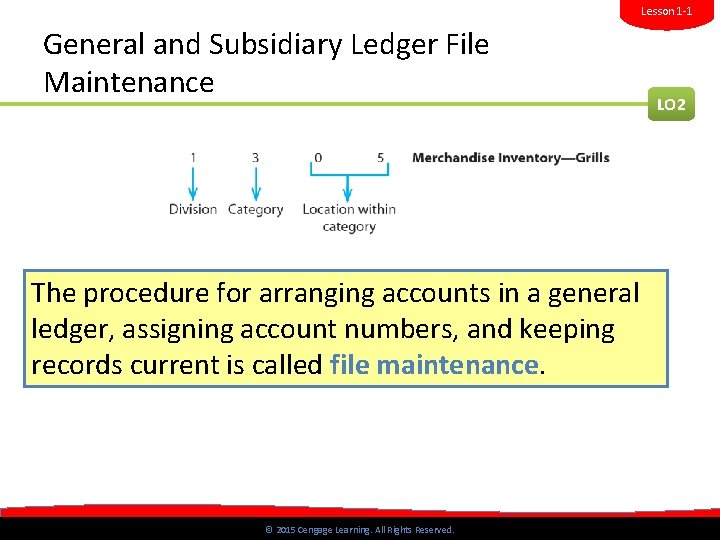
Lesson 1 -1 General and Subsidiary Ledger File Maintenance LO 2 1 The procedure for arranging accounts in a general ledger, assigning 2 account numbers, and keeping records current is called file maintenance. 3 © 2015 Cengage Learning. All Rights Reserved. SLIDE 8

Lesson 1 -1 Audit Your Understanding 1. How is the accounting equation stated most commonly? ANSWER Assets = Liabilities + Owners’ Equity. © 2015 Cengage Learning. All Rights Reserved. SLIDE 9
Lesson 1 -1 Audit Your Understanding 2. What is the normal balance of an asset account? A revenue account? ANSWER An asset account has a normal debit balance; a revenue account has a normal credit balance. © 2015 Cengage Learning. All Rights Reserved. SLIDE 10
Lesson 1 -1 Audit Your Understanding 3. What are three needs met by Whiley’s account numbering system? ANSWER (a) A separate numeric listing is provided for each ledger division. (b) A predesigned arrangement of numbers is provided within each ledger division. (c) Account number digits are spaced to allow the addition of new accounts. © 2015 Cengage Learning. All Rights Reserved. SLIDE 11
- Slides: 11