
LESSON Learning Objective 8 1 Notes Payable LO
LESSON Learning Objective 8 -1 Notes Payable LO 1 Journalize transactions for notes payable. © 2015 Cengage Learning. All Rights Reserved.
Lesson 8 -1 Borrowing Money with a Note Payable LO 1 ● Obtaining capital by borrowing money for a period of time is called debt financing. ● A written and signed promise to pay a sum of money at a specified time is called a promissory note. ● Promissory notes signed by a business and given to a creditor are called notes payable. © © 2015 Cengage Learning. All Rights Reserved. SLIDE 2

Lesson 8 -1 Borrowing Money with a Note Payable LO 1 1. The day a note is issued is called the date of a note. 2. The original amount of a note is called the principal. 3. The date on which the principal of a note is due to be repaid is called the maturity date. 4. The percentage of the principal that is due for the use of the funds secured by a note is called the interest rate. 1 2 4 © © 2015 Cengage Learning. All Rights Reserved. 3 SLIDE 3
Lesson 8 -1 Classifying a Note Payable LO 1 ● Liabilities due within a short time, usually within a year, are called current liabilities. ● A note payable that will be repaid during the next fiscal year should be recorded in an account classified as a current liability. ● A note payable scheduled to mature in later fiscal periods should be classified as a long-term liability. © 2015 Cengage Learning. All Rights Reserved. SLIDE 4
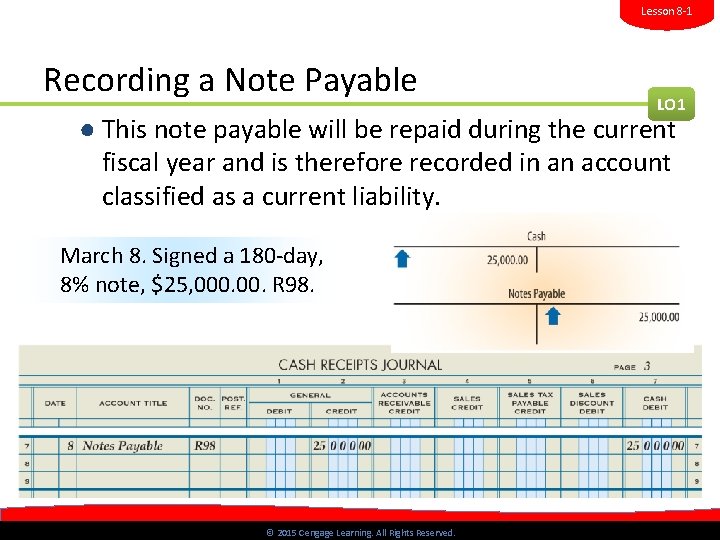
Lesson 8 -1 Recording a Note Payable LO 1 ● This note payable will be repaid during the current fiscal year and is therefore recorded in an account classified as a current liability. March 8. Signed a 180 -day, 8% note, $25, 000. R 98. © © 2015 Cengage Learning. All Rights Reserved. SLIDE 5
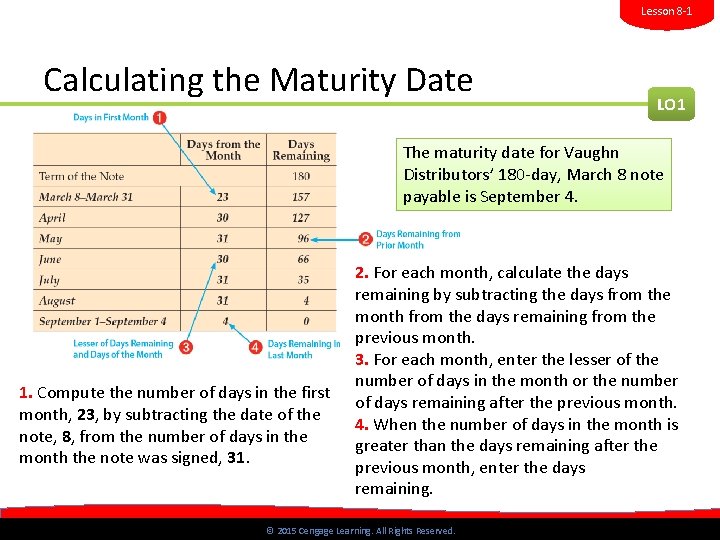
Lesson 8 -1 Calculating the Maturity Date LO 1 The maturity date for Vaughn Distributors’ 180 -day, March 8 note payable is September 4. 1. Compute the number of days in the first month, 23, by subtracting the date of the note, 8, from the number of days in the month the note was signed, 31. 2. For each month, calculate the days remaining by subtracting the days from the month from the days remaining from the previous month. 3. For each month, enter the lesser of the number of days in the month or the number of days remaining after the previous month. 4. When the number of days in the month is greater than the days remaining after the previous month, enter the days remaining. © © 2015 Cengage Learning. All Rights Reserved. SLIDE 6
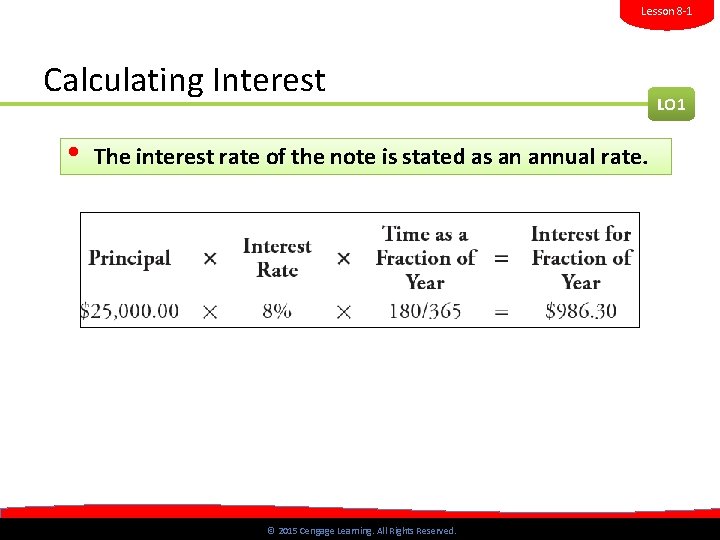
Lesson 8 -1 Calculating Interest • LO 1 The interest rate of the note is stated as an annual rate. © © 2015 Cengage Learning. All Rights Reserved. SLIDE 7
Lesson 8 -1 Paying on a Note Payable LO 1 ● Interest accrued on borrowed funds is called interest expense. ● The amount that is due on the maturity date of a note is called the maturity value. ● Only expenses that are incurred to conduct normal business activities are classified as operating expenses. ● Interest Expense is listed as an Other Expense, enabling a comparison of operating income between companies in the same industry. © 2015 Cengage Learning. All Rights Reserved. SLIDE 8
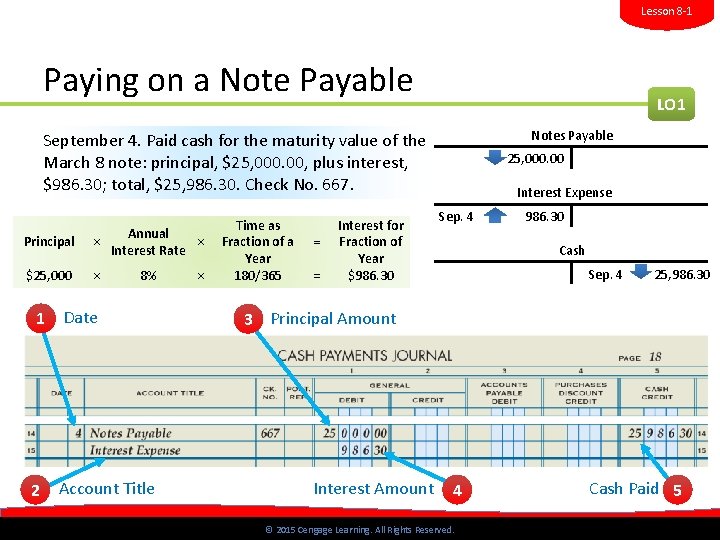
Lesson 8 -1 Paying on a Note Payable LO 1 Notes Payable September 4. Paid cash for the maturity value of the March 8 note: principal, $25, 000. 00, plus interest, $986. 30; total, $25, 986. 30. Check No. 667. Principal × $25, 000 × Annual × Interest Rate 8% 1 Date 2 Account Title × Time as Fraction of a Year 180/365 = = Interest for Fraction of Year $986. 30 25, 000. 00 Interest Expense Sep. 4 986. 30 Cash Sep. 4 25, 986. 30 3 Principal Amount Interest Amount 4 © 2015 Cengage Learning. All Rights Reserved. Cash Paid 5 SLIDE 9
Lesson 8 -1 Noninterest-Bearing Notes LO 1 ● A note having a stated interest rate is called an interest-bearing note. ● On the maturity date, the borrower pays the face value of the note plus interest at the stated interest rate. ● An alternative type of note has proceeds that are less than the maturity value of the note. ● A note that deducts interest from the face value of the note is called a noninterest-bearing note. © 2015 Cengage Learning. All Rights Reserved. SLIDE 10
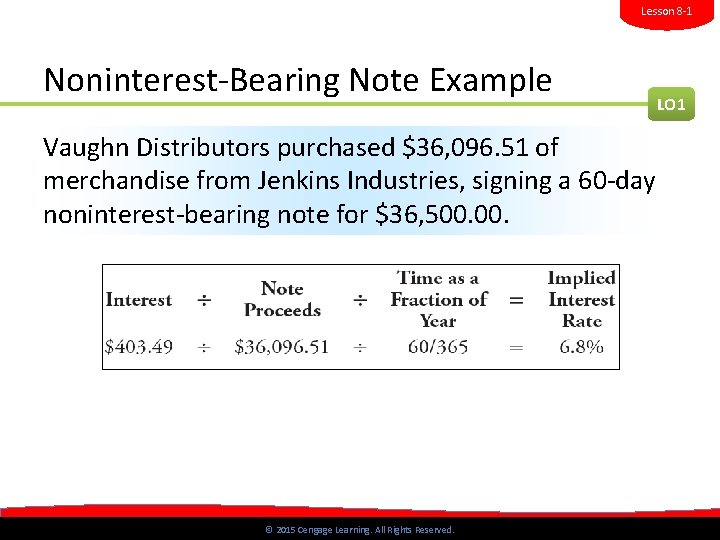
Lesson 8 -1 Noninterest-Bearing Note Example LO 1 Vaughn Distributors purchased $36, 096. 51 of merchandise from Jenkins Industries, signing a 60 -day noninterest-bearing note for $36, 500. © 2015 Cengage Learning. All Rights Reserved. SLIDE 11
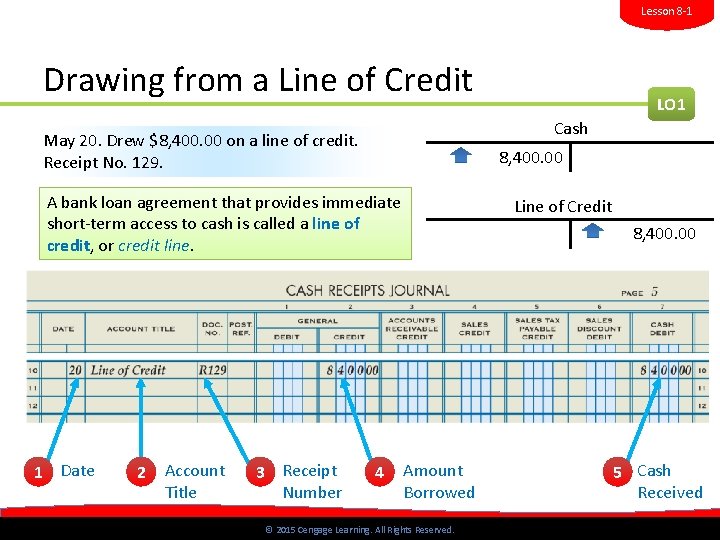
Lesson 8 -1 Drawing from a Line of Credit Cash May 20. Drew $8, 400. 00 on a line of credit. Receipt No. 129. 8, 400. 00 A bank loan agreement that provides immediate short-term access to cash is called a line of credit, or credit line. 1 Date 2 Account Title 3 Receipt Number LO 1 4 Line of Credit 8, 400. 00 Amount Borrowed © 2015 Cengage Learning. All Rights Reserved. 5 Cash Received SLIDE 12
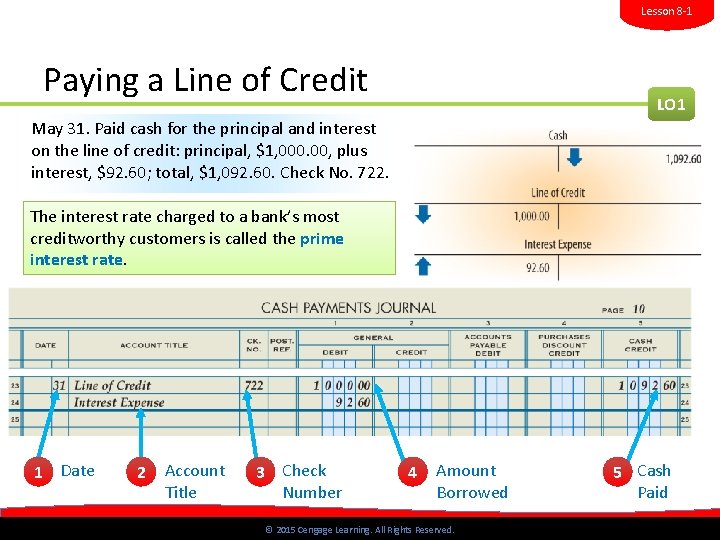
Lesson 8 -1 Paying a Line of Credit LO 1 May 31. Paid cash for the principal and interest on the line of credit: principal, $1, 000. 00, plus interest, $92. 60; total, $1, 092. 60. Check No. 722. The interest rate charged to a bank’s most creditworthy customers is called the prime interest rate. 1 Date 2 Account Title 3 Check Number 4 Amount Borrowed © 2015 Cengage Learning. All Rights Reserved. 5 Cash Paid SLIDE 13
Lesson 8 -1 Audit Your Understanding 1. What method of reporting interest expense enables the comparison of operating income between companies in the same industry? ANSWER Reporting interest expense as Other Expense enables the comparison of operating income between companies in the same industry. © © 2015 Cengage Learning. All Rights Reserved. SLIDE 14
Lesson 8 -1 Audit Your Understanding 2. Why is interest on a line of credit calculated daily? ANSWER Interest on a line of credit is typically calculated daily because the principal amount and interest range can change during a month. © 2015 Cengage Learning. All Rights Reserved. © SLIDE 15
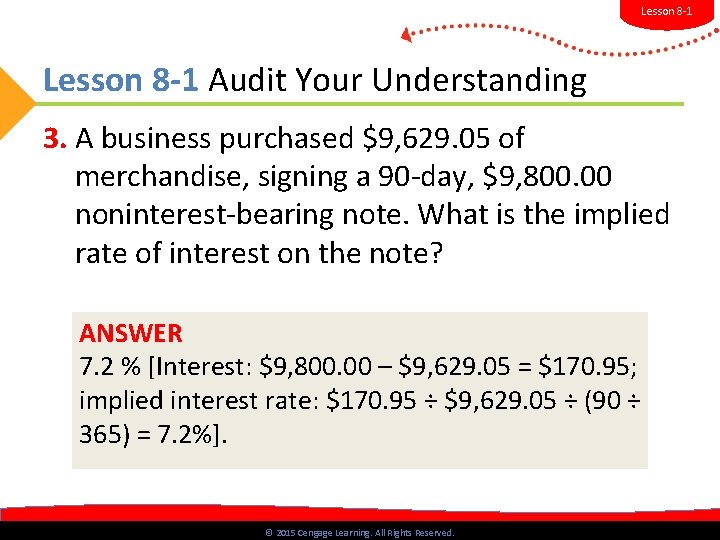
Lesson 8 -1 Audit Your Understanding 3. A business purchased $9, 629. 05 of merchandise, signing a 90 -day, $9, 800. 00 noninterest-bearing note. What is the implied rate of interest on the note? ANSWER 7. 2 % [Interest: $9, 800. 00 – $9, 629. 05 = $170. 95; implied interest rate: $170. 95 ÷ $9, 629. 05 ÷ (90 ÷ 365) = 7. 2%]. © © 2015 Cengage Learning. All Rights Reserved. SLIDE 16
- Slides: 16