
Lesson Learned PVC Pipe Explosion Presented at Accelerator
- Slides: 20
Lesson Learned: PVC Pipe Explosion Presented at Accelerator Safety Conference August 12, 2008 Creating a Safe and Sustainable Environment for Science 1
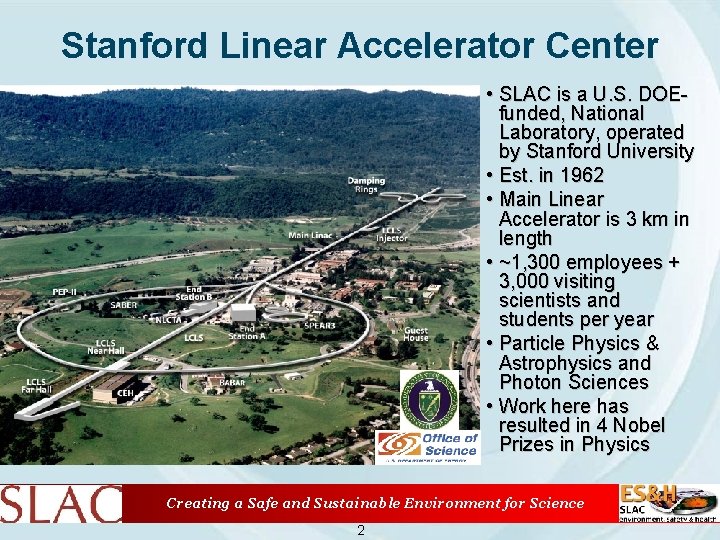
Stanford Linear Accelerator Center • SLAC is a U. S. DOEfunded, National Laboratory, operated by Stanford University • Est. in 1962 • Main Linear Accelerator is 3 km in length • ~1, 300 employees + 3, 000 visiting scientists and students per year • Particle Physics & Astrophysics and Photon Sciences • Work here has resulted in 4 Nobel Prizes in Physics Creating a Safe and Sustainable Environment for Science 2
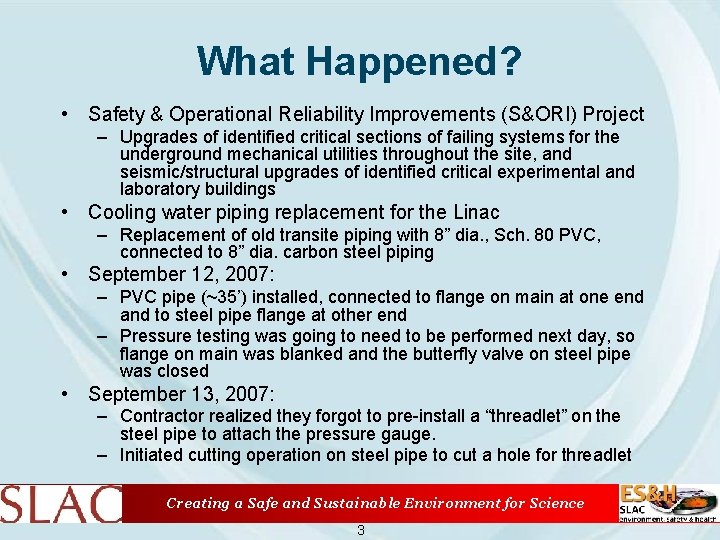
What Happened? • Safety & Operational Reliability Improvements (S&ORI) Project – Upgrades of identified critical sections of failing systems for the underground mechanical utilities throughout the site, and seismic/structural upgrades of identified critical experimental and laboratory buildings • Cooling water piping replacement for the Linac – Replacement of old transite piping with 8” dia. , Sch. 80 PVC, connected to 8” dia. carbon steel piping • September 12, 2007: – PVC pipe (~35’) installed, connected to flange on main at one end and to steel pipe flange at other end – Pressure testing was going to need to be performed next day, so flange on main was blanked and the butterfly valve on steel pipe was closed • September 13, 2007: – Contractor realized they forgot to pre-install a “threadlet” on the steel pipe to attach the pressure gauge. – Initiated cutting operation on steel pipe to cut a hole for threadlet Creating a Safe and Sustainable Environment for Science 3
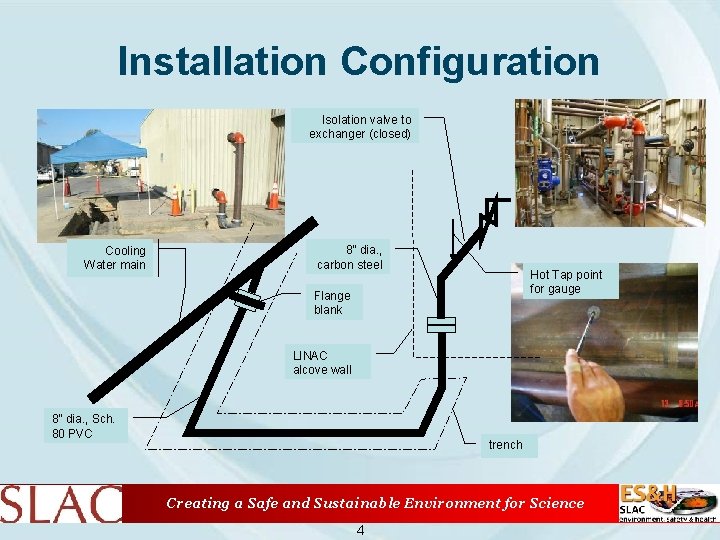
Installation Configuration Isolation valve to exchanger (closed) Cooling Water main 8” dia. , carbon steel Hot Tap point for gauge Flange blank LINAC alcove wall 8” dia. , Sch. 80 PVC trench Creating a Safe and Sustainable Environment for Science 4
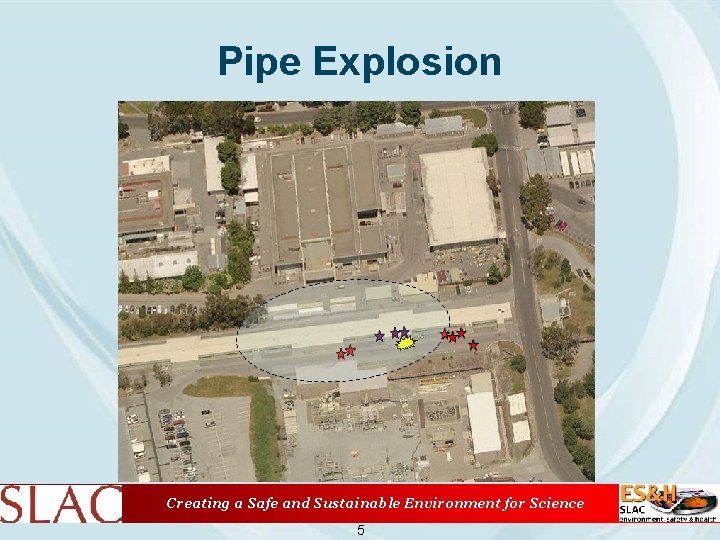
Pipe Explosion Creating a Safe and Sustainable Environment for Science 5
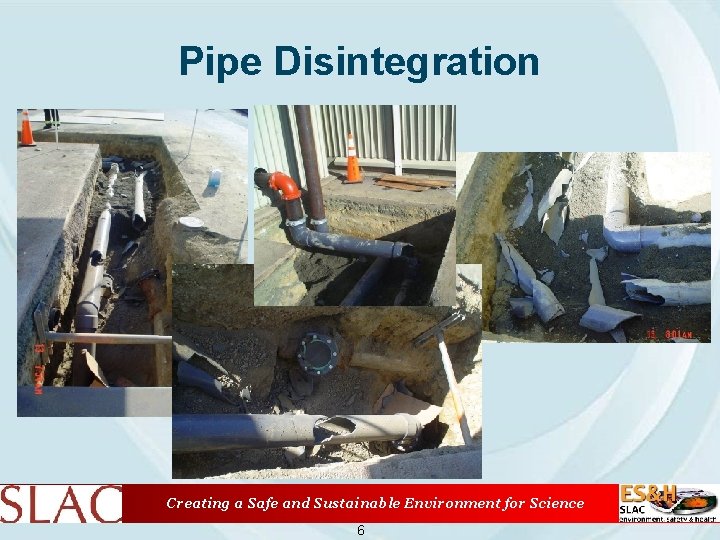
Pipe Disintegration Creating a Safe and Sustainable Environment for Science 6
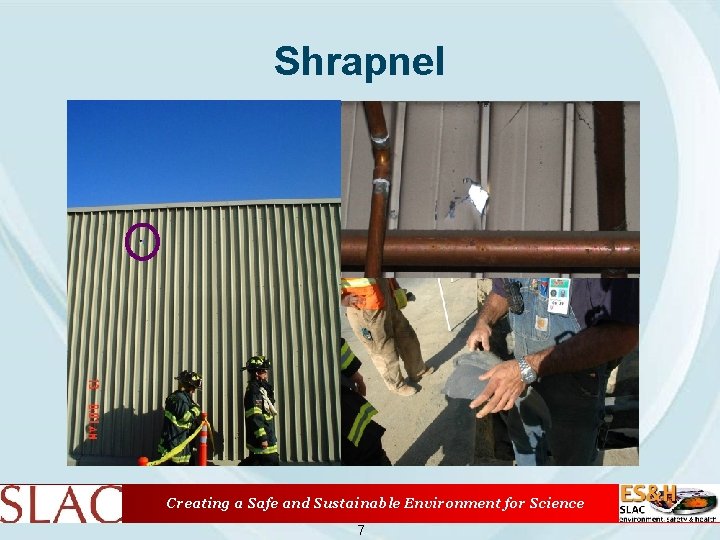
Shrapnel Creating a Safe and Sustainable Environment for Science 7
Injuries • One nearby (~25’) worker was almost knocked down by the force • One suffered temporary hearing loss, and due to elevated pulse and blood pressure was taken to Stanford Medical Center • Three others went back to work after going to SLAC medical for hearing evaluation Creating a Safe and Sustainable Environment for Science 8
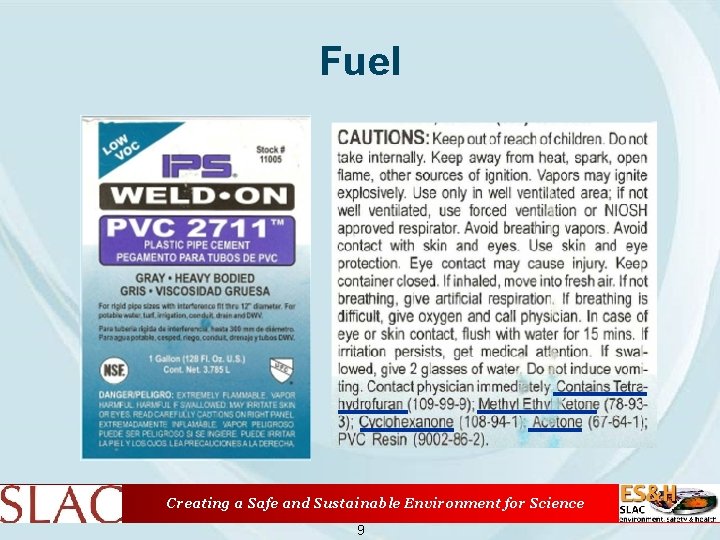
Fuel Creating a Safe and Sustainable Environment for Science 9
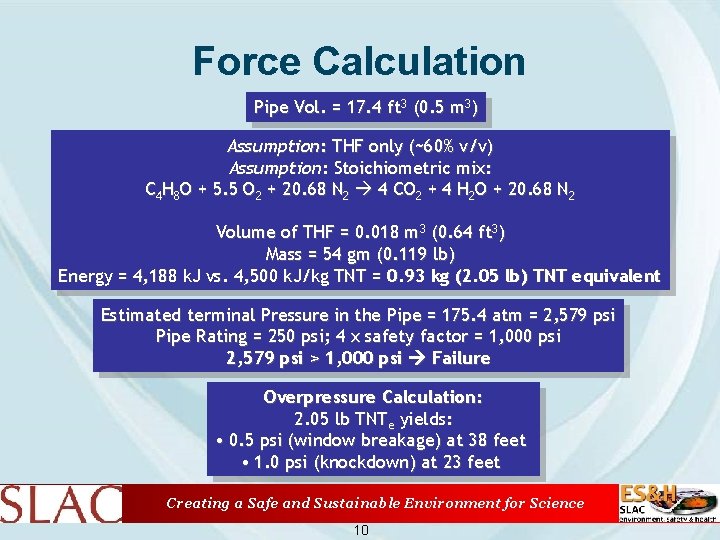
Force Calculation Pipe Vol. = 17. 4 ft 3 (0. 5 m 3) Assumption: THF only (~60% v/v) Assumption: Stoichiometric mix: C 4 H 8 O + 5. 5 O 2 + 20. 68 N 2 4 CO 2 + 4 H 2 O + 20. 68 N 2 Volume of THF = 0. 018 m 3 (0. 64 ft 3) Mass = 54 gm (0. 119 lb) Energy = 4, 188 k. J vs. 4, 500 k. J/kg TNT = 0. 93 kg (2. 05 lb) TNT equivalent Estimated terminal Pressure in the Pipe = 175. 4 atm = 2, 579 psi Pipe Rating = 250 psi; 4 x safety factor = 1, 000 psi 2, 579 psi > 1, 000 psi Failure Overpressure Calculation: 2. 05 lb TNTe yields: • 0. 5 psi (window breakage) at 38 feet • 1. 0 psi (knockdown) at 23 feet Creating a Safe and Sustainable Environment for Science 10
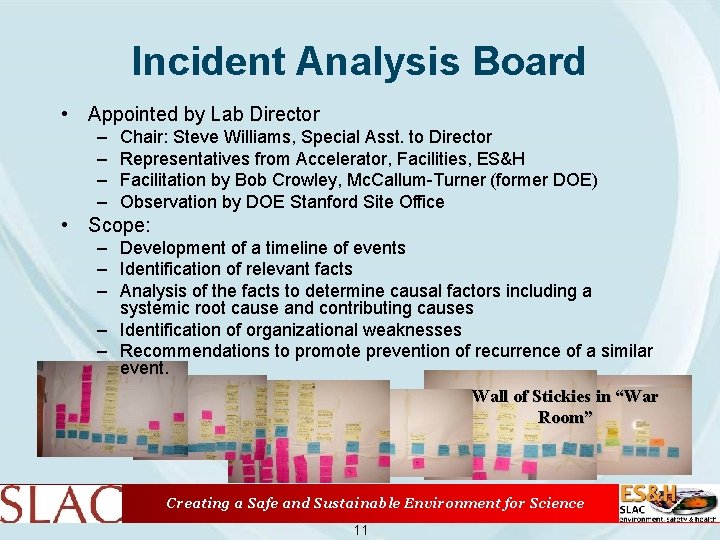
Incident Analysis Board • Appointed by Lab Director – – Chair: Steve Williams, Special Asst. to Director Representatives from Accelerator, Facilities, ES&H Facilitation by Bob Crowley, Mc. Callum-Turner (former DOE) Observation by DOE Stanford Site Office • Scope: – Development of a timeline of events – Identification of relevant facts – Analysis of the facts to determine causal factors including a systemic root cause and contributing causes – Identification of organizational weaknesses – Recommendations to promote prevention of recurrence of a similar event Wall of Stickies in “War Room” Creating a Safe and Sustainable Environment for Science 11
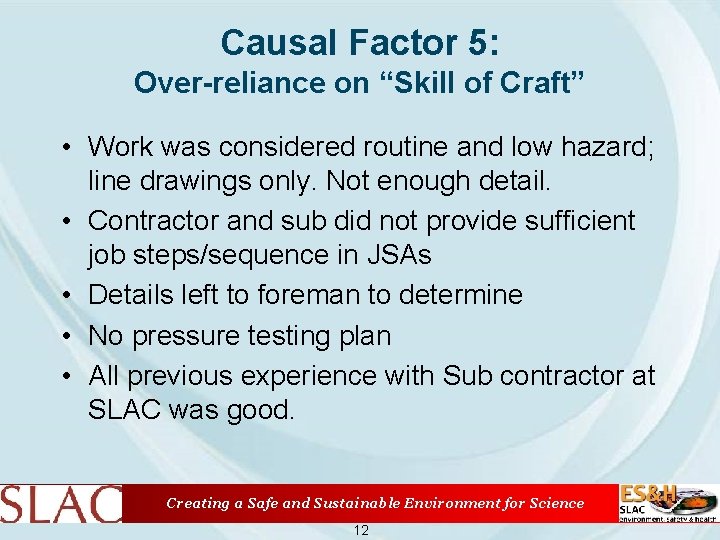
Causal Factor 5: Over-reliance on “Skill of Craft” • Work was considered routine and low hazard; line drawings only. Not enough detail. • Contractor and sub did not provide sufficient job steps/sequence in JSAs • Details left to foreman to determine • No pressure testing plan • All previous experience with Sub contractor at SLAC was good. Creating a Safe and Sustainable Environment for Science 12
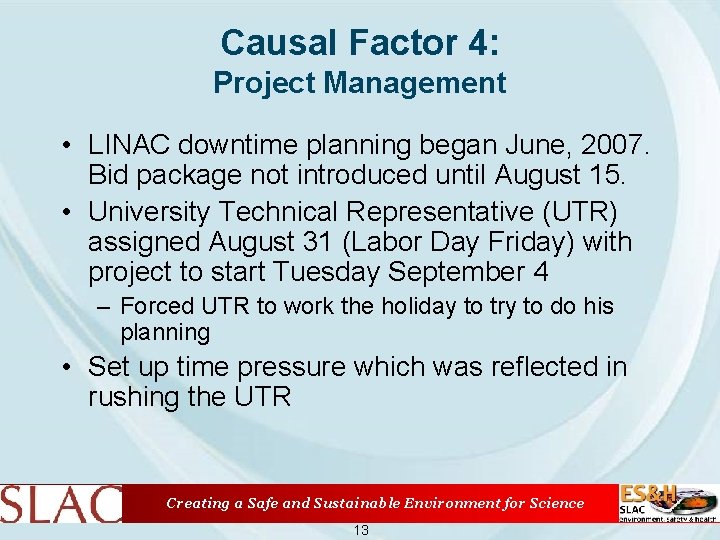
Causal Factor 4: Project Management • LINAC downtime planning began June, 2007. Bid package not introduced until August 15. • University Technical Representative (UTR) assigned August 31 (Labor Day Friday) with project to start Tuesday September 4 – Forced UTR to work the holiday to try to do his planning • Set up time pressure which was reflected in rushing the UTR Creating a Safe and Sustainable Environment for Science 13
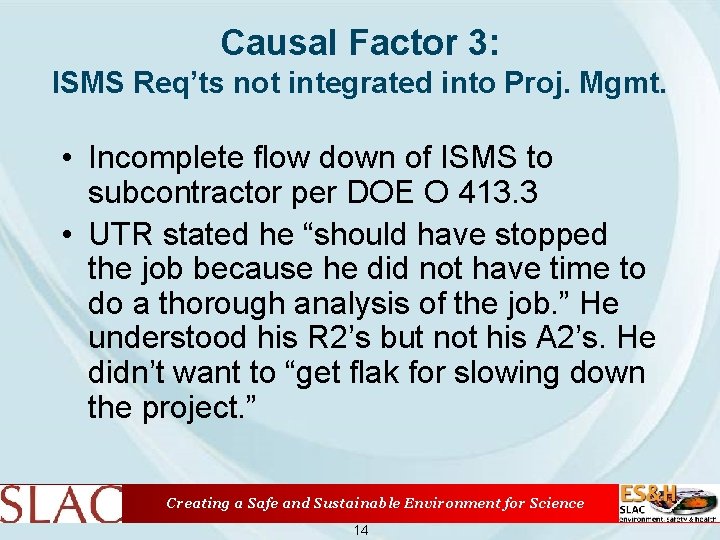
Causal Factor 3: ISMS Req’ts not integrated into Proj. Mgmt. • Incomplete flow down of ISMS to subcontractor per DOE O 413. 3 • UTR stated he “should have stopped the job because he did not have time to do a thorough analysis of the job. ” He understood his R 2’s but not his A 2’s. He didn’t want to “get flak for slowing down the project. ” Creating a Safe and Sustainable Environment for Science 14
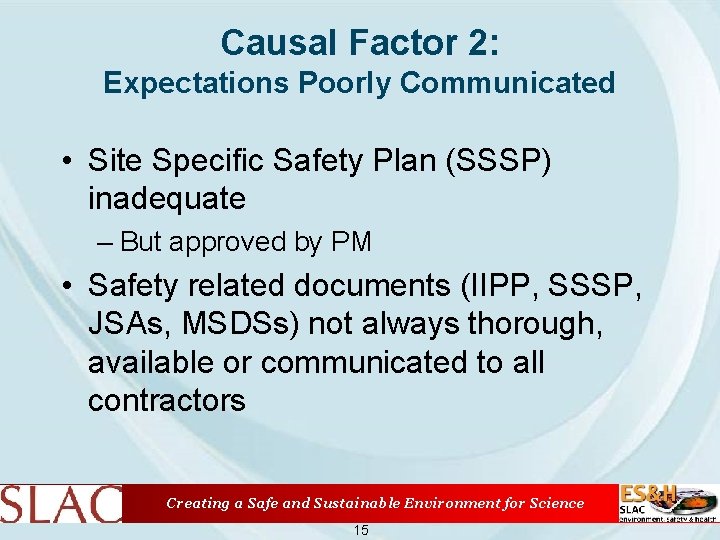
Causal Factor 2: Expectations Poorly Communicated • Site Specific Safety Plan (SSSP) inadequate – But approved by PM • Safety related documents (IIPP, SSSP, JSAs, MSDSs) not always thorough, available or communicated to all contractors Creating a Safe and Sustainable Environment for Science 15
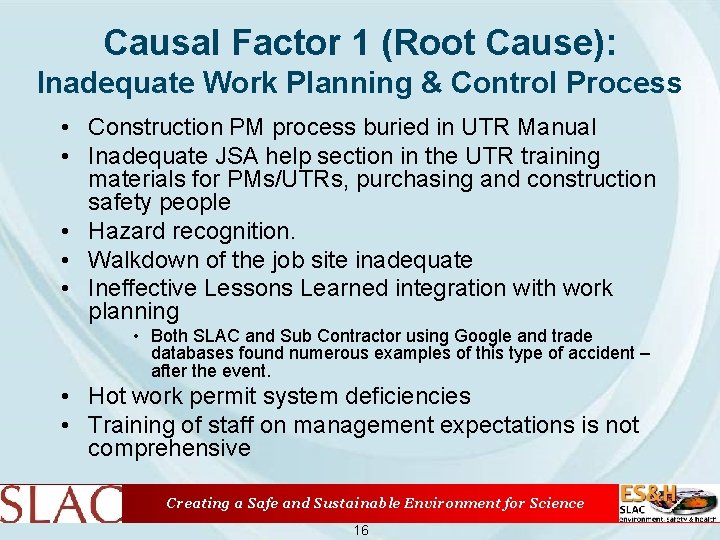
Causal Factor 1 (Root Cause): Inadequate Work Planning & Control Process • Construction PM process buried in UTR Manual • Inadequate JSA help section in the UTR training materials for PMs/UTRs, purchasing and construction safety people • Hazard recognition. • Walkdown of the job site inadequate • Ineffective Lessons Learned integration with work planning • Both SLAC and Sub Contractor using Google and trade databases found numerous examples of this type of accident – after the event. • Hot work permit system deficiencies • Training of staff on management expectations is not comprehensive Creating a Safe and Sustainable Environment for Science 16
Corrective Actions • Immediate – Stopped work; subs re-worked their safety policies and procedures; review by Facilities Dept. and ES&H – Increased oversight of Hot Work Permit Process and JSAs • Near-term – Revisions to hot work permit program – Project planning – Revisions to program documentation (SSSP, JSA) • Developed guidelines for project managers/UTRs and improved forms – Implementation of Lessons Learned (DOE O 210. 2) • Note: was not in SLACs contract prior to this year Creating a Safe and Sustainable Environment for Science 17
Corrective Actions • Long-term – ISEMS Communications and Training of Subcontractors and UTRs • Implementation of a Construction Safety at SLAC course (webbased) • Developing R 2 A 2 s for UTRs and personnel overseeing subcontracted work • Work Planning & Control – Already a pre-existing CAP from a DOE OIO Review in 2006 • A WPC Program Manager was hired in May 2008 • WPC Manager has assumed responsibility for the OIO WPC CAP. – Although the OIO findings and CAP specifically did not include subcontractor work, SLAC has incorporated subcontractor work into its draft WPC process. • Beta testing of new WPC process to commence at the end of August and run through October 2008. Full roll out of the program will occur beginning February 2009. Creating a Safe and Sustainable Environment for Science 18
OE Investigation Report • Received July 23, 2008 • Enforcement conference TBD Creating a Safe and Sustainable Environment for Science 19
Creating a Safe and Sustainable Environment for Science 20