
Lesson Identifying Engine Systems and Their Components Interest
- Slides: 36
Lesson Identifying Engine Systems and Their Components
Interest Approach n. Identify the major systems of an engine
Student Learning Objectives n. Identify the three broad categories of internal combustion engine systems. n. Identify the components of the primary or compression system. n. Describe the components of an engine’s operating system.
Terms n Accessory systems n Breaker points n Air cleaner n Camshafts n Air cooled system n Carburetor n Air intake system n Compression n Battery-type ignition system n Condenser n Cylinder head n Distributor systems n Breaker point-type battery system
Terms (continued) n Distributor cam n Flywheel n Electronic fuel n Fuel filter injection systems n Engine cooling system n Exhaust manifold n Exhaust system n Exhaust valves n Fuel injection systems n Fuel system n Head gaskets n Ignition coil
Terms (continued) n Ignition system n Mechanical fuel n Intake valves injection systems n Operating systems n Piston rings n Primary system n Pushrods n Liquid cooling system n Lubrication system n Magneto-type ignition systems
Terms (continued) n Radiator n Thermostat n Spark ignition n Valve guides systems n Spring retainers n Starting system n Valve springs n Water pump
Three categories of engine systems n Primary system – creates the engine compression and converts the energy of combustion to mechanical energy. n Operating systems – perform the other engine functions. n i. e. Electrical system n Accessory systems – are not necessary for engine operation. n i. e. Power steering system
Purpose of a Compression System n. To efficiently compress air to increase the potential energy resulting form the combustion of the fuel.
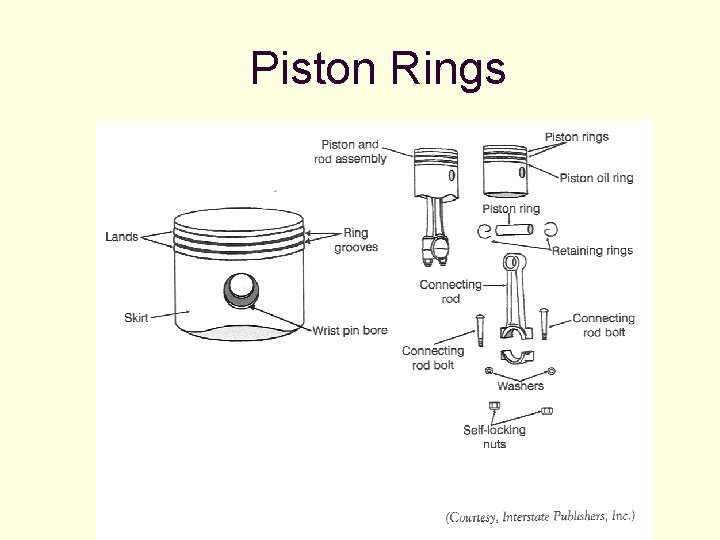
Components of the Compression System n. Piston – machined from lightweight alloys n. Piston Rings – made of cast iron and/or steel n. Compression rings n. Oil rings
Piston Rings
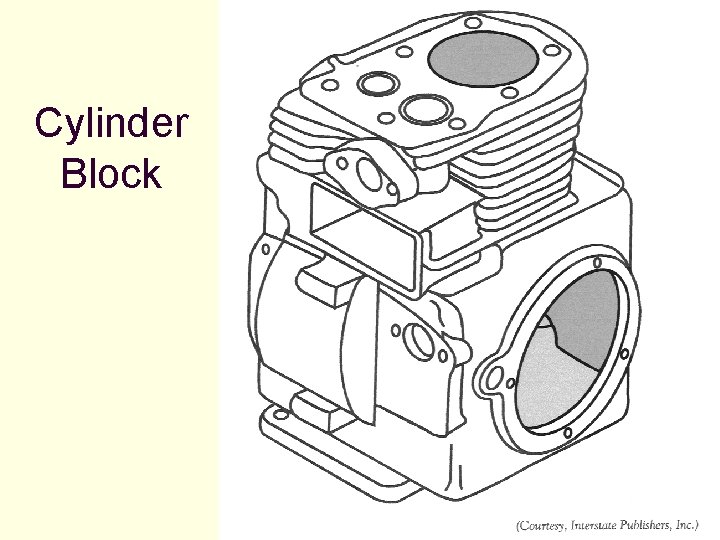
Components (continued) n. Head gaskets – provide a seal between the cylinder head and the cylinder block. n. Cylinder head – forms the top of the combustion chamber. n. Cylinder block – houses the cylinders and crankshaft.
Cylinder Block
Components (continued) n. Valves – n Intake valves – open and seal the intake ports. n Exhaust valves – open and seal the exhaust ports. n Valve springs – both close the valves and hold them open. n Spring retainers – hold the springs on the end of the valves.
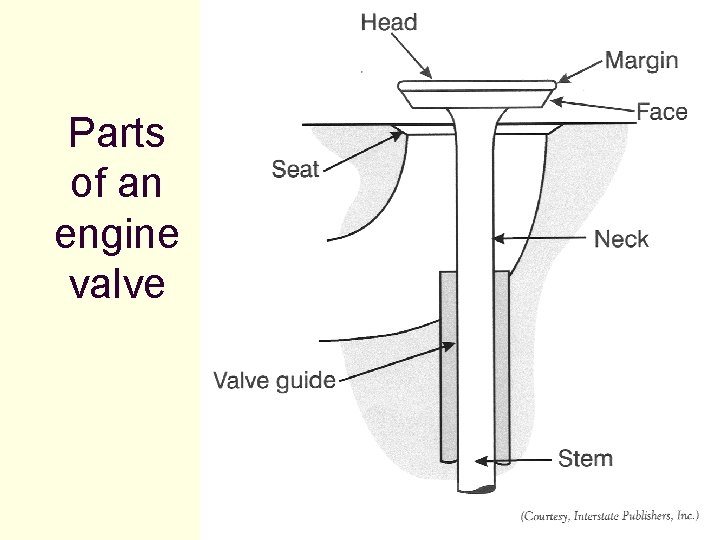
Components (continued) n. Valves – n Valve guides – support the valve stem as the valve moves back and forth. n Camshafts – open and close the valves. n Pushrods – transfer the rotating movement of the camshaft to the linear movement of the valves.
Parts of an engine valve
Combustion is usually lost in one of three places: n. Fit of the piston to the cylinder n. Head gasket n. Valves
Operating System Components n Air intake system – provides a source of clean air necessary for combustion. n Fuel system – delivers clean and adequate amounts of fuel to the cylinder. n Exhaust system – removes the exhaust gases and particles from the combustion chamber.
Operating System Components (continued) n. Engine cooling system – manages the heat produced by the combustion of the air-fuel mixture. n. Ignition System – starts the combustion of the air-fuel mixture.
Operating System Components (continued) n Lubrication system – deeps internal engine parts coated with oil to reduce friction, enhance cooling, seal internal engine components, and clean internal parts. n Starting system – used to turn the engine crankshaft until the engine starts.
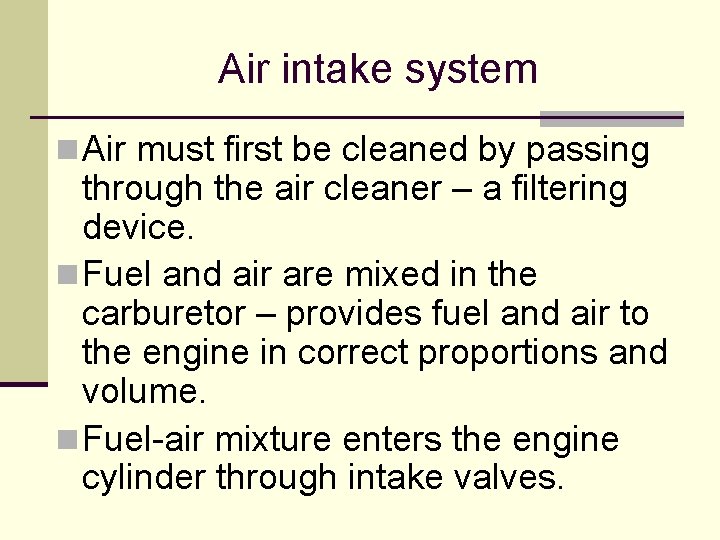
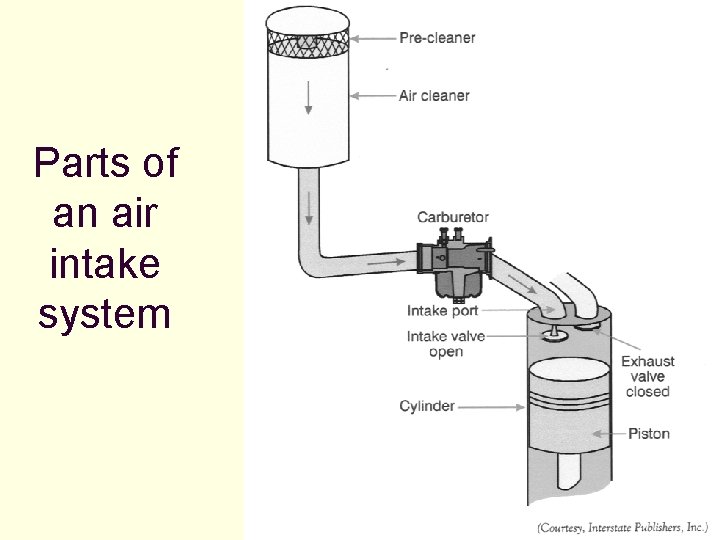
Air intake system n Air must first be cleaned by passing through the air cleaner – a filtering device. n Fuel and air are mixed in the carburetor – provides fuel and air to the engine in correct proportions and volume. n Fuel-air mixture enters the engine cylinder through intake valves.
Parts of an air intake system
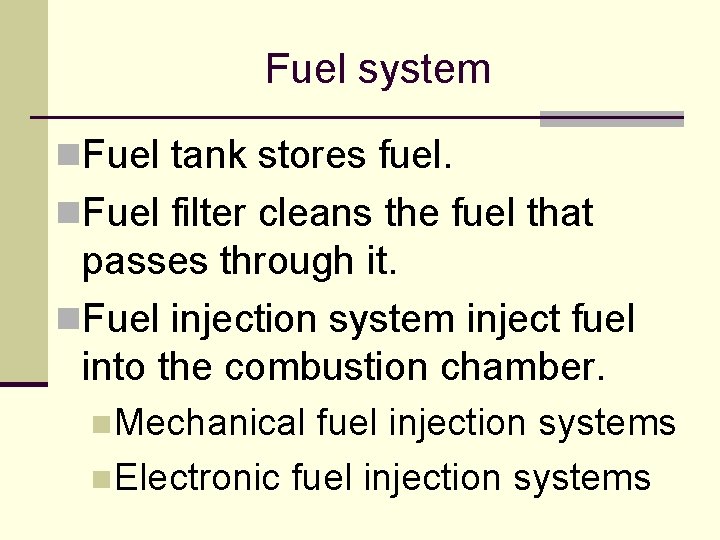
Fuel system n. Fuel tank stores fuel. n. Fuel filter cleans the fuel that passes through it. n. Fuel injection system inject fuel into the combustion chamber. n. Mechanical fuel injection systems n. Electronic fuel injection systems
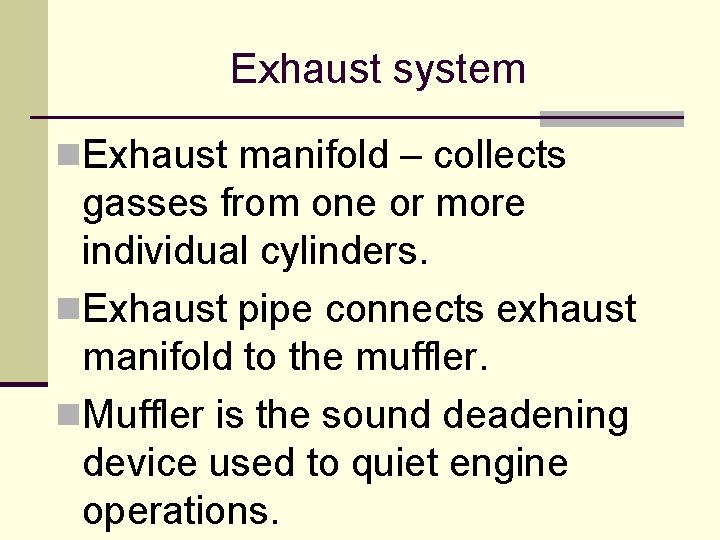
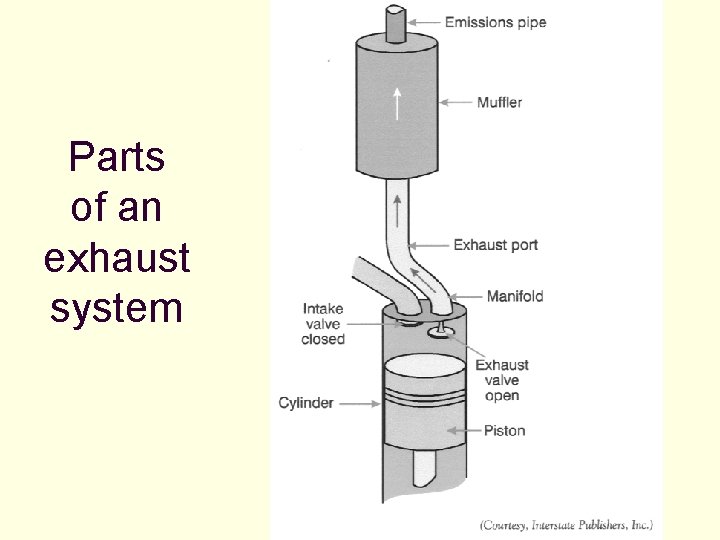
Exhaust system n. Exhaust manifold – collects gasses from one or more individual cylinders. n. Exhaust pipe connects exhaust manifold to the muffler. n. Muffler is the sound deadening device used to quiet engine operations.
Parts of an exhaust system
Engine cooling system n. Liquid cooling system – uses a liquid to transfer heat from engine components to the surrounding air. n. Air-cooled system – transfers the heat of the engine components directly to the surrounding air.
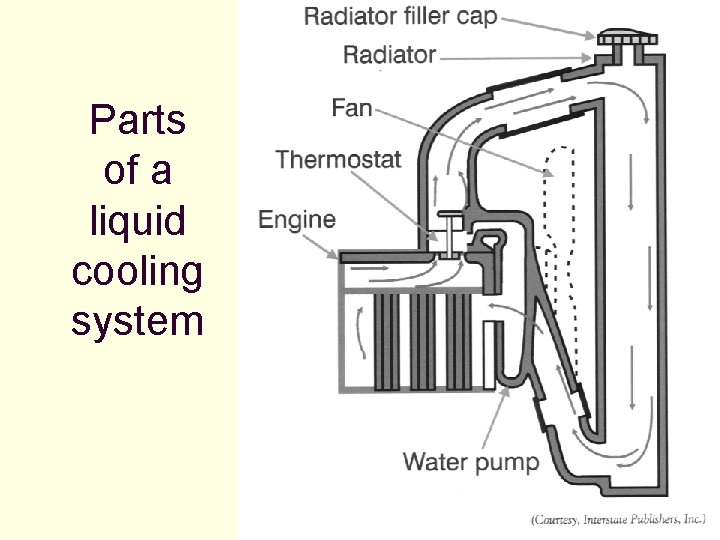
Components of a liquid cooling system n. Radiator – a heat transfer device. n. Water pump – forces the coolant to flow thorough the system. n. Thermostat – a flow control valve. n. Additional components: radiator cap, water jacket, fan belt, and temperature gage.
Parts of a liquid cooling system
Ignition system n. Compression ignition system – does not consist of any unique parts. n. Spark Ignition systems – uses high voltage electrical spark to ignite the compressed air and fuel mixture.
Spark ignition systems n. Magneto–type ignition systems – use magnets and coils to generate electrical pressure to ark the spark plug. n. Battery-type ignition systems - use the energy from a battery and/or alternator to create the ignition spark.
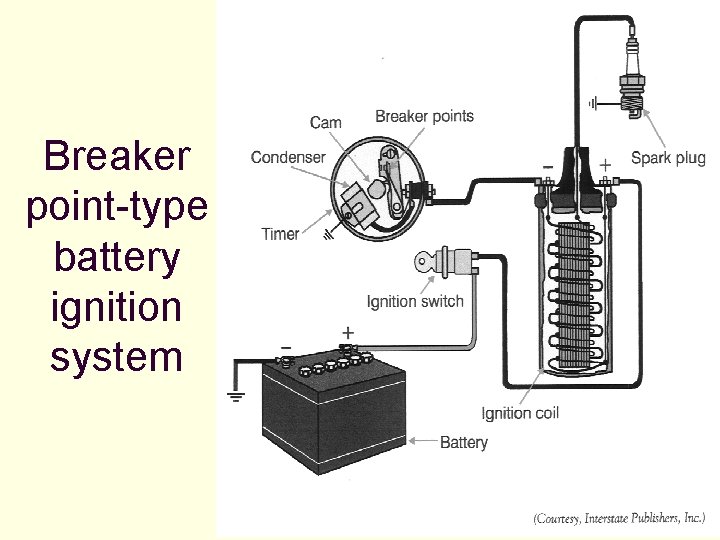
Battery-type ignition systems n Breaker point-type battery system – an ignition switch begins the process. n Ignition coil – converts low battery voltage to high voltage. n Distributor – sends the high voltage current to the correct spark plug. n Condenser – function as a capacitor which stores electrical energy.
Battery-type ignition systems (continued) n. Breaker points – provide a switch to initiate the spark in the engine. n. Distributor cam –controls the opening and closing of the breaker points, and regulates through the distributor rotor the timing of the engine spark.
Breaker point-type battery ignition system
Lubrication system n. Oil filter – removes dirt particles from oil. n. Pressure regulator – maintains the operating pressure of the system. n. Sump – a reservoir for the engine oil. n. Oil pump – circulates oil through the engine.
Starting system n. Manual – manually turning the crankshaft – rope starter n. Electrical – solenoid-type switch controls the voltage going to the starter n. Flywheel – a gear which is attached to the crankshaft
Review/Summary n. What are three categories of internal combustion engine systems? n. Identify the components of the primary or compression system n. What components make up an engine’s operating system?