
Lesson I All About Nouns Nouns are the
Lesson I All About Nouns
Nouns are the names of persons places or things.
Latin Nouns Have 4 Features • Case---how a noun works in its sentence. • Number---whether a noun is singular or plural (singular=one, plural=more than one) • Gender---whether a noun is masculine, feminine, or neuter. • Declension---each noun belongs to one of the 5 declensions: groups of nouns that share the same pattern of endings
1 st Declension Nouns • Let’s learn how to write a 1 st declension noun on its “declension chart. ” • A declension chart shows the noun in all its cases (spellings). • For example…
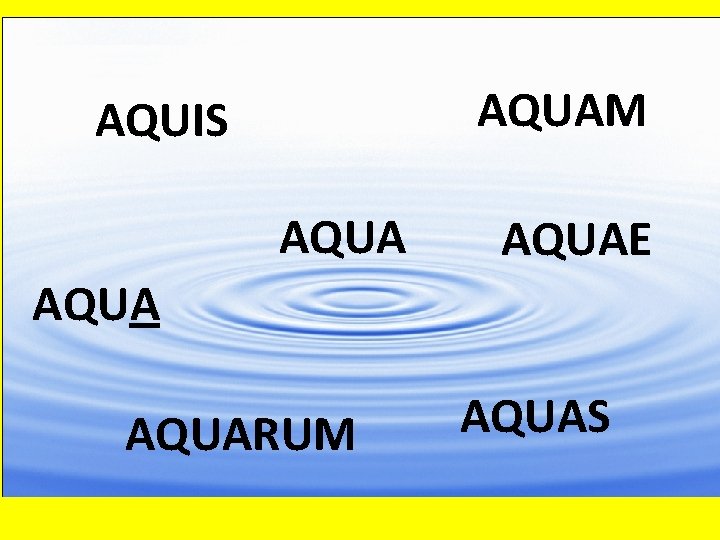
AQUAM AQUIS AQUAE AQUARUM AQUAS
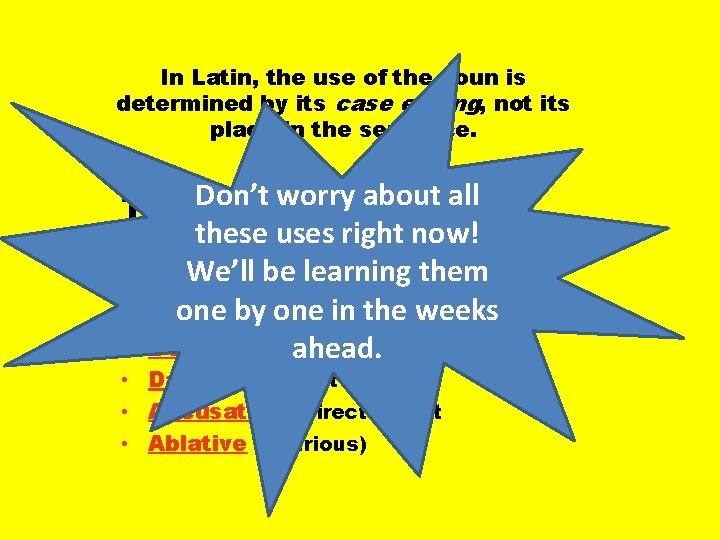
In Latin, the use of the noun is determined by its case ending, not its place in the sentence. Don’t all There areworry fiveabout cases: these uses right now! We’ll be learning them • Nominative - subject and predicate one by onenominative in the weeks • Genitive – possession ahead. • Dative - indirect object • Accusative - direct object • Ablative – (various)
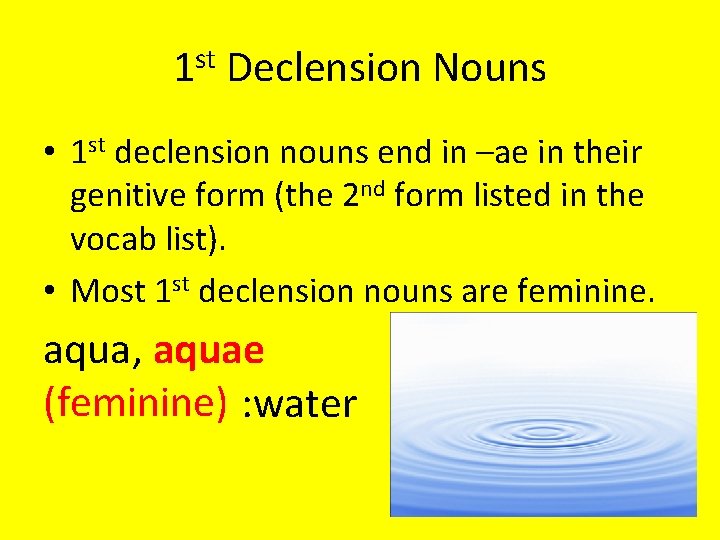
1 st Declension Nouns • 1 st declension nouns end in –ae in their genitive form (the 2 nd form listed in the vocab list). • Most 1 st declension nouns are feminine. aqua, aquae (feminine) : water
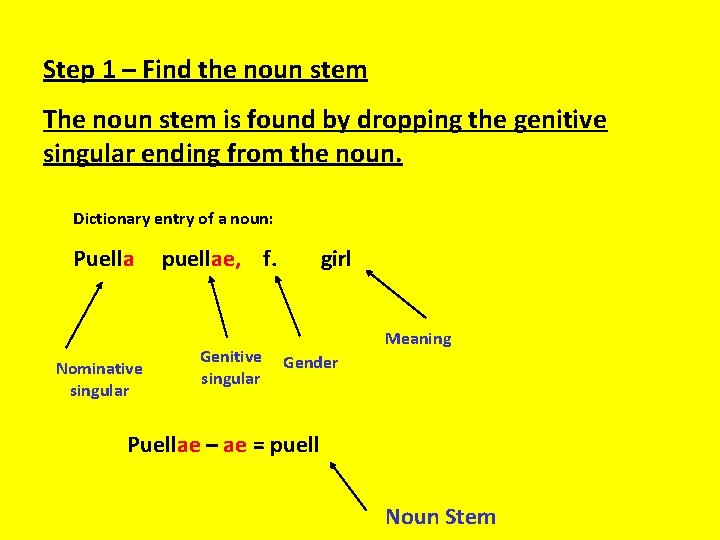
Step 1 – Find the noun stem The noun stem is found by dropping the genitive singular ending from the noun. Dictionary entry of a noun: Puella Nominative singular puellae, f. Genitive singular girl Meaning Gender Puellae – ae = puell Noun Stem
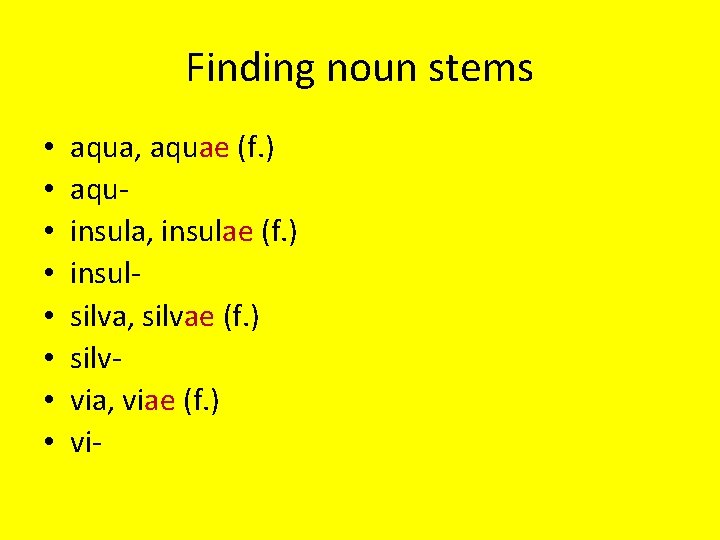
Finding noun stems • • aqua, aquae (f. ) aquinsula, insulae (f. ) insulsilva, silvae (f. ) silvvia, viae (f. ) vi-
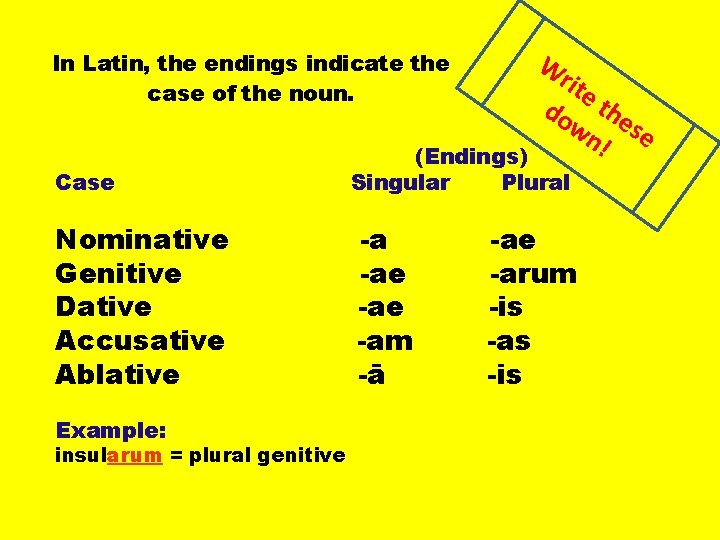
In Latin, the endings indicate the case of the noun. W rit et do he wn se ! Case (Endings) Singular Plural Nominative Genitive Dative Accusative Ablative -a -ae -am -ā Example: insularum = plural genitive -arum -is -as -is

Step 2: Add the case endings to the noun stem. Singular Plural Nominative Genitive Dative Accusative Ablative On your whiteboard, decline the following 2 nouns: via, viae (f. ) and aqua, aquae (f. )

CASES: NOMINATIVE CASE SUBJECTS AND PREDICATE NOMINATIVES

Sentences: Subject and Predicate “Sentence” comes from the Latin word “sententia” which means “thought. ” Sentences are words grouped together to form thoughts!

Sentences: Subject and Predicate Every sentence has 2 parts: the SUBJECT and the PREDICATE. ITALY is a peninsula. The GIRLS carry water.
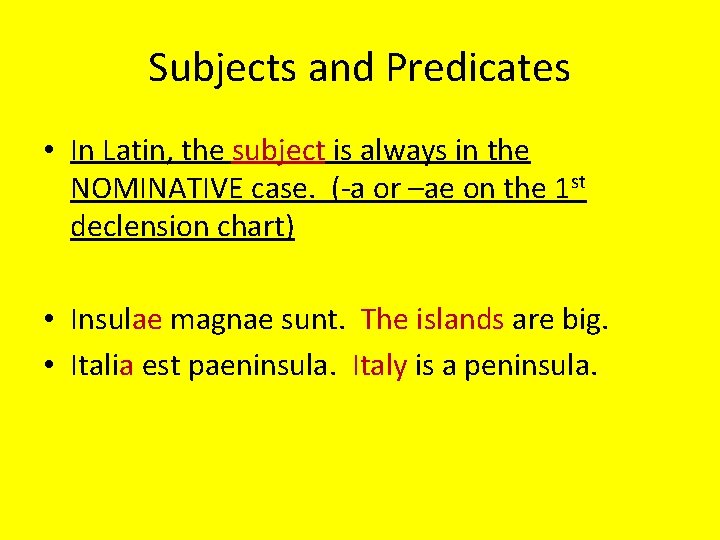
Subjects and Predicates • In Latin, the subject is always in the NOMINATIVE case. (-a or –ae on the 1 st declension chart) • Insulae magnae sunt. The islands are big. • Italia est paeninsula. Italy is a peninsula.
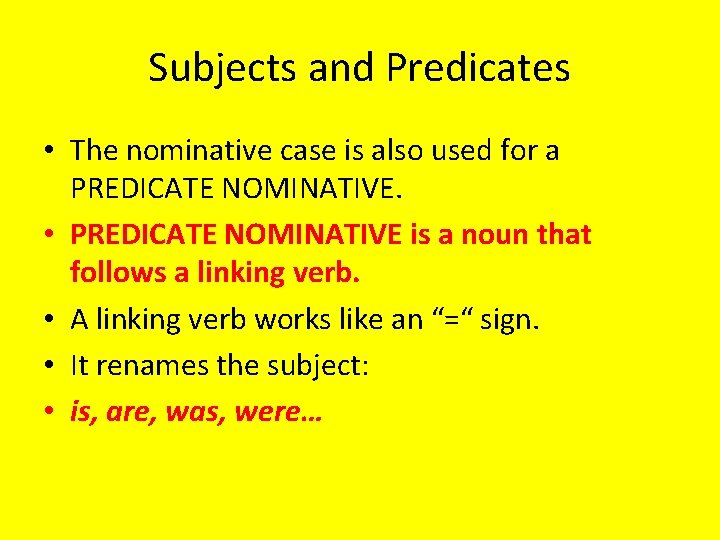
Subjects and Predicates • The nominative case is also used for a PREDICATE NOMINATIVE. • PREDICATE NOMINATIVE is a noun that follows a linking verb. • A linking verb works like an “=“ sign. • It renames the subject: • is, are, was, were…

Predicate Nominatives • • • John is a student. John=student. The teacher is Mrs. Sellers. Teacher=Mrs. Sellers. Brittania est insula. A=B Britain is an island. Britain=island.

Time to practice! • • Latin is my favorite class. Those girls are my best friends.
Time to practice! • Rome was once a little settlement on the Tiber River. • Many English words are derivatives of Latin.
Let’s Practice • • • 2. Corsica et Melita sunt insulae. 4. Florida paeninsula est. 6. Sunt silvae in Germania. 8. Troia (Troy) non in Africa sed in Asia est. 10. Estne (Is…) aqua in Sahara? Estne in Canada aqua?
- Slides: 20