
Lesson Comparing SinglePhase and ThreePhase Systems Interest Approach
- Slides: 47
Lesson Comparing Single-Phase and Three-Phase Systems
Interest Approach n Does anyone have 3 phase current at home or at work? n What would be an indication of 3 phase current
Student Learning Objectives n Describe the primary difference between single-phase and threephase current. n Describe advantages and disadvantages of three-phase current as compared to single-phase current.
Student Learning Objectives n Explain the differences between delta-connected, open deltaconnected, and wye-connected transformers and their resulting voltages.
Terms n Delta-connected transformers n Open delta-connected transformers n Wye-connected transformers
Objective 1 How is three-phase current different from single-phase current?
Electrical Service n Electrical service can be available in single-phase current or three-phase current.
Electrical Service n Many years ago, single-phase current was sufficient to do the work that was necessary on nearly all farms.
Electrical Service n However, as farm sizes increased and the size of workloads for electric motors increased, single-phase current was not enough to meet the load demands.
Electrical Service n As a result, three-phase current at the local farm level became a viable solution for several farms.
Single Phase Current n With single-phase current, the voltage rises to a peak in one direction of flow, subsides to zero, reverses, rises to a peak in the opposite direction, subsides to zero, and so on.
Single Phase Current n The cycle repeats itself 60 times every second, which is where we get the term 60 -cycle or 60 -hertz alternating current. n Single-phase current requires the use of one transformer.
Three Phase `Current n In the case of three-phase current, the same pattern exists, except that there are three separate and distinct single-phase currents, which are combined so they can be transmitted over three or four wires.
Three-Phase Current n The three currents rise to a peak in one direction, subside, reverse, and so on; however they do not peak at the same time. n Each phase reaches its peak 120 degrees apart from the others.
Three-Phase Current n Three-phase current requires two or three transformers.
Objective 2 What are some advantages and disadvantages of three-phase current as compared to single-phase current?
Single-Phase Vs. Three-Phase n As with most choices, there advantages and disadvantages that someone must consider. n In order to choose three-phase current, one must know that the advantages outweigh the disadvantages.
Single-Phase Vs. Three-Phase n Three-phase current offers a steadier source of power. n Magnetic force which, causes motor rotation is strongest when current flow is at its peak in the cycle.
Single-Phase Vs. Three-Phase n Single-phase current peaks twice during one cycle, whereas, threephase current peaks six times during one cycle.
Single-Phase Vs. Three-Phase n Three-phase motors are simpler, cheaper to buy and maintain, and safer to use around combustible materials since there is no sparking when they start.
Single-Phase Vs. Three-Phase n This is because three-phase current allows a motor to be self-starting since it produces a rotating field of magnetism in the motor. n This eliminates the need for a separate starting winding, centrifugal switch, starting capacitor, or a system of brushes.
Single-Phase Vs. Three-Phase n Three-phase motors are available in larger horsepower sizes than singlephase motors. n Current is supplied to the motor with three conductors rather than two.
Single-Phase Vs. Three-Phase n This allowed the power supplied to larger three-phase motors to be on the same size conductor as that required for smaller single-phase motors.
Single-Phase Vs. Three-Phase n. A balanced three-phase, three-wire circuit with equal voltages uses 75% of the copper required for conductors.
Single-Phase Vs. Three-Phase n They supply a single phase two-wire circuit of the same capacity, voltage rating, length of circuit, and transmission efficiency.
Single-Phase Vs. Three-Phase n Three-phase motors are less expensive and usually lighter and smaller than single-phase motors of the same horsepower rating. n There is also a wider choice of enclosures available than for singlephase motors.
Single-Phase Vs. Three-Phase n Three-phase current service is much more expensive to have than singlephase current at a local farm. n It requires more lines to be brought in and three transformers versus one transformer required for singlephase current
Objective 3 What is the difference between delta-connected, open deltaconnected, and wye-connected transformers and how do the voltages differ between them?
Three Phase n. A three-phase farm installation requires at least three primary wires instead of two and generally two or three transformers rather than one. n These transformers may be connected in one of three ways:
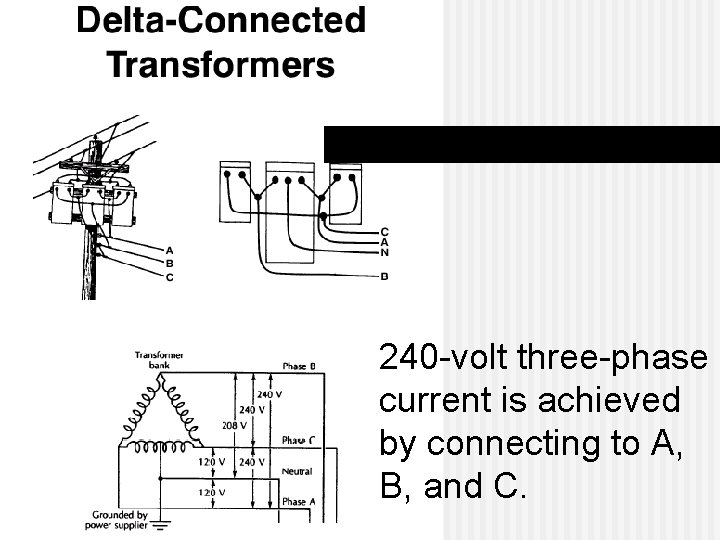
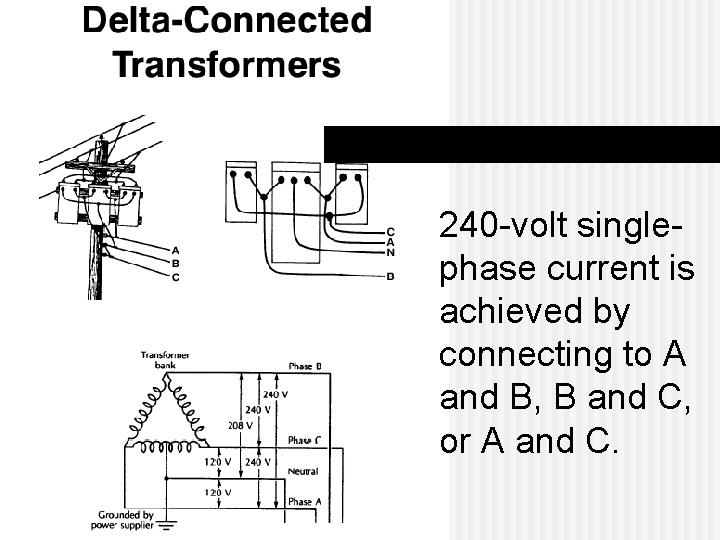
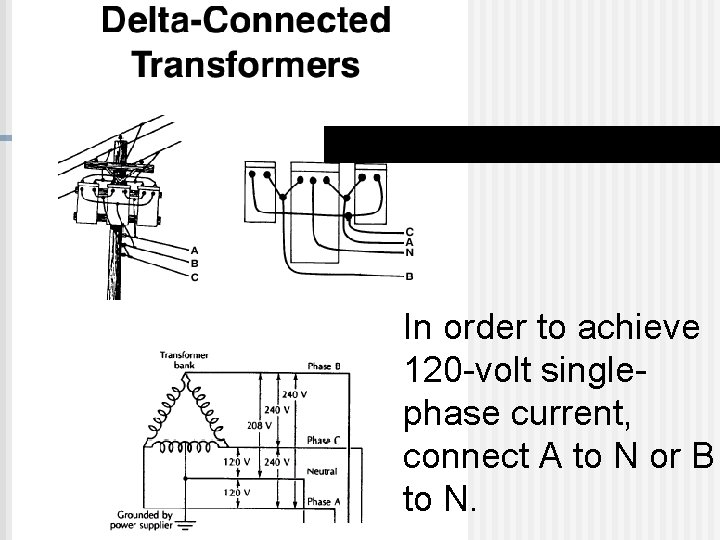
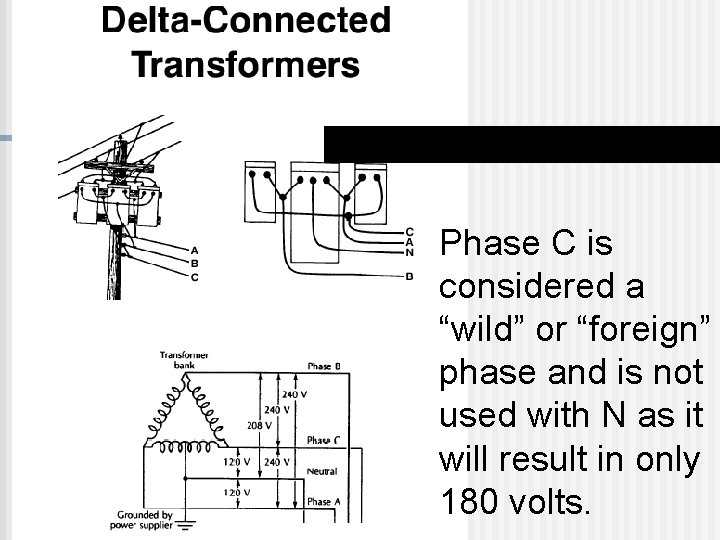
Delta-connected transformers n Require three transformers. n They are connected in a configuration resembling the Greek letter delta. n If only 240 -volt service is needed, one connection is made to each transformer.
Delta-connected transformers n However, if 120 -volt and 240 -volt services are needed, one of the transformers is center tapped to provide the 120 -volt service. n The center tap is grounded and becomes the neutral wire for the regular wiring system
240 -volt three-phase current is achieved by connecting to A, B, and C.
240 -volt singlephase current is achieved by connecting to A and B, B and C, or A and C.
In order to achieve 120 -volt singlephase current, connect A to N or B to N.
Phase C is considered a “wild” or “foreign” phase and is not used with N as it will result in only 180 volts.
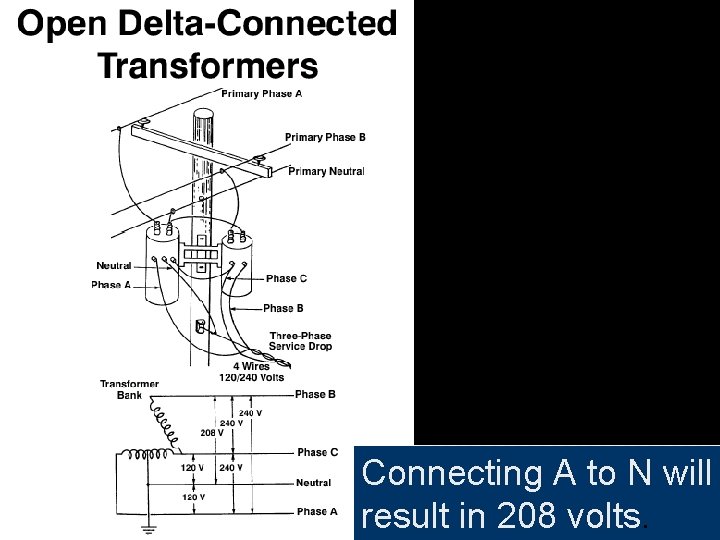
Open delta-connected transformers n Require only two transformers. n This type of connection is therefore less costly, however you cannot obtain as much power from a given size transformer as you can with the delta connection.
Open delta-connected transformers n This connection is often used where the power requirement is relatively low or intermittent.
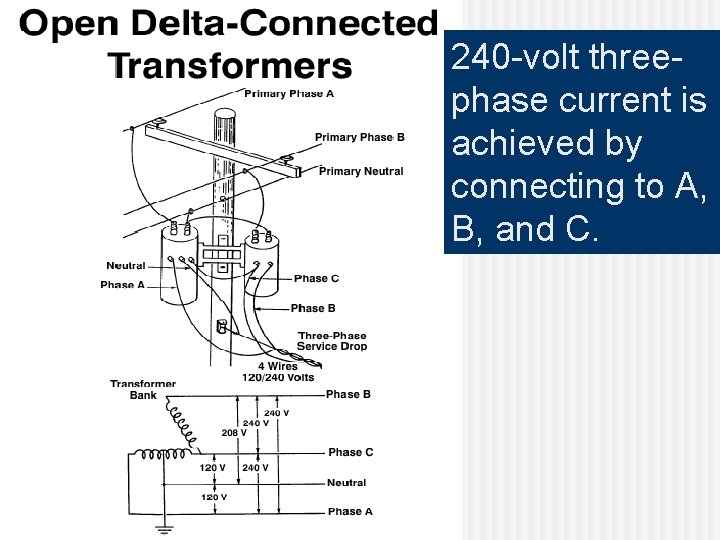
240 -volt threephase current is achieved by connecting to A, B, and C.
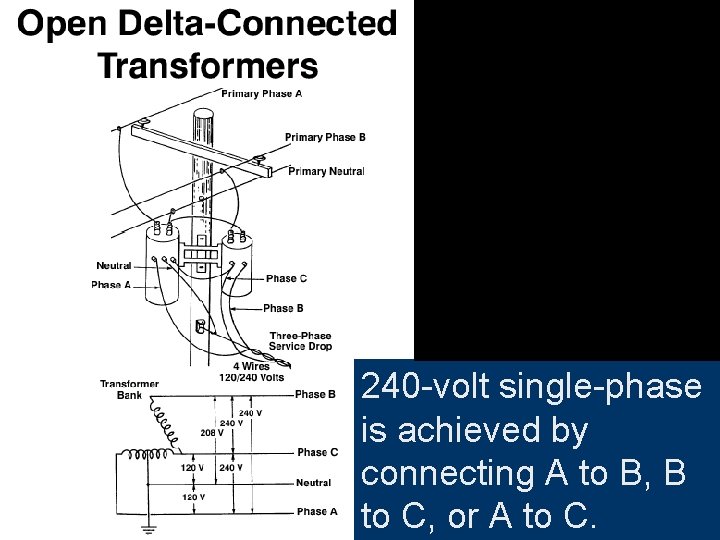
240 -volt single-phase is achieved by connecting A to B, B to C, or A to C.
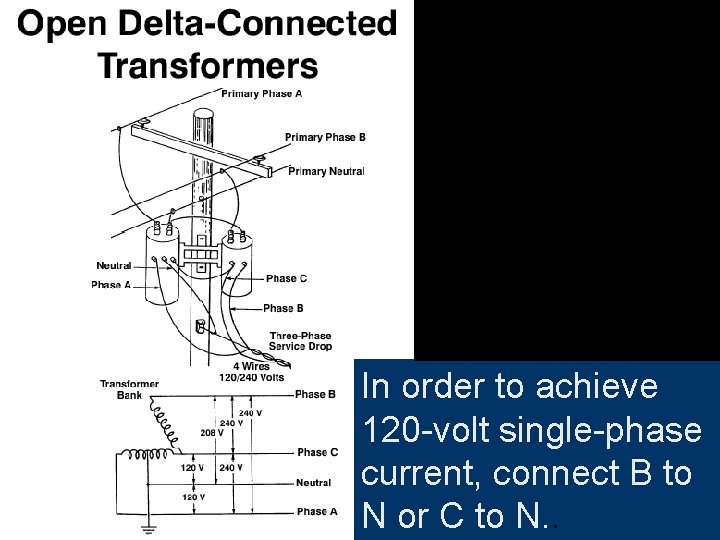
In order to achieve 120 -volt single-phase current, connect B to N or C to N. .
Connecting A to N will result in 208 volts.
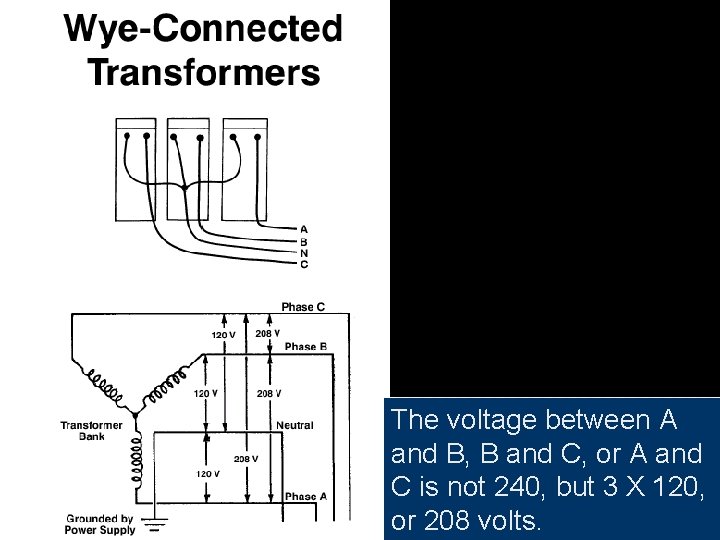
Wye-connected transformers n Require n They three transformers. are connected in a configuration that resembles the letter “Y”.
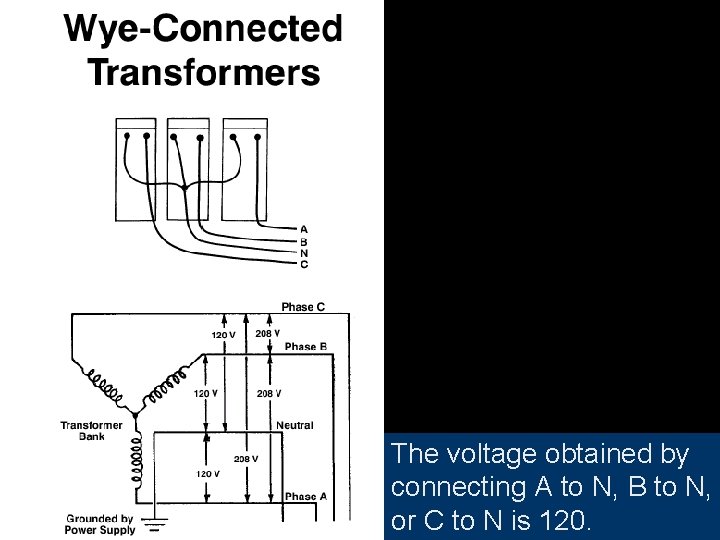
Wye-connected transformers n This type of connection usually results in a 4 -wire service, one wire being common to all transformers and grounded to form a neutral. n The wye connection offers 120 - and 208 -volt currents.
The voltage obtained by connecting A to N, B to N, or C to N is 120.
The voltage between A and B, B and C, or A and C is not 240, but 3 X 120, or 208 volts.
Review n 1. Describe the primary difference between single-phase and threephase current. n 2. Describe advantages and disadvantages of three-phase current as compared to single-phase current.
Review n 3. Explain the differences between delta-connected, open deltaconnected, and wye-connected transformers and their resulting voltages.