
Lesson C5 Checks and Balances Todays Essential Question
Lesson C-5: Checks and Balances Today’s Essential Question: How does the Constitution’s system of checks and balances keep a balance of power between the branches?
Vocabulary • check – an action that limits the action of someone else • unconstitutional – is not consistent with the Constitution • impeach – charge officially with a crime
What We Already Know The Seven Principles of the Constitution included the separation of powers and a system of checks and balances, to keep any single branch of government from gaining too much power over the people.
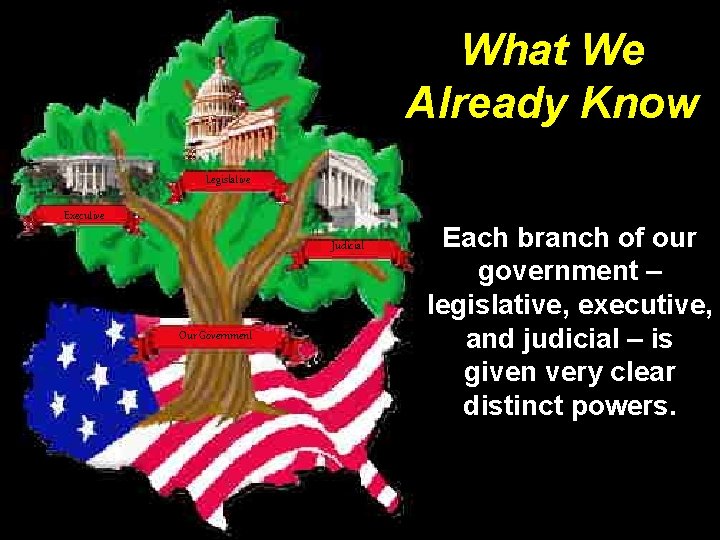
What We Already Know Legislative Executive Judicial Our Government Each branch of our government – legislative, executive, and judicial – is given very clear distinct powers.
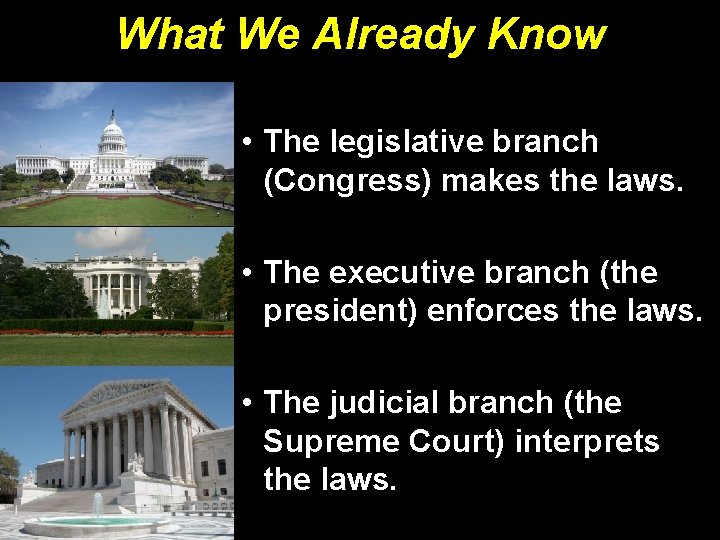
What We Already Know • The legislative branch (Congress) makes the laws. • The executive branch (the president) enforces the laws. • The judicial branch (the Supreme Court) interprets the laws.

The Legislative Branch (Congress) makes the laws. Checks on the Executive Branch • can strike down treaties made by the executive branch • can refuse to confirm the president’s appointment of cabinet members and ambassadors • can override presidential vetoes of laws • controls money from taxes and tariffs, which can be used to pay for executive actions • can impeach the president and other government officials who work for him
The Legislative Branch (Congress) makes the laws. Checks on the Judicial Branch • can refuse to confirm judicial appointments • can impeach justices • can propose amendments to overturn judicial decisions • can change the number of Supreme Court justices

The Executive Branch (President) executes laws passed by Congress. Checks on the Legislative Branch • vetoes laws he believes are unwise or unconstitutional • can propose bills and call special sessions of Congress • controls political patronage (i. e. , giving government agency jobs to supporters)
The Executive Branch (President) executes laws passed by Congress. Checks on the Judicial Branch • appoints Supreme Court justices and federal court judges • grants pardons to convicted felons
The Judicial Branch (the Supreme Court) interprets the laws. • ‘Interpret’ means to decide is a law fits with the Constitution • Also decides what the wording of the Constitution means in everyday life • This is known as judicial review.
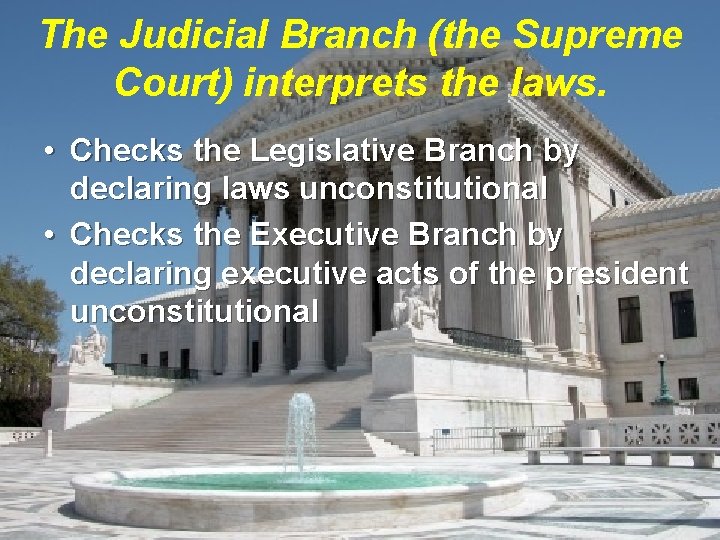
The Judicial Branch (the Supreme Court) interprets the laws. • Checks the Legislative Branch by declaring laws unconstitutional • Checks the Executive Branch by declaring executive acts of the president unconstitutional
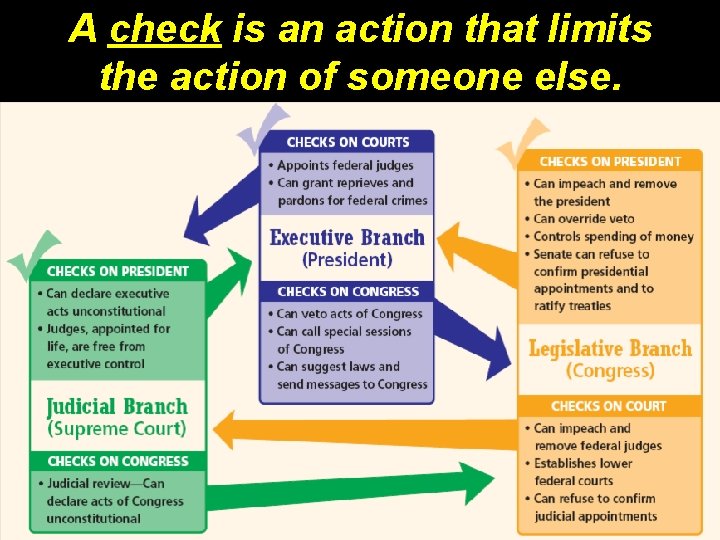
A check is an action that limits the action of someone else.
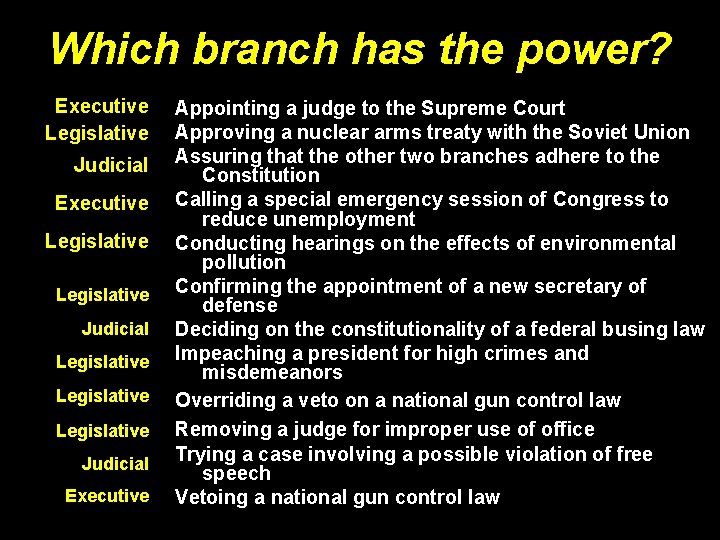
Which branch has the power? Executive Legislative Judicial Legislative Judicial Executive Appointing a judge to the Supreme Court Approving a nuclear arms treaty with the Soviet Union Assuring that the other two branches adhere to the Constitution Calling a special emergency session of Congress to reduce unemployment Conducting hearings on the effects of environmental pollution Confirming the appointment of a new secretary of defense Deciding on the constitutionality of a federal busing law Impeaching a president for high crimes and misdemeanors Overriding a veto on a national gun control law Removing a judge for improper use of office Trying a case involving a possible violation of free speech Vetoing a national gun control law
- Slides: 13