
Lesson B 3 2 Measuring Trees Next Generation
Lesson B 3– 2 Measuring Trees
Next Generation Science / Common Core Standards Addressed! · HSNQ. A. 1 Use units as a way to understand problems and to guide the solution of multi‐step problems; choose and interpret units consistently in formulas; choose and interpret the scale and the origin in graphs and data displays. (HS‐LS 2‐ 4) · HSNQ. A. 3 Choose a level of accuracy appropriate to limitations on measurement when reporting quantities. (HS‐LS 2‐ 4)
Bell Work / Student Learning Objectives. · 1. Describe the common units of measure used in forestry. · 2. Explain how to determine the diameter of a standing tree. · 3. Explain how to measure the height of standing trees.
Terms. · · · Basal area Board foot Breast height Cord Cubic foot Cubit · · dbh Hypsometer Linear foot Merchantable height · Piece
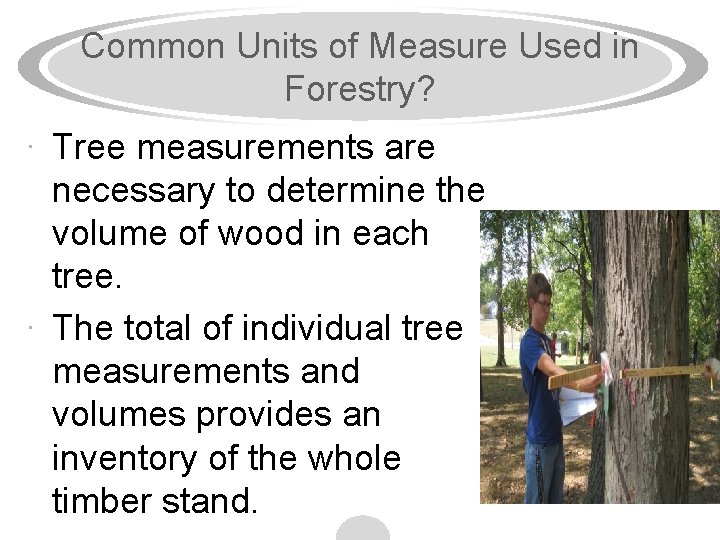
Common Units of Measure Used in Forestry? · Tree measurements are necessary to determine the volume of wood in each tree. · The total of individual tree measurements and volumes provides an inventory of the whole timber stand.
Common Units of Measure Used in Forestry? · Timber trees are measured with a variety of units of measure. · Some of these units are unique to the lumber industry and others are also used for generally measuring.
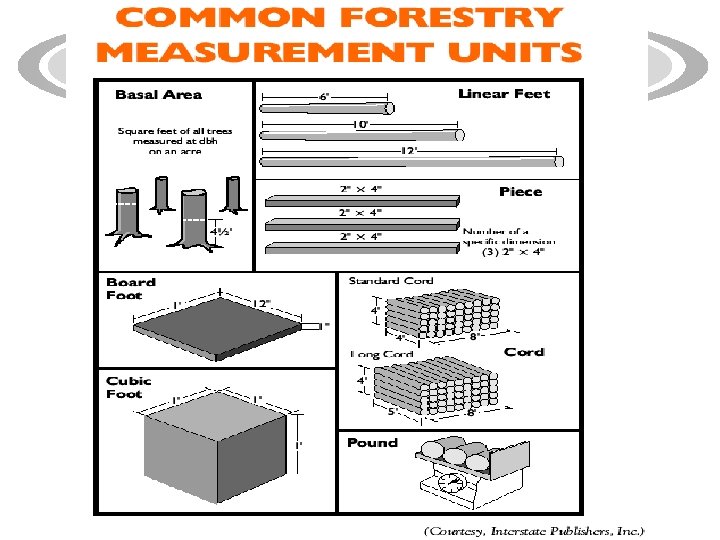
Board foot · A unit of measurement represented by a piece of rough wood 1 foot square and 1 inch think. · The board foot is generally used to measure sawtimber and veneer timber. · In surfaced or finished lumber, width and thickness are based on measurements before surfacing or other finishing.
Cubic foot · A unit of measurement equal to the volume of a cube of rough wood 1 foot in length on each of its six sides. · A cubic foot contains 12 board feet. · The unit is used to measure all kinds of timber products.
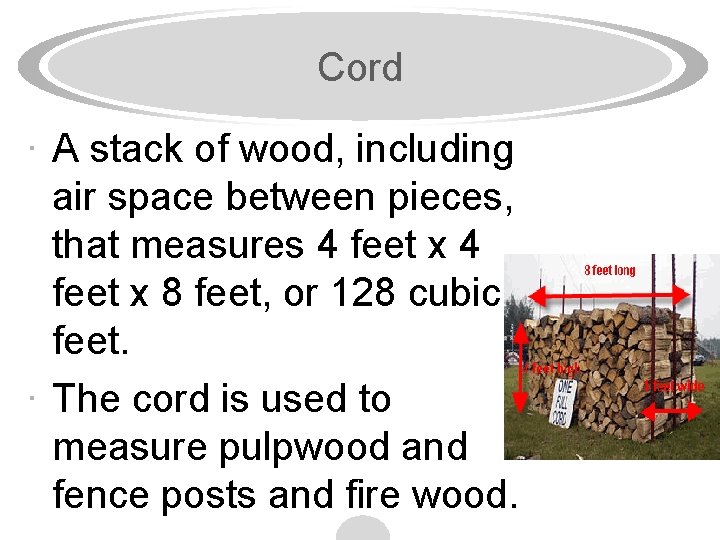
Cord · A stack of wood, including air space between pieces, that measures 4 feet x 8 feet, or 128 cubic feet. · The cord is used to measure pulpwood and fence posts and fire wood.
Cubit and Piece · A stack of wood containing 100 cubic feet of solid wood. · A “piece” is a unit of measurement that refers to the number or quantity of timber products of a specified dimension.
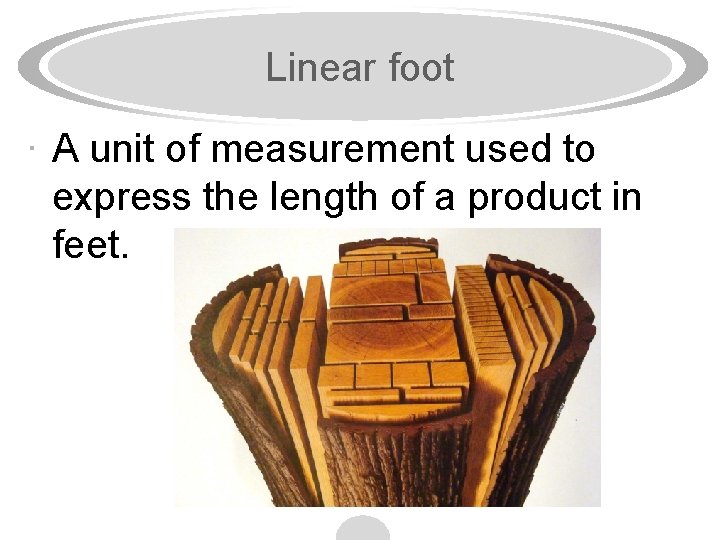
Linear foot · A unit of measurement used to express the length of a product in feet.
Basal area · A unit of measurement applied to standing timber to indicate the level of stocking. · It is the cross-sectional area of trees at breast height, or 4 1/2 feet above the average ground line. · Basal area is expressed in square feet. It may apply to individual trees, or it may apply to all trees when it is expressed on an acre basis.
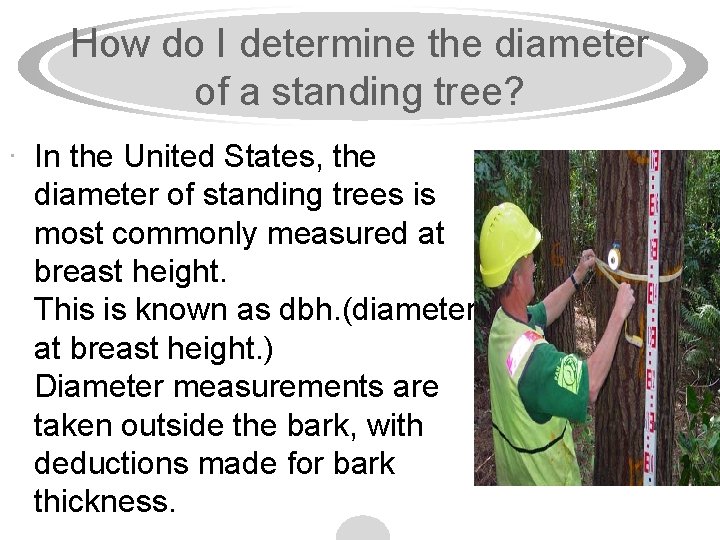
How do I determine the diameter of a standing tree? · In the United States, the diameter of standing trees is most commonly measured at breast height. This is known as dbh. (diameter at breast height. ) Diameter measurements are taken outside the bark, with deductions made for bark thickness.
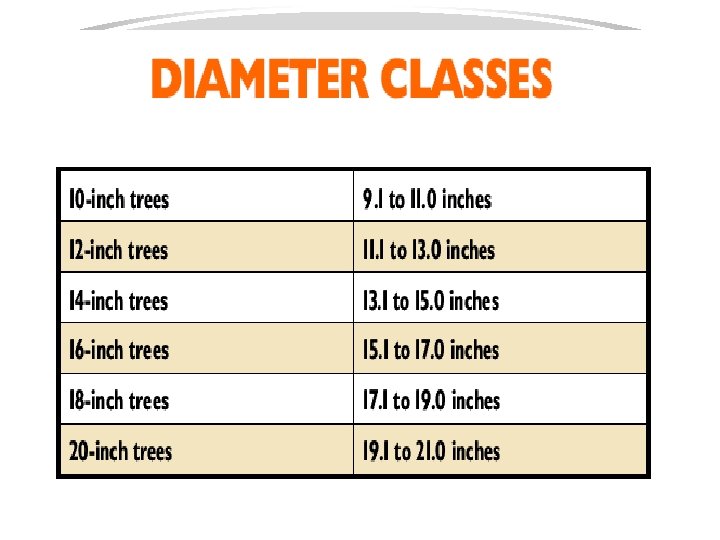
How do I determine the diameter of a standing tree? · Tree diameters are usually recorded in even 2 -inch classes to facilitate volume determination. · Typically diameter classes are 6 -, 8, 10 -, 12 -, and 14 -inch diameters. · A tree is placed in a diameter class according to diameter in the nearest 2 -inch class.
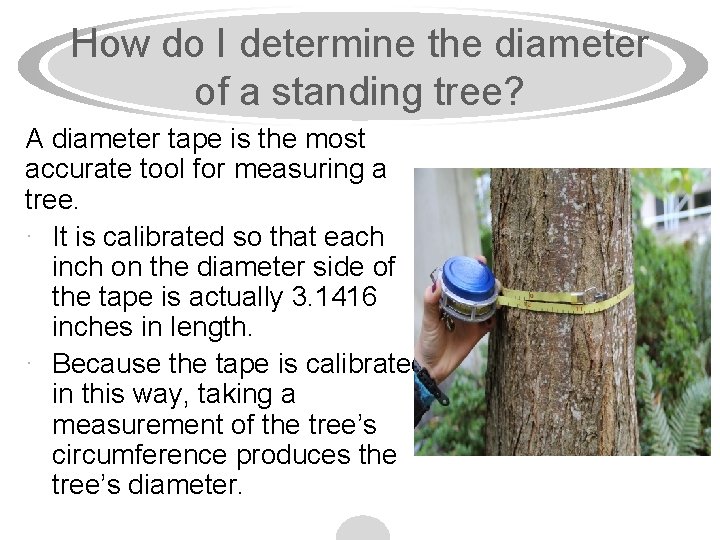
How do I determine the diameter of a standing tree? A diameter tape is the most accurate tool for measuring a tree. · It is calibrated so that each inch on the diameter side of the tape is actually 3. 1416 inches in length. · Because the tape is calibrated in this way, taking a measurement of the tree’s circumference produces the tree’s diameter.
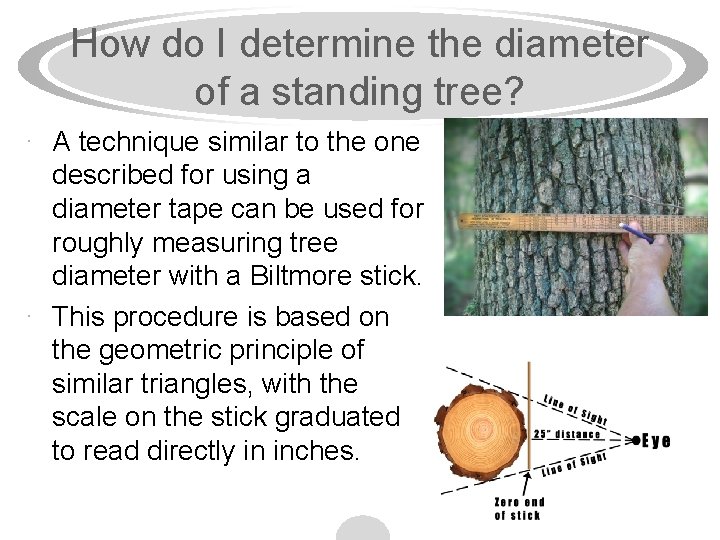
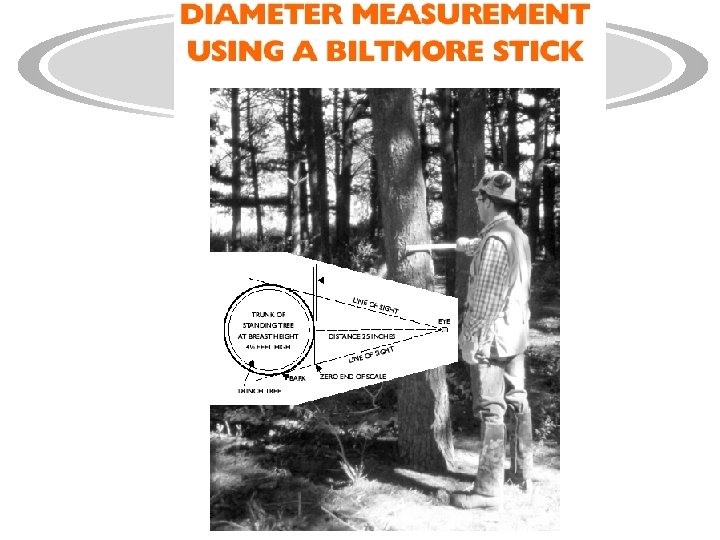
How do I determine the diameter of a standing tree? · A technique similar to the one described for using a diameter tape can be used for roughly measuring tree diameter with a Biltmore stick. · This procedure is based on the geometric principle of similar triangles, with the scale on the stick graduated to read directly in inches.
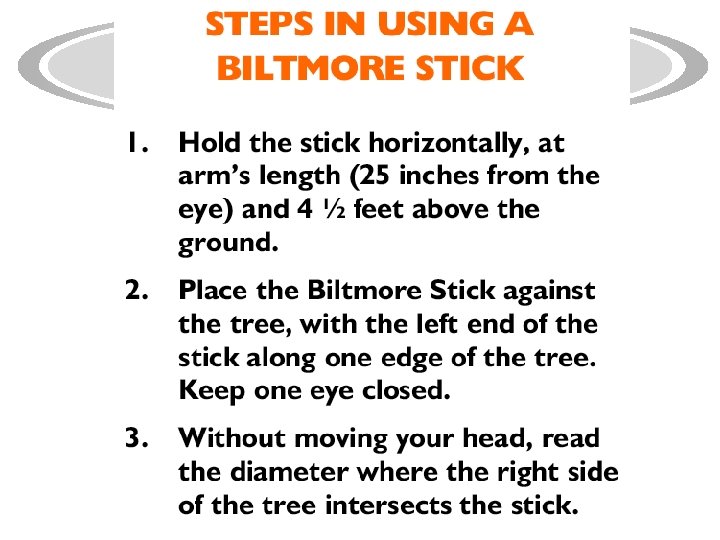
How do I measure the height of standing trees? · Tree height may be measured in terms of feet or number of logs or bolts. · A tree is measured to either its total height or its merchantable height.
How do I measure the height of standing trees? · Merchantable height refers to the usable length of the tree for a specific product and is measured from the stump height to the cut-off point near the top.
How do I measure the height of standing trees? · This cut-off point is located where the stem diameter reaches a minimum size for the product for which the tree is to be harvested or where excess limbs or forks prevent closer utilization. · Merchantable height for a sawtimber tree is determined by the number of 16 foot logs and half logs that can be cut from a tree.
How do I measure the height of standing trees? · The cut-off point for sawtimber trees varies from 6 to 10 inches. · Merchantable height for a pulpwood tree is usually tallied to the nearest pulpwood bolt of a given length. · This will be 4 feet, 5 feet, or 5 feet 3 inches, depending on pulp mill specifications. The cut-off point for pulpwood is generally 4 inches.
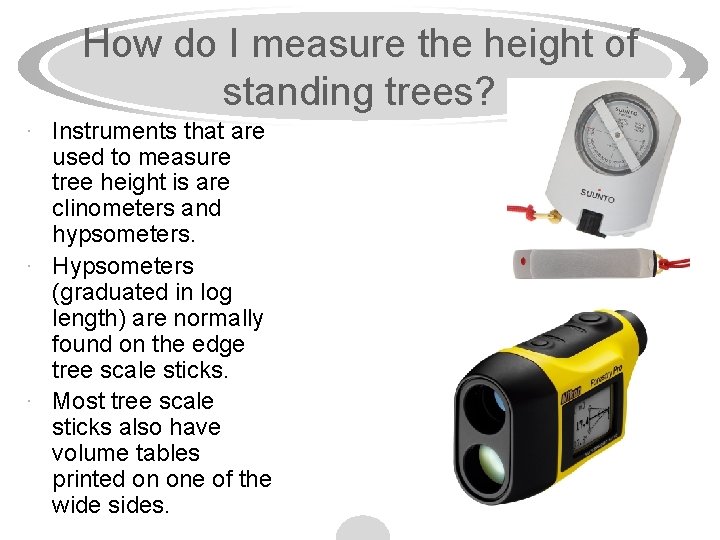
How do I measure the height of standing trees? · Instruments that are used to measure tree height is are clinometers and hypsometers. · Hypsometers (graduated in log length) are normally found on the edge tree scale sticks. · Most tree scale sticks also have volume tables printed on one of the wide sides.
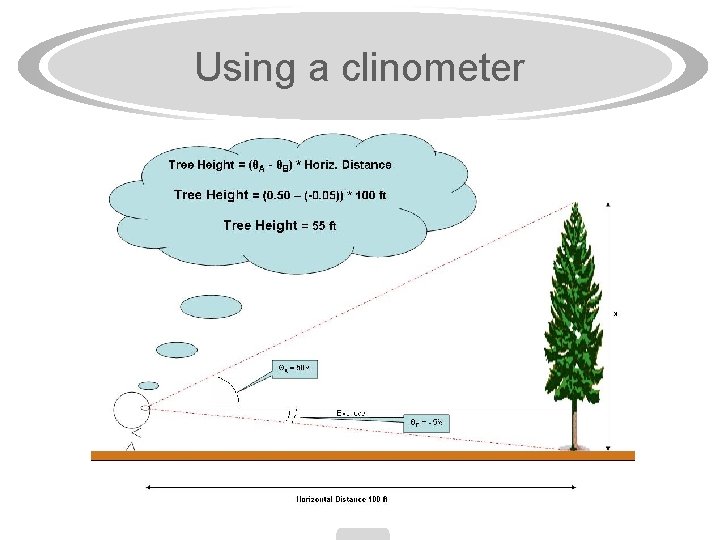
Using a clinometer
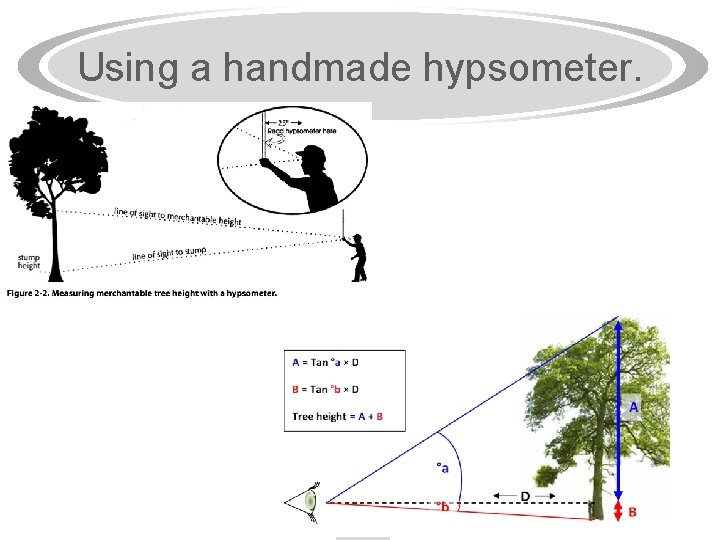
Using a handmade hypsometer.
Review / Summary. · 1. Describe the common units of measure used in forestry. · 2. Explain how to determine the diameter of a standing tree. · 3. Explain how to measure the height of standing trees.

The End!
- Slides: 29