
Lesson A Exploring the Food System 2016 Johns


- Slides: 6
Lesson A Exploring the Food System © 2016 Johns Hopkins University
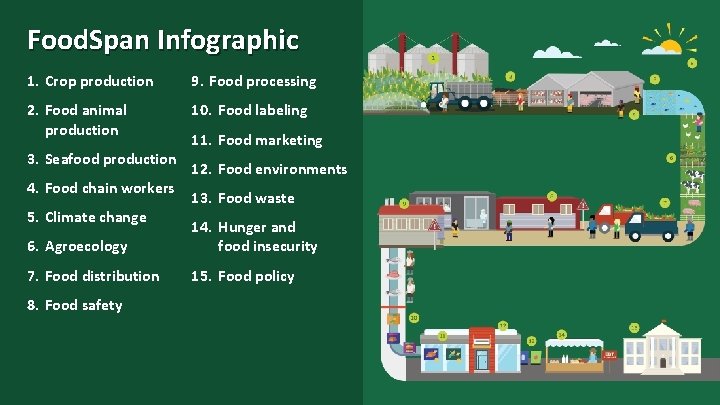
Food. Span Infographic 1. Crop production 9. Food processing 2. Food animal production 10. Food labeling 3. Seafood production 4. Food chain workers 5. Climate change 11. Food marketing 12. Food environments 13. Food waste 6. Agroecology 14. Hunger and food insecurity 7. Food distribution 15. Food policy 8. Food safety
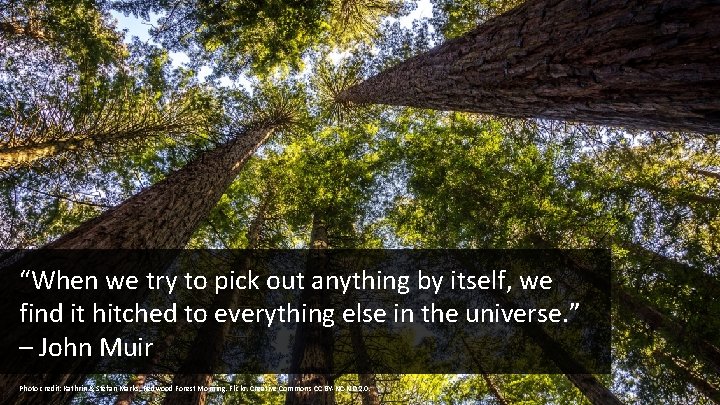
“When we try to pick out anything by itself, we find it hitched to everything else in the universe. ” – John Muir Photo credit: Kathrin & Stefan Marks. Redwood Forest Morning. Flickr. Creative Commons CC BY-NC-ND 2. 0.
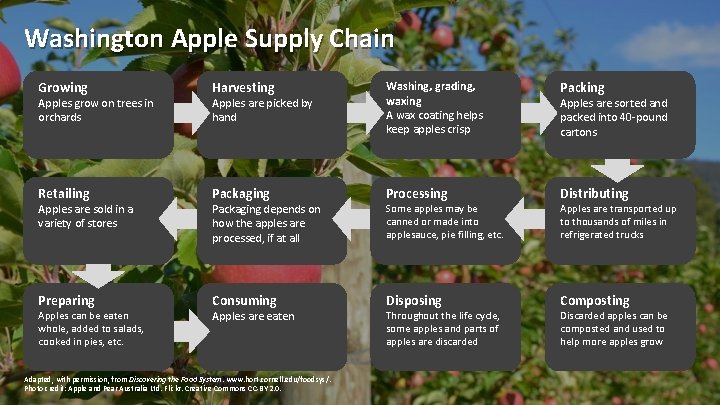
Washington Apple Supply Chain Growing Harvesting Apples are picked by hand Washing, grading, waxing A wax coating helps keep apples crisp Packing Retailing Packaging Processing Distributing Preparing Consuming Disposing Composting Apples grow on trees in orchards Apples are sold in a variety of stores Apples can be eaten whole, added to salads, cooked in pies, etc. Packaging depends on how the apples are processed, if at all Apples are eaten Adapted, with permission, from Discovering the Food System. www. hort. cornell. edu/foodsys/. Photo credit: Apple and Pear Australia Ltd. Flickr. Creative Commons CC-BY 2. 0. Some apples may be canned or made into applesauce, pie filling, etc. Throughout the life cycle, some apples and parts of apples are discarded Apples are sorted and packed into 40 -pound cartons Apples are transported up to thousands of miles in refrigerated trucks Discarded apples can be composted and used to help more apples grow
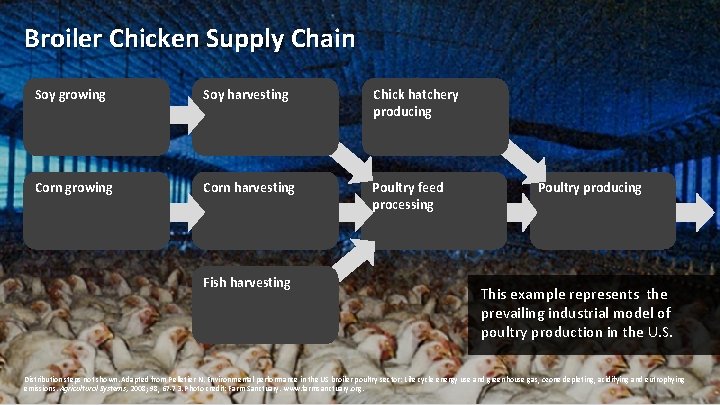
Broiler Chicken Supply Chain Soy growing Soy harvesting Chick hatchery producing Corn growing Corn harvesting Poultry feed processing Fish harvesting Poultry producing This example represents the prevailing industrial model of poultry production in the U. S. Distribution steps not shown. Adapted from Pelletier N. Environmental performance in the US broiler poultry sector: Life cycle energy use and greenhouse gas, ozone depleting, acidifying and eutrophying emissions. Agricultural Systems, 2008; 98, 67 -73. Photo credit: Farm Sanctuary. www. farmsanctuary. org.
Broiler Chicken Supply Chain (continued) Processing Retailing Preparing Consuming In this example, the chicken is minimally processed. Foods such as chicken nuggets would require additional processing steps. Distribution steps not shown. Adapted from Pelletier N. Environmental performance in the US broiler poultry sector: Life cycle energy use and greenhouse gas, ozone depleting, acidifying and eutrophying emissions. Agricultural Systems, 2008; 98, 67 -73. Photo credit: Farm Sanctuary. www. farmsanctuary. org.