
Lesson 9 Waves Physical Oceanography Last class we
- Slides: 12
Lesson 9: Waves Physical Oceanography
Last class we learned about currents 2 l What two major types of currents are there? l What is thermohaline circulation? l Which current moves north along the U. S. East Coast (from Florida to North Carolina)?
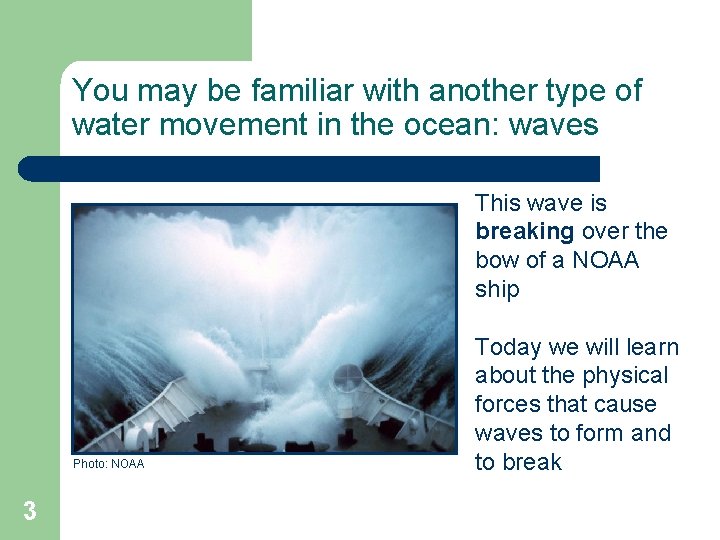
You may be familiar with another type of water movement in the ocean: waves This wave is breaking over the bow of a NOAA ship Photo: NOAA 3 Today we will learn about the physical forces that cause waves to form and to break
Understanding wave physics is important for human life (and not just for surfing) 1. A wave is the transmission of energy through matter – in this case through water 4 2. Two important types of waves are deepwater and shallow-water waves 2. Do you know what a tsunami is?
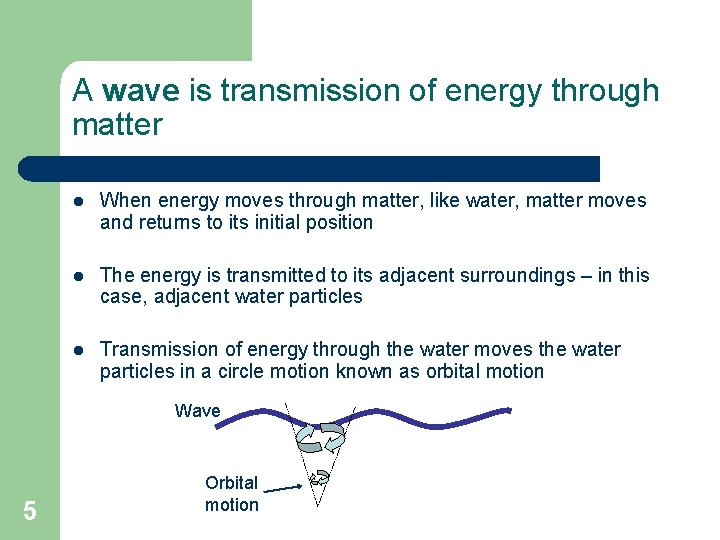
A wave is transmission of energy through matter l When energy moves through matter, like water, matter moves and returns to its initial position l The energy is transmitted to its adjacent surroundings – in this case, adjacent water particles l Transmission of energy through the water moves the water particles in a circle motion known as orbital motion Wave 5 Orbital motion
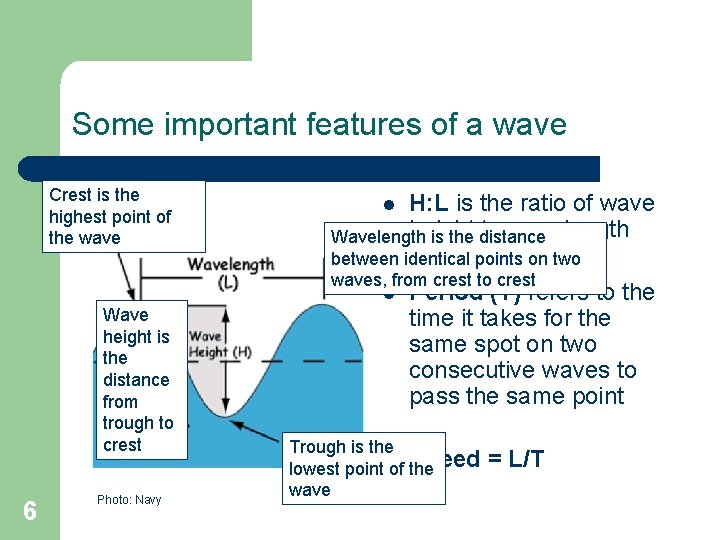
Some important features of a wave Crest is the highest point of the wave Wave height is the distance from trough to crest 6 Photo: Navy H: L is the ratio of wave height to wavelength Wavelength is the distance l between identical points on two waves, from crest to crest l Period (T) refers to the time it takes for the same spot on two consecutive waves to pass the same point Trough is the lowest pointlof Speed the wave = L/T
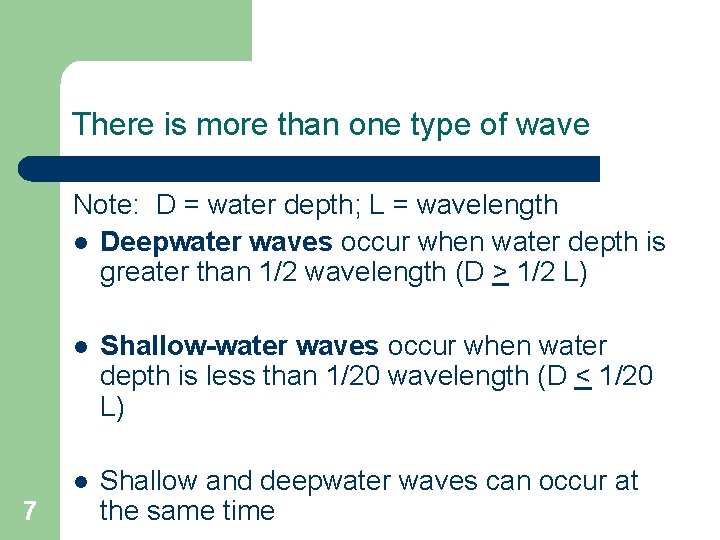
There is more than one type of wave Note: D = water depth; L = wavelength l Deepwater waves occur when water depth is greater than 1/2 wavelength (D > 1/2 L) 7 l Shallow-water waves occur when water depth is less than 1/20 wavelength (D < 1/20 L) l Shallow and deepwater waves can occur at the same time
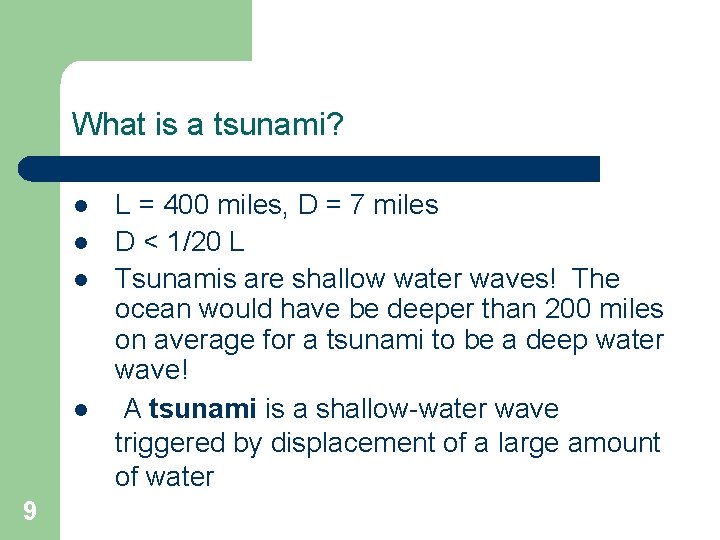
What is a tsunami? 8 l A typical tsunami wavelength is several hundred miles long, as an example let’s say wavelength is 400 miles l The deepest part of the ocean is 7 miles deep l Based on this information, do you think a tsunami is a shallow or deep water wave?
What is a tsunami? l l 9 L = 400 miles, D = 7 miles D < 1/20 L Tsunamis are shallow water waves! The ocean would have be deeper than 200 miles on average for a tsunami to be a deep water wave! A tsunami is a shallow-water wave triggered by displacement of a large amount of water
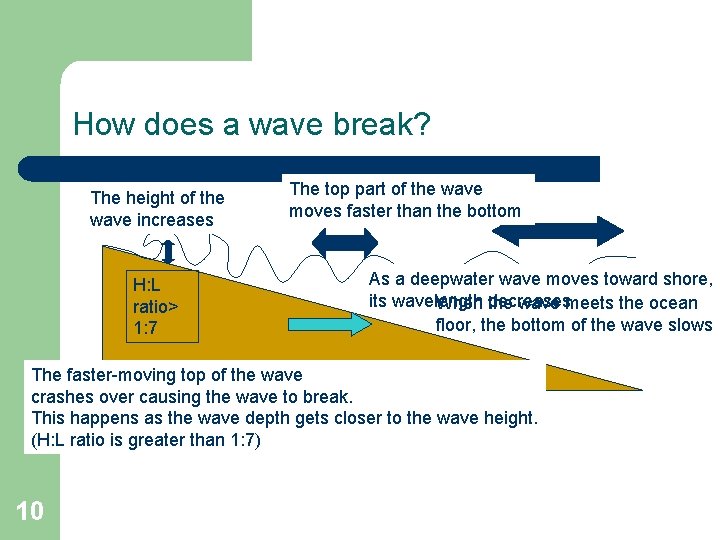
How does a wave break? The height of the wave increases H: L ratio> 1: 7 The top part of the wave moves faster than the bottom As a deepwater wave moves toward shore, its wavelength When decreases the wave meets the ocean floor, the bottom of the wave slows The faster-moving top of the wave crashes over causing the wave to break. This happens as the wave depth gets closer to the wave height. (H: L ratio is greater than 1: 7) 10
Why is it important to know so many details about waves? 11 l Waves can be very destructive l A tsunami is one type of destructive, shallowwater wave l Studying the causes and forces underlying waves can help scientists predict the timing and magnitude of these events and potentially save lives!
Can you outrun a tsunami? 12 l In today’s activity you will use wave information to calculate the speed of impending tsunamis l About how fast do you think tsunamis move? l Let’s find out…